DSSSB TGT Computer Science Previous Year Analysis: Which CS Topics Carry the Marks
Use past DSSSB CS questions as a study-order signal, not a prediction. This analysis groups recurring topic blocks and turns them into a practical practice loop.
KnowledgeGate Team
Exam prep & CS education
Updated 25 Jul 20266 min read777 views
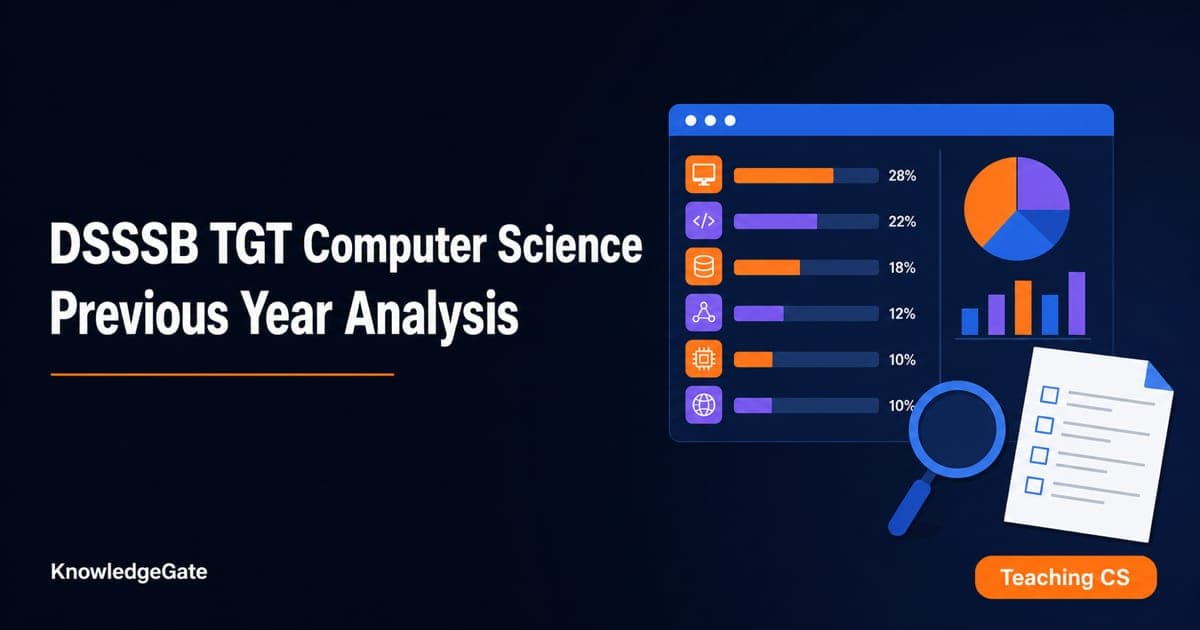
Limited preparation time creates a tempting question: which Computer Science topics keep returning in DSSSB papers, and which ones can wait? Previous-year questions can answer the first part, but they cannot promise the next paper.
The useful approach is to treat recurrence as a study-order signal. Past DSSSB Computer Science papers tell you which blocks examiners keep returning to, while the current DSSSB notification remains the authority for what is inside the syllabus.
How to read a previous-year analysis honestly
A previous-year analysis describes what examiners have asked. It does not create a guaranteed weightage table for the next CBT. A topic that appeared repeatedly deserves early attention, but an infrequent topic remains examinable if it is present in the current syllabus.
Use three checks whenever you read a trend:
Is the question actually from DSSSB and from the relevant subject paper?
Does the topic still appear in the current syllabus?
Is the observed pattern based on several questions, or on one memorable paper?
The current advertisement on the official DSSSB portal at dsssb.delhi.gov.in settles the second question. The first is settled by the paper itself: trust the header on the PDF, not a title typed above a download link. The same discipline runs through DSSSB Computer Science PYQs: find and fix three practice gaps, which turns one attempted set into a written repair list.
This distinction matters because a forecast encourages selective skipping. A planning signal encourages sensible ordering followed by full-syllabus revision.
The consistently heavy blocks
Across past DSSSB Computer Science papers, five blocks provide the strongest early return on study time: programming and OOP, data structures, DBMS, operating systems and computer networks. Each produces recognisable question shapes.
Block | Recurring question shapes | First preparation task |
|---|---|---|
Programming and OOP | Output tracing, data types, control flow, functions and concept definitions | Trace small programs by hand and explain each OOP idea with an example |
Data structures | Operations, traversals, search, sorting and structure choice | Practise state changes after each operation |
DBMS | SQL, keys, ER concepts and normalization | Write queries and test dependencies step by step |
Operating systems | Scheduling, processes, deadlocks and memory concepts | Draw timelines, state changes and allocation tables |
Computer networks | Layer models, protocols and addressing | Map each protocol to its layer and purpose |
Programming questions look easy until an operator, a loop boundary or an object-oriented rule changes the output. Data-structure questions reward a clear trace rather than a memorised definition. DBMS mixes direct recall with small relational or SQL applications, and OS and networks test whether closely related concepts stay separate under time pressure.
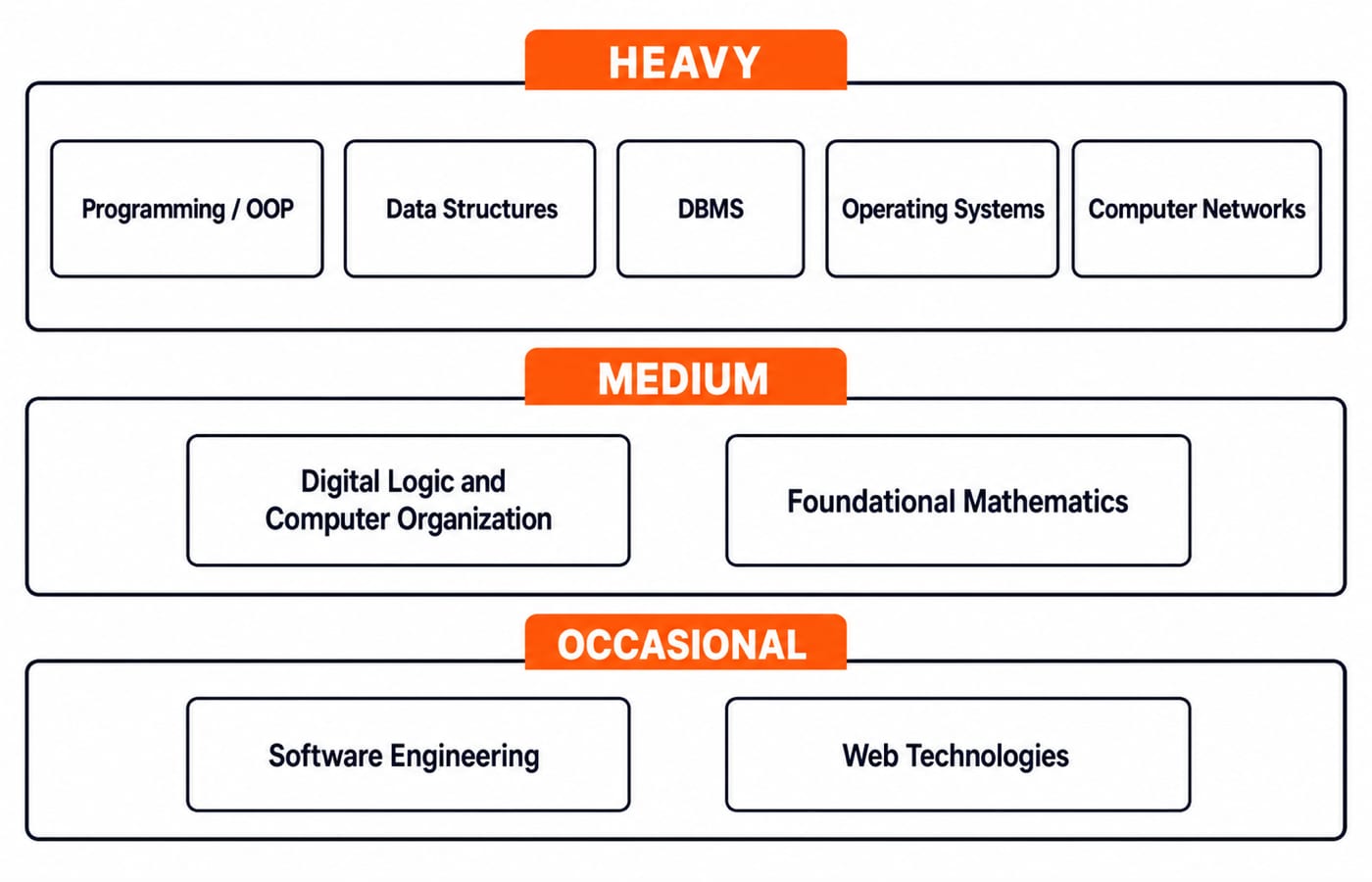
The practical conclusion is not to study only these five blocks. It is to build your main scoring base here before spreading equal hours across every line of the syllabus.
The reliably lighter blocks
Software engineering, web technologies and the more peripheral applied areas recur less insistently than the five core blocks, so they belong in the later revision phase rather than the first weeks of preparation.
Lighter does not mean optional. These areas carry direct questions that are cheap to prepare once the vocabulary is organised: a one-page sheet on software process models, testing terms, HTML basics and common web protocols protects marks without eating into early DBMS or data-structure depth.
Two areas that a generic Computer Science topic list drops keep surfacing in DSSSB papers. The first is everyday ICT and computer fundamentals: hardware and peripherals, file handling, office tools and shortcuts, internet basics. The second is computer graphics, usually primitives, devices and basic transformations. Information security and cyber-law vocabulary sits in the same band. None needs deep study, and none survives being skipped entirely.
Digital logic, computer organization and foundational mathematics sit between the two groups, and in DSSSB papers digital electronics recurs about as often as data-structure questions do. Treat medium as a scheduling label, not permission to postpone: number-system conversions, gate and flip-flop questions and small numericals decay quickly when practice stops.
Negative marking makes complete neglect especially costly. If you have never studied a lighter block, even a straightforward question becomes a blind guess. Cover it late, but cover it deliberately.
What the questions actually look like
The DSSSB Computer Science section uses single-correct objective questions inside a computer-based test, mixing straight definition recall with compact applied items.
Three shapes cover most of it. A trace item prints a short program and asks for the output, where one operator or one extra loop pass changes the answer. A placement item names a term and asks where it belongs: which OSI layer, which normal form, which scheduling policy. A one-step numeric item asks something like how many address lines a 1K x 8 memory chip needs, where 1K is 2^10 words, so the answer is 10. All three reward precise recall over passive notes. After learning a concept, solve a short timed set and say why each wrong option is wrong, because distractors usually swap two neighbouring terms.
Section B sits inside the same computer-based test as the general section, so subject depth on its own will not carry the paper. Keep the DSSSB Section A strategy beside your subject plan so the general half does not disappear from your timetable.
Turning DSSSB recurrence into a study order
Use a three-pass plan.
Pass one: build the heavy core
Start with programming and OOP, data structures, DBMS, OS and networks. Give each block a learn, recall, practise cycle. A topic is not complete when the lecture ends. It is complete when you can solve a mixed set and name the cause of each error.
Pass two: keep the medium tier active
Add digital logic, computer organization and foundational mathematics to the weekly rotation. Mix them rather than finishing one and abandoning it. Two short recall sessions can preserve formulas and circuit rules better than one large monthly session.
Pass three: close the lighter gaps
Schedule software engineering, web technologies and applied areas before full mocks begin. Make compact notes, solve their previous-year questions, and return to any term you cannot distinguish from its distractor.
For every pass, tag each error as concept, calculation, recall or haste. That turns a set of attempted questions into feedback rather than a counter.
The trap of the wrong syllabus or wrong exam papers
Two mistakes can corrupt the whole analysis. The first is mixing another teacher-recruitment examination's Computer Science questions into the DSSSB trend. The second is using an older syllabus without checking whether the current post code changed the coverage.
Similar subjects do not imply identical emphasis. A DBMS question from another exam is useful practice, but it is not evidence about DSSSB recurrence. Keep cross-exam practice in a separate folder or tag.
Before building the schedule, compare every topic label in your trend sheet with the current official syllabus. Add any newly listed area even if the old question set has no recurrence evidence for it. Historical silence is not permission to skip a current topic.
The Govt Teaching Jobs category helps you navigate related exams, but keep their paper analyses separate.
Short version and next step
The short version is to prioritise programming and OOP, data structures, DBMS, OS and networks, keep digital logic, organization and maths in rotation, and close software engineering and web gaps during revision. Recurrence decides order, not the official boundaries of the next paper.
Learn the heavy blocks through the DSSSB TGT Computer Science Section B course, or coordinate subject and general preparation with the DSSSB TGT Computer Science bundle. Then work through the 2,400-plus DSSSB previous-year Computer Science questions by topic, record the errors, and retest them in mixed sets.
For courses, previous-year papers with solutions and full-length mock tests, start at our DSSSB exam preparation hub.
Keep learning
Browsers and Search Engines MCQs: 9 Solved Questions with Explanations
Solve nine published browser and search engine questions, check each answer, and rebuild the browser, cache, crawler and indexing distinctions that exam distractors blur.
Updated 6 Oct 20267 min readTeaching Recruitment (Computer Science)
IT Act, 2000 Explained: Key Sections, Digital Signatures and Worked Exam Examples
Build an exam-ready map of the IT Act, then apply it to an exact digital-signature walkthrough and a section 43, 66, 66C and 66D caselet.
Updated 2 Oct 20266 min readTeaching Recruitment (Computer Science)
Emerging Trends Introduction MCQs: 12 Solved Questions with Explanations
Solve 12 Emerging Trends Introduction questions with clear answer logic, exam-year labels and a compact trap check for focused revision.
Updated 27 Sep 20268 min readTeaching Recruitment (Computer Science)
MS Word Basics MCQs with Answers: 12 Solved Questions Explained
Work through 12 MS Word questions covering everyday commands, page layout, formatting, links, file features and mail merge. Each answer explains the decisive clue and the closest distractor.
Updated 25 Sep 20267 min readTeaching Recruitment (Computer Science)