UGC NET Paper 1 Strategy for Computer Science Aspirants: A 10.5-Hour Weekly Plan
Protect Paper 1 from familiar CS work with a fixed seven-day cycle. The plan shows exactly how to learn, practise, review errors and recover missed blocks.
KnowledgeGate Team
Exam prep & CS education
Updated 27 Aug 20265 min read

Paper 2 feels familiar to a Computer Science aspirant, so Paper 1 is easy to push to tomorrow. The result is scattered study without a complete revision loop. This seven-day cycle gives Paper 1 fixed space for concepts, practice, error repair and missed-day recovery across 10 hours 30 minutes.
Scope note: The timings, question counts, percentages, study targets, weekly results and missed-day rules below form one illustrative practice model. They are not an official NTA recommendation, minimum, exam pattern, marking rule, cutoff or predicted result; adjust the cycle using your own results.
UGC NET Paper 1 strategy starts by protecting time from Paper 2
Put 630 minutes of Paper 1 on your calendar, then assign remaining study time to Paper 2. This protects Paper 1 without imposing one ratio on everyone. The UGC-NET Information Bulletin for your attempt lists Teaching Aptitude, Research Aptitude, Comprehension, Communication, Mathematical Reasoning and Aptitude, Logical Reasoning, Data Interpretation, Information and Communication Technology (ICT), People, Development and Environment, and Higher Education System. Use the UGC NET Paper 1 vs Paper 2 guide to separate their roles, and the UGC NET CS Exam catalogue for the broader route.
UGC NET Paper 1 weekly timetable uses seven fixed blocks
Day | Area | Minutes and split |
|---|---|---|
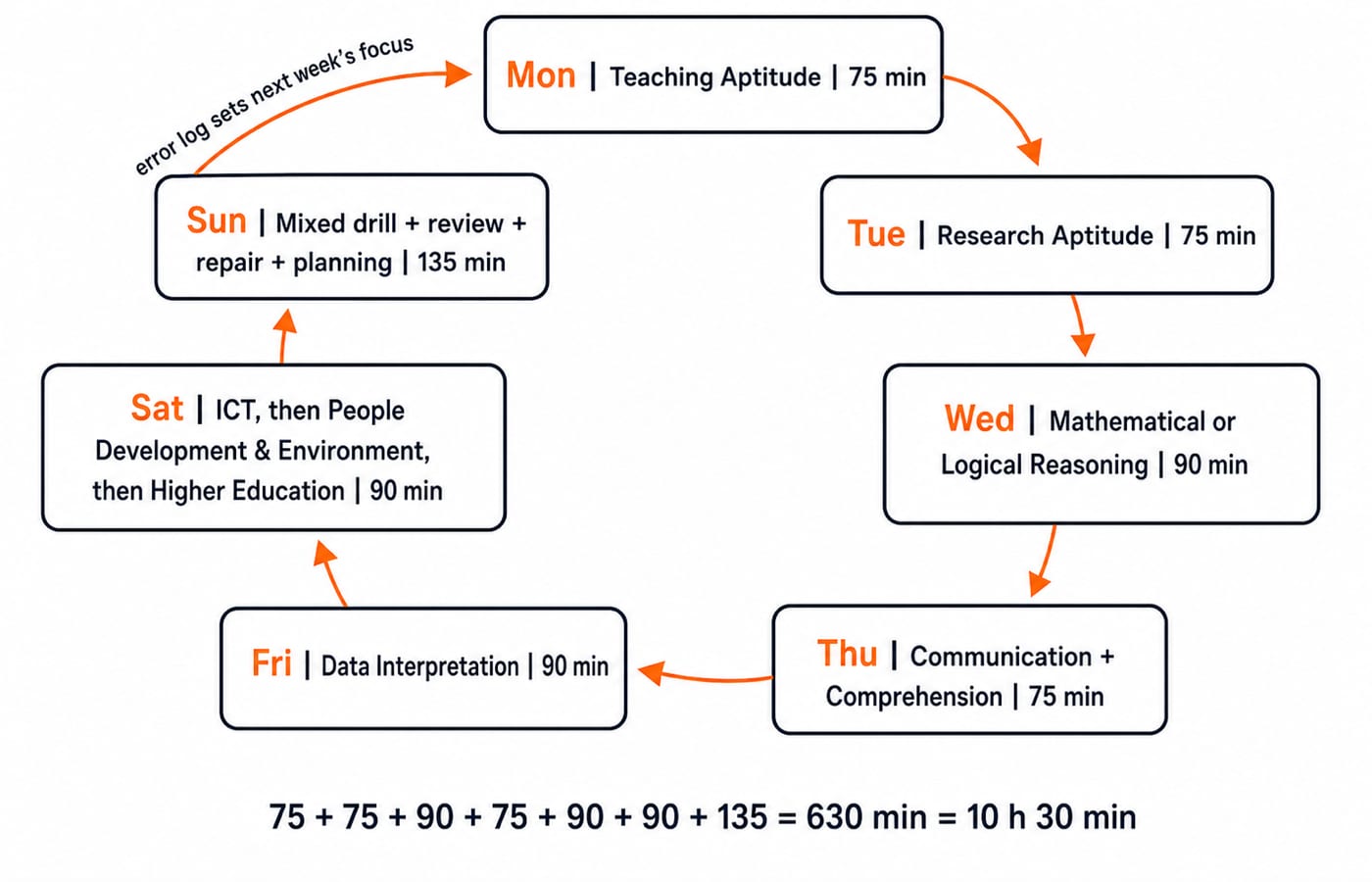
Monday | Teaching Aptitude | 75 = 30 concept + 15 recall grid + 20 for 8 items + 10 error record |
Tuesday | Research Aptitude | 75 = 30 concept + 15 recall grid + 20 for 8 items + 10 error record |
Wednesday | Mathematical or Logical Reasoning, alternating weekly | 90 = 30 concept + 35 for 15 items + 25 review |
Thursday | Communication + Comprehension | 75 = 25 communication + 25 passage work + 15 for 6 items + 10 review |
Friday | Data Interpretation | 90 = 20 method recall + 45 for 2 data sets + 25 review |
Saturday | ICT, then People, Development and Environment, then Higher Education System | 90 = 45 concept + 25 for 10 items + 20 notes |
Sunday | Mixed drill + review + repair + planning | 135 = 35 for 30 items + 55 review + 30 repair + 15 next-week planning |
The check is 75 + 75 + 90 + 75 + 90 + 90 + 135 = 630 minutes = 10 hours 30 minutes. Use the NTA UGC NET Paper 1 Course for structured concept-block material.
Teaching and Research Aptitude need a concept-to-question microcycle
On Monday, spend 30 minutes learning learner-centred versus teacher-centred methods, 15 building a two-column recall grid, 20 answering 8 fresh practice items, and 10 classifying errors. With 5 correct, 2 wrong and 1 skipped, you attempted 7. Attempted accuracy is 5 / 7 x 100 = 71.4%; completion is 7 / 8 x 100 = 87.5%. Put the two wrong and one skipped item into a three-item repair queue.
On Tuesday, compare probability and non-probability sampling:
Method | Type |
|---|---|
Simple random | Probability |
Stratified | Probability |
Convenience | Non-probability |
Purposive | Non-probability |
Retest the three unresolved ideas closed-book after 48 hours. A result of 2/3 leaves exactly one idea for Sunday repair. Retrieval and repair expose gaps that rereading both chapters can hide.
Reasoning and Communication improve through separate accuracy measures
For Wednesday's 15-question reasoning drill, suppose you attempt 12, with 9 correct, 3 wrong and 3 skipped. Attempt rate is 12 / 15 x 100 = 80%; attempted accuracy is 9 / 12 x 100 = 75%. Label one translation error, one invalid inference and one arithmetic slip. Give next Wednesday's first 15 minutes to the largest repeat category, not all reasoning.
On Thursday, use 25 minutes for sender, message, channel, feedback and barrier; 25 for one passage; 15 for 6 items split into 3 communication and 3 comprehension; and 10 for explaining why each distractor failed. Comprehension demands passage evidence, while communication theory demands precise term distinctions.
Data Interpretation practice must show the denominator
Use this selection table:
Stream | Applicants | Selected | Conversion |
|---|---|---|---|
A | 120 | 30 |
|
B | 150 | 45 |
|
C | 200 | 50 |
|
D | 180 | 36 |
|
B is highest; its gap over D is 30% - 20% = 10 percentage points.
For the combined rate, add counts first: selected candidates total 30 + 45 + 50 + 36 = 161, and applicants total 120 + 150 + 200 + 180 = 650. Thus, 161 / 650 x 100 = 24.769...%, rounded to 24.8%. The unweighted average (25 + 30 + 25 + 20) / 4 = 25% is wrong because stream sizes differ. Use the final 25 review minutes to record this denominator mistake and redo it without notes.
Paper 1 revision turns Sunday results into next week's actions
Use a 30-question mixed drill. A result of 18 correct, 8 wrong and 4 skipped gives 18 + 8 = 26 attempted, 18 / 26 x 100 = 69.2% attempted accuracy, and 8 + 4 = 12 unresolved.
Classify the eight wrong answers as 3 concept gaps, 3 process errors and 2 reading errors; label the four skips by unit. Spend 55 minutes classifying, 30 repairing the top two repeat causes, and 15 reserving next week's first blocks. Retest all 12 on Tuesday. If 10 are correct, carry exactly 2 forward. KnowledgeGate's broader practice inventory has over 21,000 published questions across eight banks.
A missed study day is redistributed, not doubled
If Tuesday's 75-minute Research Aptitude block is missed, add 25 minutes to Thursday, Friday and Saturday. They become 100, 115 and 115 minutes, while the weekly total remains 630. Wednesday stays at 90 minutes, not a 165-minute punishment session.
If Monday and Tuesday both disappear, 150 minutes are lost. Recover one 75-minute block through 25 + 25 + 25, completing 630 - 150 + 75 = 555 minutes = 9 hours 15 minutes. Move the other intact 75-minute block into next week's Saturday rotation, not on top. One support-area rotation moves back by a week. The UGC NET weekly plan for working professionals gives a job-constrained adaptation.
The short version is four cycles with three tracked numbers
Track only blocks completed out of 7, Sunday-drill attempted accuracy, and unresolved items:
Week | Blocks | Attempted accuracy | Unresolved |
|---|---|---|---|
1 | 6/7 |
| 12 |
2 | 7/7 |
| 10 |
3 | 7/7 |
| 8 |
4 | 7/7 |
| 6 |
Use the UGC NET Computer Science and Applications bundle if both papers need a planned path. Otherwise, pair this cycle with existing Paper 2 resources.
Keep learning

Scope and Importance of International Business: UGC NET Commerce Examples
Exports, licensing and foreign investment cross borders in different ways. Separate their roles, compare entry modes and work through the opportunity-cost arithmetic behind comparative advantage.
Updated 13 Oct 20266 min readNET Strategy & Updates

FEMA Explained: Objectives, Key Provisions and UGC NET Commerce Examples
Two equal overseas payments can fall into different FEMA categories. Learn to classify transactions, apply an exporter checklist and calculate a penalty ceiling without counting the first day twice.
Updated 9 Oct 20265 min readNET Strategy & Updates

CSIR NET Normalization: Percentile and Normalised Marks Worked Out
Can 120 and 130 raw marks mean the same percentile? Follow a two-shift example from raw marks to percentile and normalised marks, then check which number belongs beside a cutoff.
Updated 5 Oct 20265 min readNET Strategy & Updates

UGC NET Eligibility for CA Holders: Equivalence, Marks and Subject Choice
Completed CA but have no MCom certificate? Understand the equivalence route, check the percentage requirement and resolve marks or subject-entry doubts before applying for NET.
30 Sep 20264 min readNET Strategy & Updates