RSSB Computer Instructor Syllabus Weightage: Prioritise Without Guesswork
Turn the Basic or Senior Computer Instructor syllabus into an auditable study order using coverage, authenticated PYQs, prerequisites and a holdout test.
KnowledgeGate Team
Exam prep & CS education
Updated 4 Aug 20265 min read
A long RSSB Computer Instructor syllabus makes any confident-looking online weightage table tempting. The danger is that copied percentages may mix Basic and Senior posts, different paper sets or unverified coaching estimates. Use the RSSB Computer Instructor exam-prep hub to orient yourself, then build a repeatable priority worksheet from official syllabus coverage, answer-key-backed PYQ frequency and prerequisite value. Prioritising means ordering study, never deleting an officially named topic.
1. Fix the exam and source set before assigning weightage
Write one choice at the top of the worksheet: post = Basic Computer Instructor or post = Senior Computer Instructor. Do not merge them. KnowledgeGate maintains separate course paths because their scope differs. If you have not chosen, compare RSSB Basic vs Senior Computer Instructor before scoring anything.
Next, assemble three files from the official RSSB website: the current post-specific syllabus, a fixed set of official question papers, and their matching final answer keys. Record each document's title, publication date, post and URL. Exclude any paper or key you cannot authenticate. Do not carry remembered marks, dates, vacancies, negative-marking rules or section counts into the sheet. Where such a detail matters, take it from the RSSB notice that states it and record that notice beside it.
2. Turn the syllabus into comparable blocks
Copy every line from the current official syllabus into a two-column sheet: official syllabus line and working block. For the Basic post, workable block labels are Computer Fundamentals, Programming, Data Structures, Operating Systems, Computer Networks, DBMS, Basic IT, General Knowledge, Reasoning and Teaching Aptitude. The Senior post keeps that spine, splits Algorithms out from Data Structures, and adds Software Engineering and advanced IT in place of Basic IT. These are working labels, not official RSSB categories, so reconcile each one against your post-specific official syllabus before you score anything.
Map each line once. Split a line only if it contains independently teachable ideas, and never place the same phrase in two blocks. Count mapped official lines in each block, then divide by all mapped lines. Call the result coverage share, not marks weightage.
3. Score three signals with fixed rules
Score official coverage C from a block's share of mapped lines: 5 for 15% or more, 4 for 10% to 14.9%, 3 for 6% to 9.9%, 2 for 3% to 5.9%, and 1 below 3%.
Score dependable PYQ frequency F with the same bands, using only the fixed, deduplicated, answer-key-backed set. Count a question once. If it touches two concepts, assign it to the concept you need to reach the correct answer. This is why PYQs beat buying another question bank for estimating frequency. A large practice bank builds accuracy, but no volume of practice questions can establish a Computer Instructor weightage split. Only the papers you authenticated can do that.
Score prerequisite value R by distinct later blocks unlocked: 5 for five or more, 4 for four, 3 for three, 2 for two, and 1 for zero or one. Then calculate:
priority = 10C + 7F + 3R, with a maximum of 100.
4. Worked example: calculate an illustrative priority score
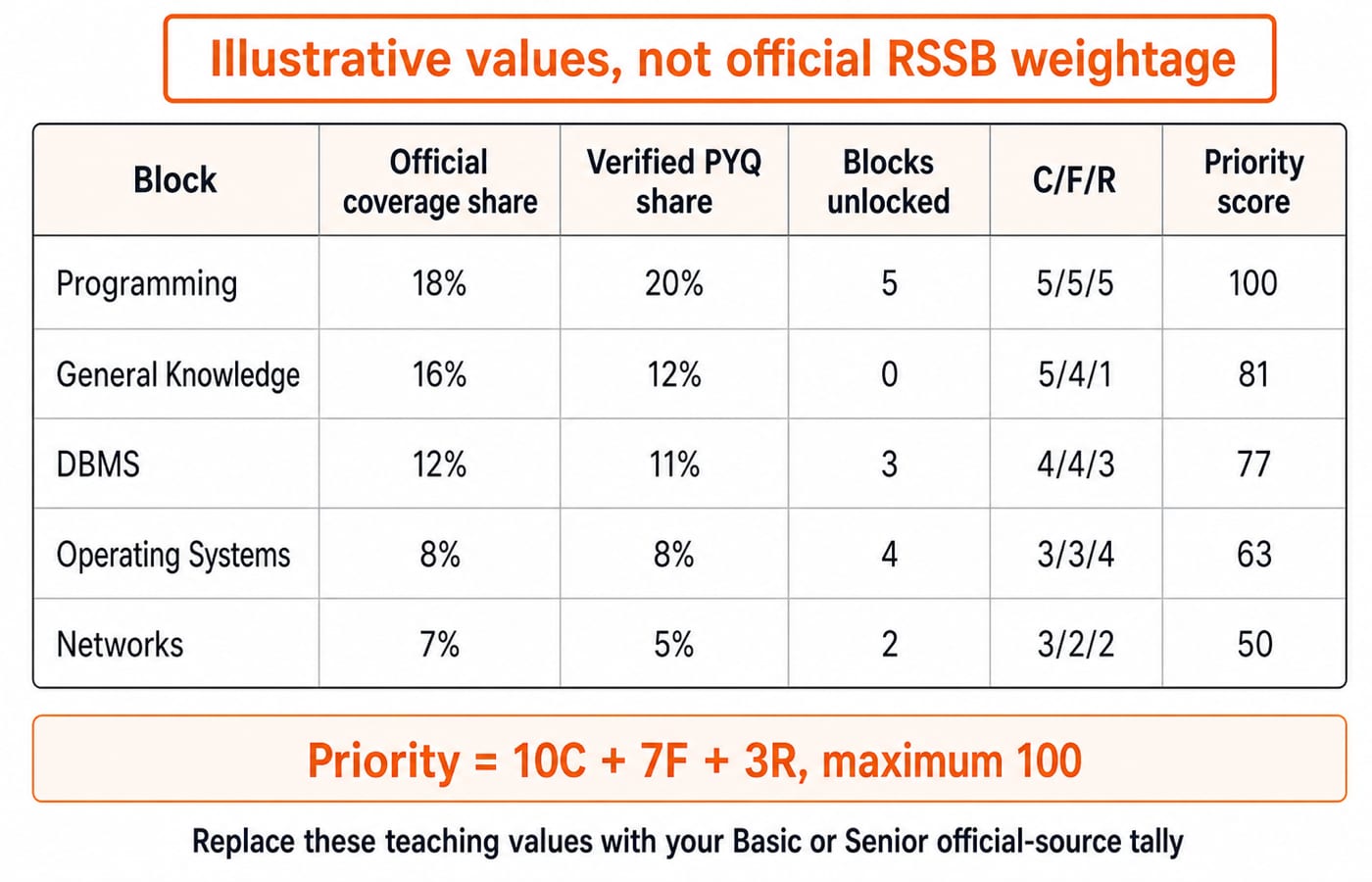
The inputs below are invented so the arithmetic is easy to follow: 100 syllabus units and a separate 100-item authenticated PYQ ledger. They are not measured RSSB weightage.
Block | Coverage | PYQs | Unlocks | C/F/R | Calculation | Priority |
|---|---|---|---|---|---|---|
Programming | 18% | 20% | 5 | 5/5/5 | 50 + 35 + 15 | 100 |
General Knowledge | 16% | 12% | 0 | 5/4/1 | 50 + 28 + 3 | 81 |
DBMS | 12% | 11% | 3 | 4/4/3 | 40 + 28 + 9 | 77 |
Operating Systems | 8% | 8% | 4 | 3/3/4 | 30 + 21 + 12 | 63 |
Networks | 7% | 5% | 2 | 3/2/2 | 30 + 14 + 6 | 50 |
The listed coverage is 61% (18 + 16 + 12 + 8 + 7), leaving 39%. Listed PYQs are 56% (20 + 12 + 11 + 8 + 5), leaving 44%. Replace all inputs with your post-specific official tally.
5. Convert scores into study queues
Use 75-100 = master, 55-74 = revise, and below 55 = recognise first. Programming, General Knowledge and DBMS enter master in the example. Operating Systems enters revise, while Networks enters recognise. Recognise does not mean omit. It means a coverage pass, definitions, one diagnostic set and a scheduled revisit.
For a 30-hour fortnight, assign 18 hours to master, 7.5 hours to revise, and 4.5 hours to recognise plus the remaining official blocks. Within master, use about 7 hours for Programming, 5.5 for General Knowledge and 5.5 for DBMS. Both totals balance: 18 + 7.5 + 4.5 = 30, and 7 + 5.5 + 5.5 = 18.
Give every official block at least one diagnostic touch. Also promote any prerequisite needed by a higher-ranked block before study begins, even when its raw score is lower.
6. Stress-test the ranking with a fresh holdout set
Keep 25 authenticated questions outside the frequency ledger, five for each worked block. Use them only after the first fortnight, so the evaluation is not circular. Suppose Programming, General Knowledge and DBMS each score 4/5 = 80%, Operating Systems scores 3/5 = 60%, and Networks scores 1/5 = 20%.
Apply one correction rule. Below 60% promotes a block by one queue next cycle. From 60% to 79% keeps it in place. At least 80% allows maintenance practice. Networks therefore moves from recognise to revise, Operating Systems stays in revise, and the three 80% blocks move to maintenance inside master.
Recalculate after each fixed paper set. Reject remembered questions, unsourced coaching compilations and repeated copies, and never adjust the bands to preserve a preferred order.
7. Avoid four misleading weightage habits
Do not mix Basic and Senior papers. Do not call syllabus coverage marks. Do not let one unusual paper determine frequency. Do not hide weak fundamentals behind a high-frequency shortlist.
Under every table, record this audit line: post, official syllabus version/date, paper years or identifiers, answer-key URLs, deduplication rule, and last recalculated date. Record each official detail beside the notification or syllabus that states it, and re-check it whenever RSSB issues a new notice, because these details change between cycles.
If you lack a sufficient official paper set, publish only the coverage-plus-prerequisite ranking and mark PYQ frequency insufficient evidence. Never fill the gap with a copied web table.
8. The short version and next study action
Choose Basic or Senior, map the current official syllabus, count authenticated PYQs, score prerequisite value, allocate the next 30 hours, then test on a holdout set. The result is a study decision, not a prediction of exact marks.
Basic aspirants can continue with the RSSB Basic Computer Instructor Course. Senior aspirants should use the RSSB Senior Computer Instructor Course so the study path stays matched to the post you actually applied for.
Keep learning
RSSB Computer Instructor Syllabus: Basic vs Senior Topic Map and Boundaries
Separate the shared Paper I from Basic and Senior Paper II, see where technical depth changes, and build a revision plan that stays inside official RSSB wording.
Updated 2 Aug 20266 min read60 viewsRSSB Computer Instructor
RSSB Computer Instructor vs DSSSB TGT CS: Role, Qualification and Location Fit
Choose between the RSSB and DSSSB routes only after checking eligibility, role preference, syllabus gaps and your real Rajasthan or Delhi commitment.
Updated 30 Jul 20266 min readRSSB Computer Instructor
RSSB Computer Instructor PYQs: Build a Weekly Study Plan From Every Paper
A score cannot tell you what to study next. This method turns each RSSB Computer Instructor PYQ into tagged evidence, a weekly repair queue and a fresh retest.
Updated 28 Jul 20265 min readRSSB Computer Instructor
RSSB Computer Instructor Eligibility and Exam Structure: Basic vs Senior Checklist
Check whether your exact qualification fits the Basic or Senior RSSB Computer Instructor route, then understand the two papers and negative marking.
Updated 25 Jul 20265 min readRSSB Computer Instructor