

Tech Mahindra Drive Mistakes: Rejection Risks and Fixes at Each Stage
Question practice alone cannot fix a mismatched application or an unsupported project claim. Use these preparation checkpoints to spot avoidable mistakes and build a focused correction plan.
KnowledgeGate Team
Exam prep & CS education
Updated 15 Nov 20265 min read
You may have practised questions yet still lose opportunities through a mismatched application, an unreliable assessment setup or a resume claim you cannot explain. Your Tech Mahindra invitation governs the actual drive, so verify the role path and requirements before you prepare. Tech Mahindra applicants need invitation checks, evidence consistency and worked error checks for IT and BPS roles. For a TCS-specific stage guide, see TCS Rejection Reasons: Application, Interview and Documents; Tech Mahindra applicants can use invitation verification and portable evidence checks alongside that employer-specific guide.
The figures, times, dates, candidate names and code snippets are illustrative. Tech Mahindra does not publish a universal rejection rubric; roles and invitations differ, so follow the requirements in your own invitation.
Application mistake: preparing for the wrong role or invitation
Copying a friend's preparation list can leave you preparing for software questions while overlooking your own role's requirements. Tech Mahindra's Careers & Job Opportunities portal separates IT Opportunities and BPS Opportunities and displays a scam alert about fraudulent job offers. Match the invitation to the live requisition and verify a forwarded message before you act on it.
In a sample application audit, the form says graduation year 2025 and CGPA 8.1, but the certificate says 2026 and 7.8. Both fields need correction through the permitted channel, or a recruiter query about amending them. Do not round up the CGPA or invent a percentage conversion.
Record the role title, application ID, eligibility wording, reporting instructions and required documents. Use broader placement preparation resources after checking what your application actually requires.
Assessment mistake: treating setup checks as optional
Question practice cannot compensate for a microphone that fails when you need it. Device permissions and login details deserve a rehearsal too.
A sample invitation gives a 9:30 am login and a 10:00 am start: a 30-minute interval. Candidate A first tests the microphone at 9:58 am, leaving 2 minutes. Candidate B tests it the previous evening and uses the login window to resolve access problems.
Follow the specified device, browser, camera, microphone and identity requirements. If something fails, note the time and error, then use the stated support channel. Do not photograph restricted test content or bypass proctoring controls. The practical risk is being unable to complete the assessment as instructed.
Aptitude mistake: confusing attempts with reliable answers
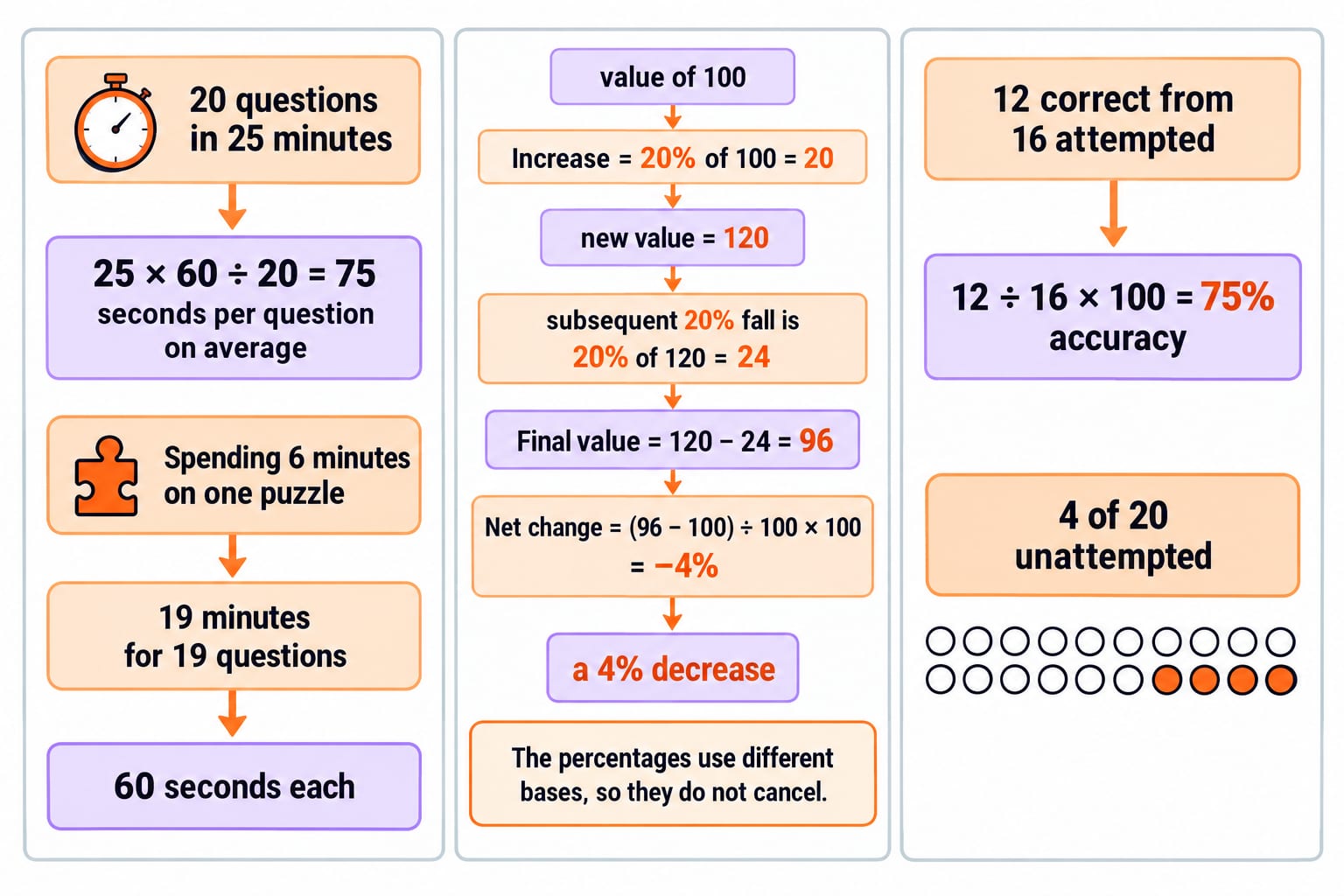
Chasing attempts can cost you easy answers. In a practice set, 20 questions in 25 minutes gives 25 x 60 / 20 = 75 seconds per question on average. Spending 6 minutes on one puzzle leaves 19 minutes for 19 questions: 60 seconds each. Use a personal skip-and-return rule only if the platform permits revisiting.
Consider a percentage trap. A value of 100 rises by 20%:
Increase = 20% of 100 = 20; new value = 120.
A subsequent 20% fall is 20% of 120 = 24.
Final value = 120 - 24 = 96.
Net change = (96 - 100) / 100 x 100 = -4%, a 4% decrease.
The percentages use different bases, so they do not cancel.
After a mock, label errors as concept, arithmetic, reading or time allocation. Getting 12 correct from 16 attempted means 12 / 16 x 100 = 75% accuracy, with 4 of 20 unattempted. Marks require the actual marking scheme. Review these common placement preparation mistakes alongside your error log.
Communication mistake: reciting an answer without answering the prompt
Where communication tasks apply, a memorised introduction can distract from the question. Clear relevance matters; accent alone does not establish competence.
Suppose the prompt is, "Describe a time you handled a missed deadline." A sample response says: "Our four-person project had five screens due on Friday. On Wednesday, two were incomplete. I split the remaining work, completed the login screen and asked a teammate to test it. We submitted all five on Friday."
That answer shows context, personal action and outcome, but it describes preventing a delay, not handling an already missed deadline. Choose a real incident matching the prompt, then use that structure. Never copy the story as personal experience.
Record a response, check each sentence against the question, and repeat it more clearly.
Technical mistake: showing code or projects you cannot defend
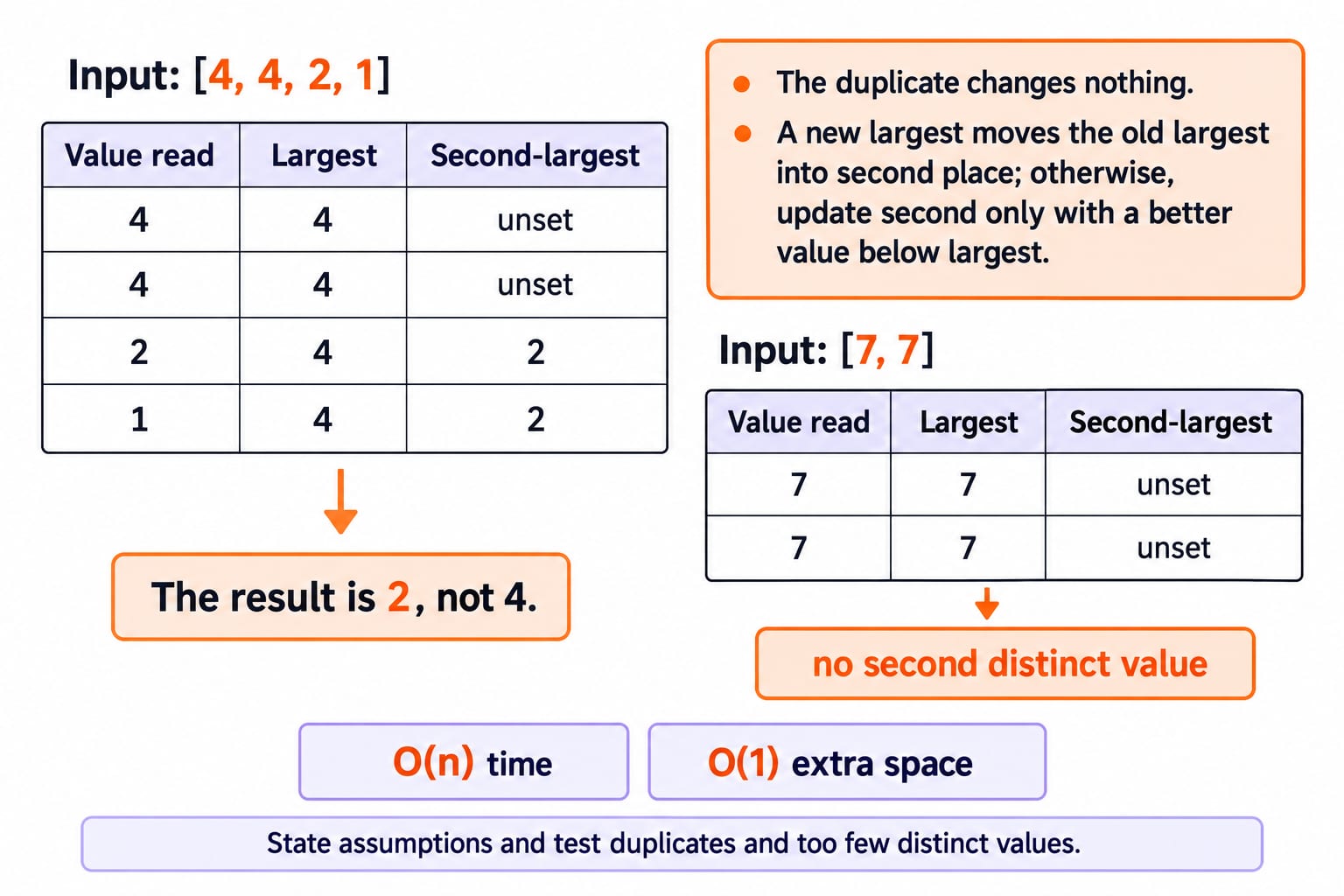
For roles involving technical tasks, rehearsing only easy inputs leaves gaps. Find the second-largest distinct value in [4, 4, 2, 1]. The result is 2, not 4.
Track the largest and second-largest distinct values, initially unset:
Value read | Largest | Second-largest |
|---|---|---|
4 | 4 | unset |
4 | 4 | unset |
2 | 4 | 2 |
1 | 4 | 2 |
The duplicate changes nothing. A new largest moves the old largest into second place; otherwise, update second only with a better value below largest. For [7, 7], report "no second distinct value" using the requested output convention. A single scan takes O(n) time and O(1) extra space.
State assumptions and test duplicates and too few distinct values. Defend project ownership equally carefully: replace "I built everything" with a truthful contribution such as "I implemented the login API; another teammate built the interface."
HR mistake: agreeing to conditions you have not understood
An immediate "yes" risks a mismatch when you later contradict it. Ask for the actual role's terms before committing.
In a sample discussion, the role requires joining in Pune on 1 November. Your university exams end on 5 November, and you can join on 9 November. Practise a clear answer: "I can relocate to Pune and join on 9 November after my exams. Is that date workable for this role?"
Be honest about location, start date and shifts. Request written clarification of unclear conditions. Prepare for discussing relocation, shifts and service agreements using your real constraints.
The short version: correct observed errors before another attempt
A rejection email alone does not identify the failed competency. Seek feedback where available, then repair errors you can observe instead of repeating the same mock blindly.
Try a 60-minute correction session:
15 minutes: check application fields against documents.
20 minutes: re-solve 5 aptitude errors at 4 minutes each.
15 minutes: test the distinct-value example and explain your project contribution.
10 minutes: record two short interview answers.
The total is 15 + 20 + 15 + 10 = 60 minutes. With only 30 minutes, repair the highest-impact observed gap first and schedule the remaining checks for another session.
Check readiness: correct form, working setup, tested answers, defensible project claims and truthful availability. If your error log shows aptitude gaps, the Aptitude Course for Placement offers general preparation, without company endorsement or a selection guarantee.
Keep learning
Capgemini Drive Mistakes: Stage-by-Stage Rejection Risks and Fixes
Diagnose the controllable evidence gaps behind common Capgemini drive risks. Repair your CV, timed practice, code traces, project proof and behavioural stories with worked drills.
Updated 30 Oct 20265 min readCompany-Specific Prep
Cognizant Drive Mistakes: Stage-by-Stage Rejection Risks
Audit five common Cognizant drive preparation failures, from mismatched application data to weak coding tests and unsupported interview claims. Each risk comes with a practical repair.
Updated 30 Oct 20264 min readCompany-Specific Prep

Accenture Drive Mistakes: Fix Common Rejection Risks at Every Stage
Use evidence sheets, diagnostic mocks, coding edge cases, response drills, and consistency checks to reduce controllable rejection risks in an Accenture drive.
Updated 29 Oct 20265 min readCompany-Specific Prep

TCS Drive Mistakes: Rejection Risks at Each Stage and How to Fix Them
A stage-by-stage audit of the mistakes candidates can control, from an incomplete drive application and weak attempt strategy to fragile code and unsupported resume claims.
Updated 30 Oct 20265 min readCompany-Specific Prep