Cognizant Drive Mistakes: Stage-by-Stage Rejection Risks
Audit five common Cognizant drive preparation failures, from mismatched application data to weak coding tests and unsupported interview claims. Each risk comes with a practical repair.
KnowledgeGate Team
Exam prep & CS education
Updated 21 Sep 20264 min read
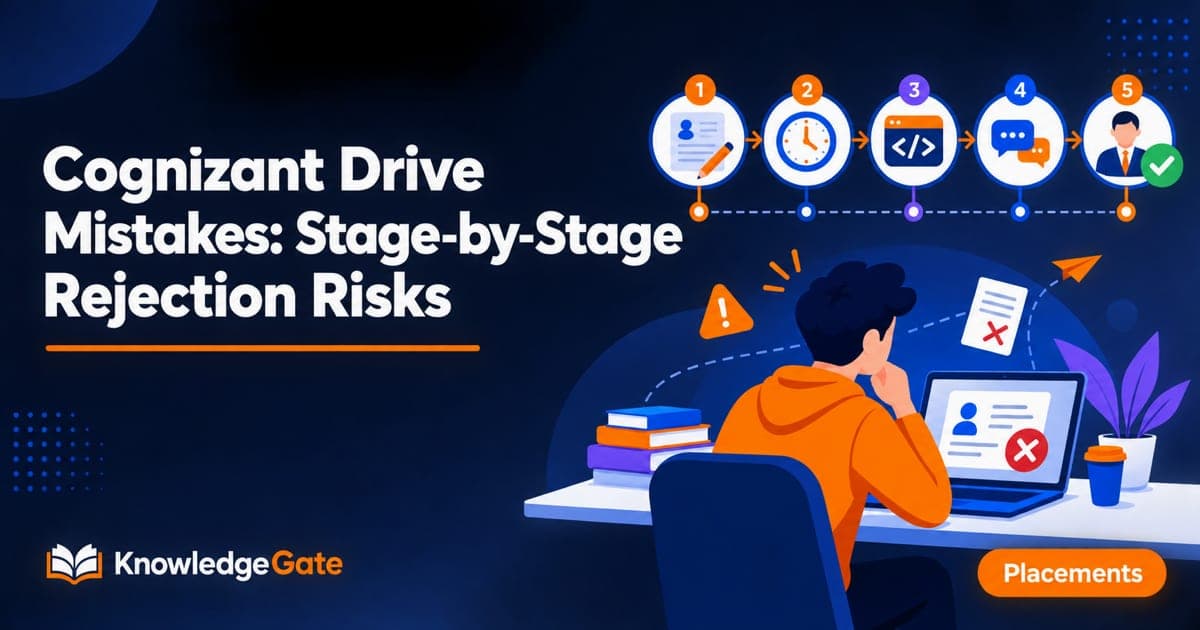
Candidates often prepare likely questions yet still lose marks or credibility through inconsistent form data, poor time control, sample-only code, unsupported resume claims, or contradictory answers. This guide turns those risks into five failure modes and specific repairs, alongside wider Company-Specific Placement Courses. Cognizant drives can vary, so the current job posting, assessment invitation, and recruiter communication always override any remembered pattern.
Cognizant drive mistakes begin with assuming a fixed process
Old stage orders, durations, or cutoffs may not apply. Extract current rules from your posting and invitation.
The preparation buckets are application, online assessment, coding, technical conversation, and HR or role fit. Use service-based company placement preparation for a wider comparison.
Preparation bucket | Evidence to check | Repair action |
|---|---|---|
Application | Form, resume, records agree | Reconcile fields |
Online mock | Rules and time plan written | Rehearse timed attempt |
Coding drill | Sample and edge cases pass | Test before submission |
Technical practice | Claim has evidence | Rehearse follow-ups |
HR practice | Answer matches record | Record and shorten |
Candidate A checks 6 fields, takes a learner-created 40-question, 60-minute mock, runs 4 code tests, defends 2 claims against 3 follow-ups each, and records a 90-second STAR answer. None is a Cognizant rule or cutoff.
![Five left-to-right boxes labelled Learner-created practice model, not an official Cognizant process or cutoff: Application, verify name, email, phone, graduation month/year, CGPA, backlog declaration (6 fields); Online mock, 40 questions, 45-minute first pass + 10-minute retry + 5-minute review = 60 minutes; Coding drill, [] -> 0, [5] -> 0, [2, 2, 3] -> 1, [2, 2, 3, 3, 3, 4] -> 2 (4 tests); Technical practice, 2 resume claims x 3 follow-ups each = 6 answers; HR practice, 90-second STAR = 15 seconds situation + 15 seconds task + 40 seconds action + 20 seconds result. Footer: Current posting, invitation and recruiter communication control the real drive. Exclude scores, selection percentages, official timings and eligibility rules.](https://cdn.knowledgegate.ai/blog-assets/blog_asset_1786681992946_rpfvz2.jpg)
Application mistake: inconsistent or inflated profile details
Converting from memory or reusing an old resume creates mismatches and integrity problems. Freeze one source-of-truth sheet. Never change a value to appear eligible.
Candidate A's record and resume say 7.8 CGPA and May 2026, but the form says 78% and July 2026. With no conversion rule, restore the recorded values. Convert only if the form and institution's documented rule require it. Also check name, email, phone, and backlog declaration.
Compare all 6 fields character by character, open the exported resume, and save the submitted values. The current posting decides eligibility and required documents.
Online-assessment mistake: letting one question consume the clock
The candidate burns review time because they treat leaving a question unanswered as failure. In Candidate A's 40-question, 60-minute mock, 7 minutes on question 4 leaves 53 minutes for 36 questions, or 53 x 60 / 36 = 88.3 seconds each before review.
Use 45 minutes for a first pass, answering 28 and flagging 12. Reserve 10 minutes to retry 6 and 5 minutes to check response states and submission. The total is 45 + 10 + 5 = 60 minutes.
Record invitation-confirmed timers, navigation, tools, marking, language, and submission. Never import another drive's rule.
Coding-task mistake: passing the sample and skipping edge cases
Count the distinct values that occur more than once. For [2, 2, 3, 3, 3, 4], the map is {2: 2, 3: 3, 4: 1}; return 2 because values 2 and 3 repeat. Pair-counting returns 1 + 3 = 4, a different task.
Passing the sample feels like proof, so the output contract is never restated and the task may be misread. Instead, restate the contract, run the sample, test [] -> 0, [5] -> 0, [2, 2, 3] -> 1, and [2, 2, 3, 3, 3, 4] -> 2, then execute again. A frequency map uses O(n) time and O(n) auxiliary space.
Rehearse for 30 minutes: 5 to read, 15 to implement, 7 to test, and 3 to review and submit. 5 + 15 + 7 + 3 = 30. The invitation controls platform, language, time, and tests.
Technical-interview mistake: resume claims without evidence
Candidate A memorises the claim, "Reduced median API latency from 500 ms to 200 ms," without its evidence. The calculation is (500 - 200) / 500 x 100 = 60% reduction; being unable to explain its measurement or trade-off destroys credibility.
Every number needs supporting evidence. Candidate A uses 20 comparable local runs before and after, reports the median rather than the fastest run, caches repeated lookups for 5 minutes, and admits that data may be up to 5 minutes stale.
Answer three follow-ups: What changed? How was it measured? What trade-off did it create? If proof is missing, remove the percentage instead of bluffing.
HR and role-fit mistake: generic answers that contradict the record
Copied answers can contradict the record. Use Infosys interview process preparation to practise a truthful answer structure.
Candidate A's 90-second STAR: 15 seconds for the situation, a 4-person team, 6 days left, 18 failing tests; 15 for the task, API integration; 40 for the action, grouping failures into 3 causes and fixing payload validation plus retry handling; and 20 for the result, reducing failures from 18 to 2 while disclosing the remaining 2. 15 + 15 + 40 + 20 = 90 seconds.
Match graduation date, skills, and role to the application. Base "Why Cognizant?" on the current job description and genuine fit. Never hide backlogs, exaggerate ownership, or invent results. The Interview & Resume Preparation Course offers structured practice.
Cognizant drive mistakes: a 48-hour repair plan and short version
Use Day 1 to reconcile 6 fields for 30 minutes, take the mock for 60, and code for 30. 30 + 60 + 30 = 120 minutes. Use Day 2 to defend 2 claims for 45 minutes, review STAR for 30, and check the invitation for 15. 45 + 30 + 15 = 90 minutes. Overall, 120 + 90 = 210 minutes, or 3 hours 30 minutes.
Keep this five-line recall card:
Profile mismatch: reconcile against records.
One-question time sink: use a written pass-and-return plan.
Sample-only code: run edge cases.
Unsupported metric: show evidence or remove it.
Generic or contradictory answer: use a truthful timed structure.
The posting and invitation override this model. Choose the Cognizant Superset Course for focused practice, or the interview course for resume work. Complete the 210-minute audit and repair the first inconsistency.
Keep learning
Accenture Coding Questions: 4 Patterns with Solved Dry Runs
Stop memorising company-question lists. Learn four reusable coding patterns through precise examples involving strings, arrays, digits, and matrices.
Updated 2 Oct 20265 min readCompany-Specific Prep
Accenture Placement Preparation: 4-Week, 56-Hour Study Plan
Turn four preparation lanes into a practical weekly calendar. Start with a baseline, move hours towards your errors, and recover missed sessions without cramming.
Updated 27 Sep 20265 min readCompany-Specific Prep
Capgemini Interview Questions: Technical and HR Rounds with Model Answers
Practise clear technical and HR answers through Java, SQL, a coding trace and one consistent project story. Each example shows what to say and how to support it.
Updated 25 Sep 20265 min readCompany-Specific Prep
Capgemini Drive Mistakes: Stage-by-Stage Rejection Risks and Fixes
Diagnose the controllable evidence gaps behind common Capgemini drive risks. Repair your CV, timed practice, code traces, project proof and behavioural stories with worked drills.
Updated 24 Sep 20266 min readCompany-Specific Prep