TCS Drive Mistakes: Rejection Risks at Each Stage and How to Fix Them
A stage-by-stage audit of the mistakes candidates can control, from an incomplete drive application and weak attempt strategy to fragile code and unsupported resume claims.
KnowledgeGate Team
Exam prep & CS education
Updated 7 Sep 20265 min read
Strong preparation can still be undone by an incomplete application, poor attempt control, fragile code, unsupported claims or document discrepancies. Each is a candidate-controlled failure point with evidence you can audit and repair before the next gate. The current drive notice controls the route; TCS does not publish a universal scoring formula.
TCS drive rejection reasons: identify the gate before fixing the mistake
“Rejected” can mean application, eligibility, assessment, interview or document verification. The TCS NQT interview process guide maps the test, technical, managerial and HR rounds and the evidence to rehearse. Failure diagnosis is a separate task: isolate the candidate-controlled risk at the relevant gate, then repair it. Use the current drive notice for the actual route.
Silence does not prove a low score. Audit data, attendance, mock accuracy, edge cases, claim evidence and documents, not unpublished cutoffs or interviewer scores.
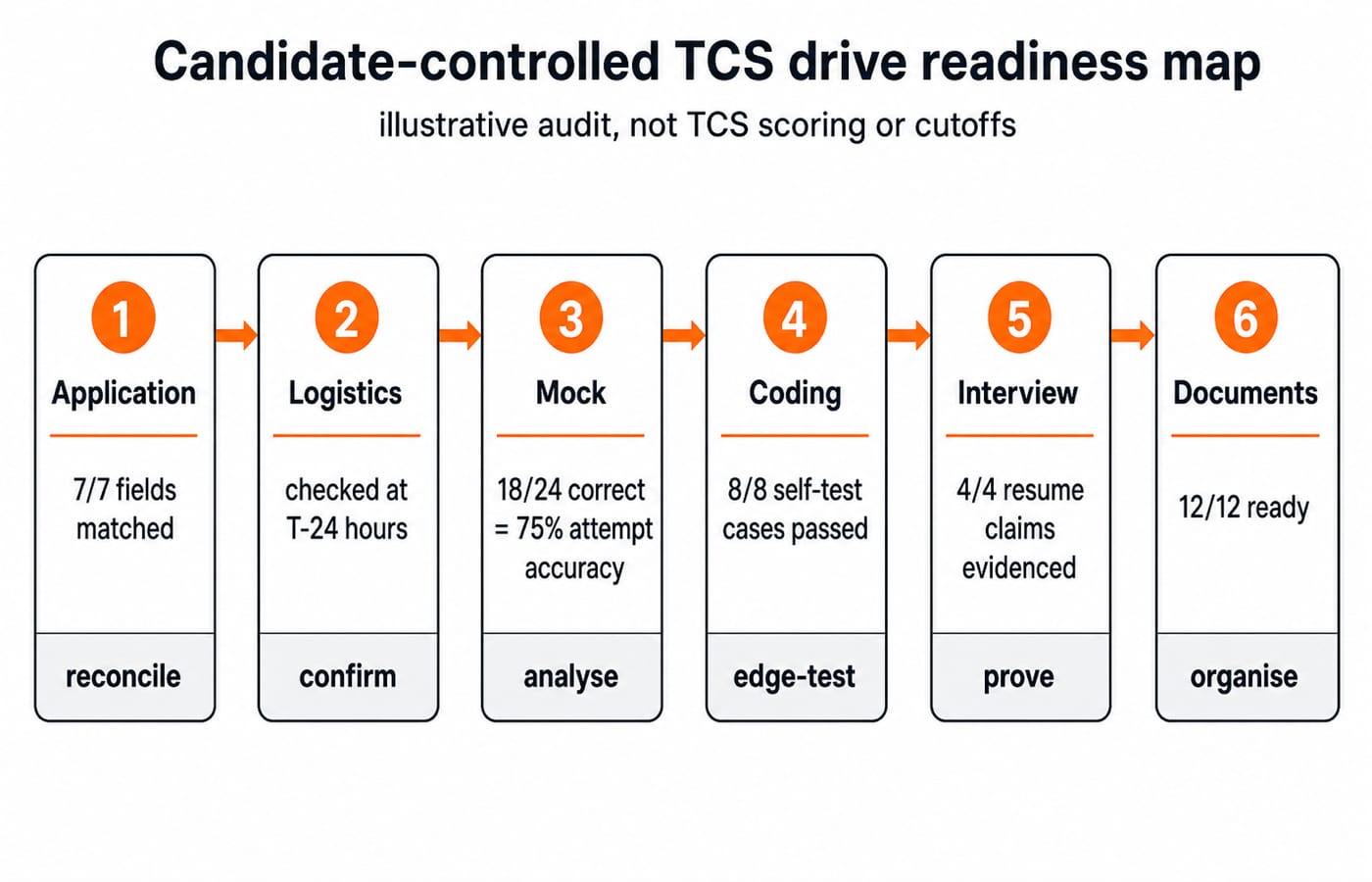
Meera's illustrative audit: 7/7 application fields matched, logistics checked at T-24 hours, 18/24 mock answers correct, 8/8 coding cases passed, 4/4 resume claims evidenced and 12/12 documents ready. Treat these six checks as a readiness record, not as a prediction of TCS scoring. Find resources in the TCS preparation category.
TCS application mistakes: registration is not applying for the drive
A candidate may copy figures from memory, choose the wrong category or stop early. As a dated example, the closed TCS All India NQT hiring notice for the 2024, 2025 and 2026 batches required NextStep, “Apply for Drive” and the tracker state “Applied for Drive”. It allowed eligibility review at every stage and disqualification for ineligibility or discrepant declarations. Check today's notice.
Rohan's six-field reconciliation finds:
Field | Portal | Evidence or required state | Audit |
|---|---|---|---|
Category | IT | IT | Match |
Tracker | Registered | Applied for Drive | Action needed |
Name | Rohan K Verma | Rohan Kumar Verma | Raise via helpdesk |
Graduation | 71.8% | Transcript 71.6% | Recalculate by notified method |
Pending backlog | 0 | 0 | Match |
Experience | 0 months | 0 months | Match |
He should resolve the mismatches and correct the tracker state, never guess or hide them.
TCS test-day mistakes: losing before the first question
Preparation cannot repair a missed instruction, identity mismatch or late arrival. The dated notice named TCS iON for test communication. Follow your current message's instructions and permitted items.
For a 09:00 appointment, an illustrative 08:00 target plus a 35-minute delay means arrival at 08:35, still 25 minutes early. Leaving at 08:45 for a 20-minute trip means 09:05. At T-48 hours check name and inbox, at T-24 hours check instructions and route, and at T-2 hours pack permitted items. Set wider buffers when your route, venue or required checks need them.
TCS aptitude mistakes: attempts rise while accuracy falls
Compulsory attempts create avoidable errors. The dated notice named Numerical, Verbal and Reasoning sections, but pattern details belong to the current notice.
In mock A, Kavya attempts 24 of 30 and gets 15 correct. Accuracy is 15 / 24 × 100 = 62.5%, with 24 - 15 = 9 errors. In mock B, she attempts 20 and gets 17 correct. Accuracy is 17 / 20 × 100 = 85%, with 20 - 17 = 3 errors. Use the comparison to diagnose whether fewer attempts are producing more correct answers; use the current notice for scoring and cutoff rules.
Label 30 questions as concept gap, calculation slip, reading error or time trap. Solve checkable questions first, review marked ones, then compare attempts, correct answers and errors across three mocks. Practise with the TCS NQT and Smart Hiring test series.
TCS coding mistakes: sample output passes, edge cases fail
Sample-only code often assumes positive, distinct values. For the task “return the second-largest distinct integer, or NONE with fewer than two distinct values”, sorting [8, 8, 3, -1, -4] leaves index 1 as the wrong answer, 8. Removing duplicates gives [8, 3, -1, -4], so the answer is 3. It returns -7 for [-10, -3, -7] and NONE for [5, 5].
Test normal values, duplicate maximum, all negative, one distinct value, two values, sorted, reverse-sorted and boundary-sized input. Include [4, 9, 2] → 4, the three cases above, dry-run variables, and rerun all eight after editing.
TCS technical interview mistakes: claims without evidence
The closed notice said shortlisted candidates would be evaluated predominantly on their selected skill alongside the usual interview. Prepare evidence for that selected skill instead of memorising an assumed universal panel script.
An unsupported number can collapse under one follow-up question. Claim “I indexed loans(member_id, returned_at) and measured 500 scripted requests on the same local setup; p95 changed from 920 ms to 430 ms” only with evidence. The reduction is 920 - 430 = 490 ms, or 490 / 920 × 100 ≈ 53.3%. Show your action, query and test artefact, and state that a local benchmark is not production proof. Audit each claim for problem, own action, measurement and trade-off.
TCS HR, managerial and document mistakes: contradictions persist
Where a drive includes an HR or managerial round, keep every answer consistent. “Willing to relocate: yes” conflicts with “only Jaipur”. A truthful constraint could be: “I can relocate to the listed locations with 30 days to arrange the move.” In a four-person STAR example, an API task was three days late, so you cut two optional endpoints, delivered six required endpoints and documented the deferral.
Check 12 documents against the notice. If 10 are ready but a semester-5 marksheet and previous employer's relieving letter are missing, readiness is 10 / 12, not “almost complete”. Contact the official helpdesk, never fabricate a substitute. The dated notice required listed originals for interview or joining, warned that hiring messages would not come from public-mail providers and said TCS did not seek money for offers.
TCS drive mistakes: the short version and the next repair
Reconcile application data and status. Follow current logistics communication. Compare aptitude accuracy and errors. Expand coding edge tests. Evidence interview claims. Resolve document discrepancies officially. None guarantees selection.
A 24-hour repair can allocate 45 minutes to portal matching, 30 to logistics, 60 to a timed 30-question set and review, 75 to coding plus eight edge cases, and 30 to four resume claims. 45 + 30 + 60 + 75 + 30 = 240 minutes, or 4 hours. Adjust the block lengths to the failure you actually measured.
Use the TCS NQT preparation guide for a self-directed plan. Repair the proven weak gate, then prepare for the next one.
Keep learning
Accenture Coding Questions: 4 Patterns with Solved Dry Runs
Stop memorising company-question lists. Learn four reusable coding patterns through precise examples involving strings, arrays, digits, and matrices.
Updated 2 Oct 20265 min readCompany-Specific Prep
Accenture Placement Preparation: 4-Week, 56-Hour Study Plan
Turn four preparation lanes into a practical weekly calendar. Start with a baseline, move hours towards your errors, and recover missed sessions without cramming.
Updated 27 Sep 20265 min readCompany-Specific Prep
Capgemini Interview Questions: Technical and HR Rounds with Model Answers
Practise clear technical and HR answers through Java, SQL, a coding trace and one consistent project story. Each example shows what to say and how to support it.
Updated 25 Sep 20265 min readCompany-Specific Prep
Capgemini Drive Mistakes: Stage-by-Stage Rejection Risks and Fixes
Diagnose the controllable evidence gaps behind common Capgemini drive risks. Repair your CV, timed practice, code traces, project proof and behavioural stories with worked drills.
Updated 24 Sep 20266 min readCompany-Specific Prep