Capgemini Drive Mistakes: Stage-by-Stage Rejection Risks and Fixes
Diagnose the controllable evidence gaps behind common Capgemini drive risks. Repair your CV, timed practice, code traces, project proof and behavioural stories with worked drills.
KnowledgeGate Team
Exam prep & CS education
Updated 24 Sep 20266 min read
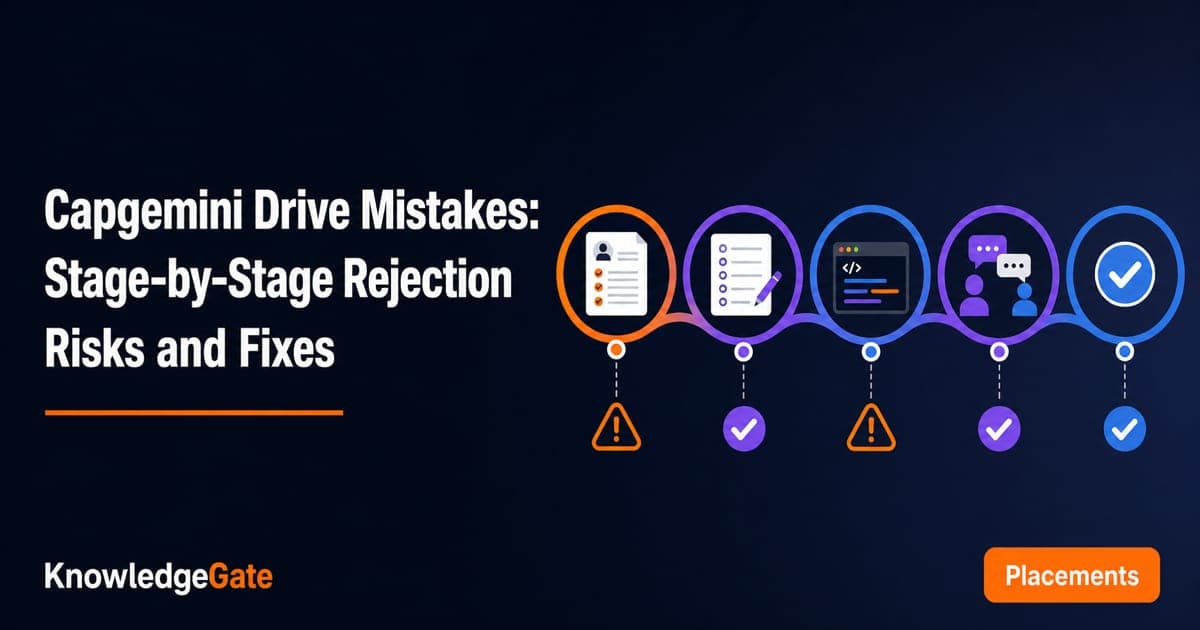
Rejection can feel like a mysterious verdict, but the controllable weakness appears earlier: a poor application match, a rushed assessment, untested code, an unsupported project claim, or a vague behavioural answer. This guide turns those risks into a stage-by-stage diagnostic with exact examples and fixes. These are rejection risks, not disclosed Capgemini rejection rules or guaranteed causes, and all numbers in the worked examples are for practice.
1. Capgemini drive stages: use the official map without assuming every round
Capgemini India's current recruitment-process page maps application; screening and position mapping; interviews, which may include applicable technical and language assessments, one or two technical interviews by role, and a formal HR behavioural interview; documentation; onboarding. Fresh graduates typically face aptitude, coding or technical assessment, select-role group discussion, technical interview, and HR interview. Follow your invitation and role listing.
Checkpoints need role fit, rule-bound accuracy, edge-case code traces, or consistent explanations. Company-Specific Placement Courses gives catalogue context; Accenture, Capgemini, Cognizant Placement Prep Compared gives broader comparison.
2. Capgemini application mistake: a generic CV makes position mapping guesswork
Why: listing tools does not show how they map to the work required by the role. Risk: Java and SQL appear without proof of what was built, owned, or verified. Fix: map only true evidence from the current job description and make each claim testable.
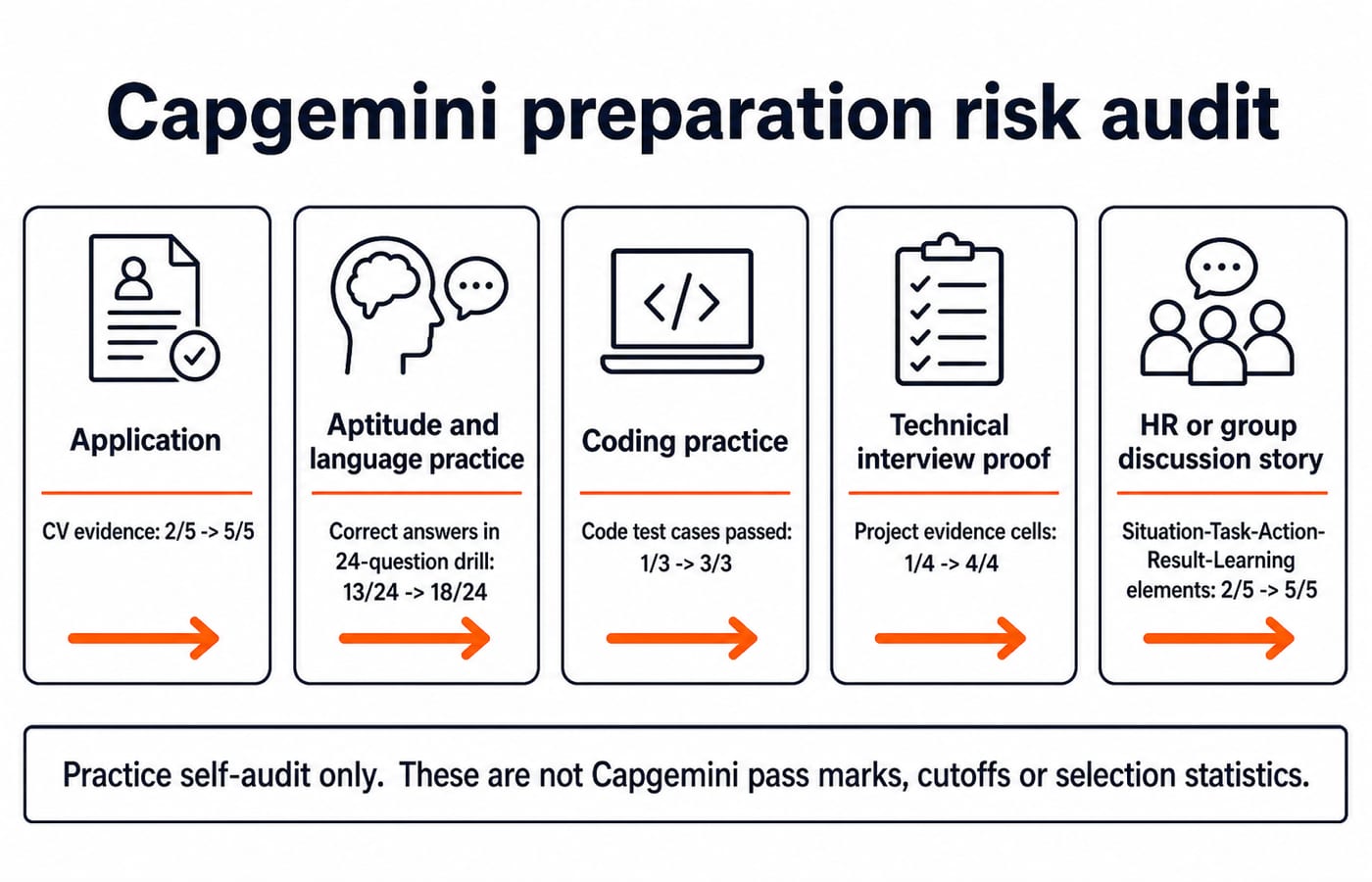
The role-mapping drill uses five signals: Java, SQL, REST APIs, Git, and teamwork. The original CV proves Java and SQL only, so its evidence covers 2/5 signals. Rewrite one bullet: Built a Java inventory service with 6 REST endpoints, a 3-table SQL schema, 18 Git commits, and delivery in a 3-person team. That sentence supplies evidence for all five signals, taking coverage to 5/5. Test each number with Resume-Based Interview Questions: Predict Every Follow-Up. Never stuff keywords or invent metrics.
3. Capgemini aptitude and language assessment mistake: speed without a decision rule
Why: untimed practice rewards attempts. Risk: one hard item drains time, prompting guesses and skimmed language instructions. Fix: adapt a timed drill, stop rule, and error log to the invitation.
Use 24 mixed questions in 30 minutes. Attempt one gives 13 correct, 7 wrong, and 4 unattempted, which accounts for all 24 questions. Repair the timing plan: 18 minutes for a first pass, 10 for flagged items, and 2 for instructions and review. The next attempt gives 18 correct, 3 wrong, and 3 unattempted, again totalling 24. Track accuracy as correct answers out of 24 rather than converting the result into marks. This makes the two attempts directly comparable and keeps the error log tied to decisions you can repair.
Error label | Record the first wrong step |
|---|---|
| Missing method |
| Misread instruction |
| Arithmetic slip |
| Item held too long |
Repair that first step, not random questions.
4. Capgemini coding and technical assessment mistake: one happy path
Why: pattern recognition triggers early typing. Risk: the visible case passes, but duplicates, empty results, or ordering fail. Fix: restate output, trace a normal case, test two edges.
Prompt: Return the first non-repeating value in [4, 5, 4, 6, 5, 7].
A faulty adjacency check returns
4because4 != 5.But another
4occurs at index2.A correct two-pass method builds
{4:2, 5:2, 6:1, 7:1}.Scanning in original order returns
6.
Before the repair, only the normal list was checked, so the code passed 1/3 planned test cases. Add a duplicate-only case, [2, 2] -> no value, and a negative-value case, [-1, 0, -1] -> 0. Passing the normal case and both edge cases raises the result to 3/3. Capgemini Technical Interview: Pseudocode to Projects bridges traces and projects.
5. Capgemini technical interview mistake: claims without proof
Why: memorised definitions or a metric without its baseline and method. Risk: “why?”, “how measured?”, or “what trade-off?” exposes the gap. Fix: give a definition, smallest clear example, trade-off, and genuine project evidence.
The claim improved API performance fills only the result cell, and even that result is vague. It leaves the baseline, change, and test method cells empty, so the claim begins at 1/4. Complete it: on 50,000 synthetic rows, the median of 20 runs fell from 1,200 ms to 320 ms after adding an index and removing repeated lookups.
Reduction:
1,200 - 320 = 880 ms.Percentage reduction:
880 / 1,200 x 100 = 73.3%approximately.
The completed evidence is easy to audit: 1,200 ms is the baseline, the index and lookup removal are the change, 20 runs on 50,000 synthetic rows are the test method, and 320 ms is the result. All four cells are now filled, so the evidence moves from 1/4 to 4/4. The trade-off is extra index storage and write cost.
6. Capgemini HR and select-role group discussion mistake: vague claims
Why: memorised strengths or dominating discussion replace evidence. Risk: collaboration, ownership, and reflection stay unproved, or facts conflict. Fix: keep one consistent five-part Situation, Task, Action, Result, Learning story.
Start with this weak version: The team had 48 hours before a demo and 6 defects. The demo ran on time. It supplies a Situation and a Result, but it omits the candidate's Task, Action, and Learning. That is 2/5 elements.
Now build the complete version one element at a time:
Situation: A3-personteam has48 hoursbefore a demo and6defects, split into2 P1and4 P2.Task: The candidate owns stabilising the demo path and making any unfinished work visible.Action: The candidate pairs on both P1 defects, helps close3P2 defects, and documents the final P2.Result: The team closes2 + 3 = 5defects, the demo runs on time, and the remaining1/6is disclosed.Learning: Prioritise user-blocking failures before polish and communicate residual risk clearly.
The expanded story contains all five Situation, Task, Action, Result, Learning elements, so it reaches 5/5.
For a select-role group discussion, practise 1 opening point, 2 evidence-backed contributions, 1 invitation to a quieter speaker, and a 20-second summary.
7. Run one Capgemini rejection-risk audit before the drive
Day 1: CV evidence 2 hours, timed drill 3, coding traces 2: 2 + 3 + 2 = 7. Day 2: concepts/project proof 3 hours, behavioural rehearsal 2, live role/company research 1, buffer 1: 3 + 2 + 1 + 1 = 7. Total: 7 + 7 = 14 hours. Reduce volume; retain evidence-first order.
Record the five repairs in the same order: CV evidence 2/5 -> 5/5; correct answers 13/24 -> 18/24; code test cases passed 1/3 -> 3/3; project proof 1/4 -> 4/4; behavioural story elements 2/5 -> 5/5.
8. Capgemini drive mistakes: the short version and next step
Before the drive:
Follow the current invite.
Prove role fit with true CV evidence.
Use a timed stop rule.
Trace normal and edge cases.
Link every project result to a baseline and method.
Keep behavioural facts consistent.
An unexplained rejection cannot locate the failed checkpoint. Repair evidence, not invented reasons. CAPGEMINI Superset covers communication, aptitude, technical, coding, behavioural, and HR preparation.
Keep learning
Accenture Coding Questions: 4 Patterns with Solved Dry Runs
Stop memorising company-question lists. Learn four reusable coding patterns through precise examples involving strings, arrays, digits, and matrices.
Updated 2 Oct 20265 min readCompany-Specific Prep
Accenture Placement Preparation: 4-Week, 56-Hour Study Plan
Turn four preparation lanes into a practical weekly calendar. Start with a baseline, move hours towards your errors, and recover missed sessions without cramming.
Updated 27 Sep 20265 min readCompany-Specific Prep
Capgemini Interview Questions: Technical and HR Rounds with Model Answers
Practise clear technical and HR answers through Java, SQL, a coding trace and one consistent project story. Each example shows what to say and how to support it.
Updated 25 Sep 20265 min readCompany-Specific Prep

Cognizant Interview Questions: Technical and HR Model Answers
Prepare clear technical and HR responses through worked programming, SQL, project and STAR examples, then test them in a timed self-review mock.
Updated 22 Sep 20266 min readCompany-Specific Prep