

Coforge Recruitment Process and Test Pattern: A Fresher’s Stage-by-Stage Guide
Conflicting lists of Coforge rounds can leave you practising the wrong thing. Use your invitation to identify the next stage, then rehearse assessments, project explanations and HR answers with concrete examples.
KnowledgeGate Team
Exam prep & CS education
Updated 16 Nov 20265 min read
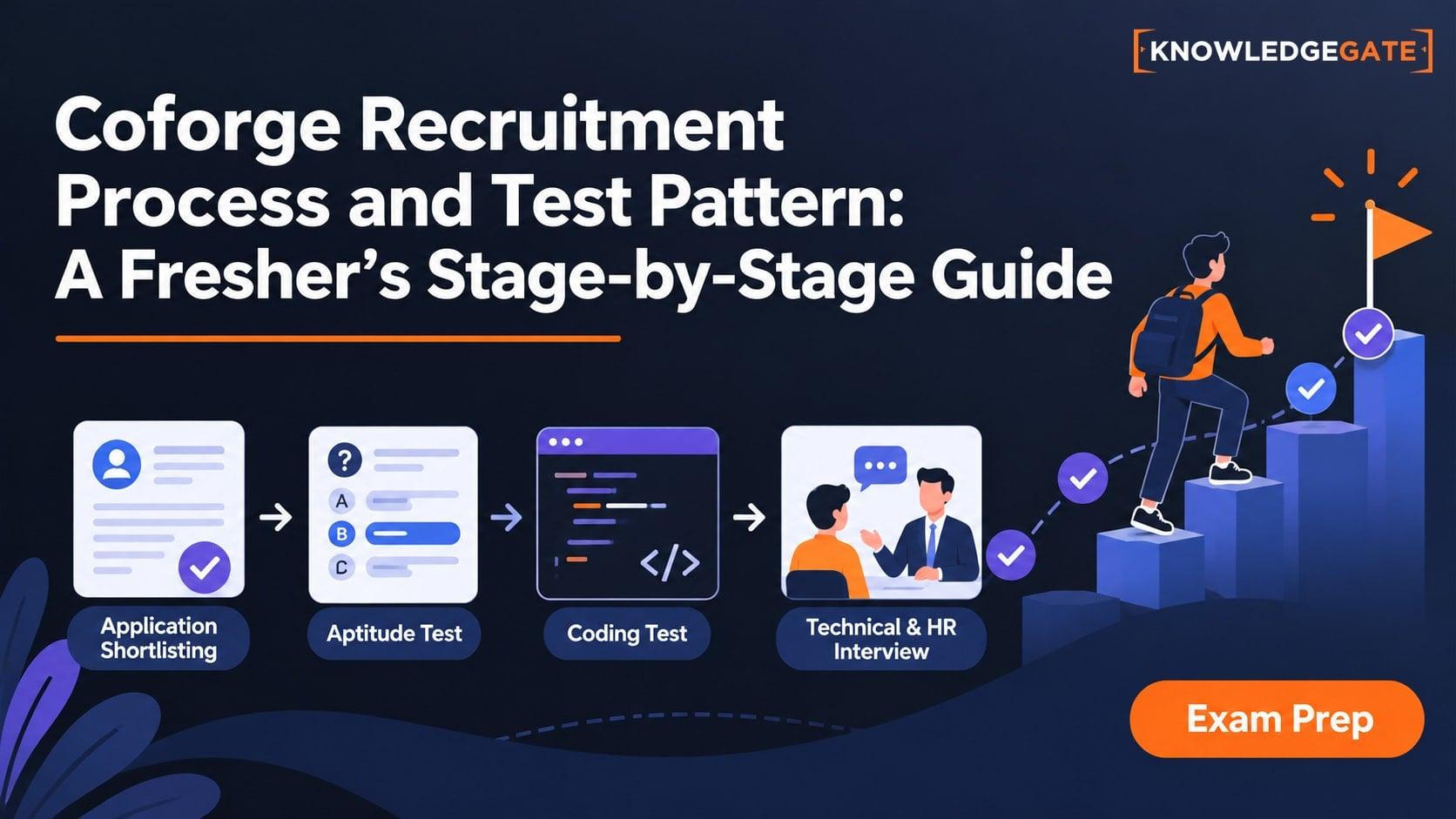
Different websites list different Coforge rounds and test patterns. Your drive communication controls the sequence, so use it to identify the next task, the skills being assessed and the evidence you need for interviews. Treat application checks, assessments, technical discussion, HR discussion and written instructions as checkpoints, and practise only the parts your invitation confirms.
The earlier Cognizant recruitment process and test pattern works through one illustrative invitation and readiness plan. This Coforge guide takes a different role: it keeps the company-specific pattern conditional and shows how to convert the next confirmed instruction into practice.
What is confirmed about the Coforge recruitment process?
Coforge’s Recruitment Privacy Notice describes application information, interviews, aptitude, personality or skills assessments, and background checks where applicable. It identifies recruitment activities, not a universal fresher exam pattern or mandatory assessment order.
Use your drive’s instructions: Round order and number, eligible degree and batch, academic thresholds, section names, timing, test vendor, permitted languages and marking rules must come from the specific job notice and assessment invitation. Include a coding or communication exercise in your assessment plan only when that drive specifies it.
Keep application checks, assessment preparation, technical discussion, HR or role discussion, and post-selection instructions in one checklist. They are preparation checkpoints, not five guaranteed Coforge rounds. Keep the notice and invitation together for reference.
Application screening: turn eligibility into a checklist
Compare the stated requirements with your documents, rather than relying on an old campus notice.
Field | Where to check in your notice |
|---|---|
Degree and branch | Eligible qualifications |
Graduation batch | Batch or graduation-year requirement |
Academic records | Academic criteria and calculation instructions |
Backlog rule | Backlog eligibility clause |
Required documents | Application or verification instructions |
Check claims too. If your resume says “SQL project completed” but the repository contains only a schema, change it to “designed the schema” or finish and demonstrate the query work. Accurate applications come before polished interview storytelling.
Once you identify the next confirmed stage, use Placement Preparation to choose relevant aptitude or interview support.
Assessment pattern: read the invitation before choosing a mock
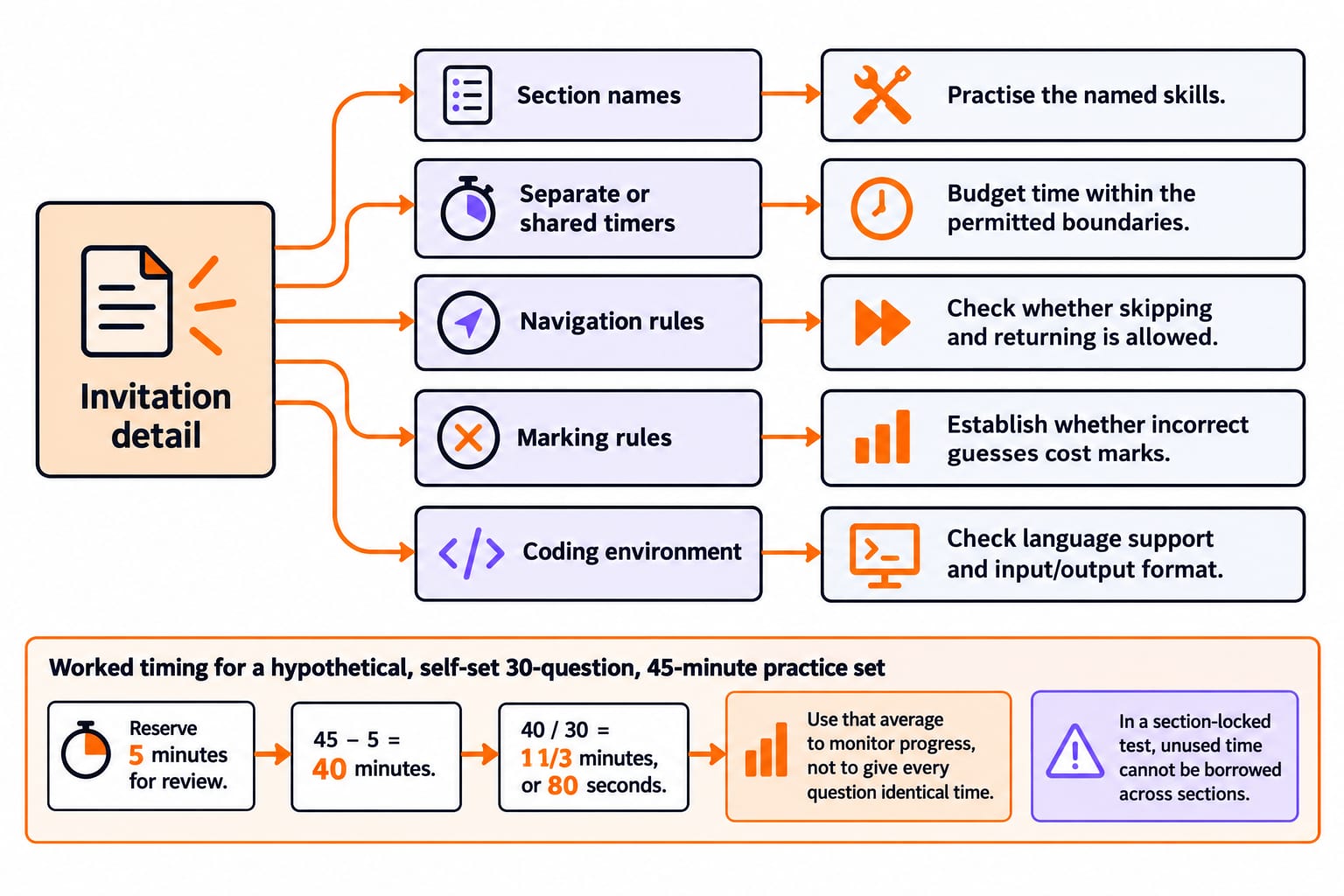
Translate each instruction into a practice decision.
Invitation detail | Preparation decision |
|---|---|
Section names | Practise the named skills |
Separate or shared timers | Budget time within the permitted boundaries |
Navigation rules | Check whether skipping and returning is allowed |
Marking rules | Establish whether incorrect guesses cost marks |
Coding environment | Check language support and input/output format |
For a hypothetical, self-set 30-question, 45-minute practice set, reserve 5 minutes for review. Working time is 45 - 5 = 40 minutes. Average time per question is 40 / 30 = 1 1/3 minutes, or 80 seconds.
Use that average to monitor progress, not to give every question identical time. Easier questions can leave room for harder ones. In a section-locked test, unused time cannot be borrowed across sections.
For transferable preparation ideas, read the comparison of service-based company placement preparation. Use it to broaden practice methods while keeping your own invitation as the reference for test rules.
Aptitude and coding practice: show the reasoning
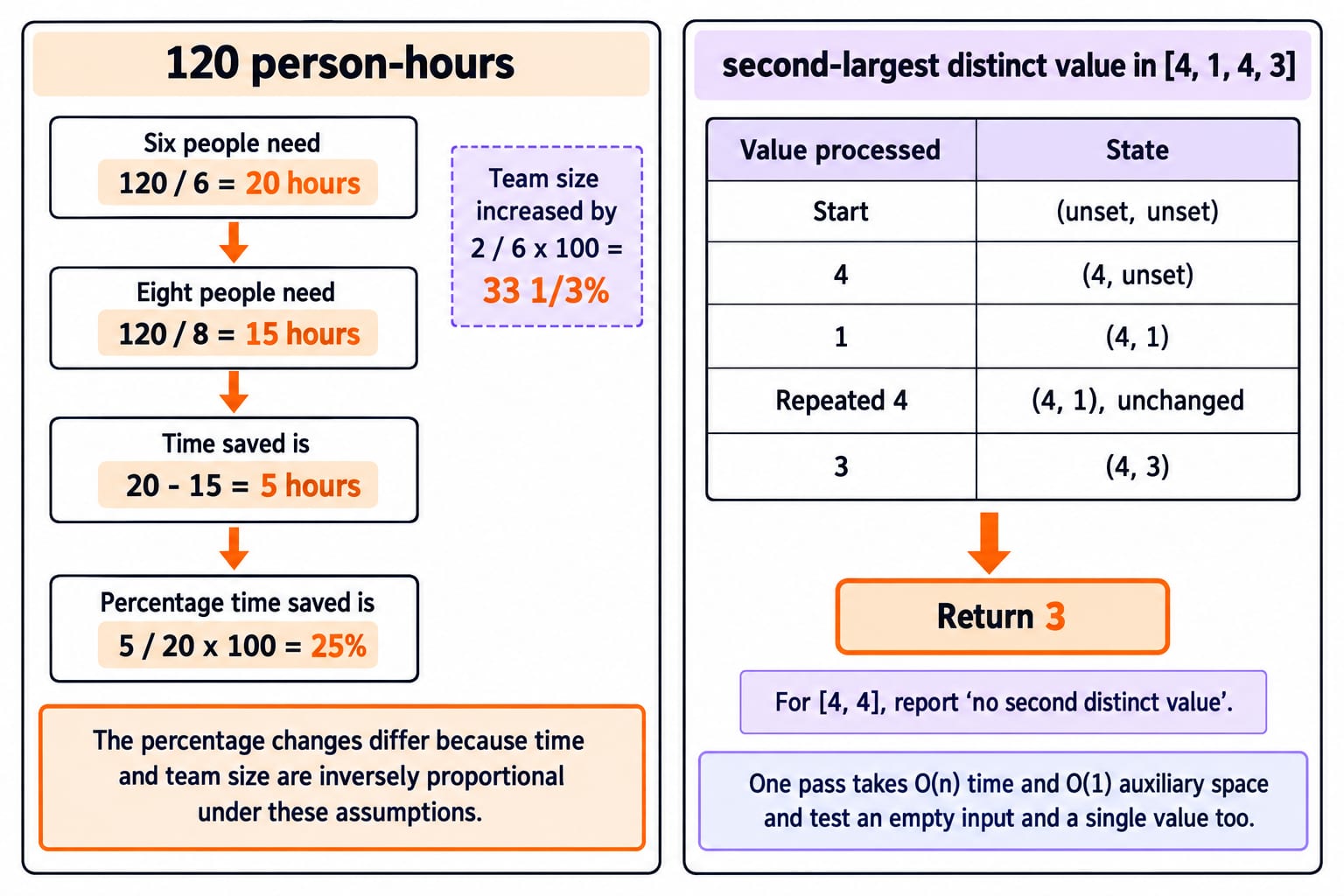
Use these two practice exercises to rehearse assumptions and edge cases.
A task needs 120 person-hours. Assume equally productive people, constant productivity and divisible work:
Six people need 120 / 6 = 20 hours.
Eight people need 120 / 8 = 15 hours.
Time saved is 20 - 15 = 5 hours.
Percentage time saved is 5 / 20 x 100 = 25%.
Team size increased by 2 / 6 x 100 = 33 1/3%. The percentage changes differ because time and team size are inversely proportional under these assumptions.
For coding, find the second-largest distinct value in [4, 1, 4, 3]. Track (largest, second):
Value processed | State |
|---|---|
Start |
|
4 |
|
1 |
|
Repeated 4 |
|
3 |
|
Return 3. For [4, 4], report “no second distinct value”. One pass takes O(n) time and O(1) auxiliary space. Explain why duplicates do not count, then test an empty input and a single value too.
Technical interview: defend your project and fundamentals
Prepare around the listed role and your own resume. An interviewer can ask why a solution works, so connect definitions to decisions. Use technical interview preparation for OS, DBMS, CN and OOP for further fundamentals practice.
Consider a rehearsal project: an attendance app stores (student_id, session_id, status). Rows (101, S1, present) and (101, S2, absent) must coexist because they describe different sessions.
A primary key on student_id alone rejects the second row: both use 101. A composite key on (student_id, session_id) permits both, but rejects another (101, S1) row. This models one attendance record per student per session.
Now rehearse your own contribution, one design choice and one failed test. Explain what the test revealed and what you changed. That gives your project discussion a concrete thread, from requirement to implementation to evidence, instead of a list of technologies.
HR discussion and post-selection instructions
Prepare factual answers about availability, preferred location, role understanding and genuine constraints. Practise a clear statement such as: “My final examination ends in the third week of June; I can join one week after that, once I have travelled.” Substitute your own real timing.
Explain commitments directly. Do not hide a pending examination or invent an achievement to make an answer sound stronger.
A positive conversation is not a final offer. Read the written instructions for documents and next steps, including background verification where applicable. Ask the stated recruiter about unresolved requirements, and distinguish an acknowledgement from a confirmed decision before acting on it.
Your next step before the drive
Can you name the next confirmed stage, locate timing and marking instructions, explain one practice problem and defend one project decision? Ask the recruiter or placement cell about missing rules.
Use this suggested 60-minute preparation block: 15 minutes reading the invitation, 20 practising the confirmed assessment skill, 15 rehearsing your project and 10 checking documents and logistics. Total: 15 + 20 + 15 + 10 = 60 minutes. Use the block to verify readiness before the drive, then schedule a fuller plan around the confirmed assessment.
If explaining projects and answering interview questions is your main gap, the Interview & Resume Preparation Course offers general interview preparation. Open your invitation and identify the next action now.
Keep learning
Capgemini Recruitment Process and Test Pattern: Fresher Stages Explained
Separate Capgemini's official hiring framework from the details that vary by role. Learn what to verify, how to read an assessment invite, and what evidence to prepare.
Updated 18 Sep 20265 min read144 viewsCompany-Specific Prep
Wipro Interview Experience Patterns: Fresher Routes Compared
Compare seven candidate-reported Wipro fresher experiences without mistaking any one route for the rule. Build a focused plan for technical, project, communication and fit questions.
Updated 30 Oct 20265 min readCompany-Specific Prep

HR Interview Questions on Relocation, Shifts and Service Agreements: A Fresher Answer Plan
Prepare truthful answers for relocation, rotating shifts and written service agreements. Follow Meera's boundary map, exact scripts and seven-day rehearsal plan.
Updated 30 Oct 20265 min readInterview Corner
One-Page Fresher Resume: Keep, Cut and Reorder Every Section
Use an evidence-first edit to turn a crowded fresher resume into a readable page, following Riya's complete budget and section decisions.
Updated 4 Sep 20266 min readInterview Corner