TCS Recruitment Process and Test Pattern: NQT to Interview, Stage by Stage
Follow the TCS recruitment process from drive identification and registration through the written test, interview, document checks and a safe next step.
KnowledgeGate Team
Exam prep & CS education
Updated 14 Aug 20265 min read
For a fresher, the confusing part of TCS recruitment is knowing which instructions apply. All India NQT, campus, BPS and other hiring tracks may not follow one permanent sequence. The route holds roughly the same shape across those tracks, and the closed 2026 All India NQT notice is the clearest worked example of it. Your current TCS drive page, portal status and official email always control your attempt.
Related reading: TCS NQT exam structure and TCS interview questions.
1. Start by identifying the exact TCS hiring drive
Use this reusable map: drive notice -> registration -> assessment -> shortlisting -> interview or interviews -> document checks -> outcome. A drive may change or omit a box. Its notice controls eligibility, assessment mode, sections and interview sequence.
Complete this drive card before preparing:
Field | Example entry |
|---|---|
Exact drive name | TCS All India NQT Hiring |
Eligible batch and qualification | Batches 2024 to 2026; check the closed notice for qualifications |
Application portal and status | TCS NextStep; registration closed |
Assessment mode | Confirm in the drive notice |
Official communication channel | Registered email and portal |
The TCS placement preparation category gathers our TCS test series, guides and practice sets in one place, while your drive notice is what decides eligibility, assessment mode and sequence.
2. Stage 1: registration ends with portal confirmation
The closed official TCS All India NQT hiring page instructed candidates to use TCS NextStep, register under IT, apply for the drive, select the skill to be evaluated, choose three preferred test centres and three preferred job cities, then check Track Your Application for Applied for Drive.
Candidate A has a CT/DT reference number, completes the profile and selects three centres, but does not see Applied for Drive. The application is incomplete. Candidate A signs in again, uses Apply For Drive, and saves a screenshot after the required status appears. If the wording changes, follow the current drive.
3. Stage 2: how the TCS NQT written assessment splits its 190 minutes
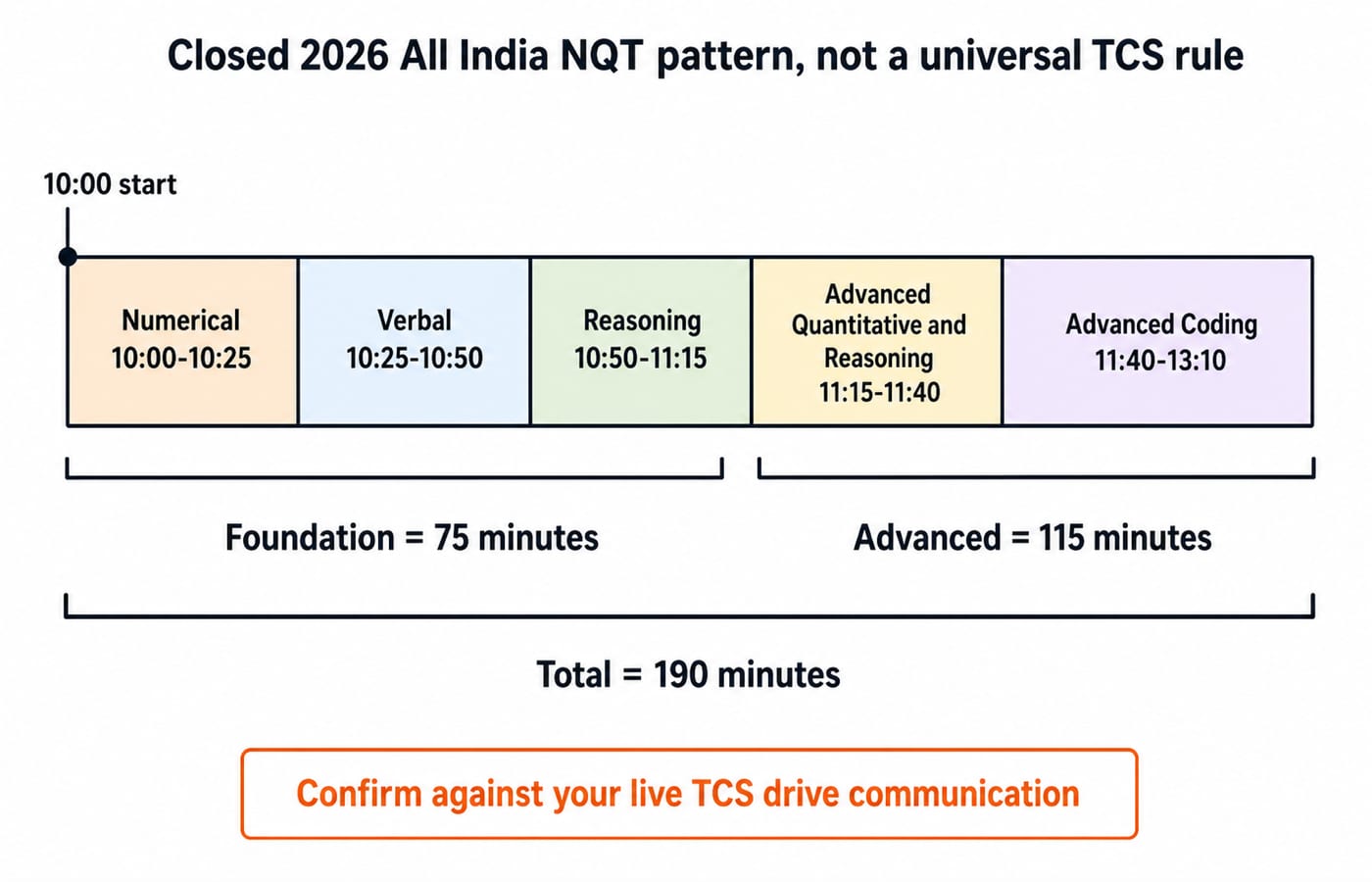
The same closed notice described an integrated test of 190 minutes. Foundation was 75 minutes: Numerical 25, Verbal 25 and Reasoning 25. Advanced was 115 minutes: Advanced Quantitative and Reasoning 25, then Advanced Coding 90.
Foundation:
25 + 25 + 25 = 75minutes.Advanced:
25 + 90 = 115minutes.Total:
75 + 115 = 190minutes.
For an illustrative sitting at 10:00, Foundation ends at 11:15. The next 25-minute block ends at 11:40, and 90 minutes of coding ends at 13:10. That notice carried no breaks, question counts, marks, negative marking or navigation rules with the timing, so those come from your own drive message. The TCS NQT exam structure explainer covers what each of those sections actually tests; the timing for a future drive comes from that drive's own notice.
4. Turn the pattern into a measurable preparation diagnosis
The pattern tells you what the sitting looks like; a timed mock tells you where you stand inside it. In a 40-question practice set, Candidate B attempts 36, gets 30 correct and 6 incorrect, and leaves 4 unattempted. The totals reconcile: 30 + 6 = 36 attempts and 40 - 36 = 4 unattempted.
Attempt rate:
36 / 40 × 100 = 90%.Accuracy among attempts:
30 / 36 × 100 = 83.3%, rounded to one decimal place.
These are practice measures, not a TCS score or cutoff. Review all six errors by topic, repeat the weakest topic with a fresh set, then compare accuracy and completion time on the next mock. Use the TCS NQT test series for timed practice and the TCS NQT preparation guide for a broader plan.
5. Stage 3: shortlisting connects assessment and interview
In the closed notice, test performance qualified candidates for interview categories, with next steps sent to their registered email. The selected skill would be evaluated predominantly in the interview alongside the usual discussion.
Use this decision line: assessment completed -> wait for registered-email or portal update -> follow the named interview instructions. Silence, coaching-site predictions and another candidate's timeline do not prove selection or rejection. Say "interview stage" unless your notice names separate technical, managerial and HR rounds. There is no universal public shortlist score.
6. Stage 4: prepare technical, project and HR evidence together
A strong project answer states a problem, an action, a measured result and a trade-off. Use this shape, and only with numbers that are true for your own project:
A 10,000-row order search took 480 ms. I added an index on
customer_idand inspected the query plan. The new time was 210 ms. The reduction was480 - 210 = 270 ms, and the improvement was270 / 480 × 100 = 56.25%. The trade-off is extra storage and possible write overhead.
Prepare three folders: chosen skill and coding fundamentals; CS concepts and actual projects; resume, communication and role-fit examples. Do not assume fixed subjects or questions. The Interview and Resume Preparation Course can structure rehearsal, but mocks are practice, not inside knowledge of TCS scoring.
7. Stage 5: verify documents, communication and offer safety
In that same notice, TCS required original academic documents at interview if shortlisted, reviewed eligibility at every stage, and sent test information through TCS iON. Build your document list from your live drive message.
Before acting, verify these six items:
Candidate name and reference ID.
Exact drive title.
Portal status.
Sender domain and registered-email match.
Interview venue or meeting link.
Documents named in the official message.
TCS says it does not ask candidates to deposit money for an employment offer or use public-mail domains for hiring communication. If uncertain, go back to the TCS careers pages on tcs.com and to your registered email rather than to a forwarded message. Do not trust unofficial payment links, phone numbers or recruiter contacts.
8. TCS recruitment process in the short version
The practical sequence is simple: identify the exact drive; complete and verify registration; read the live test pattern; diagnose preparation through timed practice; wait for official shortlisting; prepare technical, project and HR evidence; then verify documents and communication before acting.
If the assessment is next, run timed sets and compare your attempt rate and accuracy against the pattern in your notice. If the interview is next, rehearse the problem, action, measured result and trade-off shape using real numbers from your own project. The current TCS drive page and your official communication always override a past pattern or coaching summary.
Keep learning
Accenture Recruitment Process and Test Pattern: Verify Every Stage
Build a personal stage map from the current Accenture role page and invitation. The guide includes worked checks for timing, application data, pacing, coding and mock repair.
Updated 7 Oct 20265 min readCompany-Specific Prep
Accenture Coding Questions: 4 Patterns with Solved Dry Runs
Stop memorising company-question lists. Learn four reusable coding patterns through precise examples involving strings, arrays, digits, and matrices.
Updated 2 Oct 20265 min readCompany-Specific Prep
Accenture Placement Preparation: 4-Week, 56-Hour Study Plan
Turn four preparation lanes into a practical weekly calendar. Start with a baseline, move hours towards your errors, and recover missed sessions without cramming.
Updated 27 Sep 20265 min readCompany-Specific Prep
Capgemini Interview Questions: Technical and HR Rounds with Model Answers
Practise clear technical and HR answers through Java, SQL, a coding trace and one consistent project story. Each example shows what to say and how to support it.
Updated 25 Sep 20265 min readCompany-Specific Prep