TCS NQT Coding Round Edge Cases: Pre-Submission Test Plan
Use this home-practice plan to expose boundary, duplicate, negative-value, overflow, state-reset, and output-format bugs before you submit code.
KnowledgeGate Team
Exam prep & CS education
Updated 27 Aug 20265 min read
A solution can match the sample yet fail on the smallest legal input, repeated or negative values, arithmetic limits, state reset, or exact output formatting. Use a repeatable pre-submission method that works under pressure on unfamiliar hidden cases. The official TCS iON National Qualifier Test page places advanced coding skills in its NQT-IT route, while your invitation and the on-screen instructions determine the exact assessment you receive. For home coverage, use TCS NQT and TCS Exams Preparation.
1. Build an eight-hour weekly edge-case loop
Use a 480-minute cycle: Monday to Thursday 60 minutes each, Friday 45, Saturday 135, and Sunday 60:
(4 x 60) + 45 + 135 + 60 = 240 + 45 + 135 + 60 = 480 minutes = 8 hours
Monday: constraints and cases; Tuesday: implementation; Wednesday: adversarial tests; Thursday: repair and regression; Friday: closed-book recall; Saturday: timed solve and review; Sunday: cumulative rerun.
Allocate minutes by job: reading 60, edge-case design 90, implementation 120, timed solving 90, failure review 75, and contingency 45. Check: 60 + 90 + 120 + 90 + 75 + 45 = 480.
Follow the live TCS invitation for the actual round; use the 480-minute cycle only to organise home practice. Lose one weekday, and contingency covers 45 minutes while 15 minutes of new work moves forward. Lose two sessions, preserve failure review and regression, then carry the unfinished implementation into the next cycle. Never squeeze 120 missed minutes into Saturday.
2. Turn a coding prompt into a test matrix before coding
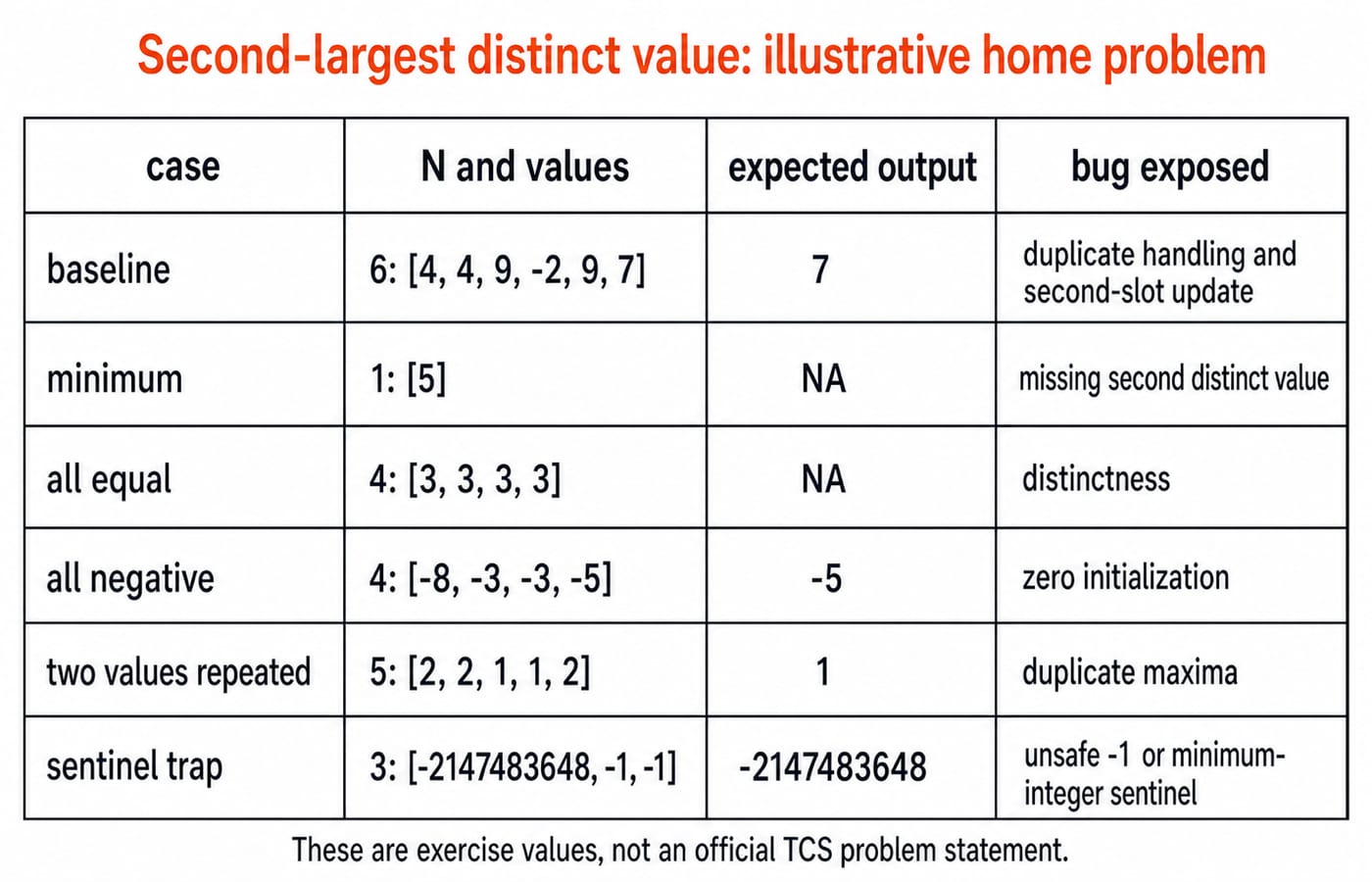
Practise with this exercise: Given N integers, print the second-largest distinct value; print NA if fewer than two distinct values exist. Set the practice constraints to 1 <= N <= 200000 and -1000000000 <= a[i] <= 1000000000. For pattern selection and implementation practice, use TCS NQT Coding Questions.
Before testing code, build an independent oracle that does not repeat the implementation logic. For N = 6 and [4, 4, 9, -2, 9, 7], the distinct values in ascending order are [-2, 4, 7, 9], so the second-largest value is 7. Use that result to judge a one-pass implementation. An output of 9 suggests duplicate handling failed; an output of 4 points to an update-order defect.
Before implementation, add five cases: N = 1, [5] -> NA; N = 4, [3, 3, 3, 3] -> NA; N = 4, [-8, -3, -3, -5] -> -5; N = 5, [2, 2, 1, 1, 2] -> 1; and N = 3, [-2147483648, -1, -1] -> -2147483648. Do not add N = 0, which violates the size bound. The sentinel trap violates the value bound, so it is only a robustness probe, not legal judge input.
3. Test the input-output contract, not only the algorithm
Wrap the exercise in multiple cases to test parsing and state reset. Here the first value is the case count, and the first array is deliberately split across lines:
2
6
4 4 9
-2 9 7
4
3 3 3 3
The exact output:
7
NA
Check three things. Whitespace-based parsing must accept the break inside the first array. Reset first and second before the second case. Print only 7 and NA on separate lines, with no Enter N, labels, or debug messages.
If case 1 leaves first = 9 and second = 7, the all-3 case may incorrectly print 7 instead of NA. Repair this with per-case initialization, then rerun both cases together. Rerunning only case 1 cannot expose stale state.
4. Probe arithmetic limits and initialization with a second worked problem
Next, find the maximum contiguous sum. For N = 4 and [1000000000, 1000000000, 1000000000, 1000000000], the answer is 4000000000. It exceeds the maximum signed 32-bit value, 2147483647, so the accumulator must be wide enough. For N = 6 and [-8, -3, -6, -2, -5, -4], the answer is -2. Initializing the best sum to 0 would invent the invalid answer 0.
Also test N = 1, [7] -> 7. For N = 5 and [4, -1, 2, 1, -7], the best segment is [4, -1, 2, 1], whose sum is 4 - 1 + 2 + 1 = 6. The running-sum and best-sum pairs are (4,4), (3,4), (5,5), (6,6), and (-1,6) before restart logic is applied.
Review every addition or multiplication whose intermediate can exceed the chosen type, not only the final variable.
5. Keep a regression card for every failure
Turn each failure into a compact record with case ID, input, expected, actual, root cause, repair, and rerun set. For example:
Field | EC-05 |
|---|---|
Input |
|
Expected |
|
Actual |
|
Root cause |
|
Repair | Track whether |
Rerun set | EC-01 through EC-06 |
After the repair, all six matrix cases must pass. Then change the values and run [-20, -5, -20, -9] -> -9 as an unseen confirmation. Passing only EC-05 is insufficient because a repair can damage duplicate handling or negative values. For more implementation work, Coding for Placements provides placement-focused coding practice, with the languages and coverage described on its course page.
6. Rehearse the final check inside a timed home solve
Run a 90-minute home drill: 8 minutes for reading, 12 for a constraint-to-case matrix, 10 for algorithm choice, 30 for implementation, 20 for testing, 5 for complexity, type, and output review, and an untouched 5-minute buffer. Check: 8 + 12 + 10 + 30 + 20 + 5 + 5 = 90. Follow the live invitation and on-screen timer if they assign a different duration.
Run six planned cases and pass five. Only [-2147483648, -1, -1] fails. Repair the sentinel handling, rerun all six, and record 6/6. Then attempt the unseen negative case from the regression section. A clean sample never closes the drill.
The Coding Round Strategy for Placements explains the broader solve-review discipline. Use the TCS NQT and Smart Hiring Test Series for timed practice. At the live assessment, follow the official instructions rather than assuming that practice-material timing or layout will match.
7. Run a 60-second gate, then stop changing stable code
Give each check 10 seconds:
Re-read the required output.
Confirm the smallest legal input.
Check legal equal, repeated, and negative values.
Verify types and per-case resets.
Confirm time and memory fit the constraints.
Run stable tests with debug output removed.
If planned tests pass, do not swap algorithms for style. Edit only for definite contract, correctness, complexity, type, or compilation problems, then rerun every regression. Under 60 seconds, remove debug output or fix an output mismatch, never attempt an untested rewrite.
Next 60 minutes: 10 copying constraints into a table, 30 solving, 15 running all six cases, and 5 recording a regression card. Use Coding for Placements for implementation or the TCS test series for timed practice. Make testing part of every submission.
Keep learning
Wipro Drive Mistakes: Stage-by-Stage Rejection Traps and Fixes
Preventable execution errors can waste solid preparation. Diagnose the risk at each Wipro drive step and replace it with a checkable habit.
25 Oct 20265 min readCompany-Specific Prep

HCLTech Recruitment Process and Test Pattern: Build Your Drive Map
Build a source-controlled HCLTech drive map from the current role page and invitation, then use worked diagnostics to prepare for each assigned stage.
Updated 23 Oct 20265 min readCompany-Specific Prep
Capgemini Coding Questions: 4 Patterns with Step-by-Step Solutions
Learn four transferable coding patterns through constructed Capgemini preparation examples. Each solution includes an invariant, complete trace, complexity and edge-case checks.
Updated 19 Oct 20266 min readCompany-Specific Prep

Capgemini Placement Preparation: An 8-Week Test-Matched Study Plan
Build an eight-week Capgemini preparation timetable from the route you are actually invited to take. Use two baselines and an error log to decide where every study hour goes.
Updated 15 Oct 20265 min readCompany-Specific Prep