TCS Placement Preparation: A 6-Week Plan Built Around Test Sections
Turn one self-made diagnostic into a six-week TCS study calendar that gives extra time to slow sections, incomplete coding and evidence-led mock repair.
KnowledgeGate Team
Exam prep & CS education
Updated 12 Aug 20266 min read
Dividing study time equally feels organised, but it ignores the fact that your accuracy and speed are unequal. Six weeks at fourteen hours is eighty-four hours, and one diagnostic decides the split: your slow section and your unfinished coding take hours away from whatever you are already quick at. Before allocating anything, copy the current sections, timing and navigation rules from your own TCS invitation or official test portal, because those instructions control your drive.
1. Confirm the current test map, then diagnose your starting point
Make a one-page map with these columns:
Section name | Time available | Question or task type | Navigation rule | Tools or languages allowed |
|---|
Fill it only from your current official communication. Preparation divides into five buckets: numerical ability, reasoning ability, verbal ability, an advanced aptitude layer (our TCS course splits it into Advanced Quantitative Ability and Advanced Reasoning Ability), and coding. Build all five, and let your invitation decide which of them your drive scores. The TCS NQT exam-structure explainer walks through what each section tests.
Take a 90-minute baseline you build yourself: 10 numerical + 10 reasoning + 10 verbal + 2 coding tasks. Learner A records numerical 6 attempted, 5 correct, 25 minutes; reasoning 8 attempted, 6 correct, 22 minutes; verbal 9 attempted, 8 correct, 18 minutes; and coding 1 of 2 tasks passing all tests, 25 minutes.
For the MCQs, attempts are 6 + 8 + 9 = 23 and correct answers are 5 + 6 + 8 = 19. Attempted-question accuracy is 19 / 23 x 100 = 82.6%. Verbal is stronger and faster. Numerical is slow, while coding is incomplete, so both deserve more hours than verbal.
2. Convert that diagnostic into an honest 84-hour calendar
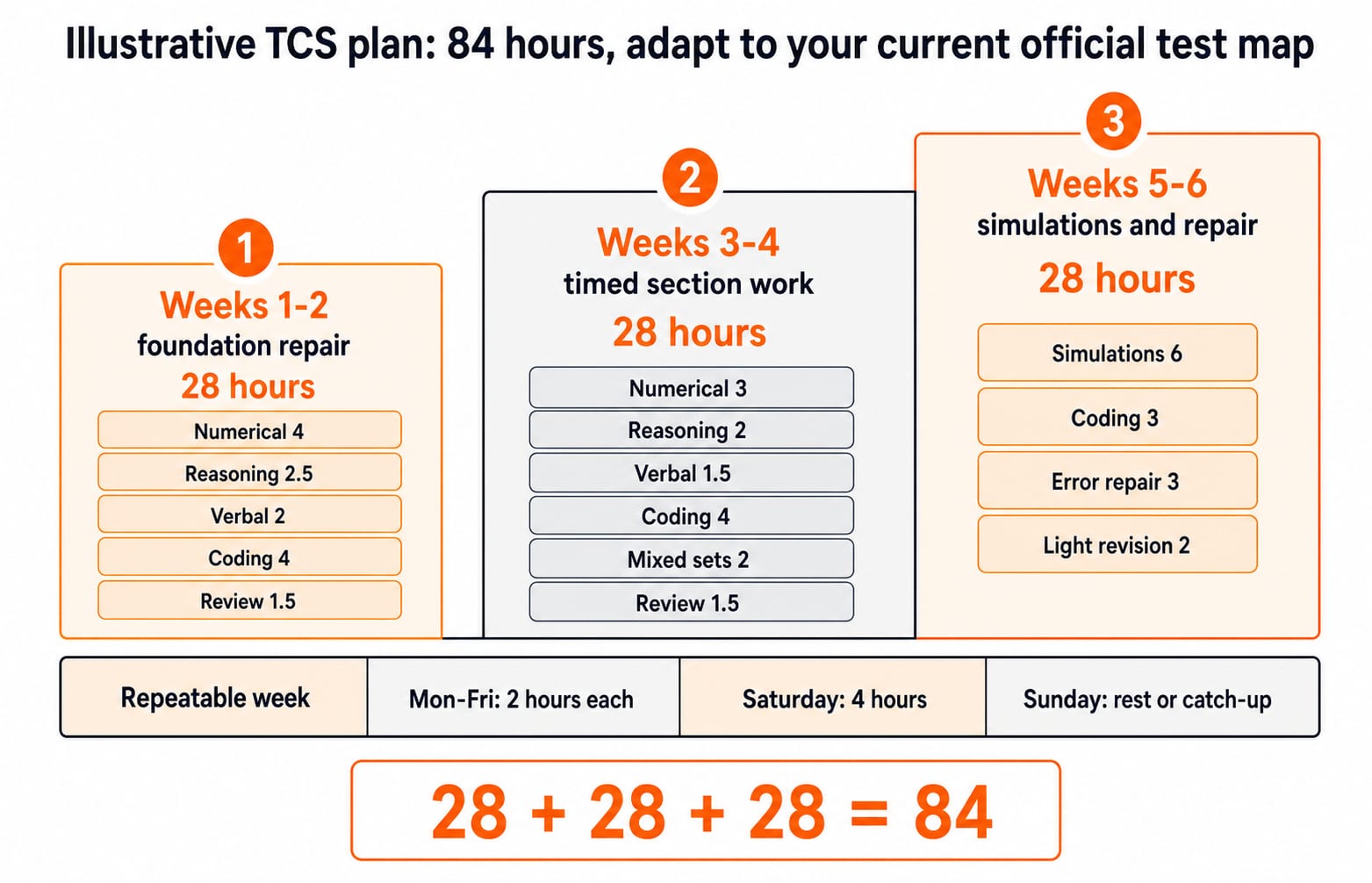
Use 6 weeks x 14 hours = 84 hours. Monday to Friday gives 2 hours per day x 5 = 10 hours, Saturday gives 4 hours, and Sunday stays free for rest or catch-up.
Phase | Weekly allocation | Weekly total |
|---|---|---|
Weeks 1-2 | Numerical 4, reasoning 2.5, verbal 2, coding 4, review 1.5 | 14 hours |
Weeks 3-4 | Numerical 3, reasoning 2, verbal 1.5, coding 4, timed mixed sets 2, review 1.5 | 14 hours |
Weeks 5-6 | Official-rule-matched simulations 6, coding 3, error repair 3, light revision 2 | 14 hours |
Each two-week phase therefore gets 2 x 14 = 28 hours, and 28 + 28 + 28 = 84 hours.
Advanced aptitude gets no separate line because it is not a separate skill: it is the longer, multi-step end of numerical and reasoning. It sits inside the numerical hours in Weeks 1 and 2, moves into the timed mixed sets from Week 3, and by Weeks 5 and 6 turns up in the simulations without special handling.
If Wednesday's two hours disappear, recover at most one hour on Sunday. Move the other hour by dropping a repeated easy drill, not by turning Thursday into a four-hour session. If two days are missed, preserve coding, the weakest section and review first. Reduce breadth before reducing sleep.
3. Weeks 1 and 2: repair concepts with short worked sets
Give every 25-minute block the same shape: 8 minutes concept recall + 12 minutes worked questions + 5 minutes error note.
For numerical practice, A completes a task in 12 days and B in 18 days. Their combined rate is 1/12 + 1/18 = 3/36 + 2/36 = 5/36 task per day. The time together is 36/5 = 7.2 days.
For reasoning, in 3, 8, 15, 24, 35, differences are 5, 7, 9, 11. The next difference is 13, so the next term is 35 + 13 = 48.
For verbal practice: Neither the manager nor the trainees were ready. In this drill, the verb agrees with the nearer subject. Trainees is plural, so were is intended.
KnowledgeGate has over 22,000 published practice questions across Mathematics and Aptitude, Reasoning and Verbal Ability combined. Those pools cover the whole of each subject, so selection is where the hours are won or lost: start from the TCS placement-preparation category and then keep only the question types on your test map.
4. Weeks 3 and 4: turn correct methods into timed decisions
Run a three-day loop. Day 1 is a timed section set. Day 2 repairs every error without a clock. Day 3 repeats the same skill in a fresh timed set.
The first set produces 14 attempted in 25 minutes, 11 correct, or 11 / 14 x 100 = 78.6% accuracy. A comparable second set produces 16 attempted in 20 minutes, 14 correct, or 14 / 16 x 100 = 87.5%. That is two more attempts, three more correct answers, five fewer minutes and an 87.5 - 78.6 = 8.9 percentage-point gain. Compare only sets of the same difficulty, otherwise that gain is measuring the paper rather than you.
Keep fixed error-log rows such as:
Item | Error | Next action |
|---|---|---|
Q7 | Percentage concept | Re-learn base value |
Q12 | Arithmetic slip | Write one intermediate line |
Q18 | Stayed too long | Apply the 90-second review trigger in this practice set |
The following day must include one untimed repair question and two timed variants for every recurring error.
5. Keep coding practice test-shaped, not tutorial-shaped
Use a 45-minute coding block: 5 minutes restate input and output + 25 minutes implement + 10 minutes test + 5 minutes record the failure.
For input [4, -1, 2, 1, -5, 4], find the maximum contiguous sum. A linear scan gives running sums 4, 3, 5, 6, 1, 5 and best values 4, 4, 5, 6, 6, 6. The output is 6, from [4, -1, 2, 1]. Also test [-3, -2, -5] -> -2 and [7] -> 7. Resetting the answer to zero would wrongly treat an empty subarray as best and return 0 for the all-negative input.
In Week 1, write correct solutions without a clock. In Week 2, add edge cases. During Weeks 3 and 4, solve mixed tasks within 45 minutes. In Weeks 5 and 6, reproduce the exact language and input-output conditions stated in your current official instructions. If you would rather not build this progression yourself, the TCS Preparation Live Course runs the same progression with the problems already chosen.
6. Weeks 5 and 6: simulate, analyse, then repair
Run two full simulations each week, copying the timing, order, navigation and coding rules from your current official communication. Analyse each one in the next block.
Use a self-made 30-MCQ + 2-coding-task scorecard. Mock 1 has 26 attempted, 22 correct, 4 wrong, so accuracy is 22 / 26 x 100 = 84.6%; 1 of 2 coding tasks is complete. Mock 2 has 28 attempted, 25 correct, 3 wrong, so accuracy is 25 / 28 x 100 = 89.3%; 2 of 2 coding tasks are complete. Read both movements together: accuracy up 4.7 points and coding finished rather than half-done. Either alone is within one mock's noise.
Mock 1 shows 12 minutes spent on two numerical questions that ended wrong. A 90-second first-pass cap would use 2 x 1.5 = 3 minutes, potentially releasing 12 - 3 = 9 minutes. Mock 2 should record whether those nine minutes reached coding. A first-pass cap needs an interface that lets you leave a question and return, so settle that from the navigation-rule column of your test map.
Sourcing two fresh simulations a week is the hard part. The TCS NQT and Smart Hiring Test Series supplies ready-made sets, which leaves your hours for the analysis instead of the assembly.
7. The short version when a week goes wrong
For a disrupted day, use 30 minutes coding + 20 minutes weakest-section questions + 10 minutes error-log review = 60 minutes. For a disrupted week, retain one simulation, two coding blocks and three weakest-section blocks. Do not double hours.
Confirm the live test map, diagnose, favour the slow section and the unfinished coding, practise under a clock, and analyse every mock. Save the section map beside the 84-hour calendar, take the baseline diagnostic this week, then open the TCS category or the live course only for the gaps your own evidence has named.
Keep learning
Accenture Coding Questions: 4 Patterns with Solved Dry Runs
Stop memorising company-question lists. Learn four reusable coding patterns through precise examples involving strings, arrays, digits, and matrices.
Updated 2 Oct 20265 min readCompany-Specific Prep
Accenture Placement Preparation: 4-Week, 56-Hour Study Plan
Turn four preparation lanes into a practical weekly calendar. Start with a baseline, move hours towards your errors, and recover missed sessions without cramming.
Updated 27 Sep 20265 min readCompany-Specific Prep
Capgemini Interview Questions: Technical and HR Rounds with Model Answers
Practise clear technical and HR answers through Java, SQL, a coding trace and one consistent project story. Each example shows what to say and how to support it.
Updated 25 Sep 20265 min readCompany-Specific Prep
Capgemini Drive Mistakes: Stage-by-Stage Rejection Risks and Fixes
Diagnose the controllable evidence gaps behind common Capgemini drive risks. Repair your CV, timed practice, code traces, project proof and behavioural stories with worked drills.
Updated 24 Sep 20266 min readCompany-Specific Prep