

LTIMindtree Placement Preparation: A 4-Week Section-Wise Study Plan
Start with a diagnostic, turn your errors into a weekly timetable, and use four focused weeks for aptitude, coding, CS fundamentals, communication and interview practice.
KnowledgeGate Team
Exam prep & CS education
Updated 6 Nov 20266 min read

Candidates often collect a large placement syllabus but cannot decide how many hours aptitude, coding, CS fundamentals, communication and interviews deserve. This four-week, 64-hour plan turns the verified course-page curriculum into weekly work. It is a preparation model, not a claim that every LTIMindtree drive uses one fixed pattern. Replace or reorder any bucket when your current official drive email or job posting lists different components.
Build the study map from the current drive notice and course curriculum
The LTI Mindtree Superset Course covers Quantitative Ability, Logical Ability, Verbal Ability, Basic Analytical Ability, Coding, Pseudocode and Debugging, OOPs, DBMS, SQL, OS, Computer Networks, Data Structures, Software Engineering, Communication Assessment and HR Interview.
Collapse these 15 headings into six buckets: quantitative; logical plus basic analytical; verbal; coding plus pseudocode; core CS, covering OOPs, DBMS, SQL, OS, networks, data structures and software engineering; and communication plus interview.
First copy only the components in your current drive communication. Check the LTIMindtree careers page alongside your invite for the current company source. Its order, duration, counts, marks and negative marking control your mocks when supplied. Otherwise, retain the six buckets without inventing specifics. Use All Courses for comparison, not pattern inference.
The earlier Cognizant Placement Preparation: A 4-Week Pattern-Matched Study Plan owns an invitation-first route card and a 54-hour communication-heavy schedule. The six-bucket, 64-hour allocation below maps directly to the LTI Mindtree Superset Course.
Run a 90-minute diagnostic before allocating time
Build this self-made diagnostic:
60 minutes: 50 objective questions, split into 10 quantitative, 8 logical or analytical, 6 verbal, 8 coding or pseudocode, and 18 core CS. Split core CS into 2 OOPs, 4 DBMS or SQL, 4 OS, 4 networks, 2 data structures and 2 software engineering.20 minutes: one coding problem.10 minutes: record and review one 90-second introduction.
For section results of 6/10, 7/8, 5/6, 4/8 and 10/18:
6 + 7 + 5 + 4 + 10 = 32/50 = 64%
Keep coding separate at 3/5, judged on correctness, edge cases, complexity, explanation and testing. Keep the introduction separate at 4/5, judged on structure, truthfulness, evidence, clarity and timing. Combining unlike rubrics creates a false company score.
For the sample error pattern, allocate Week 1 as core CS 4 hours, coding or pseudocode 3, quantitative 2.5, logical or analytical 1, verbal 0.5, communication or interview 1, and timed testing plus review 4:
4 + 3 + 2.5 + 1 + 0.5 + 1 + 4 = 16 hours
Protect a 16-hour weekly budget and set a missed-day rule
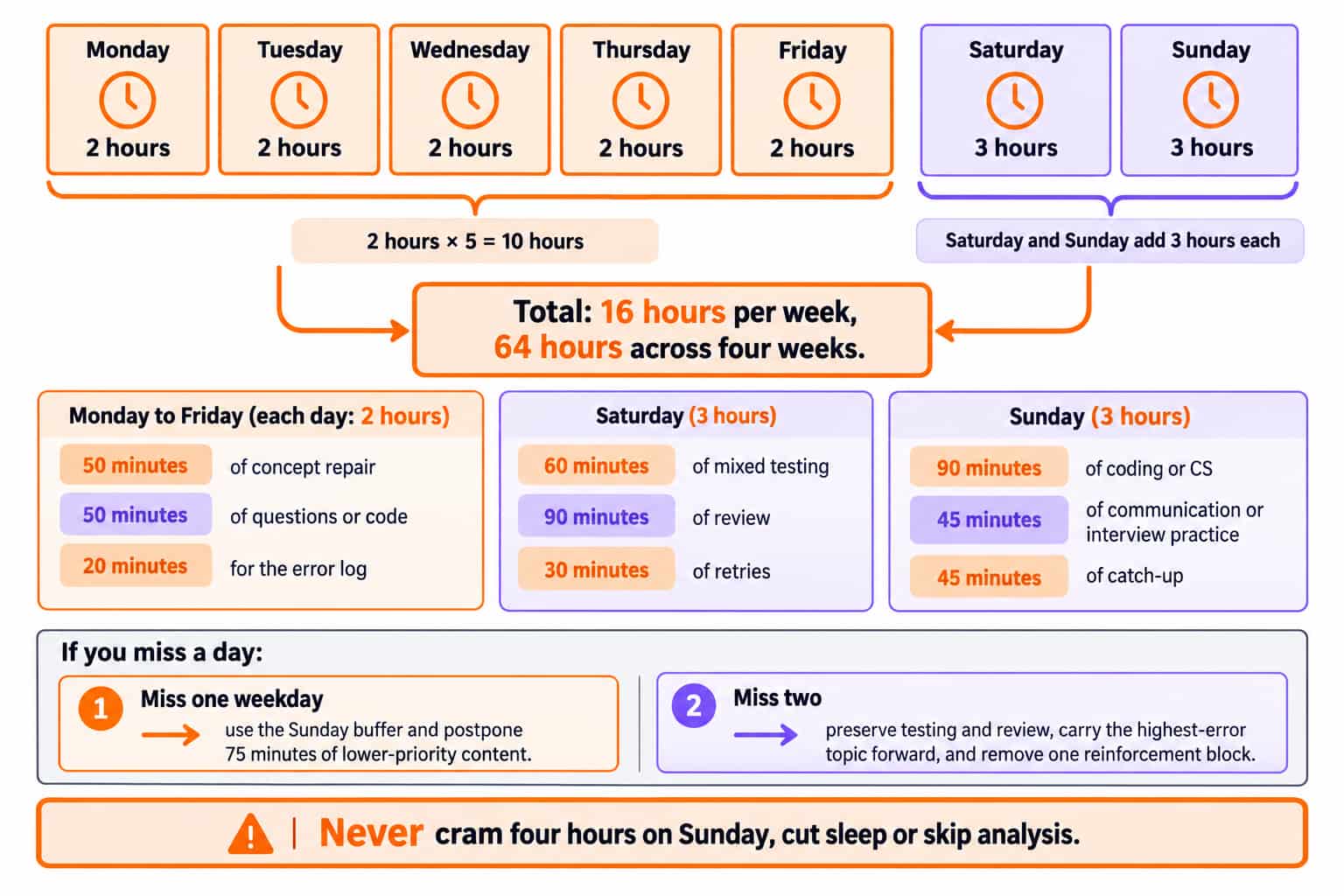
Monday to Friday gives 2 hours × 5 = 10 hours; Saturday and Sunday add 3 hours each. Total: 16 hours per week, 64 hours across four weeks.
A weekday has 50 minutes of concept repair, 50 minutes of questions or code, and 20 minutes for the error log. Saturday has 60 minutes of mixed testing, 90 minutes of review and 30 minutes of retries. Sunday has 90 minutes of coding or CS, 45 minutes of communication or interview practice, and 45 minutes of catch-up.
Miss one weekday, use the Sunday buffer and postpone 75 minutes of lower-priority content. Miss two, preserve testing and review, carry the highest-error topic forward, and remove one reinforcement block. Never cram four hours on Sunday, cut sleep or skip analysis. The TCS Placement Preparation: A 6-Week Plan Built Around Test Sections owns an 84-hour, five-bucket calendar; keep this LTIMindtree schedule tied to your current invite and six course buckets.
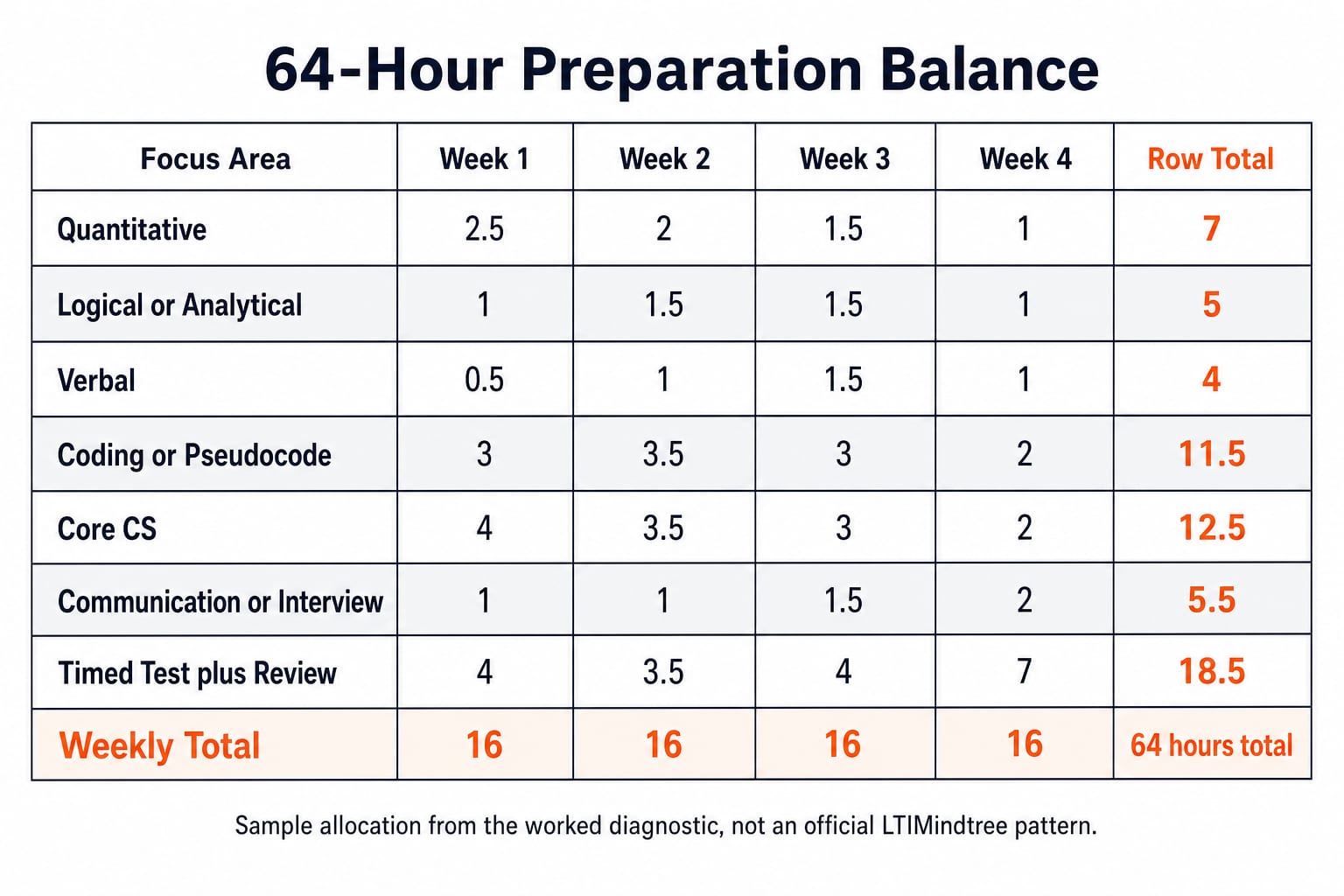
Week 1: repair aptitude accuracy and establish one coding language
Use the Week 1 hours shown in the matrix. Repair only diagnosed quantitative topics, one logical family and the exact verbal error.
A value starts at 500, rises 20% to 500 × 1.20 = 600, then falls 20% to 600 × 0.80 = 480. Change: 480 - 500 = -20. Net percentage: -20/500 × 100 = -4%.
Record: successive percentages | assumed +20% and -20% cancel | redo 8 base-change questions.
Choose one coding language. Finish one array problem, one string problem and four pseudocode traces without notes, then retake Week 1 errors.
Week 2: make coding traces and core-CS answers executable
Give coding or pseudocode 3.5 hours and core CS 3.5 hours. A coding block needs one dry run, one implementation and three edge cases. For each CS subject, make a card with definition, mechanism, example and contrast.
Trace sum = 0; for i = 1 through 4, add 2*i if even, otherwise i. States: i=1, sum=1; i=2, sum=5; i=3, sum=8; i=4, sum=16. Output: 16. Both endpoints count; the even branch adds 4, then 8.
Give six 60-second answers on encapsulation, normalisation, process versus thread, TCP versus UDP, stack versus queue, and black-box versus white-box testing. A weak answer earns a 30-minute concept-and-question repair.
Week 3: convert topic practice into timed mixed performance
Run a self-made 50-question mock in 60 minutes: 35 for confident questions, 15 for flagged ones and 10 for checks. Use displayed drive rules when available. Do not guess before seeing the marking rule.
Suppose 40/50 are attempted, 34 correct, 6 wrong and 10 unattempted. Attempt accuracy is 34/40 × 100 = 85%; coverage is 40/50 × 100 = 80%. 34/50 is not attempt accuracy.
Classify the six errors as 2 concept gaps, 2 misreads and 2 time-pressure errors. Schedule two 30-minute concept repairs, 10 slow-reading questions and one 15-minute speed drill, then retry all six without answers.
Record four 90-second responses: 15 seconds for the point, 55 for one reason with truthful evidence, and 20 for the conclusion.
The scheduled Tech Mahindra Placement Preparation: A 6-Week, 72-Hour Study Plan owns a six-week frequency map and coding drill route. The LTIMindtree route here remains a four-week, 64-hour schedule built from six LTI Mindtree course buckets.
Week 4: simulate, review and narrow the final revision list
Allocate quantitative 1 hour, logical or analytical 1, verbal 1, coding or pseudocode 2, core CS 2, communication or interview 2, and simulation plus review 7.
Complete two practice simulations. Each uses 60 minutes for objective questions, 30 for coding and 10 for communication: 100 minutes × 2 = 200 minutes. Review each for 90 minutes: 90 × 2 = 180 minutes. Spend 40 minutes checking the current invite, portal, device, network, identification and resume.
200 + 180 + 40 = 420 minutes = 7 hours
These timings are illustrative; official drive timings replace them. In the last two days, revise only the error log, failed edge cases, six CS cards and four recordings. If simulation two repeats a concept error, replace a low-priority revision block instead of adding hours.
The short version: diagnose, allocate, practise, review and repeat
Map the live invite to six buckets, run the diagnostic, protect 16 weekly hours, prioritise measured errors, and review every timed set. The 64-hour matrix is a starting point, not an official fixed pattern.
For aptitude, coding, resume and interview work together, keep the LTI Mindtree course map as the next step. Take the diagnostic today, allocate Week 1 from actual misses, and schedule the first 60-minute mixed test before opening more material.
Keep learning
Capgemini Placement Preparation: An 8-Week Test-Matched Study Plan
Build an eight-week Capgemini preparation timetable from the route you are actually invited to take. Use two baselines and an error log to decide where every study hour goes.
Updated 30 Oct 20265 min readCompany-Specific Prep
Cognizant Placement Preparation: A 4-Week Pattern-Matched Study Plan
Build a pattern card from your current Cognizant communication, diagnose your gaps, and allocate four weeks by evidence. The plan includes simulations, error review, interview practice, and a missed-day rule.
Updated 30 Oct 20265 min readCompany-Specific Prep

TCS Placement Preparation: A 6-Week Plan Built Around Test Sections
Turn one self-made diagnostic into a six-week TCS study calendar that gives extra time to slow sections, incomplete coding and evidence-led mock repair.
Updated 30 Oct 20266 min readCompany-Specific Prep
Tech Mahindra Placement Preparation: A 6-Week, 72-Hour Study Plan
Build a realistic Tech Mahindra placement routine from a 90-minute audit, then use a fixed 12-hour weekly ceiling, worked drills and an error ledger to improve without copying an outdated pattern.
Updated 1 Nov 20265 min readCompany-Specific Prep