Capgemini Placement Preparation: An 8-Week Test-Matched Study Plan
Build an eight-week Capgemini preparation timetable from the route you are actually invited to take. Use two baselines and an error log to decide where every study hour goes.
KnowledgeGate Team
Exam prep & CS education
Updated 15 Oct 20265 min read
Most Capgemini plans fail because they copy a static pattern, divide time equally, and keep solving fresh sets without letting errors change the next week. This eight-week system starts with your current official invite, measures a baseline, fixes a weekly time budget, and adapts after every review. It also survives a missed study day. The Company-Specific Placement Courses page lists company-focused preparation routes.
1. Start with the current Capgemini invite, then build the test map
Build a route card from official candidate material. Copy seven fields:
role or route
sections listed
section order
stated duration
question or task rules
platform or device instructions
assessment date or window
An unstated value stays UNKNOWN. In a constructed audit, role, sections, duration, platform instructions, and assessment window are filled, but order and question rules are not. Readiness is 5/7. Recheck communication or ask the authorised recruiter or support channel, never guess from an old post.
Use the broader Capgemini placement map to organise lanes, not override the route card.
Scope note: Current official Capgemini material controls sections, order, duration, rules, dates, and platform requirements. The scores, schedules, course links, and question-bank counts below are planning or practice inputs, not Capgemini cutoffs, selection forecasts, or evidence of live assessment content.
2. Take one baseline and separate accuracy, completion and error type
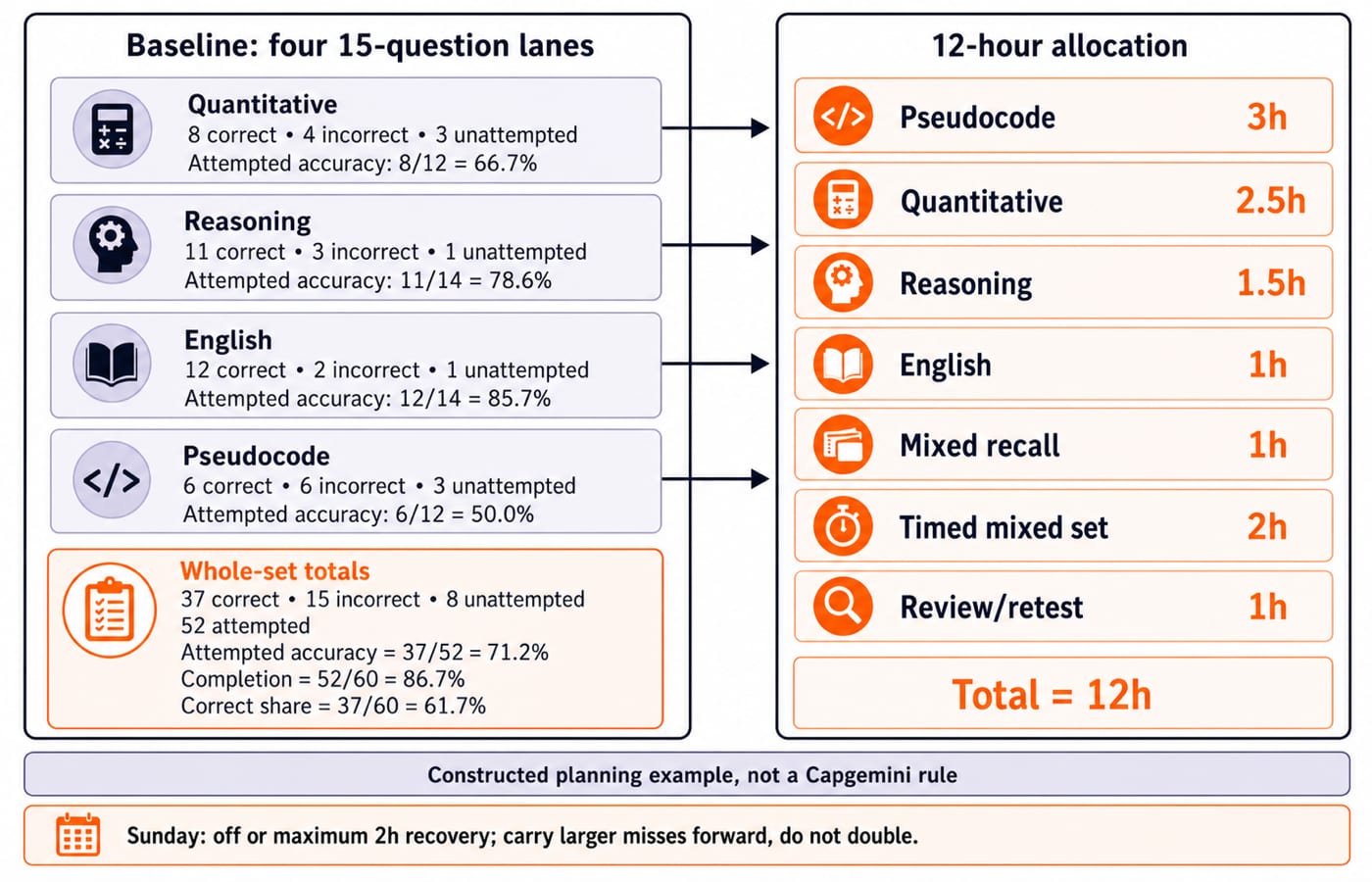
After confirming needed skills, take a constructed 60-question diagnostic in four equal lanes.
Practice lane | Correct | Incorrect | Unattempted | Attempted accuracy |
|---|---|---|---|---|
Quantitative aptitude | 8 | 4 | 3 |
|
Logical reasoning | 11 | 3 | 1 |
|
English | 12 | 2 | 1 |
|
Pseudocode | 6 | 6 | 3 |
|
Totals are correct 8 + 11 + 12 + 6 = 37; incorrect 4 + 3 + 2 + 6 = 15; unattempted 3 + 1 + 1 + 3 = 8; attempted 37 + 15 = 52.
Attempted accuracy:
37/52 × 100 = 71.2%Completion:
52/60 × 100 = 86.7%Correct share of the full set:
37/60 × 100 = 61.7%
Tag the 15 errors: 6 concept gaps, 4 misread conditions, 3 calculation or trace slips, and 2 poor-selection errors. Let evidence decide allocation.
3. Convert the baseline into a 12-hour weekly timetable
Study six days, with Sunday off or as a buffer. The scalable ceiling is 12 hours × 8 weeks = 96 hours, though Week 8 tapers.
Week 1 gives pseudocode 3 hours, quantitative 2.5, reasoning 1.5, English 1, mixed recall 1, timed work 2, and review plus retest 1. Check: 3 + 2.5 + 1.5 + 1 + 1 + 2 + 1 = 12 hours.
Day | Calendar block |
|---|---|
Monday | 2 hours pseudocode |
Tuesday | 1.5 hours quantitative aptitude |
Wednesday | 1.5 hours logical reasoning |
Thursday | 1 hour English + 1 hour mixed recall |
Friday | 1 hour pseudocode + 1 hour quantitative aptitude |
Saturday | 2-hour timed set + 1-hour review |
Sunday | Off, or up to 2 hours replacing missed work |
Sunday replaces missed work. Carry losses beyond two hours forward, drop a lower-priority fresh set, and never double tomorrow's load.
4. Weeks 1 and 2: repair weak foundations before chasing speed
Week 1 produces a completed 7-field route card, the 60-question baseline, and an error log covering all 15 wrong answers and their causes. Re-solve each one untimed within 48 hours. Compare the method, not only the answer.
In Week 2, keep 12 hours: 30 quantitative questions in three sets of 10, 24 reasoning questions in three sets of 8, 20 English sentence items plus 2 short passages, and 6 pseudocode traces plus 2 coding problems. Review every attempt. Remove an omitted lane and move its time to listed skills.
The Capgemini Superset course is an optional company-focused video and practice route. The Aptitude for Placement course offers structured aptitude, reasoning, and verbal work.
5. Weeks 3 to 5: add timing, retest and reallocate
In Week 3, time half of each lane and keep half untimed for repair. Follow current instructions. Otherwise, record total elapsed time without inventing a limit. The 30-day aptitude practice routine adds a speed-and-review method.
In Week 4, repeat the 15 + 15 + 15 + 15 diagnostic. Quantitative 11/15, reasoning 12/15, English 13/15, and pseudocode 10/15 total 11 + 12 + 13 + 10 = 46, or 46/60 × 100 = 76.7%. Against 37/60 × 100 = 61.7%, that is 9 more correct and 76.7 - 61.7 = 15.0 points gained.
In Week 5, give 9 skill hours to quantitative 2, reasoning 1.5, English 1, pseudocode 2.5, and mixed retrieval 2. Check: 2 + 1.5 + 1 + 2.5 + 2 = 9. Add 2 hours timed and 1 review, so 9 + 2 + 1 = 12 hours. Use the 150+ published Capgemini-tagged questions for extra practice.
6. Weeks 6 and 7: simulate the route and prepare the next conversation
In Week 6, use 4 hours for official-format simulation and review, 6 for the two weakest lanes, and 2 for error-log retests. Check: 4 + 6 + 2 = 12 hours. Match timer, order, breaks, and tools to current instructions. If one run needs four hours, do not force two.
In Week 7, keep 6 hours for written-test maintenance. Only if your route confirms an interview or technical conversation, use the other 6 for 3 hours tracing and explaining aloud, 2 building truthful project evidence cards, and 1 rehearsing concise HR responses. Otherwise, retain all 12 hours for the confirmed assessment.
Use the Capgemini technical interview guide as a rehearsal map. Make three evidence cards with problem, my action, measured result, validation, and trade-off. Use only your own evidence.
7. Week 8: taper the workload, recover and verify logistics
Reduce study from 12 hours to 8: 3 for weak-lane recall, 2 for one early final simulation, 2 to review it, and 1 to verify assessment details. Check: 3 + 2 + 2 + 1 = 8 hours. The released 4 hours are for recovery, not new topics.
Recheck the seven fields. Never assume check-in time, documents, browser, device, or retest rules. If the assessment is not due in Week 8, repeat Week 5. If a day is lost, recover at most two Sunday hours and carry the rest forward.
8. Capgemini placement preparation in the short version
Copy the official route first. Separate accuracy from completion. Prioritise the worst error-log lane. Retest each phase. Taper only near the assessment.
In this constructed plan, the baseline moved from 37/60 = 61.7% to 46/60 = 76.7%, so the next allocation changed instead of remaining equal.
Today, fill the seven-field route card, sit one honest baseline, classify every wrong answer, and place the resulting 12 hours across your next six study days.
Keep learning
Capgemini Coding Questions: 4 Patterns with Step-by-Step Solutions
Learn four transferable coding patterns through constructed Capgemini preparation examples. Each solution includes an invariant, complete trace, complexity and edge-case checks.
Updated 19 Oct 20266 min readCompany-Specific Prep
Cognizant Recruitment Process and Test Pattern: What Each Stage Screens
Learn how to read a Cognizant drive invitation, map each possible stage to the skill it screens, and turn the stated test blocks into a focused study plan.
Updated 11 Oct 20265 min readCompany-Specific Prep
Accenture Recruitment Process and Test Pattern: Verify Every Stage
Build a personal stage map from the current Accenture role page and invitation. The guide includes worked checks for timing, application data, pacing, coding and mock repair.
Updated 7 Oct 20265 min readCompany-Specific Prep
Accenture Coding Questions: 4 Patterns with Solved Dry Runs
Stop memorising company-question lists. Learn four reusable coding patterns through precise examples involving strings, arrays, digits, and matrices.
Updated 2 Oct 20265 min read50 viewsCompany-Specific Prep