

Tech Mahindra Placement Preparation: A 6-Week, 72-Hour Study Plan
Build a realistic Tech Mahindra placement routine from a 90-minute audit, then use a fixed 12-hour weekly ceiling, worked drills and an error ledger to improve without copying an outdated pattern.
KnowledgeGate Team
Exam prep & CS education
Updated 1 Nov 20265 min read
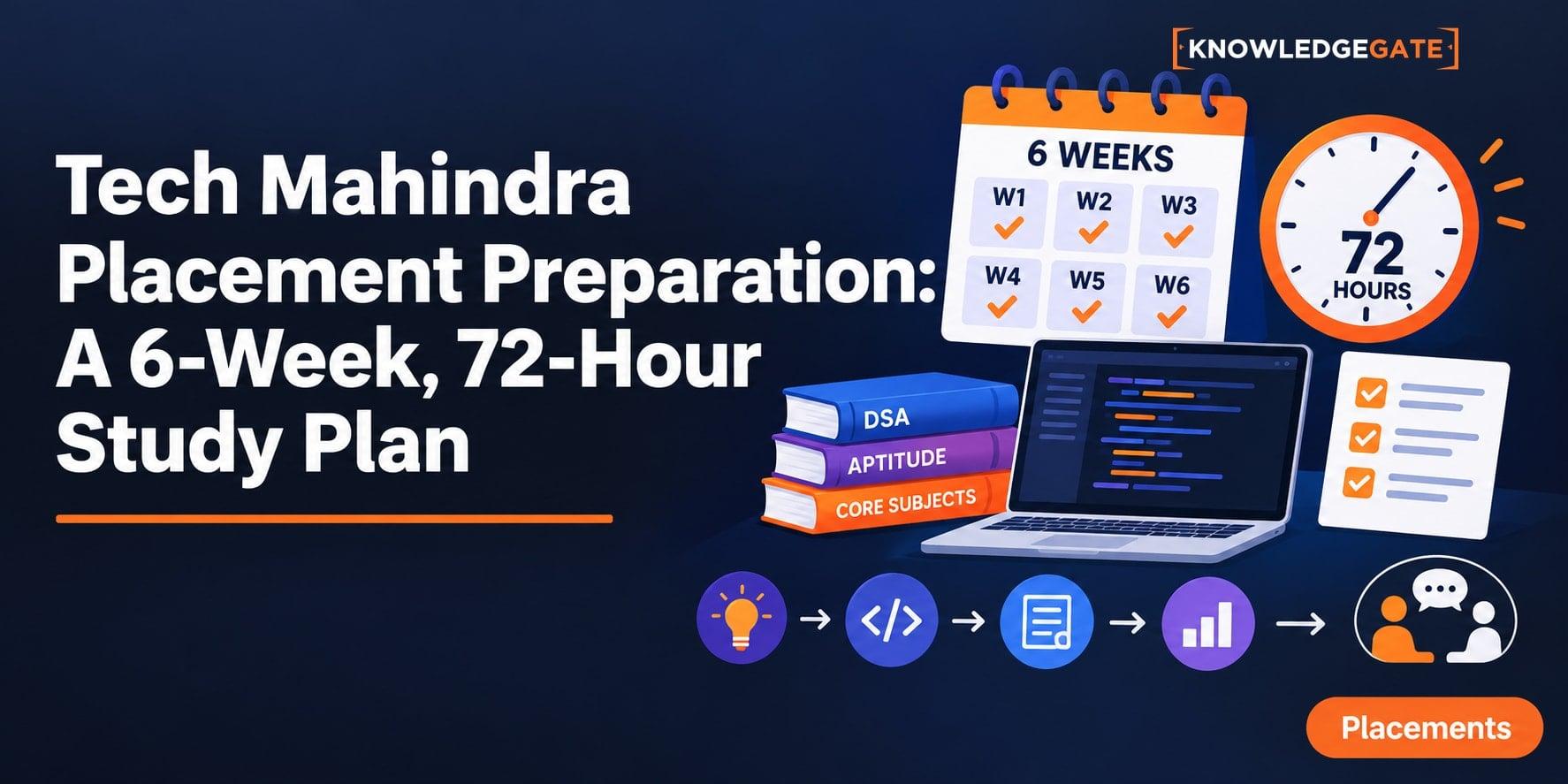
A Tech Mahindra drive may be close, but an old test pattern can waste hours when the current invitation uses different stages or labels. Use the invitation as a route card: reserve 12 hours per week and 72 hours overall across aptitude, reasoning, verbal, coding, CS and timed review. Map the job post, invitation and assessment screen to those buckets, then apply the recovery rule when a session is missed.
Tech Mahindra placement preparation starts with a 90-minute audit
Start at Tech Mahindra Careers, then read the current job post, invitation and assessment screen. These control stage and section labels, question counts, timers, scoring, navigation and permitted tools. Every number is self-made practice; topics are transferable coverage, not a Tech Mahindra syllabus. Copy six fields: role or job reference, stage names, listed sections, timer structure, scoring or negative marking, and navigation, language or tool rules. Write not stated for an absent field.
Run a self-made 90-minute baseline: 10 quantitative, 10 reasoning, 10 verbal and 10 CS MCQs, then a coding task with eight visible cases. Record 6/10 quantitative, 8/10 reasoning, 7/10 verbal, 5/10 CS and 4/8 coding cases. The MCQ result is 26/40 = 65%; coding completion is 4/8 = 50%. Repair coding, CS and quantitative first. Placement Preparation Courses for IT Jobs maps broad preparation. Tech Mahindra aptitude questions: build a safe topic map first owns topic drills; the 72-hour route card owns invitation-first allocation and recovery. Wipro Interview Process: 3 Stages and a 14-Hour Plan owns stage-by-stage interview rehearsal; use it after the pre-assessment plan.
Tech Mahindra 6-week study plan: allocate all 72 hours before choosing topics
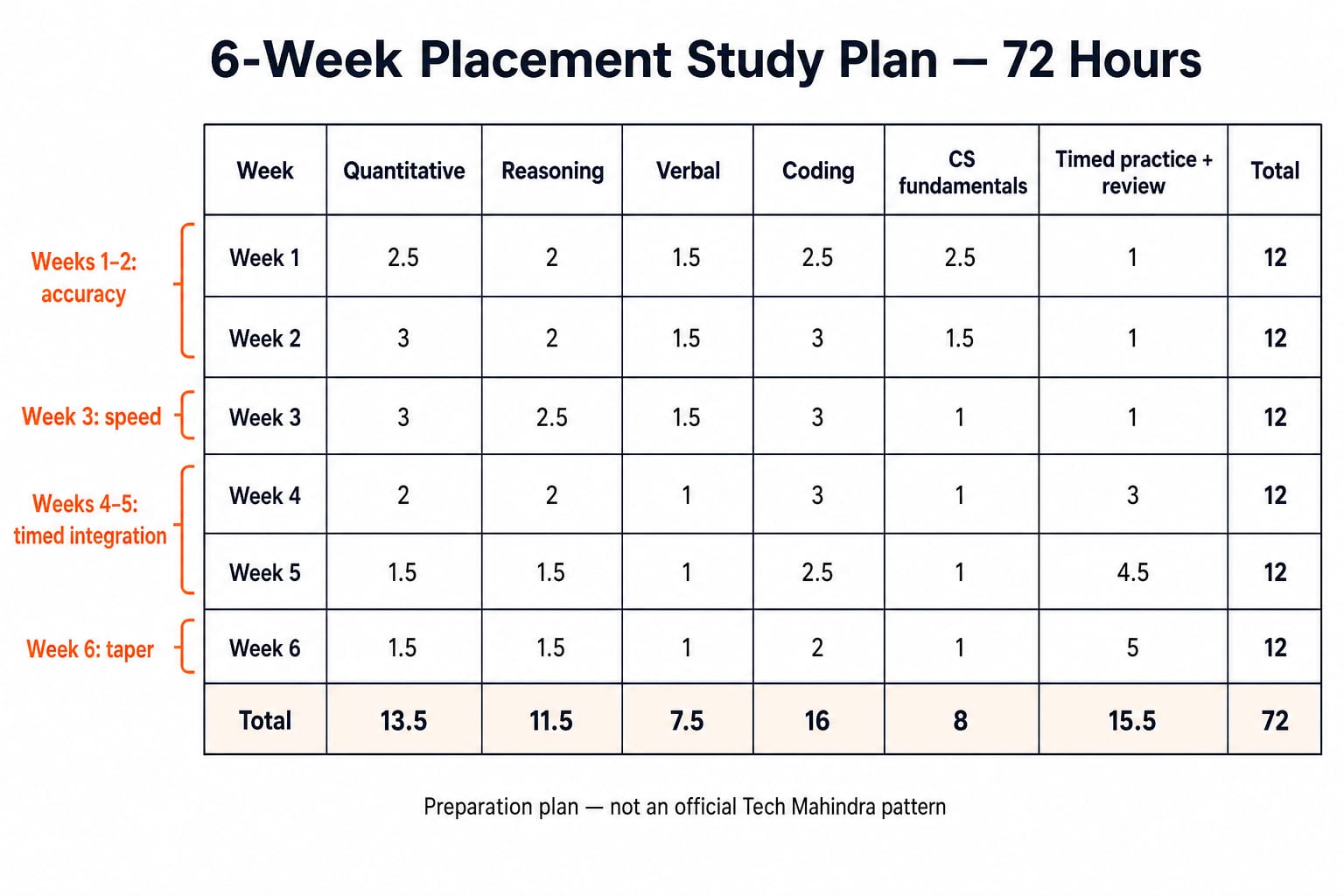
The table reserves 72 hours across six weeks; each cell is a study-hour commitment.
Week and focus | Quantitative | Reasoning | Verbal | Coding | CS fundamentals | Timed practice + review | Total |
|---|---|---|---|---|---|---|---|
Week 1: audit and repair basics | 2.5 | 2 | 1.5 | 2.5 | 2.5 | 1 | 12 |
Week 2: build accurate methods | 3 | 2 | 1.5 | 3 | 1.5 | 1 | 12 |
Week 3: add speed | 3 | 2.5 | 1.5 | 3 | 1 | 1 | 12 |
Week 4: mix sections under time | 2 | 2 | 1 | 3 | 1 | 3 | 12 |
Week 5: simulate and repair | 1.5 | 1.5 | 1 | 2.5 | 1 | 4.5 | 12 |
Week 6: taper and verify | 1.5 | 1.5 | 1 | 2 | 1 | 5 | 12 |
Six-week total | 13.5 | 11.5 | 7.5 | 16 | 8 | 15.5 | 72 |
Weeks 1 and 2 favour correct methods. Week 3 adds controlled speed, Weeks 4 and 5 move time into timed integration, and Week 6 stops syllabus expansion. Keep the ceiling at 12 honest hours instead of planning an imaginary 20-hour week.
Treat the six columns as a starting route card. Once the invitation supplies exact section labels, keep the named buckets and transfer any omitted bucket's remaining hours to the weakest named section, recording the change in your plan.
Aptitude, reasoning and verbal practice: spend 32.5 hours on measured weaknesses
The plan assigns 13.5 quantitative + 11.5 reasoning + 7.5 verbal = 32.5 hours. Practise arithmetic, ratios, percentages and data interpretation in quantitative blocks; series, arrangements and deduction in reasoning blocks; and comprehension, sentence correction and concise communication in verbal blocks. Use the buckets to choose the next drill, not an old company pattern. Aptitude for Placement provides a structured route across all three.
For one timed mixed set, attempt 30 questions in 45 minutes and record 21 correct, 6 wrong and 3 unattempted. The 21 + 6 = 27 attempts give 21/27 x 100 = 77.78% accuracy. Average time per attempt is 45/27 = 1.67 minutes, or about 100 seconds. Do not derive a marks score without a stated marking rule.
Classify the six errors: 2 concept, 2 setup, 1 arithmetic and 1 rushed guess. The next 90-minute block is 40 minutes of concept review + 30 minutes of untimed rework + 20 minutes of fresh verification.
Coding and CS preparation: use 24 hours to produce and explain working answers
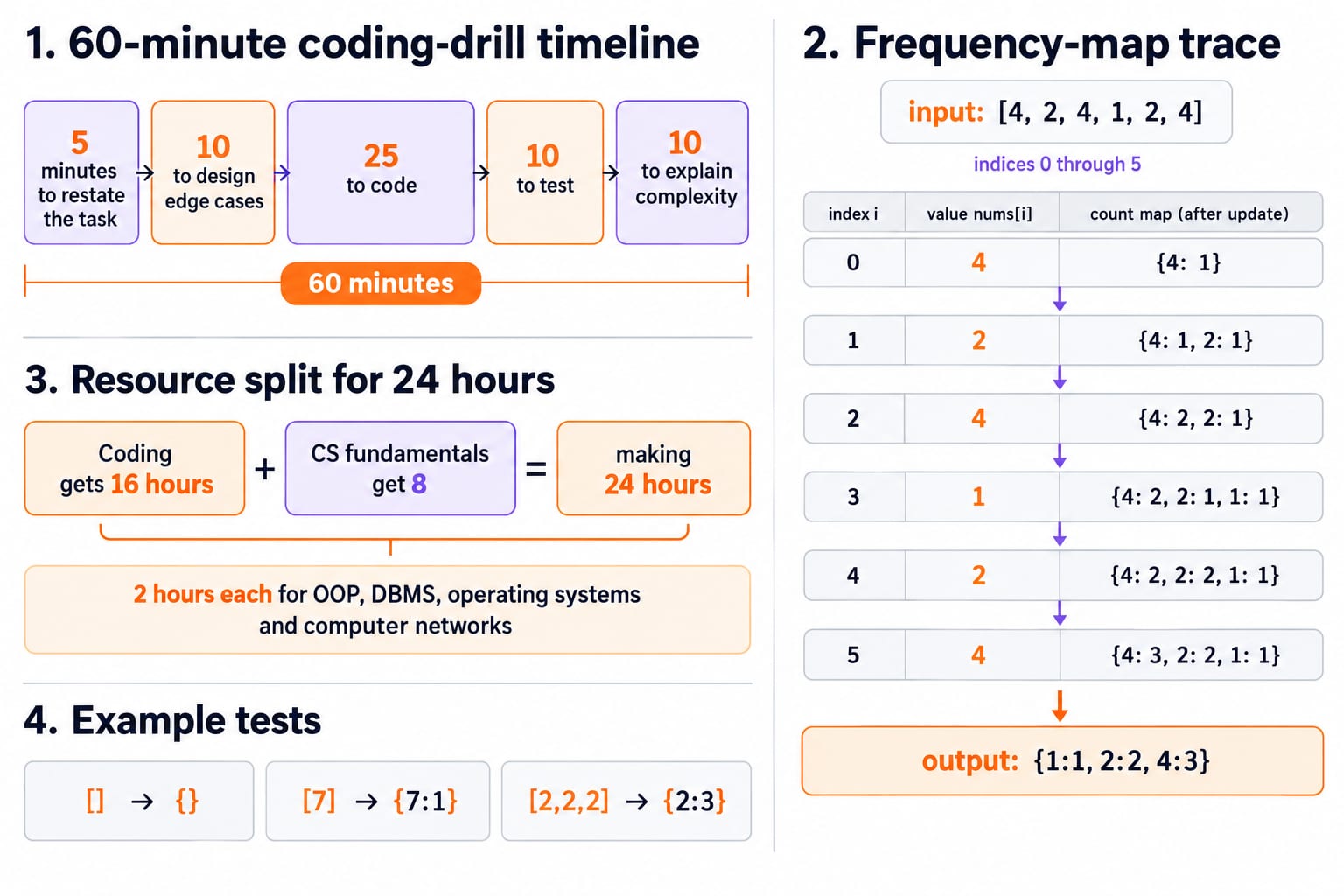
Coding gets 16 hours and CS fundamentals get 8, making 24 hours. Use one language you can write and explain reliably and the instructions permit. Split CS time evenly: 2 hours each for OOP, DBMS, operating systems and computer networks. These are useful foundations for interview explanations.
Run a 60-minute coding drill: 5 minutes to restate the task + 10 to design edge cases + 25 to code + 10 to test + 10 to explain complexity = 60 minutes. For a frequency-map task, input [4, 2, 4, 1, 2, 4] must produce {1:1, 2:2, 4:3}.
Test [] -> {}, [7] -> {7:1}, [2,2,2] -> {2:3} and the original input. A correct solution scans n values once, taking O(n) time and O(k) extra space for k distinct values. Explain the trace too: indices 0 through 5 read 4, 2, 4, 1, 2 and 4, changing the corresponding counts to 1; 1; 2; 1; 2; and 3 in that order.
Tech Mahindra mock analysis: convert 15.5 hours into an error ledger
Use the scheduled 15.5 hours for section sets, mixed simulations and review. Keep an error ledger with date, set, attempted, correct, wrong, unattempted, time, error type and next repair columns.
Mock 1 has 25 correct + 9 wrong + 6 unattempted = 40, so 34 attempts and 25/34 x 100 = 73.53% accuracy. Mock 4 has 31 correct + 5 wrong + 4 unattempted = 40, so 36 attempts and 31/36 x 100 = 86.11%. Record 6 more correct, 4 fewer wrong and 2 more attempts, without inventing a marks gain.
One cycle is 50 minutes testing + 45 minutes classifying every miss + 15 minutes redoing two failed methods = 110 minutes. Count a set only after its misses are classified and two failed methods are redone.
The final week and missed-day rule keep the plan realistic
Week 6 has six two-hour sessions. Monday: 1.5 hours quantitative + 0.5 review; Tuesday: 1.5 reasoning + 0.5 review; Wednesday: 1 verbal + 1 CS; Thursday: 2 coding; Friday: 2 timed practice and review; Saturday: another 2 timed practice and review. This reproduces 1.5, 1.5, 1, 2, 1 and 5 hours, totalling 12.
Sunday is a maximum two-hour recovery buffer, not a routine session. If Thursday is missed, move its coding block there. If four hours are missed, recover two on Sunday and replace the next week's lowest-priority new-topic block with the other two. Never cram 16 hours into one week.
With three weeks, combine adjacent phases but keep 12 hours weekly for an honest 36-hour version. Preserve the diagnostic, coding practice and mock review. Cut breadth before feedback.
Tech Mahindra placement preparation: the short version and next step
Verify the live invitation before using any schedule.
Diagnose your weaknesses before allocating hours.
Follow the 72-hour matrix with a 12-hour weekly ceiling.
Measure attempted accuracy and classify every error cause.
Taper in Week 6 instead of chasing new topics.
Before the next cycle, check these markers: baseline 26/40 = 65%, coding 4/8 = 50%, mixed-set accuracy 21/27 = 77.78%, and Mock 4 accuracy 31/36 = 86.11%. If coding remains weakest, use Coding For Placements for structured language and coding practice. If another bucket is weaker, apply the same error-ledger method there.
Keep learning

HCLTech Placement Preparation: 6-Week, 84-Hour Test Plan
Build your HCLTech test preparation around 84 planned hours, measurable diagnostics, timed practice and a recovery rule that survives missed days.
Updated 30 Oct 20266 min readCompany-Specific Prep

Accenture Placement Preparation: 4-Week, 56-Hour Study Plan
Turn four preparation lanes into a practical weekly calendar. Start with a baseline, move hours towards your errors, and recover missed sessions without cramming.
Updated 30 Oct 20265 min read51 viewsCompany-Specific Prep

LTIMindtree Placement Preparation: A 4-Week Section-Wise Study Plan
Start with a diagnostic, turn your errors into a weekly timetable, and use four focused weeks for aptitude, coding, CS fundamentals, communication and interview practice.
Updated 6 Nov 20266 min readCompany-Specific Prep
Capgemini Placement Preparation: An 8-Week Test-Matched Study Plan
Build an eight-week Capgemini preparation timetable from the route you are actually invited to take. Use two baselines and an error log to decide where every study hour goes.
Updated 30 Oct 20265 min readCompany-Specific Prep