Cognizant Placement Preparation: A 4-Week Pattern-Matched Study Plan
Build a pattern card from your current Cognizant communication, diagnose your gaps, and allocate four weeks by evidence. The plan includes simulations, error review, interview practice, and a missed-day rule.
KnowledgeGate Team
Exam prep & CS education
Updated 17 Sep 20265 min read
Search results often give you rigid round counts, but your Cognizant invitation may name a different role, module order or assessment mix. Preparing for an unverified pattern can waste your final week. This four-week preparation model copies your live invitation into a pattern card, uses a 90-minute baseline to assign 54 hours, and produces weekly budgets, two full simulations, an error log and a missed-day recovery rule. It is not an official Cognizant timetable or a score guarantee.
Build your Cognizant pattern card before the timetable
Cognizant Careers describes application, initial screening, assessment, interview and result as five broad stages, while warning that the process can vary by role. Assessments may cover communication, aptitude and, where applicable, technical skills.
Pattern rule: The current job posting and invitation control the modules, order, timings and rules. Copy only from these, your registered email, Superset status or placement officer. Use not stated for every blank.
Record role title, job ID, application route, assessment modules in invitation order, time per module, questions or tasks, coding language or environment, marking rule, proctoring requirements, interview mode, assessment date and time, and official contact channel.
Keep each subject block only when the card requires it, but retain interview practice for candidates who progress. With more time, use the Cognizant GenC role tracks and 8-week plan. Company-specific placement courses provide focused preparation, not the official pattern.
Run a 90-minute baseline and rank the gaps
For a learner-created diagnostic matching an illustrative technical-role invitation, use 15 communication questions in 20 minutes, 15 aptitude in 25, 10 technical in 25, and one coding task in 20. That is 40 objective questions plus one task, and 20 + 25 + 25 + 20 = 90 minutes. Replace blocks your invitation omits or renames.
Module | Result | Attempted accuracy | Completion or task quality |
|---|---|---|---|
Communication | 12 correct, 2 wrong, 1 unattempted |
|
|
Aptitude | 9 correct, 4 wrong, 2 unattempted |
|
|
Technical | 6 correct, 3 wrong, 1 unattempted |
|
|
Coding | 7 of 10 test cases passed | Keep separate from MCQ accuracy | 3 cases missed in 20 minutes |
Technical and coding get the largest share, aptitude comes next, and communication stays in maintenance. These are diagnostics, not Cognizant scores or cutoffs. Log module, question or task, concept gap, execution error, time issue, correct method, and retest date.
Allocate the 54-hour Cognizant preparation budget
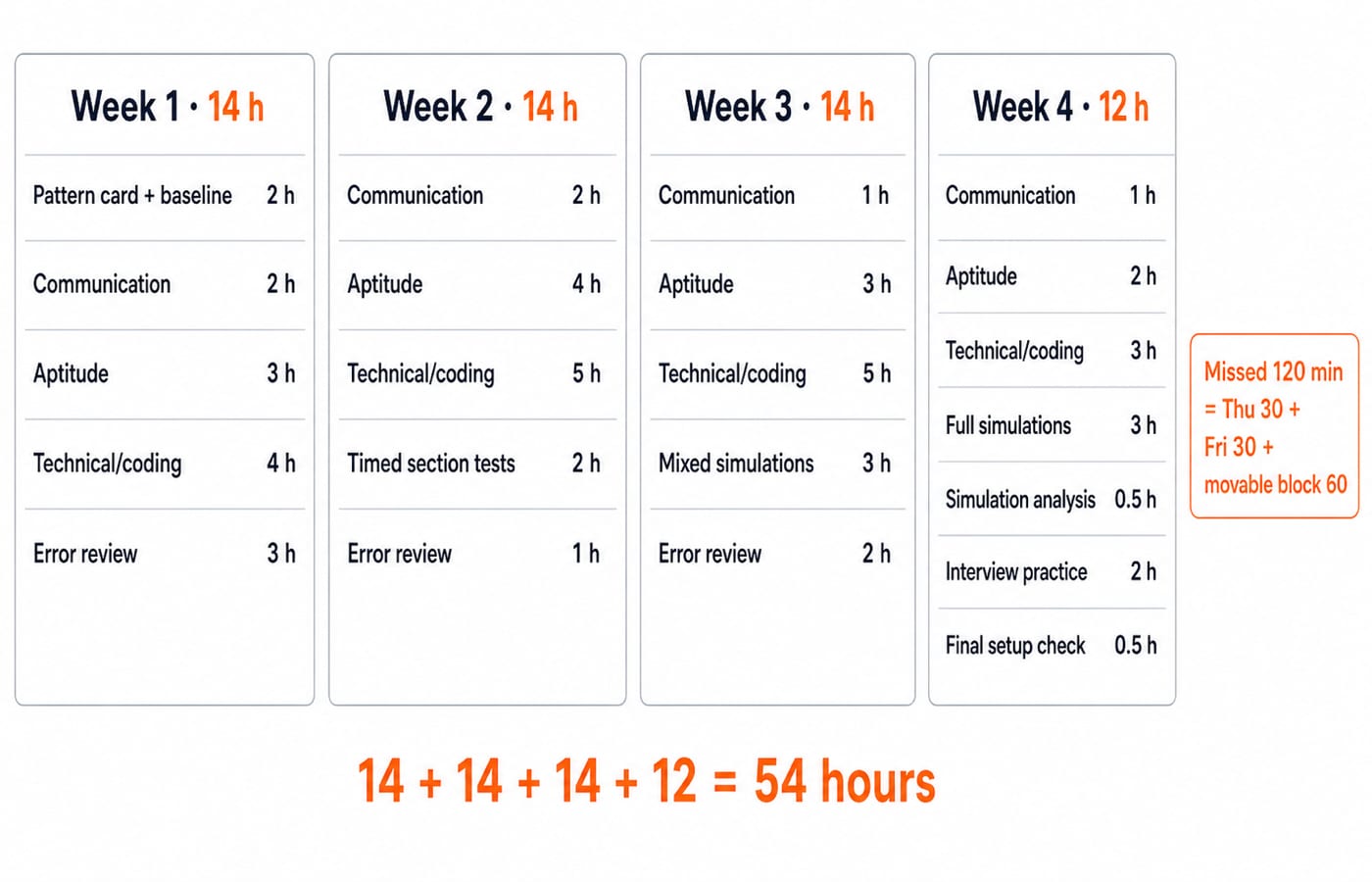
Week | Preparation allocation | Total |
|---|---|---|
1 | Pattern card and baseline 2 h, communication 2 h, aptitude 3 h, technical/coding 4 h, error review 3 h | 14 h |
2 | Communication 2 h, aptitude 4 h, technical/coding 5 h, timed section tests 2 h, error review 1 h | 14 h |
3 | Communication 1 h, aptitude 3 h, technical/coding 5 h, mixed simulations 3 h, error review 2 h | 14 h |
4 | Communication 1 h, aptitude 2 h, technical/coding 3 h, full simulations 3 h, analysis 0.5 h, interview 2 h, setup 0.5 h | 12 h |
The table gives 14, 14, 14 and 12 hours; 14 + 14 + 14 + 12 = 54 hours.
Use 50 minutes work + 10 break + 50 work + 10 logging = 120 minutes, keeping the week's final block movable. Recover a lost Wednesday as 30 minutes Thursday + 30 Friday + 60 movable = 120 minutes. Never trade sleep for a four-hour punishment session. After two misses, protect diagnostics, simulations and review, then reduce new topics.
Week 1: build the foundation
Use seven two-hour blocks. Day 1 is the 30-minute card plus the 90-minute baseline. Days 2 to 7 cover aptitude; technical concepts; communication; 60 minutes aptitude plus 60 review; coding; and technical/coding error review. Totals: pattern/baseline 2 h, communication 2 h, aptitude 3 h, technical/coding 4 h, review 3 h, or 14 h.
Aptitude uses 20 minutes recall + 70 practice + 20 checked solutions + 10 logging = 120 minutes. For technical study, answer ten retrieval questions on one role-relevant topic, then explain it from memory. Communication uses 30 minutes comprehension, 30 grammar, 30 spoken response, 20 correction and 10 logging.
The Cognizant Superset course offers structured lessons, notes and practice tests. Use it against your card, not as a universal section list.
Week 2: convert knowledge into timed accuracy
Keep 2 h communication, 4 h aptitude, 5 h technical/coding, 2 h timed tests and 1 h review. In a 40-question, 45-minute drill, score 28 correct, 6 wrong and 6 unattempted. Attempted accuracy is 28/34 = 82.4%; completion is 34/40 = 85%.
Classify the wrong answers as three concept, two arithmetic and one rushed-reading error. The unattempted set has four slow-method issues and two unfamiliar topics. Repair with 30 minutes relearning + 60 practice + 30 retesting ten questions = 120 minutes. Use the 30-day aptitude practice routine with the Aptitude for Placement course if needed. The invitation still controls aptitude.
Week 3: combine recall, coding and simulation
Allocate 1 h communication, 3 h aptitude, 5 h technical/coding, 3 h to two 90-minute mixed simulations, and 2 h review. Copy the invitation's order and timing if the baseline blocks do not match. Record accuracy, completion, coding cases passed, time lost and three repeat errors.
Practice this learner-created task: for [4, 1, 4, 2, 2, 4], return the most frequent value, choosing the smaller on a tie. Trace {4:1}, {4:1,1:1}, {4:2,1:1}, {4:2,1:1,2:1}, {4:2,1:1,2:2}, {4:3,1:1,2:2}. Answer 4; time is O(n) and auxiliary space O(k) for k distinct values. Test [], [7], and [3,2,3,2], whose tie answer is 2. In a round, read both tasks, bank the clearer one, time-box debugging and test edge cases.
Week 4: rehearse the route and taper
Use six two-hour blocks, then keep Day 28 free. Day 22: 90-minute simulation plus 30 analysis. Day 23: aptitude repair. Day 24: technical/coding repair. Day 25: 60 communication plus 60 interview. Day 26: 60 technical/coding plus 60 interview. Day 27: 90-minute simulation plus a 30-minute device, identity-document, login and environment check. Thus, 6 x 120 = 720 minutes = 12 hours.
Build a 90-second project answer: problem 15 seconds, approach 25, personal contribution 25, result and one trade-off 25. Check 15 + 25 + 25 + 25 = 90 seconds. Practise virtually and face to face. If official instructions change, update the card and affected block. Rest on Day 28.
The short version
Copy the invitation, measure the gap, spend 54 hours by weakness, simulate the stated route, then taper. For more time, use the linked 8-week plan. Now open your current Cognizant communication and fill the pattern card before Day 1.
Keep learning
Accenture Coding Questions: 4 Patterns with Solved Dry Runs
Stop memorising company-question lists. Learn four reusable coding patterns through precise examples involving strings, arrays, digits, and matrices.
Updated 2 Oct 20265 min readCompany-Specific Prep
Accenture Placement Preparation: 4-Week, 56-Hour Study Plan
Turn four preparation lanes into a practical weekly calendar. Start with a baseline, move hours towards your errors, and recover missed sessions without cramming.
Updated 27 Sep 20265 min readCompany-Specific Prep

Capgemini Interview Questions: Technical and HR Rounds with Model Answers
Practise clear technical and HR answers through Java, SQL, a coding trace and one consistent project story. Each example shows what to say and how to support it.
Updated 25 Sep 20265 min readCompany-Specific Prep
Capgemini Drive Mistakes: Stage-by-Stage Rejection Risks and Fixes
Diagnose the controllable evidence gaps behind common Capgemini drive risks. Repair your CV, timed practice, code traces, project proof and behavioural stories with worked drills.
Updated 24 Sep 20266 min readCompany-Specific Prep