Infosys Interview Experience Patterns Across Roles: A Prep Guide
Learn how to extract useful preparation signals from a small sample of Infosys interview reports, then practise project, coding, CS and behavioural answers with a 20-hour plan.
KnowledgeGate Team
Exam prep & CS education
Updated 22 Aug 20266 min read
Read a stack of Infosys interview experiences and you end up with as many different question lists. The useful move is to separate what recurs from role-specific depth and one-off prompts. Four candidate reports, spread across a Systems Engineer role, a Digital Specialist Engineer role, a Specialist Programmer role and an experienced Technology Analyst role, converge on the same four demands: your project, your code, your CS fundamentals, and how honestly you talk about constraints. Candidate reports are anecdotal, so treat them as rehearsal material rather than a preview of your own interview, and take the structured company-specific practice from the Company-Specific Placement Courses catalogue.
Read reports as signals, not as the next interview script
Across those four reports, count the themes that appear in at least two, and record the role and the route beside each. Treat exact questions as examples, never as predictions.
Reported theme | Repeated signal | What not to infer |
|---|---|---|
Resume and project | Explain personal contribution and technology choices | The same project questions will recur |
Coding and programming | Write or explain a solution | A fixed difficulty or language |
DBMS and OOP | Defend fundamentals with examples | A guaranteed subject list |
Behavioural communication | Discuss introduction, goals, teamwork or constraints | A separately named HR round |
Reports teach behaviours, not your route. Your invitation, the job description and the recruiter or placement-cell mail decide which test and which rounds you actually sit. For the role split behind that, Systems Engineer, Digital Specialist Engineer and Specialist Programmer, and the five assessment areas underneath it, the Infosys Placement Preparation Guide carries the detail.
Keep one common core, then change depth by role
Within the sample, the Systems Engineer report stresses programming basics, resume skills, one project and behavioural answers. The Digital Specialist Engineer report adds coding, DBMS and OOP depth. The Specialist Programmer report adds harder algorithms, systems subjects and stack questions. The experienced Technology Analyst report stresses production work, prior projects and managerial evidence.
Use a ladder: common core means project ownership, one strong language, DBMS/OOP and truthful behavioural answers. DSE stretch means medium DSA, complexity and deeper CS follow-ups. Specialist stretch means multi-step algorithms, optimisation and system trade-offs. An experienced-role overlay adds stack-specific design, debugging and delivery evidence. The posting controls the overlay.
Create a one-page role card: named role, named skills, resume evidence and gaps. Leave the first two blank when the communication does.
Worked project drill: survive five layers of follow-up
Consider an illustrative Campus Drive Tracker with 8,000 application rows. Across 100 comparable local runs, median search latency is 480 ms before an index on (student_id, status) and 170 ms after it. The table and its indexes occupy 120 MB before the change and 140 MB after.
Latency falls by (480 - 170) / 480 x 100 = 310 / 480 x 100 = 64.6%. Storage rises by (140 - 120) / 120 x 100 = 20 / 120 x 100 = 16.7%.
Answer five follow-ups: What did users see? What did you change? Why does index order match the query? How were runs comparable? Does the read gain justify storage and write cost?
Build a 90-second answer: 20 seconds for problem and user, 25 for ownership, 25 for measurement and result, and 20 for trade-off and next check. Check 20 + 25 + 25 + 20 = 90. Make a second version with no metric you cannot defend. Replace illustrative measurements with your own.
Worked coding and CS drill: answer, test and defend
Take a drill of the same shape: for A = [4, 2, 7, 2, 4, 9, 7], return the first value appearing once. One pass builds {4:2, 2:2, 7:2, 9:1}. A left-to-right pass returns 9. Time is O(n) and auxiliary space is O(k) for k distinct values.
Test [5] -> 5, [3, 3, 1, 1] -> no unique value, and [] -> no unique value. The basic layer is correct code plus tests. Then explain why sorting can disturb original order and how memory limits change the choice.
For DBMS, take Project(project_id, owner_id, defects) with rows (101, 17, 4), (102, 17, 0) and (103, 23, 3).
SELECT owner_id, SUM(defects) AS total
FROM Project
GROUP BY owner_id
HAVING SUM(defects) > 3;
Owner 17 totals 4 + 0 = 4, so it is the only output. Owner 23 totals exactly 3 and is excluded. WHERE filters rows before grouping; HAVING filters grouped totals. Revise the fundamentals these follow-ups sit on with Technical Interview: OS, DBMS, CN & OOP Prep.
Prepare behavioural constraints and one truthful teamwork story
Use four parts: situation, personal responsibility, action and checked result. In an illustrative four-person capstone team, the demo is three days away and duplicate imports appear in 14 of 200 test records. The candidate owns the diagnosis, adds an idempotency check and a database uniqueness rule, then reruns the same 200 records and observes zero duplicates.
Separate your change from teammates' work, name a failure the uniqueness rule could create, and explain how rejected records would be monitored. Replace every value with truthful evidence.
Availability needs the same honesty. Candidate A can relocate to Pune, Mysuru or Hyderabad with 21 days' notice. Candidate B can relocate only to Pune and needs 30 days. Neither is preferred. The goal is clarity and consistency with the application, not copied flexibility. Location, shift and joining terms come from your own offer letter, never from someone else's report.
Use a 20-hour, two-week plan with protected recovery time
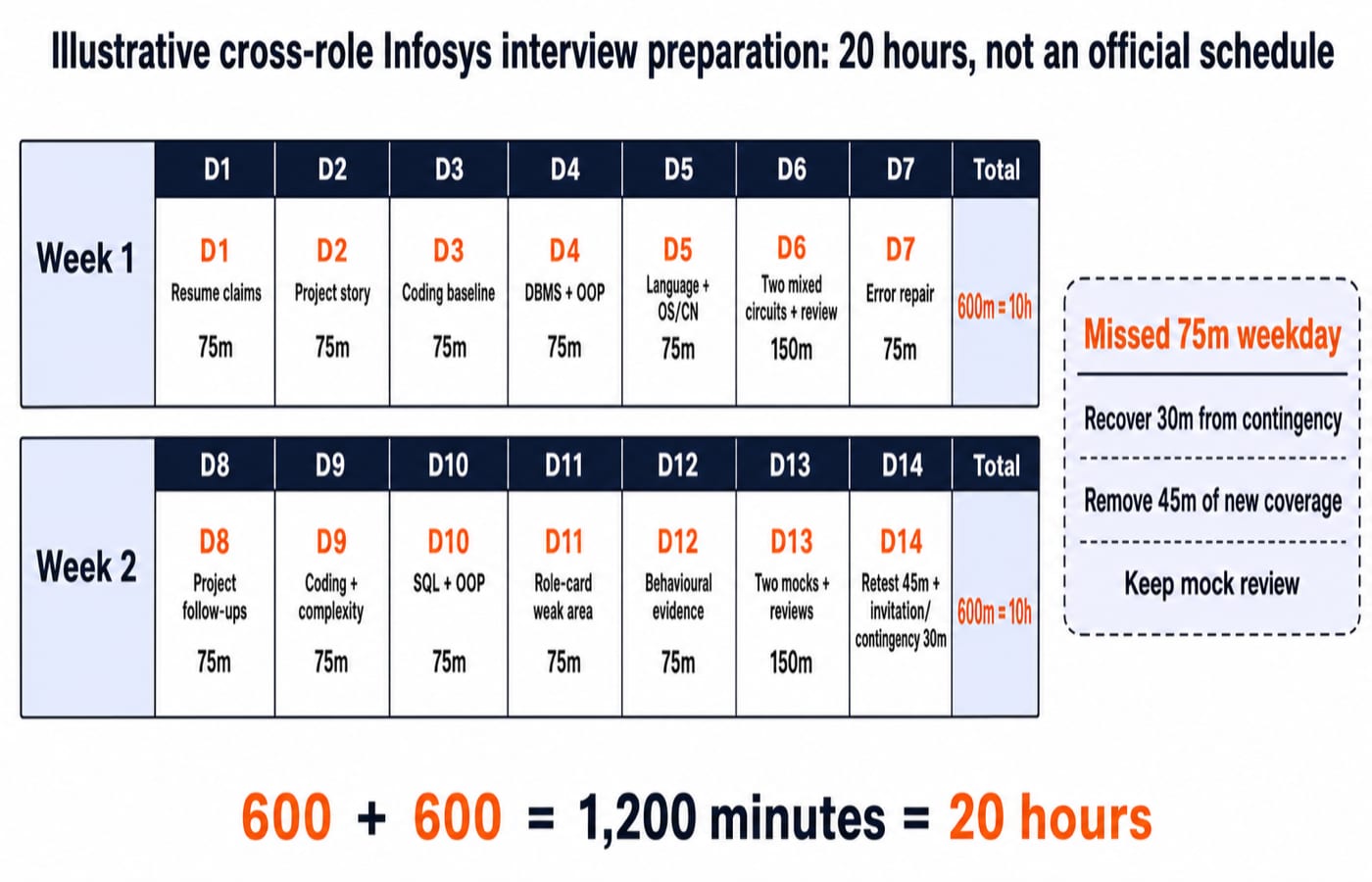
Use a 10-hour week: weekdays at 75 minutes each, Saturday at 150, and Sunday at 75. Check (5 x 75) + 150 + 75 = 600 minutes = 10 hours; then 2 x 600 = 1,200 minutes = 20 hours. Breaks are outside study time.
Week 1: D1 resume audit 75; D2 project walkthrough 75; D3 coding baseline 75; D4 DBMS/OOP 75; D5 language plus OS/CN 75; D6 two 60-minute circuits plus 30 review; D7 error repair 75.
Week 2: D8 project follow-ups 75; D9 coding and complexity 75; D10 SQL/OOP 75; D11 role-card gap 75; D12 behavioural evidence 75; D13 two mocks and reviews, 45 + 30 + 45 + 30 = 150; D14 retest 45 plus invitation and contingency 30. The Infosys Superset Preparation Course sequences these blocks along the Systems Engineer, Digital Specialist Engineer and Specialist Programmer tracks.
If a weekday disappears, recover 30 minutes from D14 and replace 45 minutes of new coverage. Protect mock review. If Saturday disappears, extend the plan when the interview date permits. Do not force 150 + 75 = 225 minutes into Sunday.
Score rehearsal quality, then take the next 60-minute action
Run a 30-minute mock: introduction 2, project 7, coding 8, DBMS/OOP or role-card 6, behavioural constraint 5, candidate question 2. Check 2 + 7 + 8 + 6 + 5 + 2 = 30.
Score correctness, ownership, reasoning aloud, concise communication and honesty from 0 to 4, for 20 total. A sample can move from 2 + 2 + 3 + 2 + 4 = 13/20 to 3 + 4 + 3 + 3 + 4 = 17/20 after repairing project contribution and SQL reasoning.
Next 60 minutes: 15 audit resume claims, 20 draft a truthful project answer, 15 solve the exercise, and 10 record location and joining constraints. The Interview & Resume Preparation Course adds structured resume review and timed mock practice.
Keep learning
Accenture Coding Questions: 4 Patterns with Solved Dry Runs
Stop memorising company-question lists. Learn four reusable coding patterns through precise examples involving strings, arrays, digits, and matrices.
Updated 2 Oct 20265 min readCompany-Specific Prep
Accenture Placement Preparation: 4-Week, 56-Hour Study Plan
Turn four preparation lanes into a practical weekly calendar. Start with a baseline, move hours towards your errors, and recover missed sessions without cramming.
Updated 27 Sep 20265 min readCompany-Specific Prep
Capgemini Interview Questions: Technical and HR Rounds with Model Answers
Practise clear technical and HR answers through Java, SQL, a coding trace and one consistent project story. Each example shows what to say and how to support it.
Updated 25 Sep 20265 min readCompany-Specific Prep
Capgemini Drive Mistakes: Stage-by-Stage Rejection Risks and Fixes
Diagnose the controllable evidence gaps behind common Capgemini drive risks. Repair your CV, timed practice, code traces, project proof and behavioural stories with worked drills.
Updated 24 Sep 20266 min readCompany-Specific Prep