

SSC JE Cutoff Trends: Compare Branches and Set a Practical Target Score
Clearing the qualifying minimum and reaching the shortlisting cutoff are different goals. Compare SSC JE Paper-I results, then turn a historical reference into a mock target and an error-ledger plan.
KnowledgeGate Team
Exam prep & CS education
Updated 2 Nov 20265 min read98 views

Your mock score is above the qualifying minimum, but is it competitive enough for SSC JE? To answer sensibly, compare the right branch and category before choosing a practice buffer. Civil, Mechanical and Electrical Paper-I results show why branch and category matter before you choose a practice buffer. A target calculation turns that reference into a study benchmark, not selection assurance.
Which SSC JE cutoff are you comparing?
Separate three thresholds: the minimum qualifying marks, the Paper-I shortlisting cutoff and the final-merit cutoff.
SSC's 2025 Paper-I result write-up, dated 6 March 2026, specified a UR qualifying minimum of 30%, or 60 marks. Its Civil UR shortlisting cutoff was 127.22748. Passing the minimum alone did not establish shortlisting.
SSC's 2024 final-result write-up, dated 3 February 2025, used both papers for final merit; allocation also considered post and department preferences. Clearing Paper I was therefore an intermediate step.
Label your comparison: 2025 cycle | Civil | UR | Paper I | normalised marks. Substitute your own branch and category. UR is not a universal reference, and final selection is outside this Paper-I calculation.
What the 2024 and 2025 cutoff figures actually show
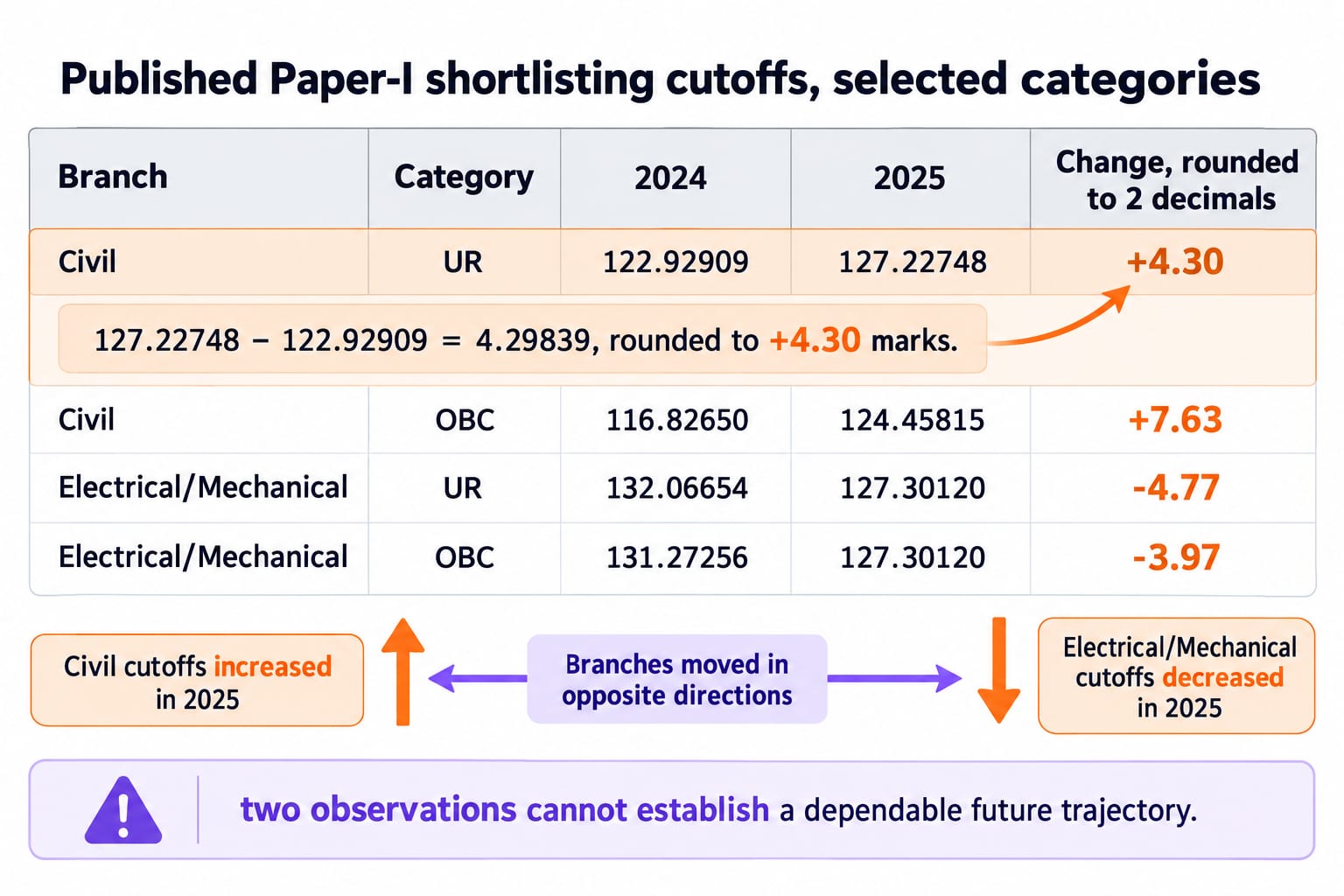
Published Paper-I shortlisting cutoffs, selected categories
Branch | Category | 2024 | 2025 | Change, rounded to 2 decimals |
|---|---|---|---|---|
Civil | UR | 122.92909 | 127.22748 | +4.30 |
Civil | OBC | 116.82650 | 124.45815 | +7.63 |
Electrical/Mechanical | UR | 132.06654 | 127.30120 | -4.77 |
Electrical/Mechanical | OBC | 131.27256 | 127.30120 | -3.97 |
Sources: SSC's 2024 Paper-I result write-up, dated 20 August 2024, and 2025 Paper-I result, 6 March 2026. Years denote exam cycles, not result-publication years. This is a selected comparison, not a complete category list.
Civil UR change = 127.22748 - 122.92909 = 4.29839, rounded to +4.30 marks. Branches moved in opposite directions; two observations cannot establish a dependable future trajectory.
The 2025 Electrical/Mechanical OBC and UR values are both 127.30120 in SSC's table. This is not a typing error. Read your category row instead of assuming a fixed gap.
The earlier SSC CHSL Cutoff Trends: Set a Target Score covers the same buffer method for CHSL; its exam-specific treatment stays there, while this post owns SSC JE Paper-I branch and category rows, normalised-score caveats and the error-ledger calculation. The earlier SSC CGL Cut Offs: Set a Target Score by Category post owns CGL tier and category interpretation. Use those posts as comparison references, not as SSC JE rules.
Why a raw mock score cannot predict your normalised score
The two Paper-I notices cited above used normalised scores. The 2024 notice referred to the procedure dated 7 February 2019; the 2025 notice referred to the procedure dated 2 June 2025. Do not treat these cycles as a controlled comparison of paper difficulty.
Consider an illustrative raw practice score of 130. It does not imply an official normalised score of 135: adding five marks has no evidential basis. A difficult shift does not justify assuming a fixed bonus.
Keep raw mock performance and historical normalised cutoffs in separate columns. Use the latter as a planning reference, without inventing a personal conversion formula.
Turn a historical cutoff into a practical target buffer
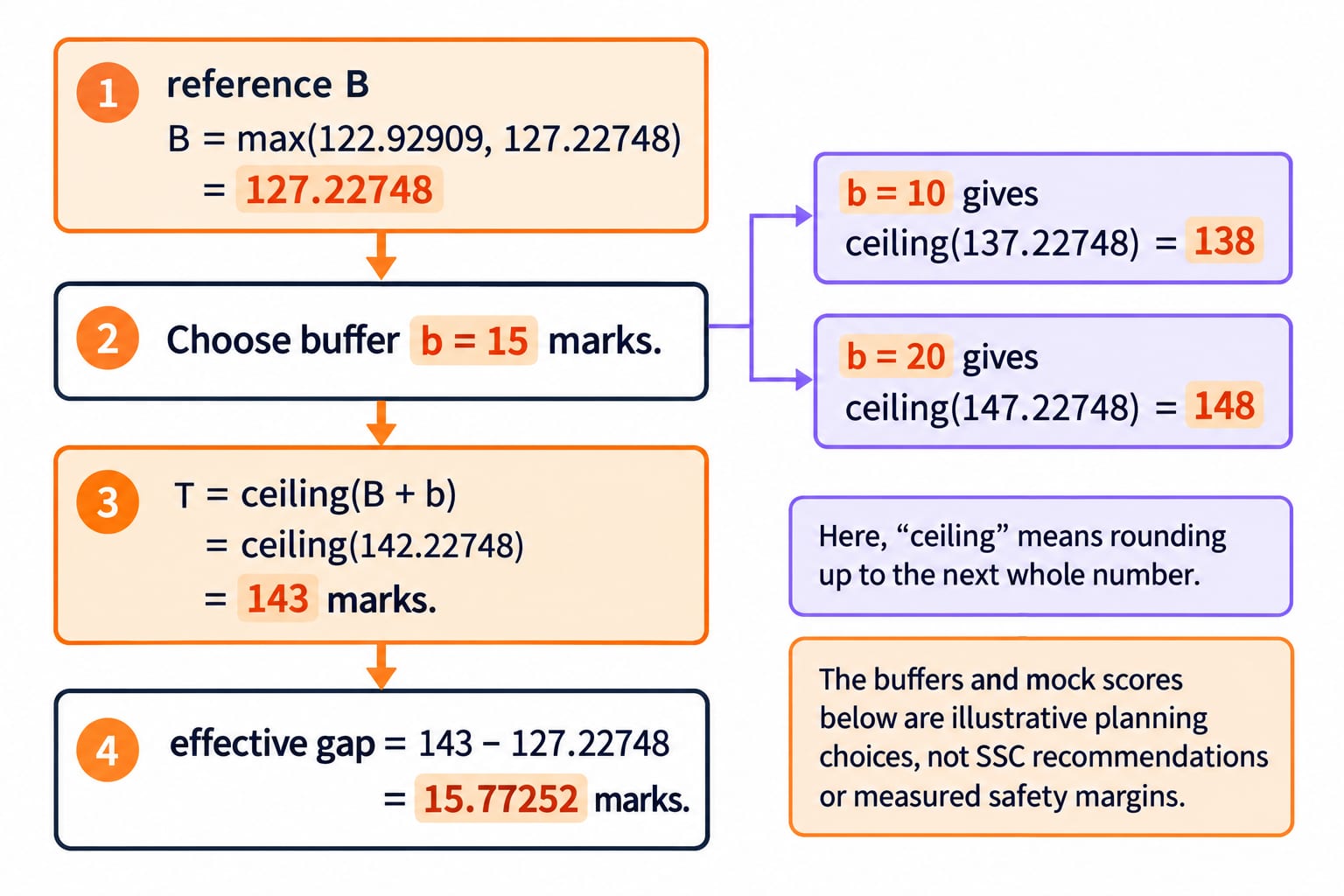
The historical cutoffs are SSC's published figures. The buffers and mock scores below are illustrative planning choices, not SSC recommendations or measured safety margins. They neither convert raw marks into normalised marks nor predict a future cutoff or selection.
For a Civil UR illustration, take the higher of the two historical values as reference B:
B = max(122.92909, 127.22748) = 127.22748.
Choose buffer b = 15 marks.
T = ceiling(B + b) = ceiling(142.22748) = 143 marks.
Here, “ceiling” means rounding up to the next whole number. It makes the practice benchmark easy to track while retaining the official cutoff's precision. Never round a published cutoff down.
The effective gap is 143 - 127.22748 = 15.77252 marks, slightly above the chosen buffer.
Check how the choice changes the workload: b = 10 gives ceiling(137.22748) = 138; b = 20 gives ceiling(147.22748) = 148. Choose a demanding benchmark you can work towards, and substitute your own branch/category row before calculating it.
Check the target against your last five mocks
Take five hypothetical, comparable full-length raw mock scores: 129, 133, 137, 135, 131.
Sorted, they are 129, 131, 133, 135, 137. The middle value, or median, is 133. The lowest is 129, the highest is 137, and the range is 137 - 129 = 8 marks.
Against the target of 143:
Median gap = 143 - 133 = 10 marks.
Lowest-score gap = 143 - 129 = 14 marks.
Highest-score gap = 143 - 137 = 6 marks.
Do not treat 137 as established performance. As a coaching checkpoint, review the next five comparable mocks for improvement in both the median and lower scores. Keep timing, coverage and scoring rules consistent so the comparison remains useful.
Convert the score gap into an error-ledger plan
Suppose review of the hypothetical median mock identifies recoverable net-mark losses of 4 in reasoning, 2 in general awareness and 4 in technical questions. Then 4 + 2 + 4 = 10, and 133 + 10 = 143.
These are net marks in the hypothetical mock, not question counts. Attach a repair to each loss:
Reasoning: re-solve errors without time pressure, then time a similar set.
General awareness: create recall prompts for missed facts and test recall later.
Technical: revise the exact concept, then solve fresh questions from your engineering branch.
Reassess in the next comparable mock before counting gains. SSC CGL Mock Analysis: Build an Error Ledger explains a transferable review process in a CGL context.
Set your next checkpoint and choose focused practice
Fill in one record: branch/category; source cycle and stage; historical reference; chosen buffer; practice target; five-mock median; next review date. Check the relevant current SSC notice and results before applying this historical method to a new cycle.
If reasoning or general awareness is the diagnosed weakness, inspect the SSC JE non-technical course for focused practice in those areas. Technical preparation still needs material for your engineering branch.
For wider browsing, the SSC JE exam and course hub sits under the CGL category label. Use it to explore resources; keep JE syllabus decisions tied to the relevant SSC notice.
Go deeper with the full courseSSC JE – Non-Technical Course
Keep learning
SSC JE Last 60 Days Plan: Revision and Mock Strategy
Repeated mocks help only when their mistakes get repaired. Build a 60-day SSC JE revision routine around branch recall, reviewed tests, recovery time and a lighter final stretch.
Updated 1 Nov 20265 min readSSC JE

SSC CHSL Cutoff Trends: Compare Results and Set a Target Score
Compare the right CHSL result rows before choosing a practice target. Work through a historical benchmark, a personal buffer and two mock-test blocks to decide what to improve next.
Updated 30 Oct 20264 min readSSC CHSL
SSC CGL Cutoffs Explained: Compare Tiers, Posts and Categories
A practical test for deciding whether two SSC CGL cutoff figures are genuinely comparable, with completed-result examples and a worksheet for rejecting mismatched rows.
Updated 30 Oct 20265 min read65 viewsSSC CGL

Decision Trees: Calculate Information Gain and Prune Weak Branches
Build one classification tree by hand from ten machine rows, audit every candidate threshold, and see why validation can justify removing a perfectly pure training branch.
Updated 15 Nov 20266 min readML & Data Science