ISRO CS PYQ Analysis: Build a Subject-Wise Speed and Accuracy Profile
Stop treating one raw PYQ score as the diagnosis. Use a subject ledger to find concept gaps, slow methods, and the next ten hours of focused repair.
KnowledgeGate Team
Exam prep & CS education
Updated 8 Aug 20266 min read103 views
Solving ISRO CS previous-year questions can leave the real weakness unclear. Is Computer Networks weak, or merely slow? Are skipped COA questions hiding a coverage gap? One raw score cannot answer that. A better rule is to put PYQs before more unsorted practice and audit coverage, accuracy and speed separately.
ISRO CS PYQ analysis needs three numbers, not one score
Track three outputs. Coverage is attempted / selected, so every skip counts against it. Attempted accuracy is correct / (correct + wrong). Pace is minutes / attempted questions. Correct divided by all selected mixes errors with skips; raw minutes hide how much was attempted.
For this audit, deliberately select 80 PYQs: ten each from OS, DBMS, Computer Networks, TOC, COA, DSA, Compiler Design, and Software Engineering plus basic AI. Ten per subject keeps every row comparable, which a paper-shaped sample would not. The counts below are one learner's worked audit, not ISRO's published figures. If a row later looks thin because the topic was never studied, ISRO CS vs GATE CS: Overlap, Gaps, 14-Day Revision Plan shows where the two syllabus lists part company.
Build the ISRO CS subject ledger before reading the result
Record each result before interpreting it. Skips expose coverage or confidence problems; the last two columns separate accuracy from speed.
Subject | Selected | Correct | Wrong | Skipped | Minutes | Attempted accuracy | Minutes per attempt |
|---|---|---|---|---|---|---|---|
OS | 10 | 7 | 2 | 1 | 14 | 77.8% | 1.56 |
DBMS | 10 | 8 | 1 | 1 | 11 | 88.9% | 1.22 |
Computer Networks | 10 | 5 | 4 | 1 | 16 | 55.6% | 1.78 |
TOC | 10 | 6 | 2 | 2 | 18 | 75.0% | 2.25 |
COA | 10 | 4 | 3 | 3 | 17 | 57.1% | 2.43 |
DSA | 10 | 9 | 1 | 0 | 13 | 90.0% | 1.30 |
Compiler Design | 10 | 7 | 1 | 2 | 10 | 87.5% | 1.25 |
Software Engineering plus AI | 10 | 6 | 1 | 3 | 11 | 85.7% | 1.57 |
Totals are 80 selected = 52 correct + 15 wrong + 13 skipped, 67 attempted, and 110 minutes. The ledger carries no marks column on purpose: a score merges accuracy and pace into one number and hides both.
Calculate the ISRO CS speed and accuracy profile step by step
Overall coverage is 67 / 80 × 100 = 83.8%. Overall attempted accuracy is 52 / 67 × 100 = 77.6%. Overall pace is 110 / 67 = 1.64 minutes per attempt.
For COA, 4 + 3 = 7 questions were attempted. Therefore, accuracy is 4 / (4 + 3) × 100 = 57.1%, and pace is 17 / 7 = 2.43 minutes per attempt. For TOC, 6 + 2 = 8 were attempted, giving 6 / 8 × 100 = 75.0% and 18 / 8 = 2.25 minutes per attempt.
Coverage answers the skipped-question worry on its own. COA has the thinnest coverage at 7 / 10 = 70% and converts only 57.1% of what it does attempt, so its three skips read as a knowledge gap rather than a time squeeze. Software Engineering plus AI skips the same three questions but converts 6 / 7 of its attempts, so coverage is the whole of its problem: what was studied holds up, what was skipped was never studied. Computer Networks is the mirror image, attempting nine of ten and still landing at 55.6%, which is a concept problem, not a matter of reaching more questions. DSA is the only complete row at 10 / 10.
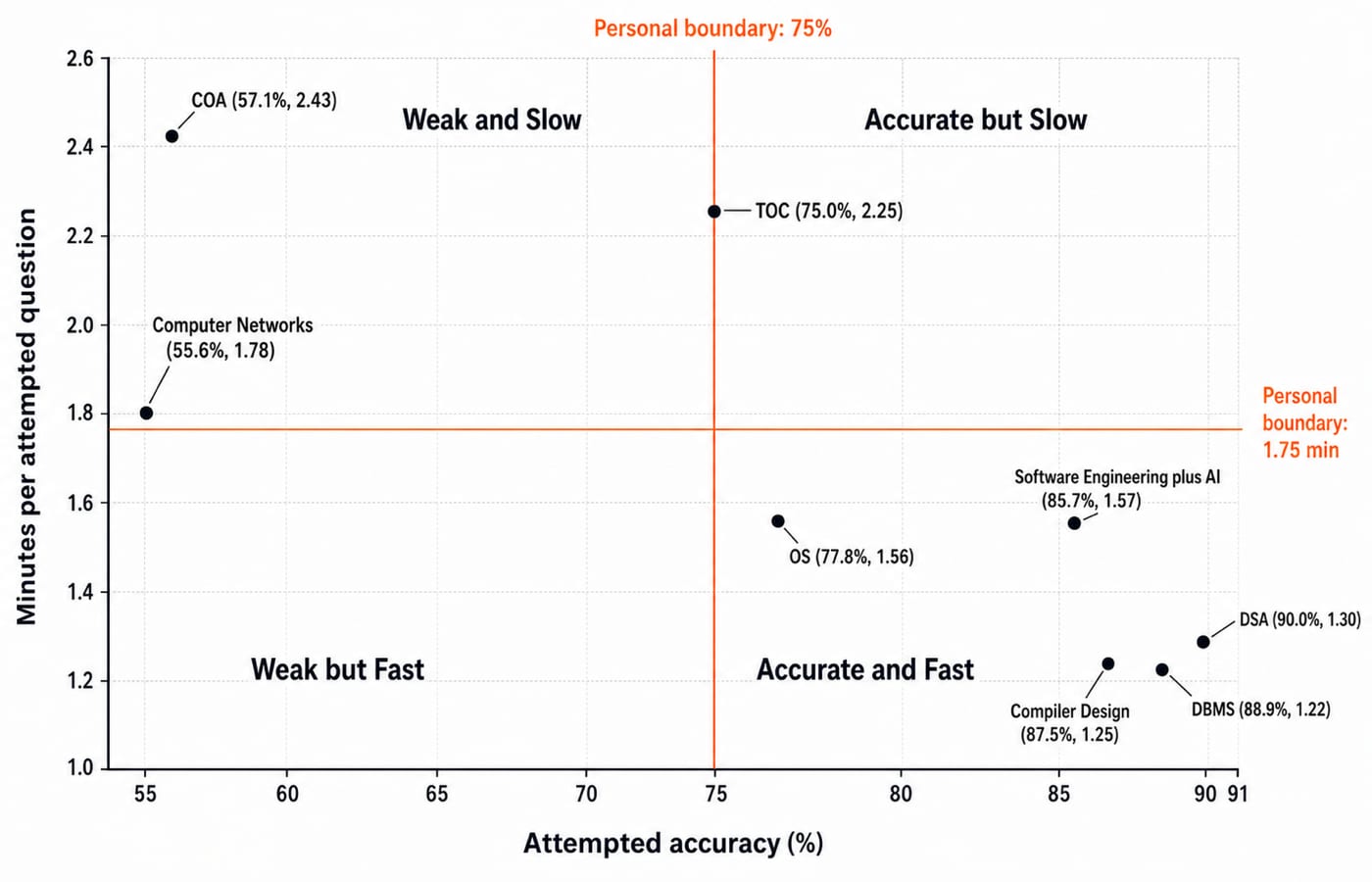
Now set two triage boundaries: 75% attempted accuracy and 1.75 minutes per attempt. Move them if your target pace differs; the method does not depend on these two values.
COA and Computer Networks fall in weak and slow. TOC sits exactly on the accuracy boundary and well over the pace boundary. OS, DBMS, DSA, Compiler Design, and Software Engineering plus AI land in accurate and fast.
Separate concept gaps, recall slips, misreads, and slow methods
Classify the 15 wrong answers. In this audit they split into six concept gaps, three formula or fact-recall slips, three question-reading errors, two calculation slips, and one blind guess. Only the first six need new study; the other nine need process work, and no amount of rereading a textbook will touch them.
With a 32-bit byte address, 1,024 cache lines, four-way set associativity, and a 64-byte block, the offset needs log2(64) = 6 bits. There are 1,024 / 4 = 256 sets, requiring log2(256) = 8 index bits. The tag needs 32 - 6 - 8 = 18 bits. Using ten index bits and answering 16 tag bits is a concept gap because associativity was ignored, not a speed error.
A correct TOC row still taking 2.25 minutes per attempt points elsewhere. Knowledge is present, so assign timed method practice before rereading the whole subject.
Turn the ISRO CS profile into a ten-hour repair week
Allocate 600 minutes from the profile:
Repair activity | Minutes |
|---|---|
COA concept repair | 150 |
Computer Networks concept repair | 120 |
TOC timed drills | 90 |
One mixed timed PYQ set | 90 |
Error-log review and closed-book re-solve | 60 |
Rotating maintenance for the five stronger rows | 90 |
150 + 120 + 90 + 90 + 60 + 90 = 600 minutes = 10 hours.
Lose a two-hour block? Carry 60 minutes of COA or Computer Networks repair and 60 minutes of the mixed set into later blocks. Never compress all 120 minutes into a tired late-night sitting. Drop optional topic browsing first. Use ISRO CS Preparation: 12-Hour Weekly Study Plan to find these ten hours inside a working week; let the profile decide what fills them.
Retest with fresh questions, not the ones you remember
After the repair week, take an unseen 40-question diagnostic: 15 COA, ten Computer Networks, five TOC, and ten mixed maintenance questions. A result of 29 correct, six wrong, and five skipped means 35 attempts in 55 minutes. Attempted accuracy is 29 / 35 × 100 = 82.9%; pace is 55 / 35 = 1.57 minutes per attempt.
Coverage rises to 35 / 40 × 100 = 87.5%. Compare all three metrics against the first audit, and read the jump carefully: this retest is deliberately weak-area-heavy, so 82.9% here is not the same achievement as 82.9% on a balanced set. Keep a subject in repair while it stays below 75% accuracy or above 1.75 minutes per attempt; otherwise move it to maintenance.
Map the diagnosis to ISRO preparation and official checks
The ISRO Scientist/Engineer SC (CS) Course page maps these resources to the repair loop:
Course resource | Use in the profile |
|---|---|
Recorded core-CS lessons | Repair COA and Computer Networks concepts |
Detailed PYQ discussions | Compare reasoning after attempting questions |
Notes and formula sheets | Correct recall slips |
Full-length mocks with overall, subject-wise, and topic-wise scores | Validate the profile |
The ISRO Scientist/Engineer CS Preparation page groups wider ISRO preparation; the course supplies the structured route.
For current eligibility, dates, vacancies, written-test particulars, interview particulars, marks, negative marking, and selection weightage, check the applicable current notice reached through the official ISRO Careers page.
The short version: audit, repair, retest
Three steps: log every subject's attempts and minutes, calculate coverage, attempted accuracy and pace, then aim ten hours at the thin, weak or slow rows before an unseen retest. The linked ISRO course supplies the lessons, PYQ discussions, notes and mock-score breakdowns on one route. The same eight-row ledger works on any PYQ set you can mark honestly. Draw it before you solve the next batch, not after.
Keep learning

ISRO Scientist CS Cutoff Trends: How to Set Your Target Score
A remembered cutoff is useful only when you know its score scale and recruitment stage. Compare two historical CS notices, calculate an illustrative buffer and use weaker mocks to plan your next repair week.
30 Sep 20264 min readISRO Recruitment
ISRO CS Theory of Computation and Compiler Design PYQs: 7 Solved Questions
Seven exact ISRO Theory of Computation and Compiler Design previous-year questions, with options, correct answers and clear explanations.
21 Sep 20266 min read135 viewsISRO Recruitment
ISRO CS Computer Organization and Architecture PYQs: 7 Solved Questions
Seven exact ISRO Computer Organization and Architecture previous-year questions, with options, correct answers and clear explanations covering cache, memory, control units, interrupts and addressing modes.
21 Sep 20266 min read68 viewsISRO Recruitment
ISRO CS Data Structures and Algorithms PYQs: 6 Solved Questions
Six exact ISRO Data Structures and Algorithms previous-year questions, with options, correct answers and explanations covering arrays, trees, searching, BFS and sorting.
21 Sep 20265 min read166 viewsISRO Recruitment