

Spyware and System Monitoring Malware: How It Works, a Worked Trace and Exam Traps
Learn to separate spyware from legitimate monitoring by tracing delivery, persistence, collection, staging and transfer. The worked example calculates item counts, data volume and evidence limits.
KnowledgeGate Team
Exam prep & CS education
Updated 5 Nov 20266 min read

Spyware, keyloggers, screen capture tools, browser stealers and legitimate monitoring agents can observe similar events, so one-line definitions cannot classify a scenario. Classification depends on collected data, authorisation, visibility, persistence, destination and operator intent. In the fictional 30-minute trace, 210 captured items occupy 1444.5390625 KiB before a 1536 KiB transfer. The UGC NET CS Exam Preparation pathway connects these clues to the surrounding security and ICT topics.
Spyware and system monitoring malware are related, not identical labels
Spyware covertly or without valid authorisation gathers information about a person, account or device for another party. System monitoring malware maliciously observes processes, active windows, keystrokes, clipboard contents, screenshots, browser data, files, microphone or camera activity, or network use. Spyware names a broad surveillance purpose; keylogger and screen grabber name capabilities.
Observation alone is inconclusive. Classification turns on authorised installation, required disclosure, purpose limits, approved destination, auditability and policy controls. A visible process-health agent may be legitimate; a hidden tool copying passwords and screenshots to an unknown operator is not.
Label | Defining clue | Can overlap with |
|---|---|---|
spyware | covert or unauthorised information collection | keylogger, browser stealer, screen grabber |
keylogger | records keystrokes | spyware, trojan, authorised testing tool |
stalkerware | covert surveillance of a person, often through a personal device | spyware |
rootkit | hides or protects malicious presence and privilege | spyware or another payload |
trojan | arrives disguised as something useful or benign | can deliver spyware |
adware | displays or injects advertising | may also track, but advertising alone is not the same as spyware |
Follow the monitoring chain from entry to exfiltration
Use this six-stage chain: delivery or installation -> execution -> persistence -> collection -> staging -> exfiltration or operator access.
Delivery or installation places the software on the device.
Execution starts its code.
Persistence helps it run after a restart or sign-in.
Collection captures selected information.
Staging prepares captured data locally.
Exfiltration or operator access transfers data or makes it available remotely.
Map fake invoice or bundled installer to delivery, autostart to persistence, keys and screenshots to collection, local archive to staging, and upload to exfiltration. In-memory tools may lack persistence; others await interactive retrieval. Encryption proves nothing alone. Computer Networks separates DNS lookup, connection establishment and application traffic. One destination or process name cannot establish attribution.
Advanced and Financial Cyber Attacks: Concepts, Worked Analysis and Exam Traps treats multi-stage intrusion and financial-abuse paths. Spyware analysis instead turns on surveillance-specific evidence: captured inputs, persistence, staging, destination and byte reconciliation.
Worked example: calculate what a 30-minute monitor collected
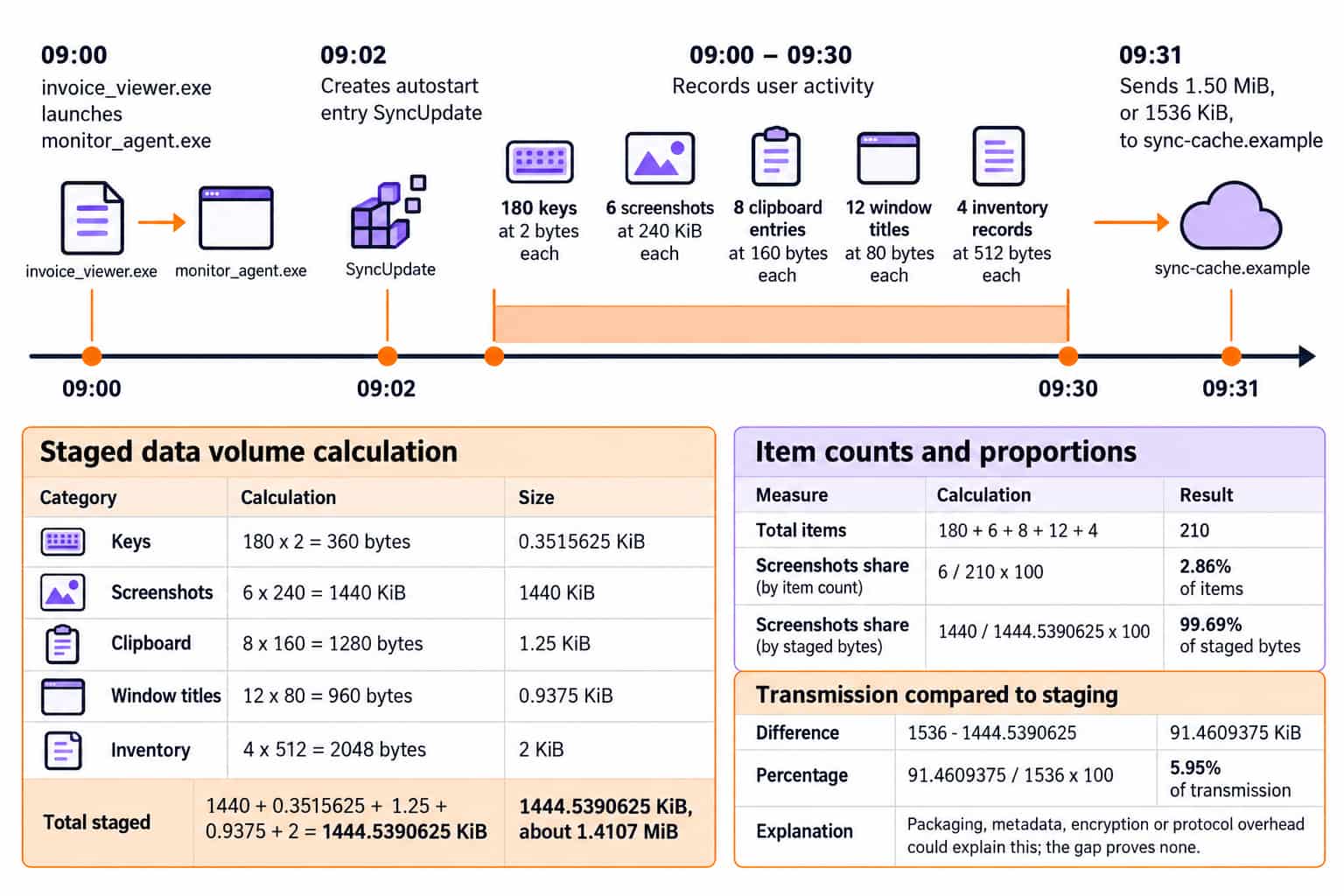
sync-cache.example uses the reserved .example domain, while invoice_viewer.exe, monitor_agent.exe and SyncUpdate are fictional labels. At 09:00, invoice_viewer.exe launches monitor_agent.exe; at 09:02 it creates autostart entry SyncUpdate. From 09:00 through 09:30 it records 180 keys at 2 bytes each, 6 screenshots at 240 KiB each, 8 clipboard entries at 160 bytes each, 12 window titles at 80 bytes each and 4 inventory records at 512 bytes each. At 09:31 it sends 1.50 MiB, or 1536 KiB, to sync-cache.example.
Keys:
180 x 2 = 360 bytes = 0.3515625 KiB.Screenshots:
6 x 240 = 1440 KiB.Clipboard:
8 x 160 = 1280 bytes = 1.25 KiB.Window titles:
12 x 80 = 960 bytes = 0.9375 KiB.Inventory:
4 x 512 = 2048 bytes = 2 KiB.Total staged:
1440 + 0.3515625 + 1.25 + 0.9375 + 2 = 1444.5390625 KiB, about1.4107 MiB.
Items total 180 + 6 + 8 + 12 + 4 = 210. Screenshots are 6 / 210 = 2.86% of items but 1440 / 1444.5390625 x 100 = 99.69% of staged bytes. Transmission exceeds staging by 1536 - 1444.5390625 = 91.4609375 KiB, which is 91.4609375 / 1536 x 100 = 5.95% of transmission. Packaging, metadata, encryption or protocol overhead could explain this; the gap proves none.
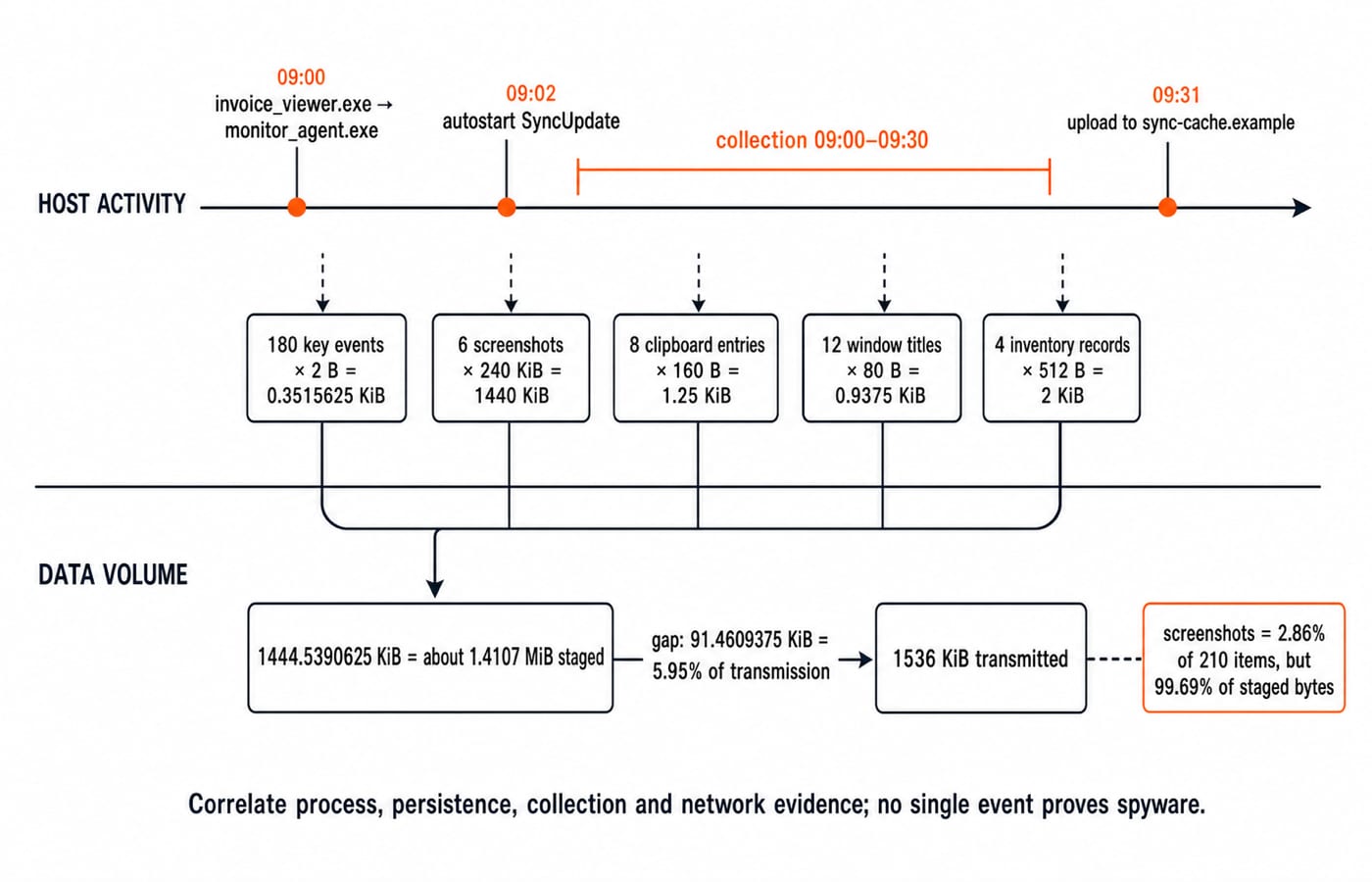
Read the trace as correlated evidence, not an automatic verdict
Launch, autostart, five collection categories and timed transfer are observations. Covert monitoring with persistence and staged exfiltration is an inference. Proof needs approved-software inventory, signer, hash, installation record, authorisation, destination owner, contents, process memory and policy.
Evidence | What it supports | Benign alternative | Next check |
|---|---|---|---|
| disguised delivery hypothesis | approved plug-in or updater | verify package origin and signer |
| persistence | authorised agent startup | compare with change record and baseline |
keys + clipboard + screenshots | surveillance capability | approved testing or accessibility workflow | inspect scope, consent and captured content |
1536 KiB to | possible exfiltration | approved telemetry or backup | identify destination owner and correlate payload timing |
Four correlated signals strengthen the malicious-monitoring hypothesis, but they do not prove a named actor, a spyware family or credential theft.
Distinguish the families that scenario questions mix together
Scenario clue | Best primary label | Why | Do not overclaim |
|---|---|---|---|
secretly records keys and sends them away | keylogger with spyware behaviour | capability plus covert collection and transfer | not every keylogger is a standalone program |
pretends to be an invoice viewer and installs the monitor | trojan delivery of spyware | disguise describes delivery, surveillance describes payload | one case can have both labels |
alters low-level views to hide the monitor | rootkit capability protecting spyware | hiding and privilege are the decisive clues | rootkit does not specify the stolen data |
encrypts files and demands payment | ransomware | denial plus extortion is primary | recording system information does not make it spyware-first |
approved visible agent reports CPU and process health | legitimate system monitor | authorisation, scope and destination fit policy | monitoring behaviour alone is not malware |
Layer rule: trojan says how software arrives, rootkit how it hides, keylogger what it records, and spyware why it gathers information. Labels can coexist without being synonyms. When advertising software records browsing beyond disclosed consent and sends it to a third party, adware names the advertising function and spyware behaviour names covert or unauthorised tracking. Not all adware is spyware.
Choose controls from surveillance evidence, not the malware label
Observed signal | Control and limit |
|---|---|
Unexpected installer or autostart | Restrict installation, apply least privilege and baseline persistence; this exposes unauthorised execution without trusting a process name |
Keys, clipboard and screenshots staged locally | Preserve process, memory and file evidence, then isolate through the authorised procedure without destroying the timeline |
Transfer to a confirmed malicious destination | Block the destination and rotate exposed credentials from a known-clean device; blocking does not remove persistence |
Compromise confirmed after evidence preservation | Rebuild from a trusted image and verify that persistence and transfers are gone |
Preserve the 09:00 to 09:31 timeline, file and process metadata, the SyncUpdate change and network records before cleanup. MFA may devalue a captured password but cannot stop screenshots. Blocking one destination cannot remove persistence. A trusted-image reinstall follows evidence preservation and credential review.
Exam traps and short classification drills
Monitoring capability does not prove malware. Authorisation, transparency, scope and purpose matter.
Keylogger is a capability. Spyware is the broader malicious collection purpose.
Trojan describes deceptive delivery, not every later action.
Rootkit concerns hiding or privileged control, not a particular data target.
Encrypted outbound traffic may be benign or malicious. Correlate it with host events.
Classify each case before reading the answer after the arrow:
Approved visible agent sends CPU load every five minutes to the company server -> legitimate monitoring in the supplied facts.
Fake PDF reader secretly records passwords and uploads them -> trojan delivery plus keylogger and spyware behaviour.
Program hides processes but shows no collection -> rootkit is supported; spyware is not established.
Tool takes 10 screenshots at 300 KiB each and sends 3.2 MiB ->
3000 KiBstaged,3276.8 KiBsent and276.8 KiBdifference using binary units.
Classify each stem as a definition, clue match, stage order, control choice, benign-versus-malicious decision or incident-table calculation. The supplied facts determine the answer.
Short version and the next step
Ask: What was collected? Was it authorised and disclosed where required? How did it persist? Where did data go? Which evidence links events? Aligned process, persistence, collection and transfer support the hypothesis, not a magic 1536 KiB threshold or process name.
A defensible conclusion has two clauses: the process tree, autostart, input capture, staging and transfer support covert monitoring; they do not yet identify an actor, prove credential theft or exclude authorised software. That wording states the strongest justified finding without converting a hypothesis into a verdict.
Learn concepts with NTA-UGC-NET Paper 2, then practise through the UGC NET Computer Science and Applications Test Series. Classify evidence before naming malware.
Go deeper with the full courseUGC NET Computer Science (Paper 1 + Paper 2)
Keep learning

Program and System Threats in Operating Systems: Worked Attack Trace and Exam Traps
Learn to separate program and system threats by trigger, propagation, target and effect, then test the method on one fully worked fictional attack trace.
Updated 18 Nov 20266 min readOperating Systems
Language Processing System Interview Questions and Answers: Trace Source to Execution
Trace two C files from preprocessing to execution, then explain why compilation can succeed while linking fails. Practise short answers using the same example.
Updated 12 Nov 20266 min readCompiler Design
System Calls and Dual Mode in OS: Mode-Bit Trace, Worked Example and Exam Traps
Follow one read() call across the user-kernel boundary, calculate its stated overhead, and learn the distinctions that make system-call questions easier.
Updated 30 Oct 20265 min readOperating Systems
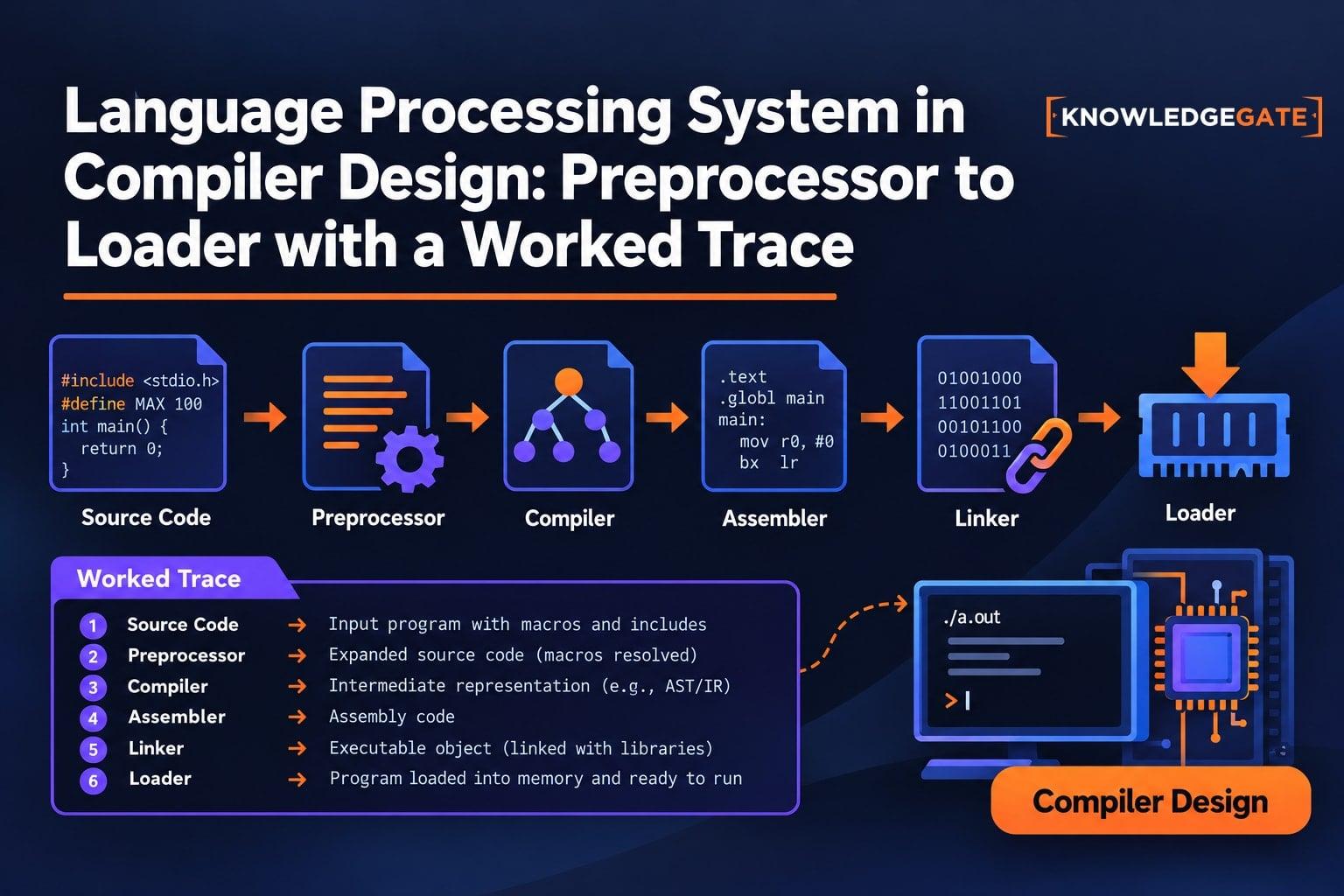
Language Processing System in Compiler Design: Preprocessor to Loader with a Worked Trace
Follow one macro-containing C program through every language processor. The trace shows object-file relocation, a linker patch of +4, and the final value 7.
Updated 18 Sep 20265 min read62 viewsCompiler Design