

Data Protection, IPR & Open Source MCQs: 12 Solved Questions with Explanations
Solve 12 data protection, IPR and open-source MCQs with explanations that separate privacy, patents, copyright, trademarks, Creative Commons and GPL duties.
KnowledgeGate Team
Exam prep & CS education
Updated 4 Nov 20268 min read
Data privacy, copyright, patents, trademarks, Creative Commons and open source sound related, but the exam tests the boundary between them. A logo, a source-code file and a water-purification method need three different classifications. That is why memorising a single definition is not enough.
The 12 questions test data protection, IPR and open-source concepts through exam-style scenarios. Choose an option before opening the explanation. KnowledgeGate has 50+ practice questions on this exact topic inside UGC NET CS Exam Preparation. Linked solutions provide additional detail, while the explanations here resolve the remaining questions.
Build the six-bucket map before attempting the MCQs
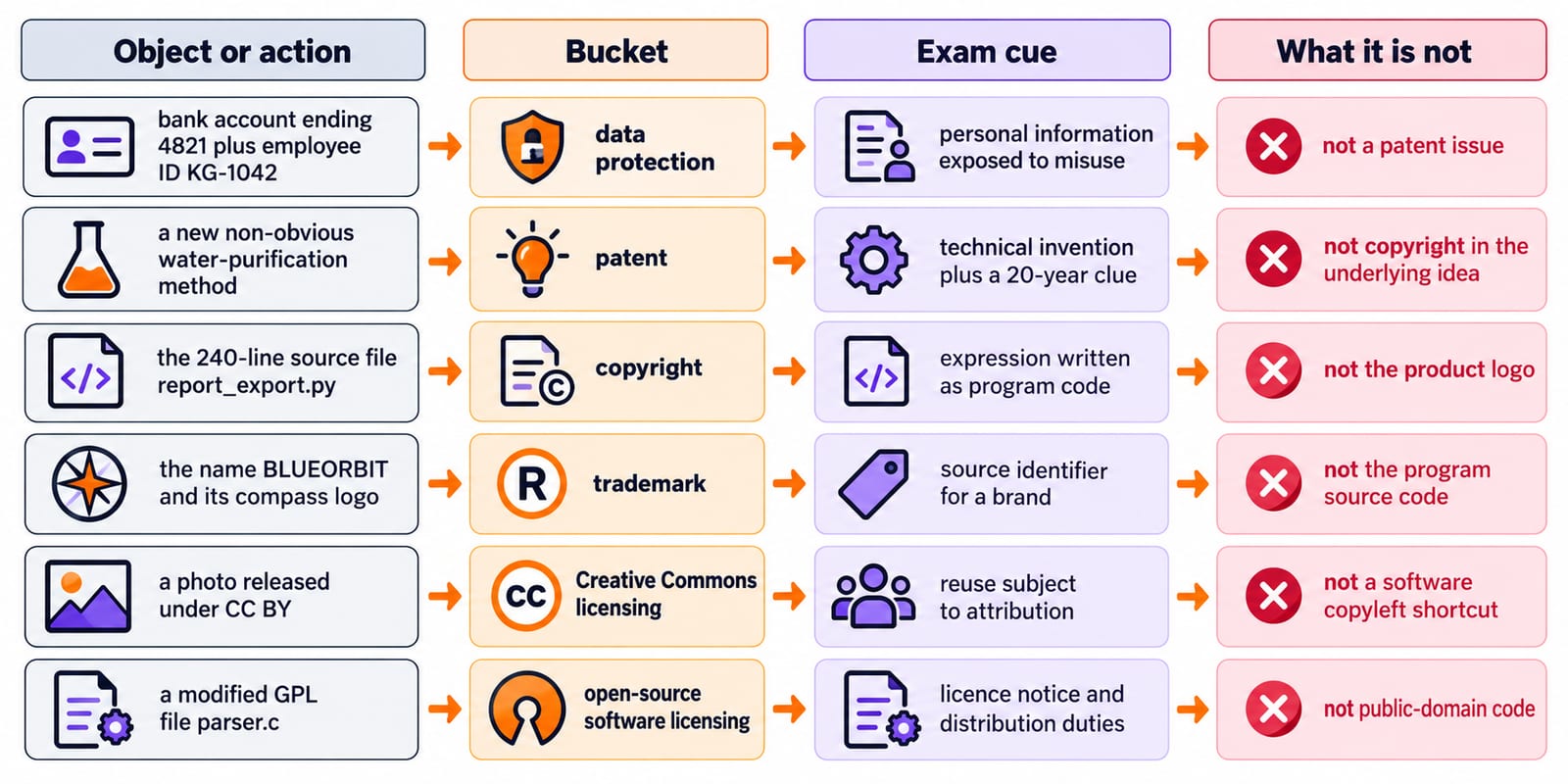
Object or action | Bucket | Exam cue | What it is not |
|---|---|---|---|
bank account ending 4821 plus employee ID KG-1042 | data protection | personal information exposed to misuse | not a patent issue |
a new non-obvious water-purification method | patent | technical invention plus a 20-year clue | not copyright in the underlying idea |
the 240-line source file report_export.py | copyright | expression written as program code | not the product logo |
the name BLUEORBIT and its compass logo | trademark | source identifier for a brand | not the program source code |
a photo released under CC BY | Creative Commons licensing | reuse subject to attribution | not a software copyleft shortcut |
a modified GPL file parser.c | open-source software licensing | licence notice and distribution duties | not public-domain code |
Sort the six assets: (1) a 2,400-row customer CSV is data protection; (2) the 240-line report_export.py is copyright; (3) a new filtration process is patent; (4) BLUEORBIT is trademark; (5) a CC BY 4.0 tutorial image raises permission; (6) a modified GPL file raises software-licence compliance. One product can occupy several buckets.
Questions 2, 4, 7 and 9 do not have a question-specific page. Use the Data Protection, IPR & Open Source question hub for those four; every linked question heading opens its exact bank question.
Data protection MCQs 1-3: purpose, sensitive information and the DPDP Act
Question 1
Bank attribution: HPSC PGT Computer Science, 2018.
The main purpose of the Data Protection Act is to
A. protect personal privacy
B. prevent viruses
C. increase the security of computer systems
D. reduce project failures
Correct answer: A. protect personal privacy.
Data protection concerns information connected to people. Viruses and system security are technical; project failure is management. With no jurisdiction named, choose the general privacy answer.
Open the full solved question.
Question 2
Sensitive data includes:
A. Bank account details
B. Personal identification
C. Both of the above
D. Public posts only
Correct answer: C. Both of the above.
Bank details can enable financial misuse; identification data can enable impersonation. The 2,400-row CSV carries both, so A and B apply. Sensitive data here is a broad ICT-study term, not a DPDP Act category.
Question 3
Bank attribution: UPPSC Polytechnic Lecturer, Computer Science, 2024.
In context of the Digital Personal Data Protection Act, 2023, which of the given following is correct?
A. “Child” means an individual who has not completed the age of eighteen years
B. “Digital personal data” means personal data in physical form
C. “Chairperson” does not mean the chairperson of the board
D. “Data” means representation of facts only
Correct answer: A. “Child” means an individual who has not completed the age of eighteen years.
The Digital Personal Data Protection Act, 2023 gives that definition. B swaps digital for physical form, C negates the Board relationship, and D reduces data to facts only.
Open the full solved question.
IPR MCQs 4-6: the umbrella term, patents and software copyright
Question 4
IPR stands for:
A. Internet Privacy Rule
B. Intellectual Property Rights
C. Internal Protection Regulation
D. Indian Policy Rule
Correct answer: B. Intellectual Property Rights.
IPR means Intellectual Property Rights. Patent fits the filtration invention, copyright fits report_export.py, and trademark fits BLUEORBIT. The distractor expansions are invented.
Question 5
Bank attribution: UPPSC Polytechnic Lecturer, Computer Science, 2026.
A scientist invents a new, non-obvious method for purifying water and wants to prevent others from making or selling this specific technology for a limited period of 20 years. Which protection should they apply for?
A. Patent
B. Geographical Indication
C. Industrial Design
D. Copyright
Correct answer: A. Patent.
The cues are new, non-obvious method, making or selling, and 20 years. WIPO's patent FAQ gives a general 20-year term from filing. Geographical indication concerns origin, industrial design concerns appearance, and copyright protects expression, not this method.
Open the full solved question.
Question 6
Bank attribution: UPPSC Polytechnic Lecturer, Computer Science, 2026.
Which form of Intellectual Property Rights (IPR) is most commonly used to protect the actual source code of a software program?
A. Patent
B. Copyright
C. Trademark
D. Open Source
Correct answer: B. Copyright.
Actual source code is written expression. WIPO's software guidance places programs under copyright, but excludes abstract ideas, procedures and methods. Trademark identifies a brand; open source is a licensing model. Copyright fits the 240-line report_export.py.
Open the full solved question.
Rights and reuse MCQs 7-9: trademarks, plagiarism and Creative Commons
Question 7
Unauthorized use of a brand name or logo falls under:
A. Patent breach
B. Trademark infringement
C. Copyright violation
D. Data misuse
Correct answer: B. Trademark infringement.
WIPO describes a trademark as a sign distinguishing an enterprise's goods or services. That cue fits a name or logo, not Question 6's code or Question 5's method.
Question 8
Bank attribution: BPSC, 2025.
Sangeeta asks her colleague for her project work and then copies the entire work and submits it to her team leader claiming it to be her own work. The act performed by Sangeeta is known as __________.
A. Phishing
B. Plagiarism
C. Spamming
D. Virus
Correct answer: B. Plagiarism.
Claiming another person's work as one's own is plagiarism. Phishing deceives, spamming sends unwanted messages, and a virus is malicious code. Plagiarism concerns attribution; copyright infringement depends on additional facts absent here.
Open the full solved question.
Question 9
Which license allows creators to share their work while specifying how others may use it?
A. Patent License
B. Creative Commons License
C. Trademark License
D. Government License
Correct answer: B. Creative Commons License.
Creative Commons licences standardise permissions for creative works. CC BY 4.0 permits reuse and adaptation with attribution; other variants add noncommercial, no-derivatives or share-alike conditions. Creative Commons recommends purpose-built licences for software.
Open-source MCQs 10-12: Apache and GPL duties, the GPL name and a quality caveat
Question 10
Bank attribution: UPPSC Polytechnic Lecturer, Computer Science, 2026.
Which of the following is a common requirement found in both the Apache License and the GPL in software licensing?
A. Both prevent the code from being used on mobile devices
B. Both require the final version of product to be strictly non-commercial
C. Both require you to pay a fee to the original developers
D. Both require that all modified files include prominent notices stating that you changed the files
Correct answer: D. Both require that all modified files include prominent notices stating that you changed the files.
Apache License 2.0 and GNU GPL v2 section 2(a) both require prominent change notices in modified files. That narrow overlap makes D correct. Neither imposes a mobile ban, blanket non-commercial rule or mandatory fee. Their wider duties differ.
Open the full solved question.
Question 11
Bank attribution: UPPSC Polytechnic Lecturer, Computer Science, 2026.
In the field of computers, GPL stands for:
A. GNU General Public License
B. General Protection of Licenses
C. Generic Programming Language
D. Popular Programming Logical Algorithm
Correct answer: A. GNU General Public License.
The exact expansion is GNU General Public License, including GNU. The other choices are invented. GPL governs copying, modifying and redistributing covered code, but one version's clause cannot represent every open-source licence.
Open the full solved question.
Question 12
Bank attribution: BPSC, 2025.
Which of the following could be a disadvantage of 'open source' software?
A. High quality software with lots of features
B. Not as customizable
C. May not have been tested as much as proprietary software so might have bugs
D. You can edit the source code to customize it
Correct answer: C. May not have been tested as much as proprietary software so might have bugs.
Read could. A and D can be advantages, while B conflicts with the Open Source Definition modification baseline. C is the possible risk here, not a claim that every open-source project is less tested or lower quality.
Open the full solved question.
The six traps these data protection, IPR and open-source MCQs use
Trap | Questions | Correction |
|---|---|---|
generic privacy law versus a named statute | Q1 and Q3 | use the exact statute only when the stem names it |
broad study term versus legal definition | Q2 | do not call sensitive data a DPDP Act term |
idea, expression and brand | Q5-Q7 | patent, copyright and trademark answer different object cues |
plagiarism versus copyright | Q8 | attribution failure and legal infringement are not automatically identical |
Creative Commons versus software licences | Q9-Q11 | CC is for creative works, while Apache and GPL are purpose-built software licences |
could versus always | Q12 | choose a possible risk without stereotyping all open-source projects |
For worked concept teaching, use Data Protection, IPR and Open Source Explained: Two Worked Cases and Exam Traps. That explainer develops lifecycle and licensing casework; this question set tests retrieval, option analysis and answer cues.
Re-test the boundary cases and choose the next study step
Cover the correct-answer lines and defend each choice with one rejecting clue: a technical method is not expression, source code is not a brand, a logo is not an invention, and a reuse licence is not a patent.
The short version: classify the object, check jurisdiction or licence names, then inspect could, only and both. Concept learners can use the NTA UGC NET Paper 1 Course. For timed practice, use the UGC NET exam hub.
Create six two-sided cards: object on the front, governing right or licence plus one disqualifying cue on the back. Keep every missed card in a second pile until you can explain both the correct bucket and its nearest distractor.
Go deeper with the full courseUGC NET Computer Science (Paper 1 + Paper 2)
Keep learning

Data Protection, IPR and Open Source Explained: Two Worked Cases and Exam Traps
Separate privacy from security, match IP rights to software assets, and solve two numerical cases on data minimisation and mixed-licence releases.
Updated 12 Oct 20266 min readUGC NET Computer Science

Open Addressing Probing MCQs: 12 Solved Questions with Explanations
Solve 12 open-addressing MCQs with worked probe sequences, collision traces, wrap-around cases, clustering rules and insertion-order constraints.
Updated 16 Sep 20268 min readData Structures MCQs
Data Structures Basics and Types MCQs: 12 Solved Questions with Explanations
Attempt 12 data structures basics MCQs, then use the concise solutions to correct common errors about representation, classification, access, and operations.
Updated 31 Oct 20267 min readData Structures MCQs

Data Hazards and Solutions MCQs: 12 Solved Questions with Explanations
Test yourself on 12 published data-hazard questions, then check concise explanations for dependencies, forwarding, renaming and variable-latency pipeline timing.
Updated 9 Sep 20268 min read84 viewsComputer Organization MCQs