

Advanced and Financial Cyber Attacks: Concepts, Worked Analysis and Exam Traps
Learn to separate APTs, zero-days, credential attacks and financial attack methods, then analyse a fictional login-to-transaction signal funnel step by step.
KnowledgeGate Team
Exam prep & CS education
Updated 3 Nov 20266 min read
APT, zero-day, credential stuffing, business email compromise, salami attacks and card skimming are often memorised as one undifferentiated list. That makes a scenario question feel like guesswork when several labels appear plausible. A better method is to classify an attack by its entry vector, persistence, target and objective, then follow the evidence through the incident chain. An indicator supports a hypothesis, but it does not prove attribution on its own. Practise these distinctions in the UGC NET CS Exam Preparation category, which places the topic within the wider syllabus.
What makes an attack advanced, persistent or financial?
Advanced describes tailored tooling, stealth, privilege abuse or evasion, not simply a large loss. Persistent means continued access or repeated attempts to retain it. Financial describes the objective or workflow, such as credential theft, payment redirection, transaction manipulation, extortion or abuse of a card or ATM channel.
Term | Entry or mechanism | Defining clue | Immediate objective | Do not confuse with |
|---|---|---|---|---|
APT | Targeted multi-stage intrusion | Stealth plus durable access | Long-term intelligence or later action | Any one-off malware infection |
Zero-day exploit | Previously unknown or unpatched weakness | Exploit precedes an available fix or defender knowledge | Initial access or privilege gain | Every old unpatched vulnerability |
Supply-chain compromise | Trusted vendor, update or dependency | Trust path is abused | Reach many downstream systems | Ordinary phishing |
Living off the land | Legitimate system tools | Normal binaries perform malicious actions | Evade simple allowlists | Assuming malware-free means harmless |
Financial cyber attack | Account, card, payment or transaction workflow | Monetary objective or financial-system target | Theft, redirection, manipulation or extortion | Every attack against a bank's website |
For structured coverage, continue with the NTA-UGC-NET Paper 2 course.
Build two chains: intrusion and financial abuse
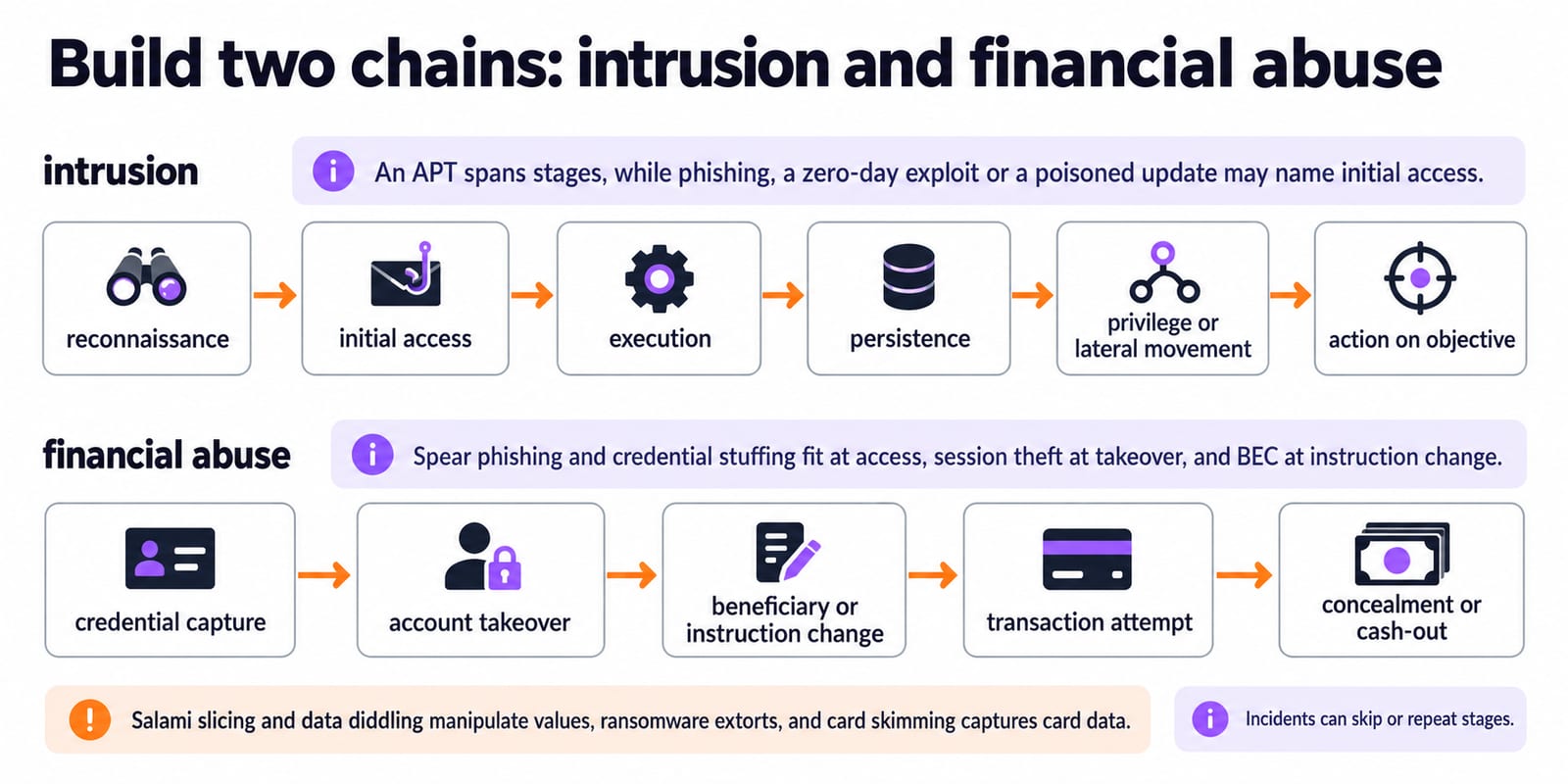
Use reconnaissance -> initial access -> execution -> persistence -> privilege or lateral movement -> action on objective. An APT spans stages, while phishing, a zero-day exploit or a poisoned update may name initial access.
A financial path can run as credential capture -> account takeover -> beneficiary or instruction change -> transaction attempt -> concealment or cash-out. Spear phishing and credential stuffing fit at access, session theft at takeover, and BEC at instruction change. Salami slicing and data diddling manipulate values, ransomware extorts, and card skimming captures card data. Incidents can skip or repeat stages.
Computer Networks helps separate DNS, HTTP, transport connections and identity systems within the attack surface. Not every cyber attack is a networking attack.
Worked example: calculate the signal funnel
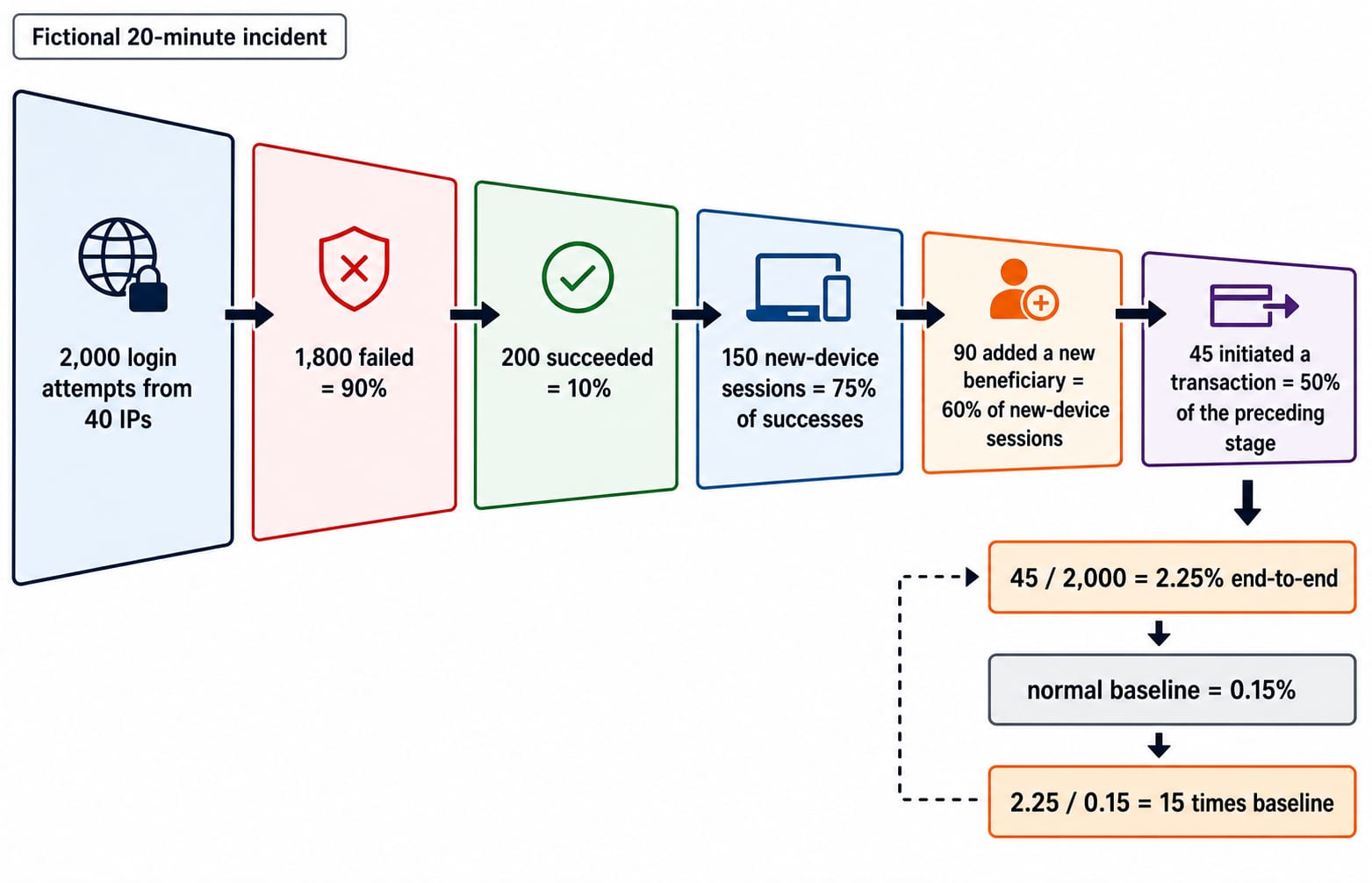
In a fictional 20-minute window, a payment portal receives 2,000 login attempts from 40 IP addresses. Of these, 1,800 fail and 200 succeed. Among the successes, 150 use new devices, 90 of those add a new beneficiary, and 45 then initiate a transaction. In comparable normal windows, 0.15% of all attempts reach this combined condition.
Use the correct denominator at each stage:
Failure rate =
1,800 / 2,000 x 100 = 90%.Successful-login rate =
200 / 2,000 x 100 = 10%.New-device share among successes =
150 / 200 x 100 = 75%.New-beneficiary share among new-device sessions =
90 / 150 x 100 = 60%.Transaction-initiation share at the preceding stage =
45 / 90 x 100 = 50%.End-to-end suspicious-path rate =
45 / 2,000 x 100 = 2.25%.Elevation over baseline =
2.25% / 0.15% = 15 times.
The 40-IP fan-out, 90% failure rate and 15 times elevation support a credential-attack and account-takeover hypothesis, followed by payment abuse. They do not prove credential stuffing, identify an attacker or make all 45 attempts fraudulent. Check leaked-credential reuse, device fingerprints, session tokens, beneficiary history, authentication events and transaction outcomes.
Financial attacks name different layers of the same incident
Attack | What is abused | Recognition clue | Typical financial objective | First control layer |
|---|---|---|---|---|
Spear phishing or BEC | Human trust and message context | Tailored sender or payment instruction | Credential theft or payment redirection | Out-of-band verification plus mail controls |
Credential stuffing | Reused username-password pairs | Many known pairs tried across accounts | Account takeover | Unique passwords, rate limits and MFA |
Password spraying | One or a few common passwords | Few guesses across many accounts | Account takeover | Lockout-aware detection and MFA |
Ransomware | Data or system availability | Encryption or access denial plus extortion | Extortion | Least privilege, segmentation and recoverable backups |
Salami attack | Repeated small data or transaction changes | Tiny changes aggregate over time | Covert diversion | Reconciliation and integrity monitoring |
Data diddling | Data before or during processing | Input is altered while processing appears normal | Record or transaction manipulation | Validation, separation of duties and audit trails |
Card skimming | Card and PIN capture channel | Hidden or tampered capture device | Unauthorised card use | Device inspection and transaction monitoring |
APT | Sustained targeted access | Multiple stealth and persistence signals | Intelligence, disruption or staged fraud | Layered prevention, detection and response |
Labels may name methods, campaigns, payloads or objectives. BEC can combine phishing, stolen credentials and payment redirection, so several labels may fit different layers. Application Layer Protocols: DNS and HTTP covers web and name-resolution surfaces.
Map controls to the login-to-transaction funnel
Login attempts: Rate limits and MFA reduce automated guessing and account takeover. Analyse the 2,000-attempt pattern instead of blocking all 40 IP addresses mechanically.
New-device success: Step up authentication for the 150 sessions and invalidate a session when verification fails.
Beneficiary addition: Independently verify the 90 additions and apply separation-of-duties or cooling controls where policy requires them.
Transaction attempt: Hold and review the 45 attempts using the combined risk signals. A hold prioritises investigation; it is not a fraud verdict.
Evidence and recovery: Preserve the 20-minute chronology and correlate account, device and session records before rotating credentials or restoring verified state.
Careless containment can destroy evidence. Preserve relevant logs and records while following the organisation's incident-response and legal process.
Separate method, campaign and objective in mixed scenarios
Credential stuffing uses reused credential pairs. Password spraying tries one or a few passwords across many accounts.
Phishing is the broad deceptive-message method. Spear phishing is targeted.
Vishing uses voice. Smishing uses SMS.
Authentication asks who the user is. Authorisation asks what an authenticated identity may do.
Zero-day describes vulnerability or exploit timing. APT describes a sustained campaign.
A financial objective does not make every technical stage a separate financial attack.
Classify these four scenarios:
One password is tried once against 500 employee accounts.
Five hundred leaked username-password pairs are tested against their matching accounts.
A supplier's signed update installs a backdoor on 80 customer systems.
Unauthorised changes of 1 unit across 600 records accumulate to 600 diverted units.
Answers: (1) password spraying, (2) credential stuffing, (3) supply-chain compromise, and (4) salami attack.
Assertion: Every APT must use a zero-day exploit. Reason: APTs are targeted and persistent. The assertion is false, while the reason can be true. An APT may begin with phishing, stolen credentials or a known vulnerability.
Use a two-axis method in exam questions
First locate the layer named by the prompt: entry method, persistence or campaign, financial objective, evidence, or control. Then test the decisive clue against close alternatives. Term matching, chain ordering, control selection, calculations and assertion-reason items all use this two-axis method. Confirm exam-specific syllabus, marks, dates or pattern in the relevant exam body's current official notice.
The funnel prioritises investigation, not proof of fraud or attribution. Redraw the six-stage chain and recompute it without looking. Then change 45 to 30: 30 / 2,000 x 100 = 1.5%, and 1.5% / 0.15% = 10 times the baseline.
Concept learners should continue with the NTA-UGC-NET Paper 2 course linked above. Practice-ready learners can use the NTA UGC NET Paper 2 Test Series after reproducing the chain and calculations unaided.
Go deeper with the full courseUGC NET Computer Science (Paper 1 + Paper 2)
Keep learning

Cyber Threats and Malware Attacks: Types, Attack Vectors, and Worked Security Problems
Learn to distinguish malware classes, map attacks to the CIA triad, and solve password, cipher, and key-count numericals. The guide also covers common attack vectors and a safe way to study Indian cyber law.
Updated 30 Oct 20266 min readGATE Strategy & Roadmap
Cyber Threats and Attacks Explained: Types, Worked DDoS Example and Exam Traps
Learn to separate threats, vulnerabilities, vectors and attacks, then apply the distinctions to a calculated DDoS scenario and exam-style questions.
Updated 10 Oct 20266 min readComputer Networks

Cyber Threats and Attacks MCQs: 12 Solved Questions with Explanations
Attempt 12 cyber-security MCQs, then use the explanations and classification drills to separate attacks, controls, impacts and malware behaviours.
Updated 30 Oct 20267 min readComputer Networks MCQs

Cyber Threats and Malware Attacks: Types, Attack Chains and a Worked Incident
Learn to separate vectors, techniques and payloads, classify mixed malware behaviour, calculate exposure, and map controls to each incident stage.
Updated 26 Jul 20266 min readDBMS