

Simple Interest and Compound Interest: Formulas, Shortcuts and Worked Examples
Learn why simple interest keeps the principal fixed while compound interest resets the base. Then practise direct, reverse, half-yearly, and split-sum questions.
KnowledgeGate Team
Exam prep & CS education
Updated 4 Nov 20265 min read
Simple interest and compound interest questions can look almost identical. The deciding detail is the base: simple interest keeps the original principal fixed, while compound interest adds each period's interest before calculating the next period. Once you spot that distinction, formula selection becomes much easier. The examples move from a shared comparison to direct, reverse, changing-rate, and split-sum questions used in placement aptitude preparation.
Simple Interest vs Compound Interest: The One Difference That Controls the Method
Let principal be P, annual rate be R, time in years be T, interest be I, and final amount be A. Since an amount includes both principal and interest, A = P + I.
For simple interest:
SI = PRT/100
For annual compound interest:
A = P(1 + R/100)^T and CI = A - P
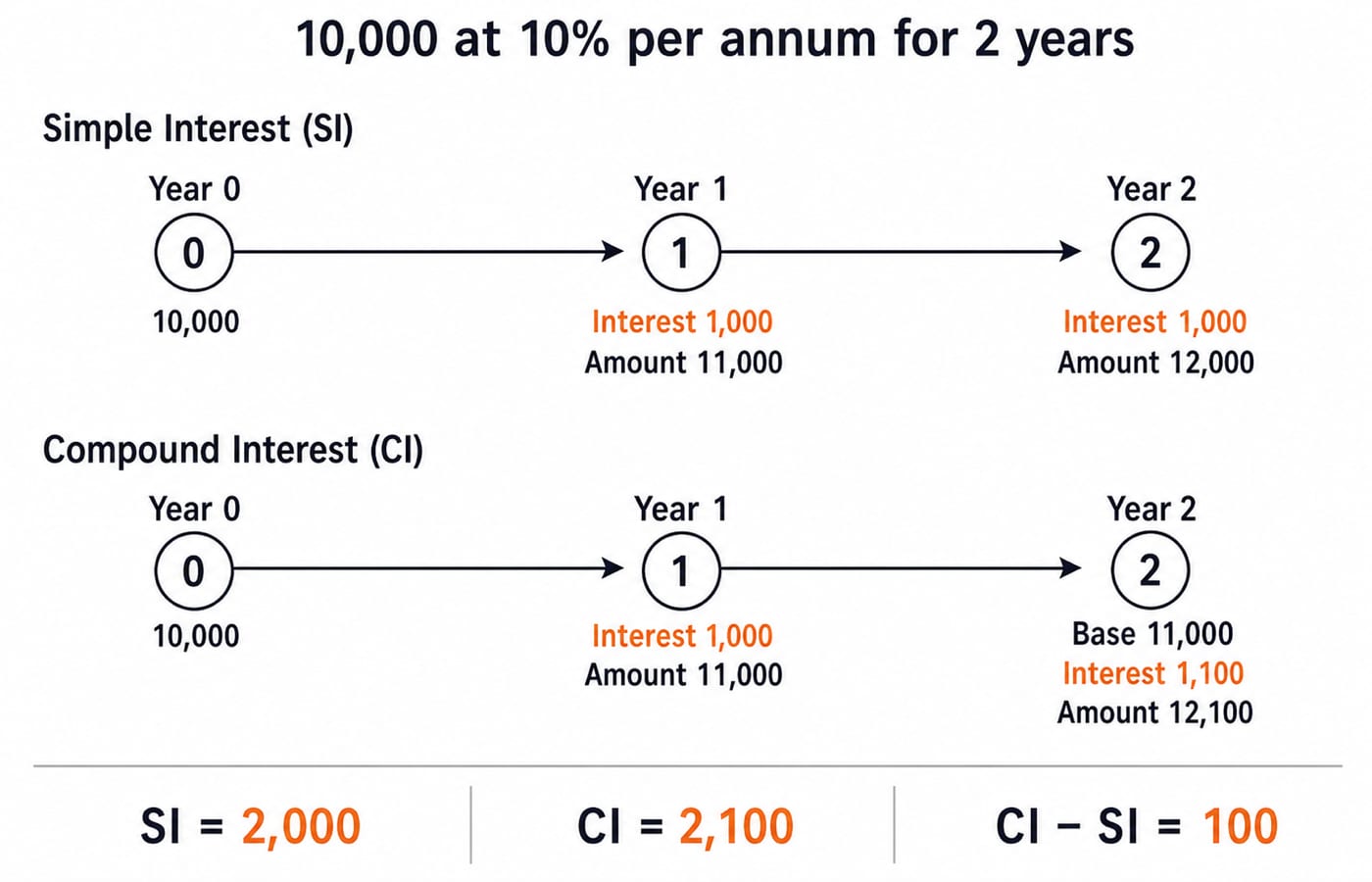
Take P = 10,000, R = 10% p.a., and T = 2 years.
With SI, the interest is calculated on 10,000 in both years:
SI = 10,000 × 10 × 2/100 = 2,000
Therefore, A = 10,000 + 2,000 = 12,000.
With CI, year 1 interest is 1,000, so the balance becomes 11,000. Year 2 interest is 10% of 11,000, which is 1,100. The final amount is 12,100, so total CI is 2,100. Compounding creates the extra 100 because the second year's base includes the first year's interest.
Simple Interest: Solve Direct and Reverse Questions Without Losing Units
Suppose P = 7,500, R = 8% p.a., and T = 2.5 years. Substitute the values before calculating:
SI = 7,500 × 8 × 2.5/100 = 1,500
A = 7,500 + 1,500 = 9,000
If the time were given as 30 months, convert it to 2.5 years because the rate is annual.
For a reverse question, suppose the interest is 2,160 on 9,000 for 3 years. Rearrange the formula instead of guessing:
R = 100I/(PT)
R = (100 × 2,160)/(9,000 × 3) = 216,000/27,000 = 8% p.a.
A quick check reaches the same result. At 8% for 3 years, SI is 24% of the principal, and 24% of 9,000 = 2,160.
Compound Interest: Build the Amount Period by Period
For P = 12,000, R = 5% p.a., and T = 3 years, the multiplier method gives:
A = 12,000(1.05)^3 = 13,891.50
CI = 13,891.50 - 12,000 = 1,891.50
Check it year by year. The balances are 12,600 after year 1, 13,230 after year 2, and 13,891.50 after year 3. Both routes agree.
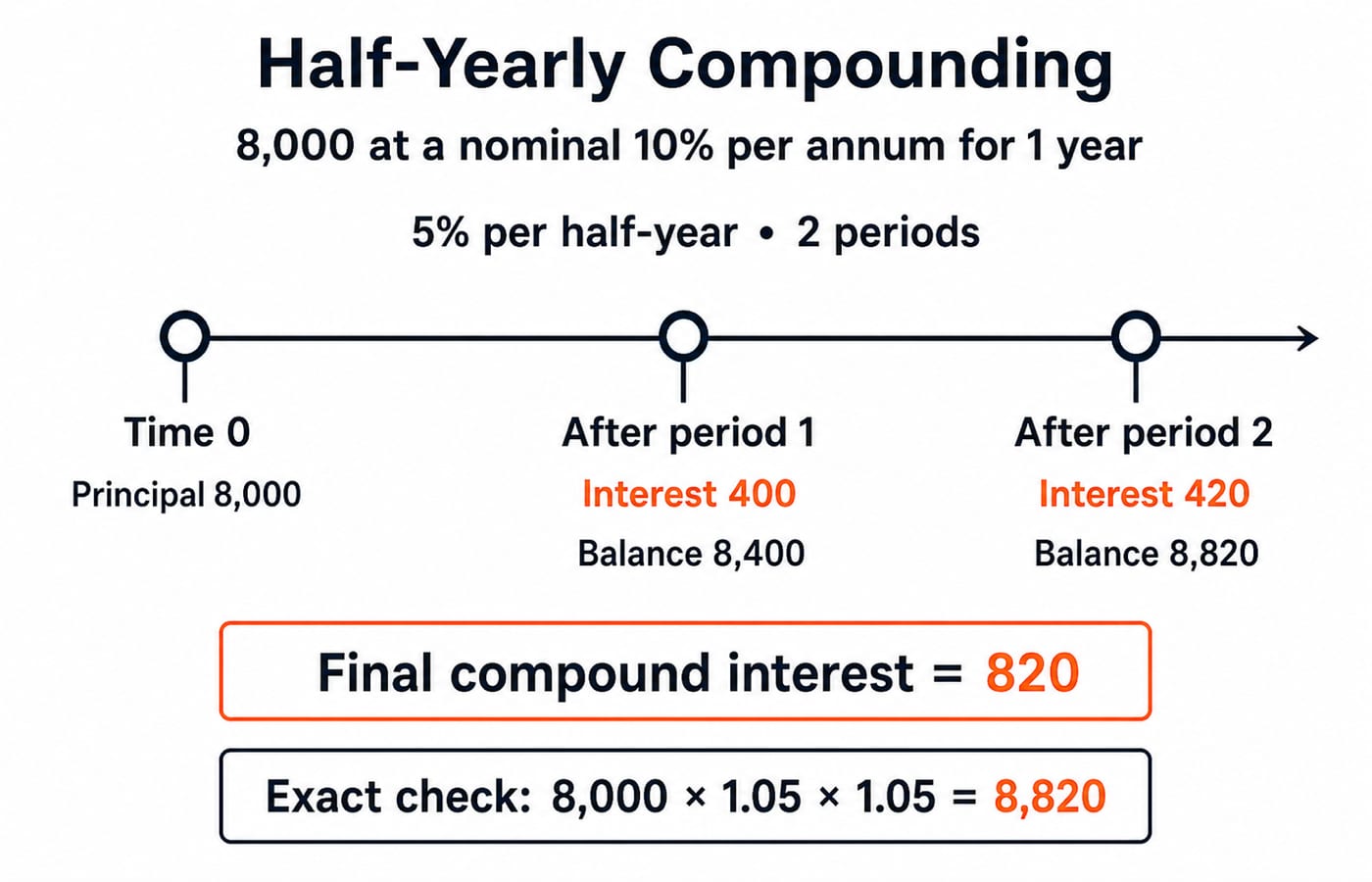
For half-yearly compounding, match the inputs to half-year periods. On 8,000 at a nominal 10% p.a. for 1 year, the rate per half-year is 5% and the number of periods is 2:
A = 8,000(1.05)^2 = 8,820
CI = 8,820 - 8,000 = 820
The general rule is to align rate and time with the compounding interval. For half-yearly compounding, use R/2 and 2T. For quarterly compounding, use R/4 and 4T.
Shortcuts That Follow From the Concept
For two years at the same annual rate, the CI-over-SI difference is the interest earned in year 2 on year 1's interest:
CI - SI = P(R/100)^2
For 20,000 at 8% for 2 years:
CI - SI = 20,000(0.08)^2 = 128
Verify the shortcut. SI = 20,000 × 8 × 2/100 = 3,200. Under compounding, CI = 20,000(1.08)^2 - 20,000 = 3,328. The difference is indeed 128.
Successive multipliers also handle changing rates. If 5,000 grows by 10% in year 1 and 20% in year 2:
A = 5,000 × 1.10 × 1.20 = 6,600
The total interest is 1,600, a 32% increase. Adding 10% and 20% would miss the 2% cross-effect. Use SI for a fixed original base, CI for a refreshed balance, and successive multipliers when rates change by period.
Translate Word Problems Into the Right Equation
If an amount becomes 13,310 after 3 years at 10% p.a. compounded annually, remember that 13,310 is the amount, not the interest:
13,310 = P(1.10)^3 = 1.331P
P = 13,310/1.331 = 10,000
Now consider a split investment. 12,000 is divided between 8% and 10% simple interest for one year, producing 1,080 interest. Put x at 8% and (12,000 - x) at 10%:
0.08x + 0.10(12,000 - x) = 1,080
0.08x + 1,200 - 0.10x = 1,080
0.02x = 120, so x = 6,000.
The check is 8% of 6,000 + 10% of 6,000 = 480 + 600 = 1,080.
Use the same four-line habit for any word problem: list the known values, decide whether the base resets, align rate with time, and write the equation before calculating.
How Competitive Exams Turn the Same Idea Into Different Questions
Questions can ask for interest or amount directly, a missing principal or rate, the SI-CI difference, a compounding-frequency conversion, changing rates, or a split sum. Placement-focused learners can connect these forms to the wider plan in Aptitude for Placements: Section Topics and Weekly Plan. Bank-exam learners can use Bank PO Quant: High-Yield Topics First to place interest questions within a broader revision sequence. SSC aspirants can use SSC CGL Quantitative Aptitude Strategy to fit the topic into an exam-focused study plan.
Question styles, syllabi, and instructions can change. Confirm the current requirements with the relevant recruiter or exam authority.
Use this 30-second triage order: underline amount or interest, circle the compounding frequency, convert time, choose the formula or multiplier, estimate the answer range, then calculate. For 8,000 at 10% half-yearly for 1 year, the correct inputs are 5% and 2 periods.
Common Traps and the Exact Correction for Each
Rate-period mismatch: For 10,000 at 12% p.a. compounded half-yearly for 18 months, use 6% for 3 periods. Then
A = 10,000(1.06)^3 = 11,910.16andCI = 1,910.16.Amount versus interest: A formula for
Agives the total balance. SubtractPonly if the question asks for compound interest.Resetting the wrong base: In the 10,000 at 10% comparison, year 2 CI is 10% of 11,000. Only SI continues to use 10,000.
Premature rounding: Retain the multiplier until the last step, then round money to paise if needed. The three-year amount above stays 13,891.50.
The Short Version and the Next Practice Step
SI uses a fixed base and PRT/100. CI uses a changing base and a period multiplier. Rate and time must refer to the same period, and an amount always includes the principal.
For a 15-minute mixed drill, solve these five prompts: direct SI on 7,500 at 8% for 2.5 years; reverse SI from 2,160; annual CI on 12,000 at 5% for 3 years; half-yearly CI on 8,000 at 10% for 1 year; and the SI-CI difference on 20,000 at 8% for 2 years. Solve each once normally, then again with the relevant check or shortcut.
For a structured route through the wider topic, continue with the Aptitude for Placement course.
Keep learning

Speed, Time and Distance: Formulas, Shortcuts and Solved Examples
Learn how to choose the right speed, time and distance model, keep units consistent, and solve common journey, train, boat and track problems.
Updated 5 Nov 20266 min readAptitude & Reasoning

Mensuration and Geometry for Competitive Exams: Formulas, Shortcuts and Solved Examples
Learn how to choose the right mensuration formula, avoid common geometry traps, and solve 2D path and 3D recasting problems step by step.
Updated 6 Oct 20266 min read74 viewsAptitude & Reasoning

Circular Permutations: Formulas and Shortcuts for Seating Problems
Learn how to choose the right circular permutation model, derive each formula, and solve together, apart, alternating, opposite, and fixed-gap cases.
Updated 8 Sep 20265 min read74 viewsAptitude & Reasoning

Bar Charts for Data Interpretation: Grouped and Stacked Questions Made Simple
Learn a reliable way to read grouped and stacked bar charts, choose the correct operation, and protect your answer from unit and percentage-base errors.
Updated 6 Sep 20266 min read55 viewsAptitude & Reasoning