

Speed, Time and Distance: Formulas, Shortcuts and Solved Examples
Learn how to choose the right speed, time and distance model, keep units consistent, and solve common journey, train, boat and track problems.
KnowledgeGate Team
Exam prep & CS education
Updated 5 Nov 20266 min read

Speed, time and distance questions become manageable when each model is tied to its units and a physical situation. Start with the basic relation, then choose inverse ratios, average speed or relative speed for journeys, trains, boats and circular tracks. These models recur in placement and government aptitude tests. Use the placement aptitude preparation, while remembering that the exact test pattern varies by exam.
1. Start with the Distance = Speed x Time Model
The basic model connects three quantities:
Distance = Speed x Time
Speed = Distance / Time
Time = Distance / Speed
Units must match the question. Kilometres and km/h produce time in hours. Metres and m/s produce time in seconds. If a question mixes these systems, convert before substituting.
To convert km/h to m/s, multiply by 5/18:
54 km/h x 5/18 = 15 m/s
To convert m/s to km/h, multiply by 18/5:
15 m/s x 18/5 = 54 km/h
Now the units fit a simple check. At 15 m/s, the time needed to cover 750 m is:
Time = 750/15 = 50 seconds
Before accepting an answer, test its direction. For a fixed distance, higher speed must mean lower time. At a fixed speed, doubling the distance must double the time.
2. Use Ratios When the Distance Stays Fixed
For the same distance, speed and time are inversely proportional. If the speed ratio is a:b, the time ratio is b:a.
Suppose speed falls by 20%, from 60 km/h to 48 km/h. The time does not rise by 20%. It is multiplied by 60/48 = 5/4, so it rises by 25%.
Take a 240 km journey. At 48 km/h:
Time = 240/48 = 5 hours
At 60 km/h:
Time = 240/60 = 4 hours
The higher speed saves 5 - 4 = 1 hour. The ratio method confirms this. Speeds are 48:60 = 4:5, so times are 5:4. Their one-part difference is 1 hour, giving 5 hours and 4 hours.
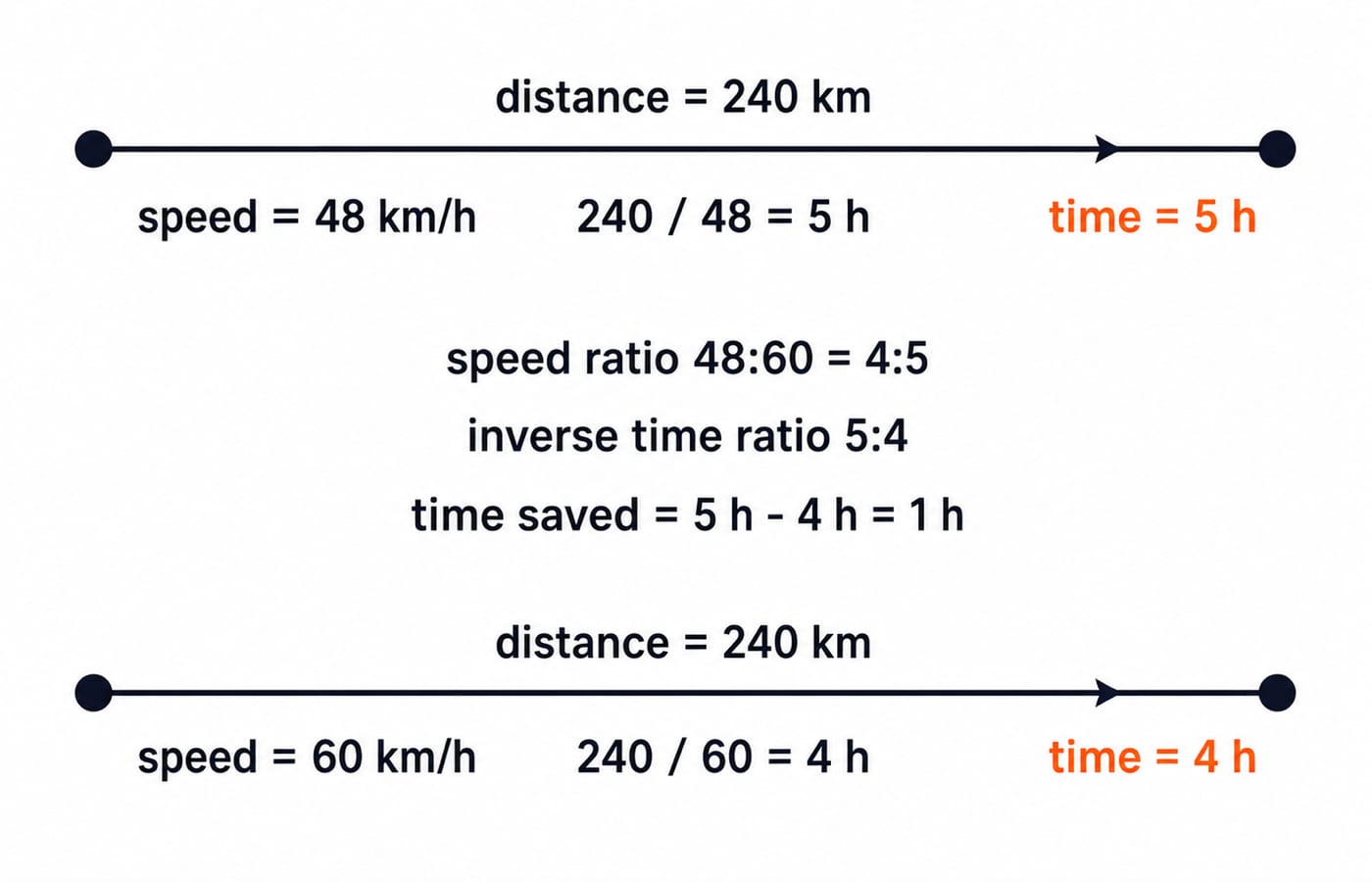
Use this inverse shortcut only when the distance is unchanged.
3. Average Speed Means Total Distance Divided by Total Time
Average speed is always total distance divided by total time. Do not average two speeds automatically.
Consider a trip with 150 km travelled at 50 km/h and 60 km travelled at 30 km/h:
First-leg time = 150/50 = 3 hours
Second-leg time = 60/30 = 2 hours
Total distance = 210 km
Total time = 5 hours
Average speed = 210/5 = 42 km/h
The result is not the arithmetic mean (50 + 30)/2 = 40 km/h because the two legs take different times.
For equal distances at speeds x and y, the shortcut is 2xy/(x + y). It is useful when the two distances are equal, but total distance divided by total time is the rule that works in every case.
This shortcut applies only when the two distances are equal. If the traveller instead moves for 2 hours at 40 km/h and 3 hours at 60 km/h, the distances are 80 km and 180 km. The average is:
(80 + 180)/(2 + 3) = 260/5 = 52 km/h
The general formula handles both cases.
4. Relative Speed Solves Meetings, Overtaking and Trains
Choose the sign before using a train formula. Objects moving towards each other use the sum of their speeds. Objects moving in the same direction use the difference. Convert all speeds to the same unit first.
Train A is 180 m long and travels at 72 km/h = 20 m/s. Train B is 120 m long and travels at 54 km/h = 15 m/s in the same direction.
Relative speed = 20 - 15 = 5 m/s
For a complete overtake, A must gain both train lengths:
Relative distance = 180 + 120 = 300 m
Overtaking time = 300/5 = 60 seconds
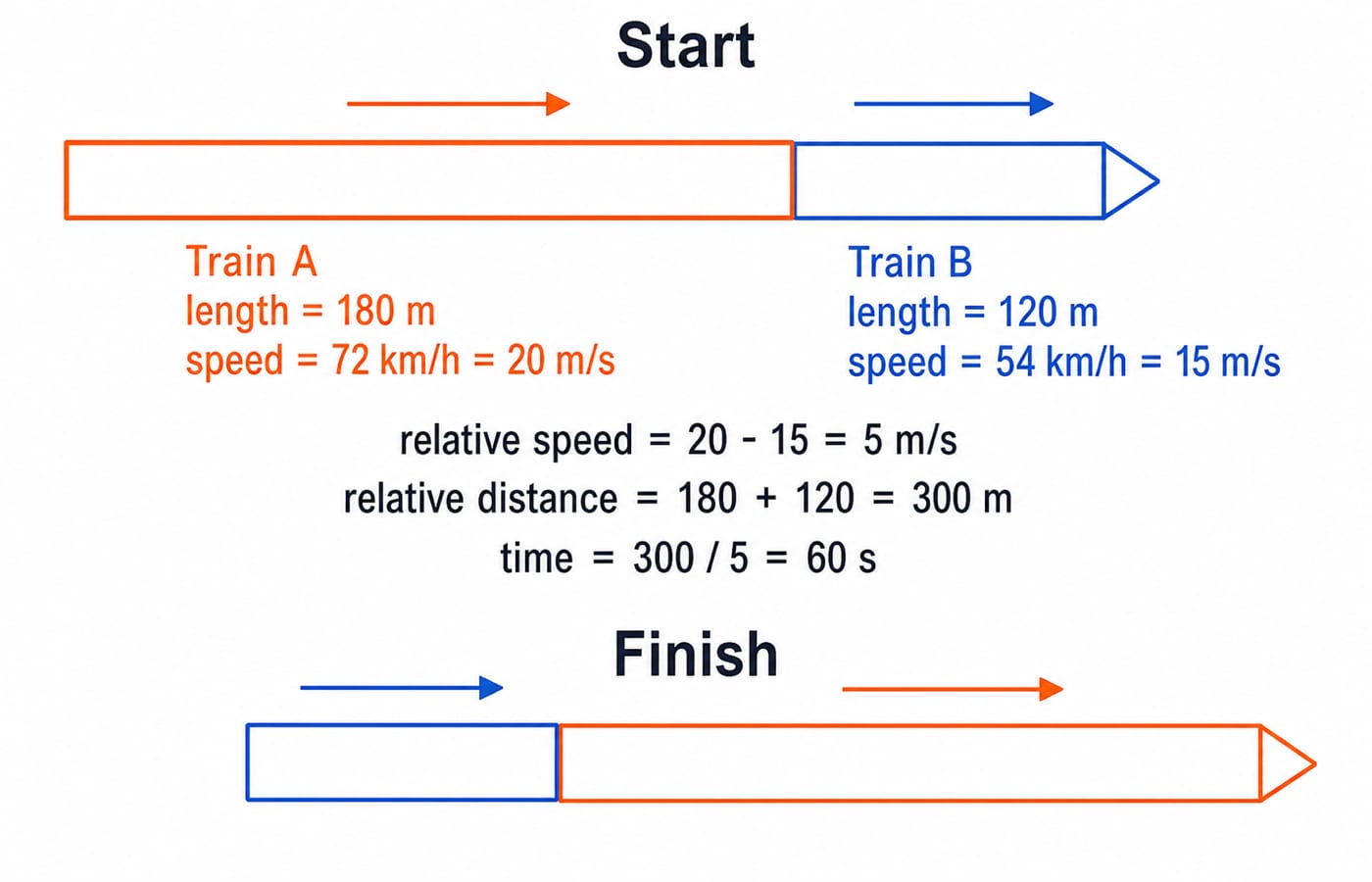
The start and finish positions explain the addition. A starts with its front at B's rear and finishes with its rear at B's front, so one full length of each train must pass.
A platform question uses a stationary reference. If the 180 m Train A crosses a 220 m platform, it covers 180 + 220 = 400 m at 20 m/s. Time = 400/20 = 20 seconds.
5. Treat Boats and Streams as Relative-Speed Questions
For a constant current:
Downstream speed = speed in still water + stream speed
Upstream speed = speed in still water - stream speed
If downstream speed is 18 km/h and upstream speed is 10 km/h:
Still-water speed = (18 + 10)/2 = 14 km/h
Stream speed = (18 - 10)/2 = 4 km/h
For a 42 km downstream journey, time = 42/18 = 7/3 hours = 2 hours 20 minutes. For 42 km upstream, time = 42/10 = 4.2 hours = 4 hours 12 minutes. The round trip therefore takes 2 hours 20 minutes + 4 hours 12 minutes = 6 hours 32 minutes.
These formulas assume that the boat's speed in still water and the current both remain constant. If the current changes along the route, split the route into suitable parts instead.
6. Use Relative Laps for Circular Tracks
Two runners start together on a 360 m circular track at 6 m/s and 4 m/s. In the same direction, the faster runner must gain one full circumference. Relative speed = 6 - 4 = 2 m/s, so catch-up time = 360/2 = 180 seconds.
In 180 seconds, the faster runner covers 6 x 180 = 1,080 m = 3 laps. The slower runner covers 4 x 180 = 720 m = 2 laps. The one-lap difference confirms the result.
In opposite directions, they jointly cover one circumference. Relative speed = 6 + 4 = 10 m/s, so meeting time = 360/10 = 36 seconds. The faster runner covers 6 x 36 = 216 m, and the slower covers 4 x 36 = 144 m. Since 216 + 144 = 360 m, the answer checks.
The reusable decision is simple: ask whether one circumference must be gained or jointly covered, then divide by the correct relative speed.
7. Recognise the Pattern Before Starting the Clock
Use this 20-second classification routine:
Underline the quantity requested.
Mark whether distance or time is fixed.
Convert every unit.
Choose ordinary, average or relative speed.
Estimate whether the answer should rise or fall before calculating.
The earlier averages explanation owns ordinary and weighted-mean methods. Use it for those questions. Speed, time and relative motion require unit, ratio and relative-speed methods. For broader placement context, use the aptitude overview for placements.
Then try a focused drill: six questions in 12 minutes, one each on unit conversion, fixed-distance ratio, average speed, trains, boats and circular tracks. Label every miss as a model, unit, arithmetic or time-pressure error. Use that diagnosis to plan the next round with the 30-day aptitude routine.
8. Common Traps, the Short Version and the Next Step
Watch for these traps:
Averaging speeds without checking how distance or time is weighted.
Mixing km/h with metres and seconds.
Adding speeds during a same-direction overtake.
Forgetting a train's length or a platform's length.
Rounding 7/3 hours too early. The fractional 1/3 hour is 20 minutes, not 0.33 minutes.
The short version is five lines:
Start with d = st.
Standardise the units.
Use inverse ratios only when distance is fixed.
Use total distance / total time for every average.
Use the sum or difference of speeds according to direction.
Now redo the 240 km journey, the two-train overtake and the 42 km boat trip without looking at the solutions. Then move to the Aptitude for Placement course for structured learning and practice.
Keep learning

Disk Access Time and Performance: Formulas, Worked Example and GATE Traps
Learn how seek time, rotational latency and transfer time combine, then apply the formulas to random and contiguous reads without losing track of units.
Updated 10 Sep 20265 min read284 viewsComputer Organization & Architecture

Simple Interest and Compound Interest: Formulas, Shortcuts and Worked Examples
Learn why simple interest keeps the principal fixed while compound interest resets the base. Then practise direct, reverse, half-yearly, and split-sum questions.
Updated 4 Nov 20265 min readAptitude & Reasoning

Mensuration and Geometry for Competitive Exams: Formulas, Shortcuts and Solved Examples
Learn how to choose the right mensuration formula, avoid common geometry traps, and solve 2D path and 3D recasting problems step by step.
Updated 6 Oct 20266 min read74 viewsAptitude & Reasoning

Circular Permutations: Formulas and Shortcuts for Seating Problems
Learn how to choose the right circular permutation model, derive each formula, and solve together, apart, alternating, opposite, and fixed-gap cases.
Updated 8 Sep 20265 min read74 viewsAptitude & Reasoning