Mensuration and Geometry for Competitive Exams: Formulas, Shortcuts and Solved Examples
Learn how to choose the right mensuration formula, avoid common geometry traps, and solve 2D path and 3D recasting problems step by step.
KnowledgeGate Team
Exam prep & CS education
Updated 6 Oct 20266 min read
Mensuration questions look like formula-recall questions, but most errors happen before the formula. A solver treats a diameter as a radius, confuses boundary with area, chooses total instead of curved surface area, or misses the smaller figure inside a composite shape. Use a repeatable route: identify the measure, label every value and unit, choose the formula family, calculate, and check the answer's dimension. The 2D path and 3D recasting examples below show this route in action.
1. Mensuration and geometry: first identify what the question measures
Geometry supplies relationships involving angles, similarity and the Pythagorean theorem. Mensuration uses known dimensions to calculate perimeter, area, surface area or volume.
Read the decision words carefully: boundary means perimeter, cover or shaded region means area, exposed material means surface area, and capacity or occupied space means volume. For a rectangle of length 12 cm and breadth 8 cm, perimeter is 2(12 + 8) = 40 cm, while area is 12 × 8 = 96 cm². For a cuboid measuring 12 cm × 8 cm × 5 cm, volume is 12 × 8 × 5 = 480 cm³.
The units reveal the job. The Aptitude for Placements guide places this diagnostic method within a broader preparation map for quantitative aptitude, reasoning and verbal ability.
2. The 2D formula sheet and safe substitution shortcuts
Define a as a side, l as length, b as breadth or base, h as perpendicular height, r as radius, and π as pi.
Figure | Given dimensions | Perimeter or circumference | Area |
|---|---|---|---|
Square | side |
|
|
Rectangle | length |
|
|
Triangle | base | sum of three sides |
|
Equilateral triangle | side |
|
|
Parallelogram | adjacent sides |
|
|
Trapezium | parallel sides | sum of four sides |
|
Circle | radius |
|
|
Halve a stated diameter before using a radius formula. Use perpendicular height, not a sloping side, for area. Include the straight diameter in a semicircle's perimeter.
For r = 7 cm and π = 22/7, circle area is (22/7) × 7² = 154 cm², circumference is 2 × (22/7) × 7 = 44 cm, and semicircle perimeter is πr + 2r = 22 + 14 = 36 cm. A perimeter in square units or an area in linear units cannot be correct.
3. Geometry shortcuts: triangles, similarity and scale factors
Angles in a triangle total 180 degrees. An exterior angle equals the sum of the two remote interior angles. A right triangle obeys a² + b² = c². Useful triples include 3-4-5, 5-12-13 and 7-24-25, plus their multiples. Check the squares before using a remembered triple.
For similar figures with linear scale factor k, the perimeter ratio is k and the area ratio is k². If corresponding sides of two triangles are in the ratio 3:5 and the smaller area is 54 cm², the larger area is 54 × (5/3)² = 54 × 25/9 = 150 cm², not 90 cm².
Now take a triangle with sides 13 cm, 14 cm and 15 cm. Its semiperimeter is s = (13 + 14 + 15)/2 = 21 cm. Heron's formula gives area = √(21 × 8 × 7 × 6) = √7056 = 84 cm². Since area = r × s, where r is the inradius, r = 84/21 = 4 cm.
4. The 3D formula sheet: surface area and volume do different jobs
Here l, b and h mean length, breadth and vertical height. For a cone, s is slant height.
Solid | Curved or lateral surface area | Total surface area | Volume |
|---|---|---|---|
Cube, side |
|
|
|
Cuboid, |
|
|
|
Cylinder, |
|
|
|
Cone, |
|
|
|
Sphere, |
|
|
|
Hemisphere, |
|
|
|
The open-versus-closed test matters. A closed cylindrical tank with r = 3.5 m, h = 10 m and π = 22/7 has volume π(3.5)²(10) = 385 m³, curved surface area 2π(3.5)(10) = 220 m², and total surface area 2π(3.5)(10 + 3.5) = 297 m². An open tank omits the top circular base, so its exposed area depends on the wording.
5. Solved 2D example: a uniform inner path
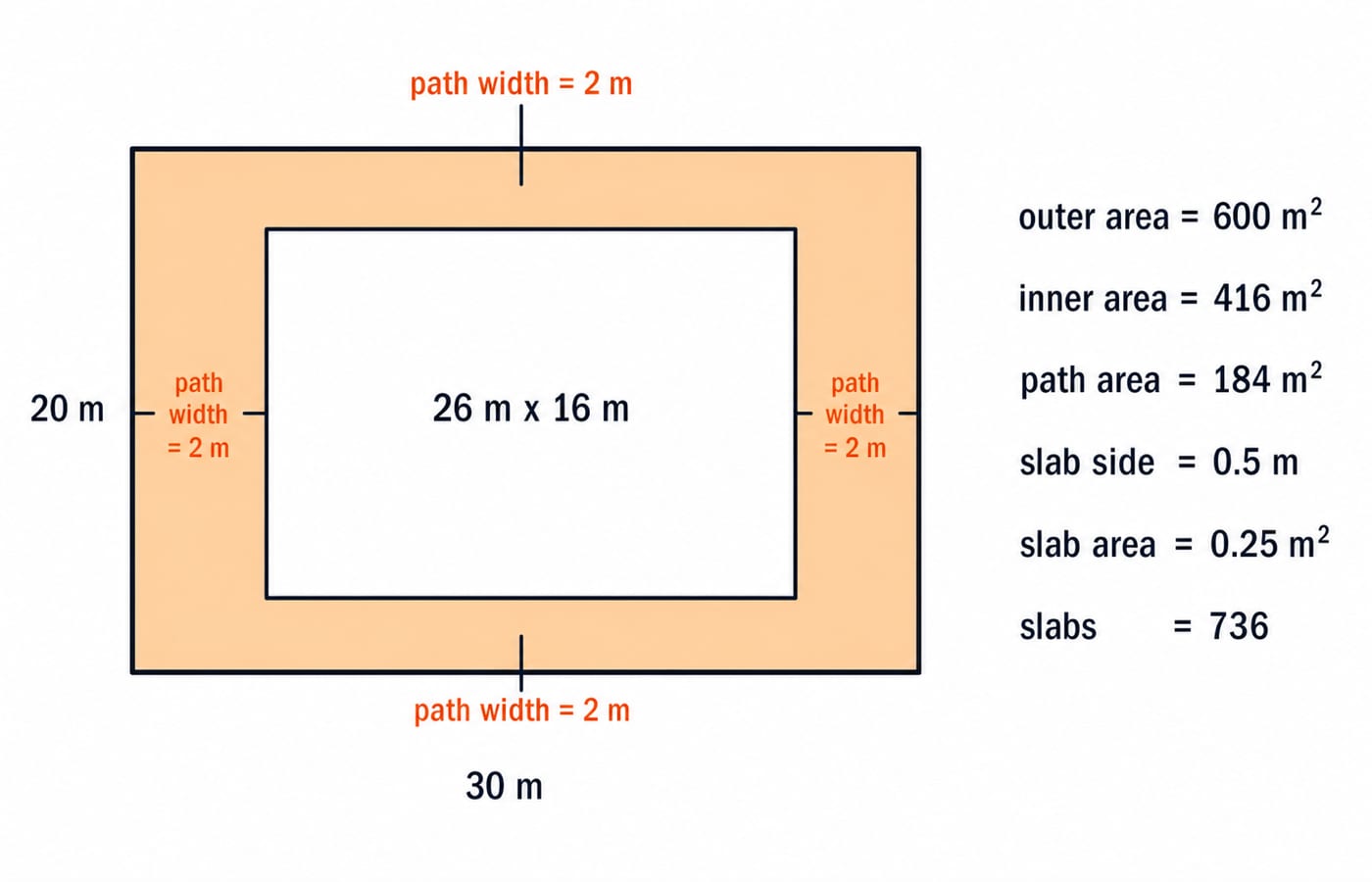
A rectangular park is 30 m long and 20 m wide. A uniform path 2 m wide runs inside all four edges. Find the path's area. If square paving slabs have side 0.5 m, how many whole slabs cover it with no wastage?
Draw the inner rectangle first. The path removes 2 m at both ends of each dimension, so the inner length is 30 - 2 - 2 = 26 m and the inner breadth is 20 - 2 - 2 = 16 m.
Outer area
= 30 × 20 = 600 m²Inner area
= 26 × 16 = 416 m²Path area
= 600 - 416 = 184 m²One slab's area
= 0.5 × 0.5 = 0.25 m²Number of slabs
= 184/0.25 = 736
Subtracting the inner area from the outer area counts every corner once. Adding four strips can count corner regions twice.
6. Solved 3D example: conserve volume while recasting
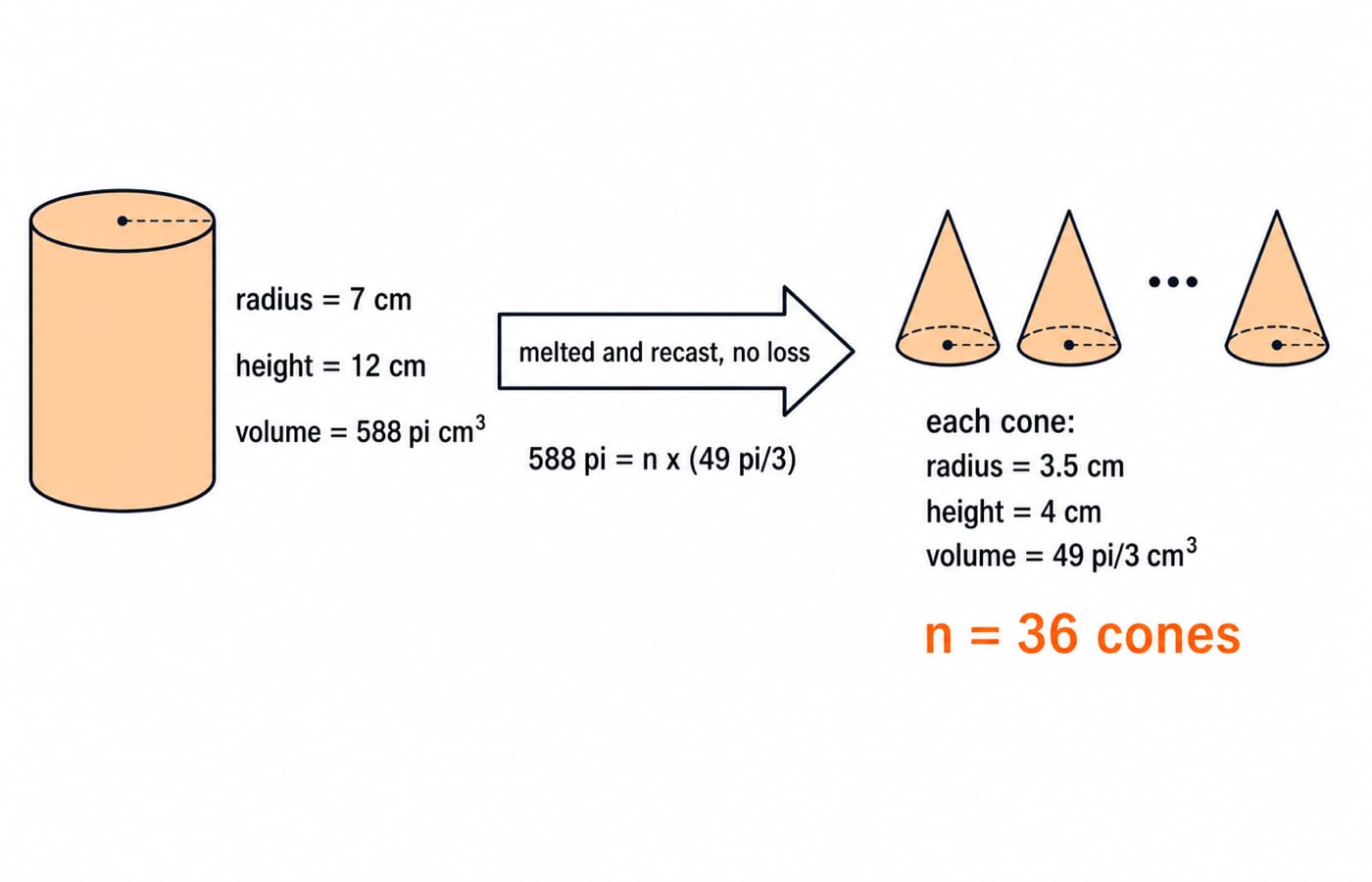
A solid cylinder of radius 7 cm and height 12 cm is melted and recast into identical solid cones, each of radius 3.5 cm and height 4 cm. Assuming no material is lost, how many cones are formed?
Original volume equals combined final volume. Surface area is not conserved during melting and recasting.
The cylinder's volume is π × 7² × 12 = 588π cm³. One cone's volume is (1/3)π × (3.5)² × 4 = (49/3)π cm³. Therefore,
number of cones = 588π/((49/3)π) = 588 × 3/49 = 36.
Keep π symbolic so it cancels. Cancelling common factors before multiplying also avoids unnecessary decimal work.
7. Common competitive-exam question types and traps
Representative problem families include direct substitution, a missing dimension recovered from a perimeter or diagonal, a shaded composite region, similar-figure scaling, changed dimensions, and volume conservation during filling or recasting.
If every relevant linear dimension rises by 20%, the scale factor is 1.2. Area becomes 1.2² = 1.44 times, a 44% rise. Volume becomes 1.2³ = 1.728 times, a 72.8% rise. This works only when all relevant linear dimensions scale together.
Remove these seven traps:
Halve the diameter before using it as the radius.
Use perpendicular height, not a sloping side.
Include the straight diameter in a semicircle's perimeter.
Convert mixed centimetres and metres before calculating.
Separate curved from total surface area.
Use complements to avoid double-counting corners.
Conserve volume, not surface area, during recasting.
For wider exam context, use the SSC CGL quant strategy. Treat any exam's current pattern as notice-specific, then check units and approximate size before accepting an answer.
8. Mensuration and geometry: the short version and next step
Use five steps: sketch the figure, label dimensions and convert units, identify whether the answer needs length, square units or cubic units, choose the matching formula, then estimate before accepting the calculation.
Practise in a ladder: 10 direct-formula questions, 10 missing-dimension or similarity questions, 10 composite or recasting questions, then one timed mixed set followed by error review. KnowledgeGate currently has more than 500 published questions mapped to Mensuration and Geometry.
For a structured general route, use Aptitude for Placement. Readers preparing specifically for that exam can use the SSC CGL Tier 2 course, while the Aptitude Courses for Exams & Placements category offers more ways to browse and practise.
Keep learning

Age Comparison and Multiple-Condition Problems: 12 Solved MCQs
Practise 12 age-problem MCQs with equations, timelines, back-checks, relation chains, changing ratios, birth years, and family conditions.
1 Oct 20268 min readAptitude & Reasoning
True, False and Cannot Say Questions: 10 Solved Passage MCQs
Learn how to separate contradictions from missing evidence, then apply the method to 10 previous-year passage MCQs with concise, evidence-led solutions.
26 Sep 20268 min readAptitude & Reasoning
TCS Aptitude Questions: High-Yield Quant and Reasoning Topics, Solved Step by Step
Learn the first move for common quant and reasoning question families through solved examples on ratios, work, trains, data, remainders, and seating.
Updated 25 Sep 20266 min read104 viewsAptitude & Reasoning
Data Interpretation for Competitive Exams: Concepts, Shortcuts and 4 Solved Sets
Learn a repeatable way to read Data Interpretation sets, choose the correct base, calculate efficiently, and check your answer. Four worked sets cover table, bar, pie and line data.
Updated 23 Sep 20266 min readAptitude & Reasoning