

SDD and Quality Assurance in System Analysis and Design: Structure, Traceability and Worked QA Metrics
Learn how an SDD turns requirements into inspectable design decisions, then trace one course-registration service through tests and quality metrics.
KnowledgeGate Team
Exam prep & CS education
Updated 4 Nov 20266 min read

A requirement may be correct on paper and still produce weak software when the design leaves module boundaries, data rules, failures or tests implicit. The Software Design Description (SDD) links requirements to construction through quality criteria, traceability and quality-assurance controls. A college course-registration service illustrates how the last available seat, duplicate-enrolment rule and two-second response requirement move from requirement to design to test.
SDD in system analysis and design: the bridge from requirements to construction
An SDD explains how approved requirements will be realised through architecture, components, data, interfaces, behaviour and deployment decisions. Some curricula use SDS for Software Design Specification or System Design Specification for a closely related document. Treat the local convention carefully instead of assuming every expansion means exactly the same thing.
Question | SRS | SDD |
|---|---|---|
Main concern | What the system must do and which constraints it must satisfy | How components, data and interfaces will satisfy those requirements |
Seat rule |
|
|
The CS Fundamentals for Exams and Placements category is a broader route for studying Software Engineering concepts around this distinction.
SDD structure and design-description tools: make every decision inspectable
A usable SDD records decisions and constraints, not just screenshots or diagram names. Its ordered structure should cover:
Purpose, scope, context and assumptions.
Architecture, component responsibilities and design rationale.
Data design, internal and external interfaces, and user-interface behaviour.
Control, error, security and recovery paths.
Deployment, requirement traceability, glossary and change history.
A context diagram or DFD explains boundaries and data movement. Component diagrams show decomposition; ER diagrams and data dictionaries define stored data; sequence diagrams show interaction order; decision tables expose combined rules; pseudocode fixes logic; state models capture history-dependent behaviour. No diagram replaces written input, output and failure contracts.
Check the result for completeness, correctness, consistency, unambiguity, traceability, verifiability and modifiability. If the dictionary defines capacity as a positive integer but an interface example sends "sixty", the SDD is inconsistent before coding starts.
SDD worked example: design a course-registration service from three requirements
In the course-registration case:
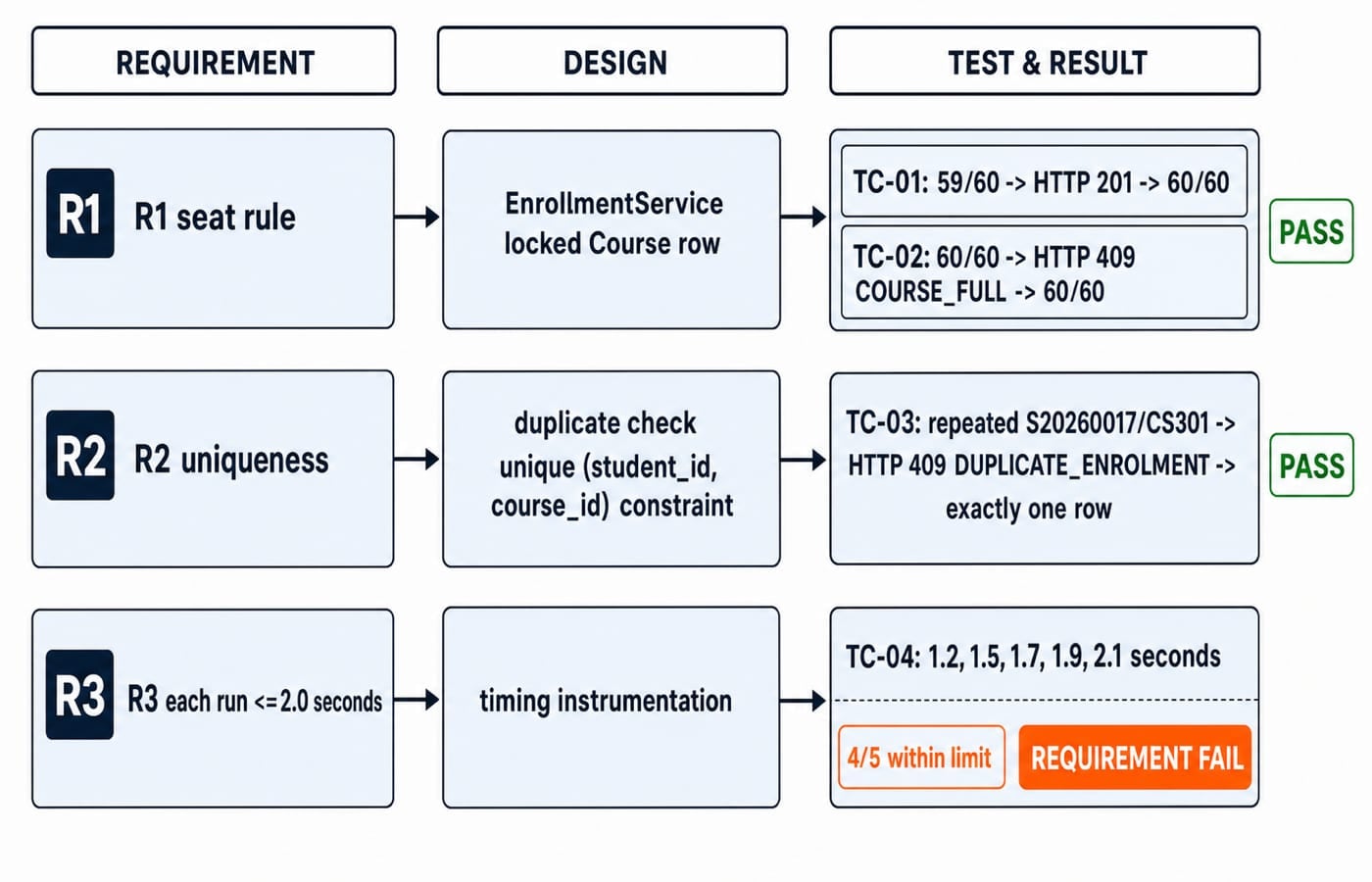
R1: a student may register forCS301only whileenrolled < capacity; capacity is60.R2:(student_id, course_id)must be unique, so duplicate enrolment is rejected.R3: each of five reference-environment requests must finish within2.0 seconds.
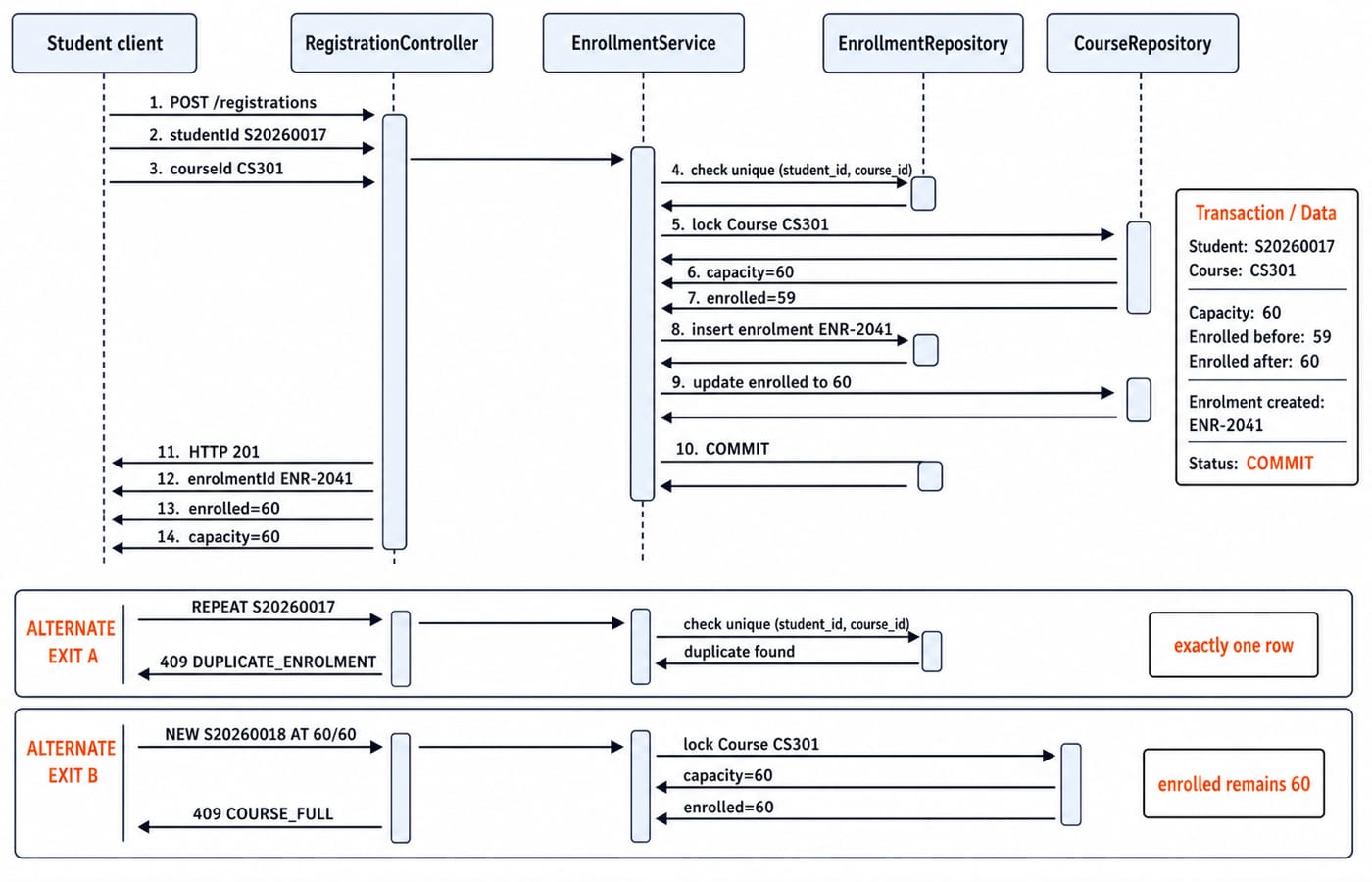
RegistrationController accepts POST /registrations with {studentId:"S20260017", courseId:"CS301"}. EnrollmentService owns the rule sequence. CourseRepository reads and locks Course(course_id, capacity, enrolled), while EnrollmentRepository stores Enrollment(enrolment_id, student_id, course_id, created_at) under a unique (student_id, course_id) constraint. Named response contracts are 201, 409 DUPLICATE_ENROLMENT, 409 COURSE_FULL and 404 COURSE_NOT_FOUND.
Start with CS301 at capacity=60, enrolled=59, and no matching enrolment for S20260017. Begin a transaction, check for a duplicate, lock the course row and verify 59 < 60. Insert ENR-2041, update enrolled to 60, commit, then return 201 {enrolmentId:"ENR-2041", enrolled:60, capacity:60}.
Repeating that request returns 409 DUPLICATE_ENROLMENT with one row stored. A request from S20260018 at 60/60 returns 409 COURSE_FULL; the count remains 60.
SDD traceability and test design documentation: prove every requirement has a check
Traceability connects each approved requirement to a design decision and observable result.
Requirement | Design element | Test | Expected result |
|---|---|---|---|
|
|
|
|
| Duplicate check and unique constraint |
|
|
| Request timing instrumentation |
| Four of five runs meet |
A test plan defines scope, approach, resources and exit conditions. Test design identifies conditions and coverage; a test case fixes inputs, preconditions and expected outputs; a test procedure gives execution steps; a test log records results; a test report interprets completion and remaining risk.
If capacity becomes department-specific, update the SRS rule, Course.capacity, service comparison, 59/60 and 60/60 fixtures, and TC-01 and TC-02 matrix rows together. A stale matrix shows broken traceability.
Quality assurance, quality control, verification and validation: separate the roles
Concept | Focus | Registration example |
|---|---|---|
Quality assurance (QA) | Prevent defects through standards, templates, training, reviews, audits and change control | SDD review checklist and traceability policy |
Quality control (QC) | Detect product defects through inspection and testing | Execute |
Verification checks whether the SDD correctly implements the SRS. For R1, verify the capacity comparison, locked transaction and failure contract. Validation checks whether the built service meets the user's need, such as allocating the final seat once and refusing a later request. Neither belongs only to a late phase.
An SQA plan should name standards and templates, review roles, baselines, change control, test levels, defect workflow, audit points, metrics, entry and exit conditions, and reporting. A metric is useful only when its definition, source and decision rule are recorded.
Quality-assurance worked metrics: calculate, interpret and resist false confidence
For this invented release, calculate each measure from its stated denominator:
Checklist conformance:
16/18 x 100 = 88.9%. The two gaps are missing rollback behaviour and ambiguous error priority.Traceability coverage:
3/3 x 100 = 100%, because all three requirements have design-and-test chains.R3 execution pass rate:
4/5 x 100 = 80%. This fails the every-run rule because2.1 > 2.0.Defect-removal efficiency: reviews and pre-release tests found
36defects, and the pilot found4, soDRE = 36/(36+4) x 100 = 36/40 x 100 = 90%.Defect density:
12confirmed defects in4 KLOCgives12/4 = 3 defects per KLOC. KLOC means thousand lines of code; it does not make unrelated languages or teams directly comparable.
Read the measures together. 100% traceability proves that links exist, not that they are correct. 90% DRE still leaves four escaped defects, while 88.9% identifies two design gaps. There is no universal pass threshold here.
SDD and QA questions in exams and interviews: solve from the artefact
Realistic questions ask you to distinguish SRS from SDD or QA from QC, match a diagram to its purpose, find ambiguity or inconsistency, complete a traceability matrix, derive tests from a rule, calculate DRE or coverage, and explain change impact. Useful memory anchors are 59/60 -> 60/60, 4/5 = 80%, and 36/(36+4) = 90%.
Keep these traps and corrections together: diagrams without interface contracts are incomplete; QA is more than testing; verification differs from validation; a test plan is not a test case; 100% traceability does not prove correctness; readable documents can be inconsistent; and an unlocked capacity check can allocate the last seat twice under concurrent requests.
Current exam marks, question counts, weightage, dates and recurrence vary by exam cycle; check the notification for the exam you are targeting. For a related technical-topic map, use IBPS SO IT Professional Knowledge: Subject Topic Map. The practice bank offers over 20 questions on this topic for concept practice.
SDD and quality assurance: the short version and next step
Retrieve the method in seven steps: start from approved requirements; name component responsibilities; define data and interfaces; record failures and transaction behaviour; trace each requirement to design and tests; review the document; measure outcomes without confusing coverage with correctness.
For a self-check, reset CS301 to 58/60. S20260018 must produce 59/60; distinct student S20260019 must produce 60/60; S20260020 must receive 409 COURSE_FULL; repeating S20260018 must receive 409 DUPLICATE_ENROLMENT with only one matching row.
Use CS Fundamentals for Placements by Sanchit Sir for placement-focused CS and Software Engineering basics. Choose ZERO TO HERO for a broader core-CS path that includes Software Engineering.
Go deeper with the full courseGATE Guidance by Sanchit Sir
Keep learning

Software Quality in Software Engineering: Metrics, Testing and Worked Examples
Learn the vocabulary and calculations behind software quality, from McCall's factors to basis-path testing and service availability.
Updated 21 Jul 20266 min readUGC NET Computer Science

System Analysis and Design for GATE: What the CS Syllabus Includes and What to Skip
Audit System Analysis and Design against the official GATE CS syllabus, keep examinable overlaps in their proper subjects, and redirect study time with two worked examples.
Updated 12 Nov 20264 min readGATE Strategy & Roadmap

Security, Risk Management and Maintenance in System Analysis and Design: A Worked Risk Register
Follow one university registration system from testable security requirements through risk ranking, maintenance classification, and a controlled production change.
Updated 7 Nov 20266 min readGATE Strategy & Roadmap

SDLC and Development Approaches in System Analysis and Design: Models, Selection Rules, and a 16-Week Worked Example
Learn how analysis, design, traceability, and major SDLC models fit together. Then use project conditions and risk exposure to plan a 16-week examination portal.
Updated 6 Nov 20265 min readGATE Strategy & Roadmap