

SDLC & FAST Methodology Questions: Solved MCQs and Scenarios
Solve nine SDLC MCQs and three FAST scenarios by separating phase boundaries, implementation risk, concurrent work and repository-backed control.
KnowledgeGate Team
Exam prep & CS education
Updated 26 Nov 20268 min read

SDLC phase names feel easy until a question describes a task instead of naming the phase. FAST adds another trap: concurrency does not permit discarded documentation. First separate planning, analysis, design and implementation, then apply the same boundaries to rollout and repository decisions.
Make a phase-and-method map before solving
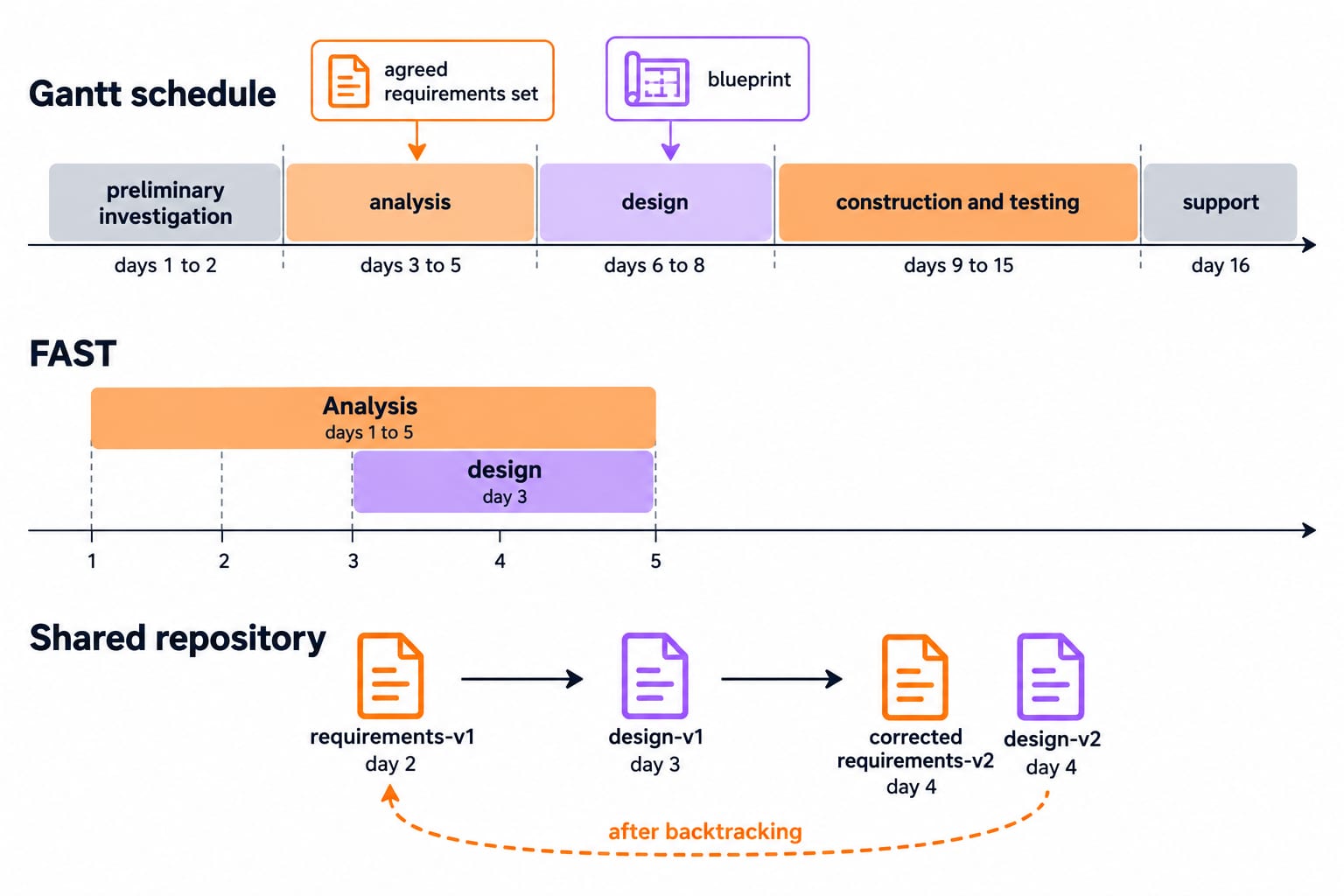
Answer from the task, not a phase number. Labels vary, but the jobs stay stable: preliminary investigation or planning decides whether to proceed; analysis discovers requirements; design specifies the solution; implementation builds and introduces it; support or maintenance keeps it useful.
In one project, preliminary investigation occupies days 1 to 2, analysis days 3 to 5, design days 6 to 8, construction and testing days 9 to 15, and support starts on day 16. Planning produces a Gantt schedule, analysis an agreed requirements set, and design a blueprint.
FAST changes the timing, not the need for controlled outputs. Analysis can run on days 1 to 5 while design starts on day 3. A shared repository may hold requirements-v1 on day 2, design-v1 on day 3, then corrected requirements-v2 and design-v2 on day 4 after backtracking.
SDLC meaning and phase boundaries: Questions 1 to 4
Use Software Development Life Cycle MCQs: 12 Solved Questions on SDLC Stages for stage order, feasibility and maintenance. The RSSB SDLC and FAST Methodology module holds the practice topic and is the fallback when an individual question page is unavailable. Planning, analysis and design are separate jobs; rollout risk and repository versions add the next two distinctions.
Question 1
Full form of SDLC is :
A. System Development Life Cycle
B. Software Data Life Cycle
C. Software Design Life Cycle
D. System Design Life Cycle
Answer: A. System Development Life Cycle. Development names the lifecycle. Design is one phase, and data is not this expansion. Exam source: HTET Computer Science (2024). Open Question 1 in the practice module.
Question 2
In this phase of the systems life cycle, new or alternative information systems are designed.
A. Systems Maintenance
B. Systems Analysis
C. Systems Design
D. Systems Development
Answer: C. Systems Design. Analysis finds what is needed. Design turns it into architecture, specifications and the blueprint shown on days 6 to 8. Development is the broader lifecycle.
Question 3
Project requests are evaluated in the __________ phase of System Development Life Cycle.
A. Preliminary Investigation
B. System Testing
C. System Design
D. Requirement Analysis
Answer: A. Preliminary Investigation. Evaluation precedes detailed requirements, design and testing. Management first needs a high-level problem statement and feasibility recommendation. Exam source: RPSC Programmer - P2 (2024). Open Question 3 in the practice module.
Question 4
In the preliminary investigation phase of the systems life cycle, which one of the following tasks would not be included?
A. Briefly defining the problem
B. Suggesting alternative solutions
C. Gathering the data
D. Preparing a short report
Answer: C. Gathering the data. Preliminary investigation stays high-level: define the problem briefly, suggest alternatives and report a recommendation. Detailed fact gathering belongs to analysis.
Planning and design tools: Questions 5 to 7
Planning tools schedule work; design tools describe conditions, data and structure. Match each tool to its job.
Question 5
Gantt charts are used in ____________ phase.
A. Analysis
B. Planning
C. Design
D. Implementation
Answer: B. Planning. In the example, the Gantt chart gives the pre-support tasks start and finish dates; support starts on day 16. Teams update it during execution, but scheduling belongs to planning. Exam source: HTET Computer Science (2024). Open Question 5 in the practice module.
Question 6
Which of the following activity is not involved in the Design of Database during System Designing phase of System Development Life Cycle?
A. Physical Layout Design
B. Data Modeling
C. Conceptual Modeling
D. Input/output Volume
Answer: D. Input/output Volume. Conceptual design identifies Student, Course and Enrollment; logical design maps them to three tables; physical design selects a B-tree index on student_id. Estimating 2,000 attendance writes per hour is capacity sizing, not database structure. Exam source: RPSC Programmer - P2 (2024). Open Question 6 in the practice module.
Question 7
Decision tables are especially useful when
A. Data relationships are complex
B. Many conditions and actions exist
C. System response time is critical
D. User interfaces are designed
Answer: B. Many conditions and actions exist. The binary conditions fees paid? and attendance at least 75%? produce 2^2 = 4 rule columns. Assigning allow exam form or hold form to each column exposes every combination. This is not data modelling, performance work or UI design.
Direct versus parallel implementation: Questions 8 and 9
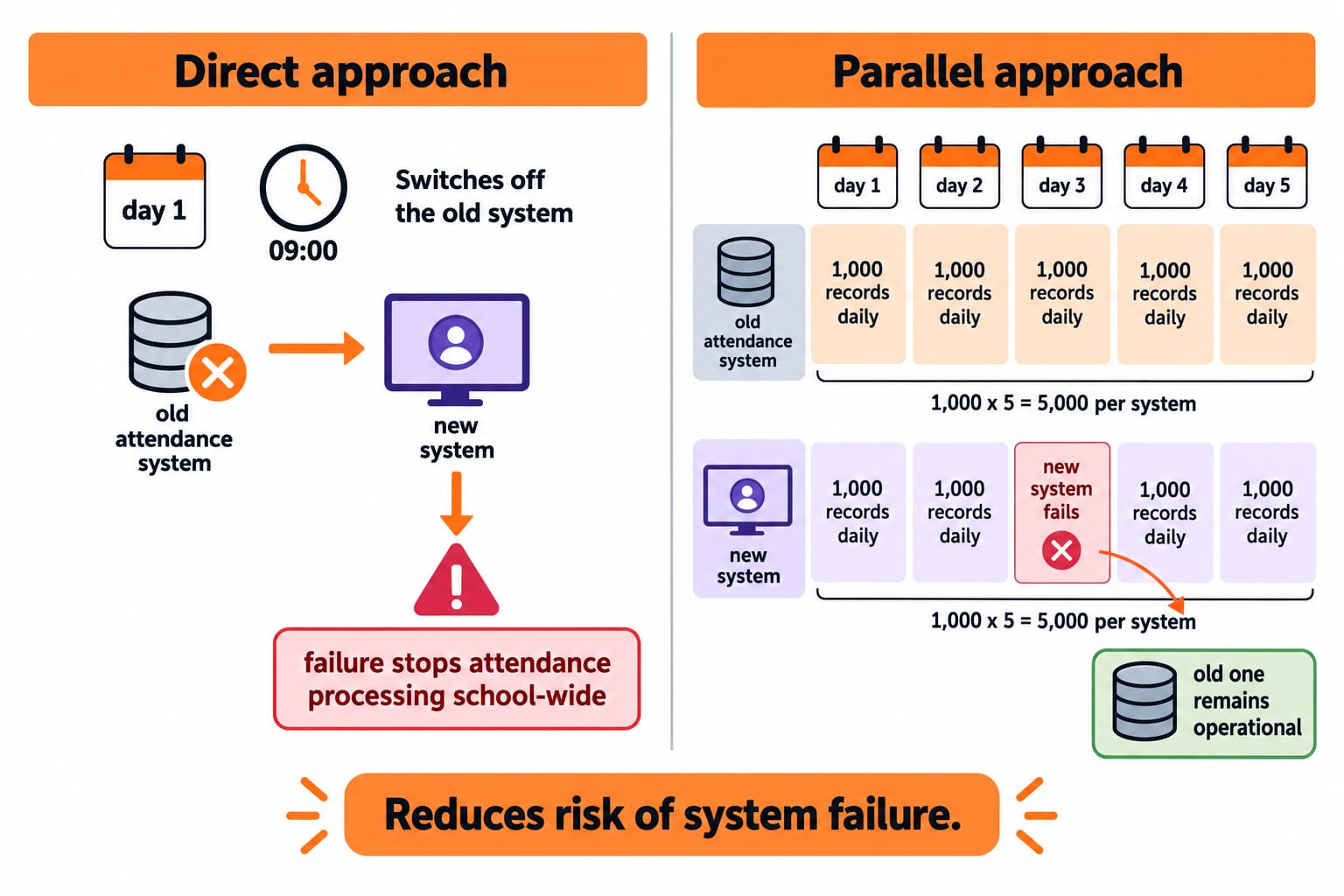
Use risk as the rule. The old attendance system processes 1,000 records daily. In parallel, both systems process those 1,000 records for five days, or 1,000 x 5 = 5,000 per system. If the new system fails on day 3, the old one remains operational.
Question 8
Parallel implementation is generally preferred over direct implementation because it
A. Is cheaper
B. Requires less hardware
C. Reduces risk of system failure
D. Needs less training
Answer: C. Reduces risk of system failure. Parallel running is more resource-intensive, not cheaper, because both systems run together. Its advantage is the working fallback.
Question 9
Problems arising in this approach would spell disaster. इस दृष्टिकोण (Approach) में यदि कोई समस्या उत्पन्न होती है, तो यह बहुत बड़ा नुकसान या विनाश का कारण बन सकती है।
A. Direct approach / डायरेक्ट अप्रोच
B. Parallel approach / पैरेलल अप्रोच
C. Phased approach / फेज़्ड अप्रोच
D. Pilot approach / पायलट अप्रोच
Answer: A. Direct approach / डायरेक्ट अप्रोच. Direct rollout switches off the old system at 09:00 on day 1, so failure stops attendance processing school-wide. Parallel keeps the fallback, phased limits the affected slice, and pilot limits the user group.
Applied SDLC scenario: Question 10
Question 10
A primary school intends to automate its manual attendance and grading system. The administration believes that the 'System Construction & Implementation' phase is the most critical and suggests skipping the formal 'System Analysis' and 'System Design' stages to save time, as they already have a general idea of the requirement. As a System Analyst, evaluate this decision based on the standard SDLC methodology provided in your study material. Discuss the potential impact on 'System Support' and explain why every phase must consist of specific inputs, tasks, and outputs to ensure system success.
Write a structured response before comparing it with the model answer.
Model answer. Reject the proposal. For an illustrative school with 400 pupils, 20 teachers and 8 subjects, a general idea does not decide whether attendance is daily or period-wise, how marks are validated, or who can edit records. Analysis validates these rules. Design then defines the data model, permissions and screens, giving construction controlled inputs. FAST may overlap analysis and design, but it does not permit either controlled output to disappear.
Skipping both phases pushes ambiguity into code. Repair, onboarding, scaling and support slow down because maintainers lack requirements and design references. Each phase needs an inputs -> tasks -> outputs chain, with its output becoming the next controlled input. That traceability connects documentation to maintainability.
FAST repository, concurrency and backtracking: Questions 11 and 12
Question 11
A software firm is transitioning from a traditional sequential SDLC to the FAST methodology to handle a complex project. The lead developer argues that since FAST allows working on two phases simultaneously, the team no longer needs to worry about previous phase documentation or structured inputs. Critically evaluate this argument based on the FAST methodology. Explain the role of the 'Repository' in this context and discuss how the ability to 'backtrack' and perform concurrent work changes the development dynamic compared to traditional sequential models.
Write a structured response before comparing it with the model answer.
Model answer. The argument is incorrect. The repository is the central store for inputs, outputs, specifications and versions, so overlapping teams share one source of truth. Unlike a strict finish-one-phase-first sequence, analysis can run on days 1 to 5 while design starts on day 3 from requirements-v1.
On day 4, the client adds a two-stage approval rule instead of one manager approval. The team backtracks, commits requirements-v2, updates the workflow model, and produces design-v2 in the same repository. Backtracking enables controlled correction, but downstream consistency still requires version updates and communication.
Question 12
Explain the FAST methodology in the System Development Life Cycle (SDLC). How does it improve upon the traditional sequential SDLC framework using a repository?
Write a structured response before comparing it with the model answer.
Model answer. FAST adds three controls: a shared repository preserves versions, phases overlap, and backtracking corrects earlier outputs. In a library system, analysis records one common loan period in requirements-v1 while design begins from that version. A later policy change introduces different loan periods by member type, so the team records requirements-v2 and updates design-v1 to design-v2 in the repository. Concurrent work speeds feedback, while versioned documentation keeps downstream work consistent.
Answer grid, recurring traps and the next practice step
Question | Answer or key points |
|---|---|
1 | System Development Life Cycle |
2 | Systems Design |
3 | Preliminary Investigation |
4 | Gathering the data |
5 | Planning |
6 | Input/output Volume |
7 | Many conditions and actions exist |
8 | Reduces risk of system failure |
9 | Direct approach / डायरेक्ट अप्रोच |
10 | Validated rules; design blueprint; support references |
11 | Repository; concurrent phases; controlled backtracking |
12 | Shared versions; simultaneous execution; dynamic correction |
Use these diagnostic questions when two terms look plausible:
Confusion | Ask this under exam pressure |
|---|---|
Analysis vs design | Am I discovering what is needed or specifying how to build it? |
Preliminary investigation vs detailed data gathering | Is this a go-ahead decision or detailed fact gathering? |
Database structure vs I/O sizing | Am I defining relationships or sizing workload? |
Direct vs parallel | Does the old-system fallback remain? |
FAST concurrency vs no documentation | Where is the versioned source of truth? |
The short version
Identify the task, map it to the phase, then test rollout or FAST choices by asking where risk and shared state sit. For broader practice, continue with the UGC NET Computer Science and Applications Test Series.
Go deeper with the full courseMP SET Computer Science (Paper 1 + Paper 2)
Keep learning

Software Development Life Cycle MCQs: 12 Solved Questions on SDLC Stages
Solve 12 published SDLC MCQs with direct explanations, stage cues, and a worked campus clinic portal that connects requirements, design, testing, and maintenance.
Updated 17 Nov 20267 min readUGC NET Computer Science

Software Engineering Basics Explained: SDLC, Process Models and Worked Example
Learn how software engineering extends beyond coding, how major process models differ, and how to choose and apply one in a constructed student portal project.
Updated 30 Oct 20266 min read114 viewsUGC NET Computer Science

Software engineering for CS teaching exams: SDLC, models and testing
The software engineering spine for TGT and PGT computer science papers: the SDLC phases in order, waterfall vs spiral vs agile, functional and non-functional requirements, cohesion and coupling, and the four testing levels.
Updated 18 Jul 20265 min read66 viewsUGC NET Computer Science

SDLC and Development Approaches in System Analysis and Design: Models, Selection Rules, and a 16-Week Worked Example
Learn how analysis, design, traceability, and major SDLC models fit together. Then use project conditions and risk exposure to plan a 16-week examination portal.
Updated 6 Nov 20265 min readGATE Strategy & Roadmap