

Regression, Alpha, Beta and Performance Testing MCQs: 12 Solved Questions
Build a four-way testing map, then solve 12 MCQs on regression, alpha, beta and performance testing with clear explanations tied to one release case.
KnowledgeGate Team
Exam prep & CS education
Updated 27 Nov 20267 min read

Regression, alpha, beta and performance testing can surround a release, so their names are easy to mix up. A trigger clue points to regression, a location clue separates alpha from beta, and a metric points to performance. Regression follows a change, alpha occurs in a developer-controlled setting, beta uses external users in their settings, and performance testing measures response time, throughput, memory use or traffic under a workload. Commit to an option before reading its explanation. Questions 2 and 11 open individual solved pages; for the other questions, use the specialised-testing practice hub after choosing an option.
The four-way testing map to build before solving
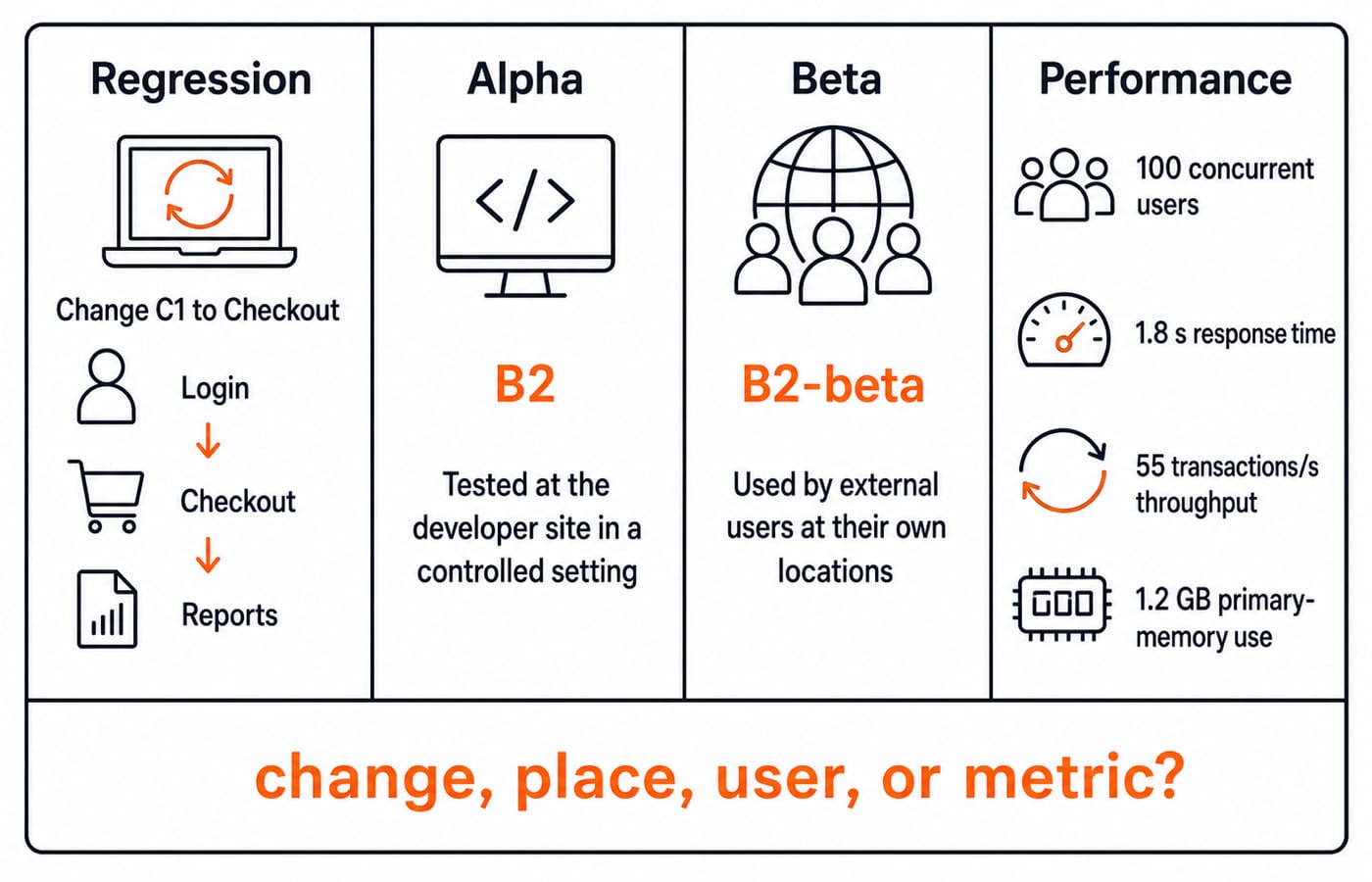
Regression testing reruns existing tests after a change to find unintended breakage. Alpha testing is pre-release evaluation in a developer-controlled setting. Beta testing gives external users real-world exposure in their settings. Performance testing measures response time, throughput, memory use or traffic under a workload. Software Quality in Software Engineering owns the broader quality-factor, metric, QA/QC and verification/validation map; this section only separates the four test types used below.
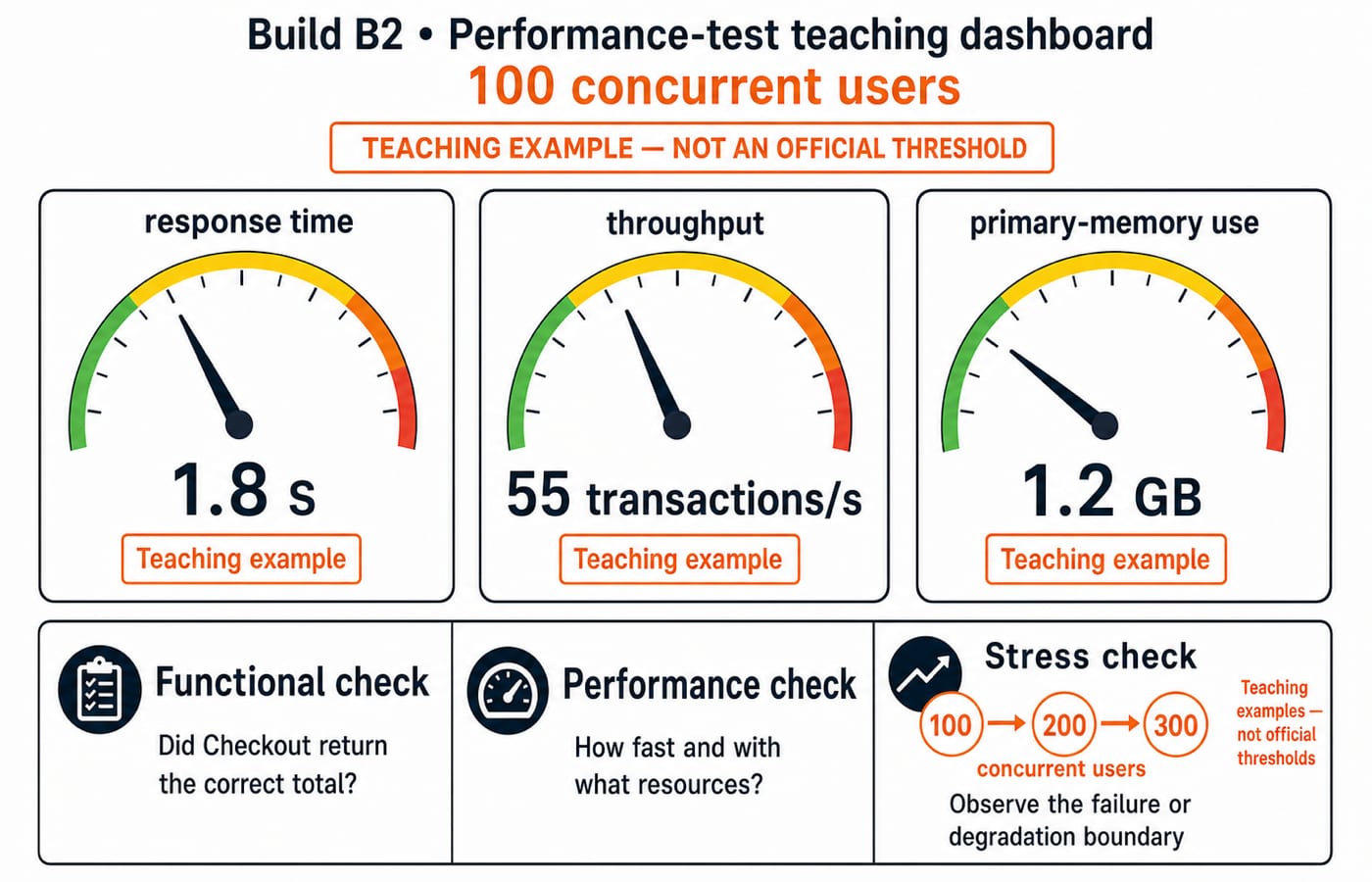
A release example links the build change, retesting, user evaluation and workload measurements. Build B1 contains Login, Checkout and Reports. Change C1 modifies Checkout's discount rule. On B2, the team reruns all three checks. It runs alpha at the developer site and sends B2-beta to external users at their locations. At 100 concurrent users, performance records 1.8 s response time, 55 transactions/s throughput and 1.2 GB primary-memory use. They illustrate the measurement categories; acceptable limits depend on the system's service objectives.
The decision rule is compact: change plus old behaviour means regression; developer-controlled user evaluation means alpha; external real-world user evaluation means beta; timing, rate, capacity or resource use means performance.
Regression testing MCQs 1 to 3: trigger, purpose and classification
Question 1
Which software testing type is performed after code modifications to ensure that previously working functionalities remain unaffected ?A. Regression testing
B. Alpha testing
C. Beta testing
D. None of theseAnswer: A. Regression testing.
The clues are after code modifications and previously working functionalities. Regression reruns established tests after change. For C1, that means Login, Checkout and Reports on B2. Alpha and beta classify user evaluation by setting.
Question 2
In software testing, what is the purpose of regression testing ?A. Test new features only
B. Verify that changes haven't broken existing functionality
C. Test system performance
D. Validate user requirementsAnswer: B. Verify that changes haven't broken existing functionality.
Regression seeks side effects beyond the changed feature. A Checkout change can justify Login and Reports checks when dependencies connect them. Performance measures non-functional behaviour; validation asks whether the product meets user needs. See solution 2.
Question 3
Which of the following statement(s) is/are TRUE with regard to software testing?
I. Regression testing technique ensures that the software product runs correctly after the changes during maintenance.
II. Equivalence partitioning is a white-box testing technique that divides the input domain of a program into classes of data from which test cases can be derived.A. only I
B. only II
C. both I and II
D. neither I nor IIAnswer: A. only I.
Statement I describes regression after maintenance changes. Statement II mentions equivalence classes but assigns the wrong family: equivalence partitioning is black-box, not white-box. Therefore only I is true.
Regression testing MCQs 4 and 5: change impact and maintenance
Question 4
Each time a new module is added to the system, new data flow paths are established, new input/output may occur and new control logic is invoked. These changes may cause problems with functions that previously worked flawlessly. __________ Tests ensure that changes or corrections have not introduced new errors.A. Top-Down Integration
B. Regression
C. Bottom-Up Integration
D. PerformanceAnswer: B. Regression.
A new module changes data flow, interfaces or control logic, which can affect existing functions. Old tests detect that damage. Top-down and bottom-up describe integration order; performance measures speed or resources.
Question 5
Regression testing is primarily related toA. Functional testing
B. Development testing
C. Data flow testing
D. Maintenance testingAnswer: D. Maintenance testing.
Maintenance changes require confirmation of existing behaviour, so maintenance is the textbook association. Regression also runs during active development. Functional is a focus, data flow a structural technique, and development testing too broad.
Alpha and beta testing MCQs 6 to 8: validation and acceptance
Question 6
Which of the following statements is/are FALSE with respect to software testing?
S₁: White-box tests are based on specifications; better at telling whether program meets specification, better at finding errors of omission.
S₂: Black-box tests are based on code; better for finding crashes, out of bounds errors, file not closed errors.
S₃: Alpha testing is conducted at the developer’s site by a team of highly skilled testers for software that is developed as a product to be used by many customers.A. Only S₁ and S₂ are FALSE.
B. Only S₁ and S₃ are FALSE.
C. Only S₂ and S₃ are FALSE.
D. All of S₁, S₂, and S₃ are FALSE.Answer: A. Only S₁ and S₂ are FALSE.
S₁ and S₂ swap the foundations. White-box uses code structure; black-box uses specifications and visible behaviour. S₃ is true in the intended classification, with the developer site as the decisive alpha clue. Its tester description is not universal.
Question 7
Which of the following is related to Alpha Testing and Beta Testing?A. Unit Testing
B. System Testing
C. Acceptance Testing
D. Integration TestingAnswer: C. Acceptance Testing.
Alpha and beta are acceptance stages because representative users evaluate a near-release product. Unit checks components; integration checks interactions. System testing is broader, while acceptance is the specific class asked.
Question 8
Alpha and Beta Testing are types ofA. Unit Testing
B. Integration Testing
C. Validation Testing
D. Recovery TestingAnswer: C. Validation Testing.
Validation asks whether the product satisfies user needs; acceptance is a validation context; alpha and beta are acceptance forms. This hierarchy reconciles Question 7. Unit, integration and recovery answer different questions.
Alpha and beta testing MCQs 9 to 11: site, users and exposure
Question 9
Which user acceptance testing is generally performed by the external users and normally involves sending the product outside for real world exposure?A. Beta testing
B. Gamma testing
C. Alpha testing
D. Regression testingAnswer: A. Beta testing.
The clues external users, outside and real world exposure identify beta. Alpha is developer-controlled. Regression is triggered by change, while gamma is not intended here.
Question 10
In software testing, beta testing is the testing performed by _______________.A. potential customers at the developer's location
B. potential customers at their own locations
C. product developers at the customer's location
D. product developers at their own locationsAnswer: B. potential customers at their own locations.
Check who and where. Beta uses customers at their locations. Customers at the developer's location are closer to alpha. Product developers are not the external-user group.
Question 11
Testing of software with actual data and in actual environment is calledA. Alpha testing
B. Beta testing
C. Regression testing
D. None of the aboveAnswer: B. Beta testing.
Actual data and actual environment indicate beta's real-world use. Alpha is developer-controlled. Regression is defined by retesting after change, not environment. See solution 11.
Performance testing MCQ 12: identify the measurement family
Question 12
__________ tests are performed on a program unit to verify the response time, the execution time, the throughput, primary and secondary memory utilization and traffic rates on data channels and communication links.A. Performance
B. Stress
C. Parallel
D. FunctionalAnswer: A. Performance.
Response and execution time measure latency; throughput measures work per unit time; memory and traffic measure resource use. This is performance testing. Stress pushes beyond expected workload. Functional testing checks correctness.
The trial serves 100 concurrent users and records 1.8 s response time, 55 transactions/s throughput and 1.2 GB primary-memory use. These are separate measurements under one workload.
Diagnose each testing miss by its clue
Sort each mistake by the clue you ignored:
Questions 1-5: underline the change and previously working behaviour. Without both, regression is probably a distractor.
Questions 6-11: mark who tests and where. Developer-controlled evaluation indicates alpha; external users in their own setting indicate beta. Acceptance names the stage, while validation names the purpose.
Question 12: separate workload from measurement. Response time, throughput and memory use are performance measures; deliberately exceeding the expected workload points to stress.
Retry Questions 3, 6, 8 and 12 without the definitions visible. Each forces you to connect a clue to a testing family instead of matching one familiar word.
Continue with NTA-UGC-NET Paper 2 for sequenced Software Engineering study and the NTA UGC NET Paper 2 Test Series for practice. Read Software Testing in Software Engineering for the broader black-box, white-box, levels and cyclomatic-complexity chain; this set stays with regression, alpha, beta and performance clues.
The short version: regression protects unchanged behaviour after change; alpha and beta differ by setting and users; performance testing measures time, rate and resource use under a workload.
Go deeper with the full courseUGC NET Computer Science (Paper 1 + Paper 2)
Keep learning
Alpha-Beta Pruning Explained: Bounds, Cutoffs and a Complete Game-Tree Trace
A complete left-to-right alpha-beta trace shows how MAX and MIN update bounds, where cutoffs happen, and why move ordering changes the work without changing the minimax result.
Updated 30 Oct 20266 min read251 viewsML & Data Science

Minimax Search Algorithm: Two Worked Game Trees, an Alpha-Beta Trace and Exam Traps
Learn minimax from one fixed payoff perspective, then work through a full game tree, a cutoff example, and the exact alpha-beta cutoffs for a left-to-right visit.
Updated 5 Sep 20266 min read143 viewsML & Data Science

Game Playing in AI: Minimax, Alpha-Beta Pruning, and How Exams Test Them
Build the full game-playing AI toolkit through one tree solved first with minimax and then alpha-beta pruning, plus evaluation functions, chance nodes, and exam traps.
Updated 27 Jul 20266 min read93 viewsML & Data Science

Performance & Speedup MCQs: 12 Solved Pipelining Questions
Work through 12 solved pipelining questions step by step, from finite pipeline time and latch overhead to bubbles, MIPS, CPI and bottleneck splitting.
Updated 29 Oct 20268 min readComputer Organization MCQs