

Functional and Non-Functional Requirements MCQs: 10 Solved Questions
Solve 10 published-bank MCQs on requirement types, then use the explanations and answer clues to separate behaviour, quality, constraints and levels of detail.
KnowledgeGate Team
Exam prep & CS education
Updated 26 Nov 20267 min read

Functional requirements describe observable behaviour. Non-functional requirements state quality, capacity, reliability, security, usability or operating constraints. User requirements express goals; system requirements refine them into testable detail. Attempt each question before reading its explanation. For broader SDLC context, see Software Engineering for CS Teaching Exams.
Functional and non-functional requirements: how to use this 10-question set
Use four checks. Does the statement name an observable action? Mark it functional. Does it set a measurable quality? Mark it non-functional. Does it restrict an acceptable solution? Mark it a constraint. Does it refine a stakeholder goal into design or test detail? Mark it a system requirement.
Question 4 has an individual practice page. The requirements-types subtopic hub provides further practice for the remaining classifications. The UGC NET CS learning and practice routes place requirement types inside the broader subject sequence.
Requirement categories and functional intent, Questions 1-2
Question 1
BPSC 2024, Computer Science, PGT Tier-3.
Which of the following is NOT a software development requirement?

A. Functional requirements
B. System requirements
C. Physical requirements
D. More than one of the above
E. None of the above
Answer: C. Physical requirements. Here, functional and system requirements are software-development categories, while physical requirements are the outsider. Real projects may still have physical constraints.
A payroll portal can specify FR-4: calculate net pay after approved attendance and deduction records are supplied. It can refine that as SR-4.2: reject the payroll run when an employee tax profile is missing. A server-room temperature limit may constrain deployment, but it is not a software function.
Question 2
Which one of the following is a functional requirement?

A. Maintainability
B. Portability
C. Business needs
D. Reliability
Answer: C. Business needs. C is the best answer because the other three choices are quality attributes. Strictly, a business requirement is a high-level goal, not a detailed function, until it is decomposed into system behaviour.
Suppose the need is reduce counter queues from 20 minutes to 5 minutes, a reduction of 20 - 5 = 15 minutes. It can lead to FR-1: accept an online appointment request and FR-2: send a slot confirmation, plus NFR-1: return available slots within 2 seconds for 500 concurrent sessions.
Quality of service and measurable capacity, Questions 3-4
Question 3
Accenture 2023.
Which one of the following refers to the non-functional requirements like disaster recovery, security, reliability, etc.?

A. Service Development
B. Quality of Service
C. Plan Development
D. Technical Service
Answer: B. Quality of Service. Disaster recovery, security and reliability are service qualities or operating constraints, not business actions. The other labels do not name that bundle.
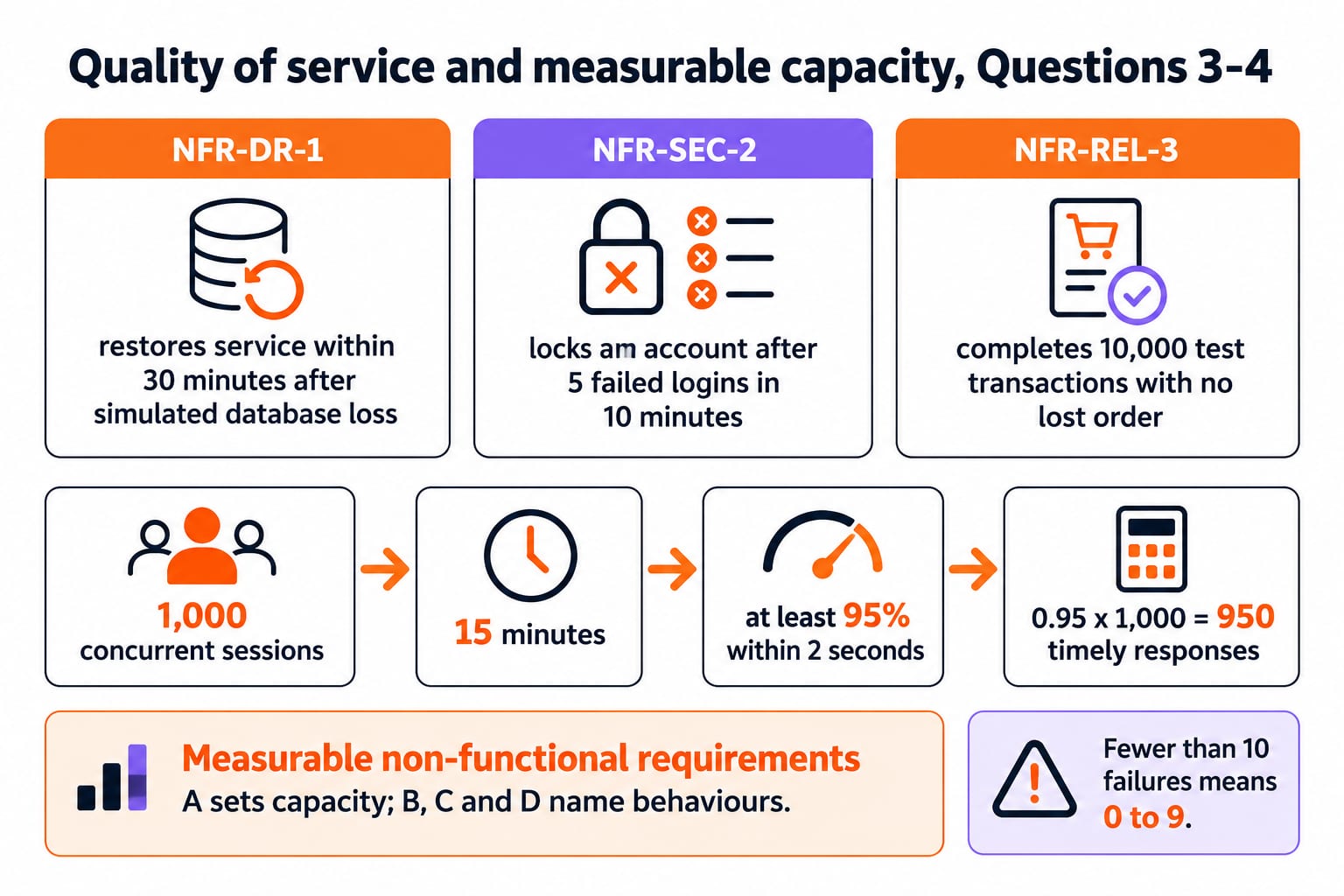
For a hypothetical service with baselined targets, NFR-DR-1 restores service within 30 minutes after simulated database loss, NFR-SEC-2 locks an account after 5 failed logins in 10 minutes, and NFR-REL-3 completes 10,000 test transactions with no lost order.
Question 4
TPSC 2025, Computer Science, Programmer. Question 4 practice page.
Which of the following is a non-functional requirement?

A. The software should be able to handle 1000 users simultaneously
B. The software should display data on the screen
C. The software should allow users to log in
D. The software should save user data
Answer: A. The software should be able to handle 1000 users simultaneously. A sets capacity; B, C and D name behaviours. Ask whether an option states an action or specifies how well the system performs under load.
Test 1,000 concurrent sessions for 15 minutes. If each makes one login request, at least 95% within 2 seconds means 0.95 x 1,000 = 950 timely responses. Fewer than 10 failures means 0 to 9. Only concurrency comes from the stem; the rest demonstrate a testable NFR.
User requirements, system detail and constraints, Questions 5-6
Question 5
MPPSC 2025, Computer Science.
System requirements are more detailed descriptions of the

A. Text requirements
B. Data requirements
C. User requirements
D. Model requirements
Answer: C. User requirements. User requirements state reader-facing needs. System requirements refine them into functions, interfaces, data rules and constraints for design and testing.
The user requirement A passenger can cancel a booking can become system requirements to accept a PNR and account ID, reject cancellation after departure, and store the cancellation time in UTC. Test three boundaries: a matching account before departure succeeds and records UTC; a request after departure is rejected without a cancellation record; a mismatched account is rejected without changing the booking.
Question 6
TPSC 2026, Computer Science, Programmer.
Which type of requirement covers accessibility and legal compliance?

A. Constraint
B. Business
C. System
D. Functional
Answer: A. Constraint. Accessibility obligations and legal compliance constrain acceptable solutions, so A fits. Accessibility can also be a measurable quality requirement. Identify the applicable rule and make compliance testable.
For a classroom system, write C-1: all 6 checkout controls must be reachable by keyboard alone. Test it by traversing all 6 controls without pointer input and recording each visible focus state.
Functional behaviour versus quality attributes, Questions 7-8
Question 7
TPSC 2025, Computer Science, Assistant Programmer.
Which of the following is true about functional requirements?

A. They specify what the system should do
B. They specify how the system should be built
C. They describe the non-functional aspects of the system
D. They only focus on performance criteria
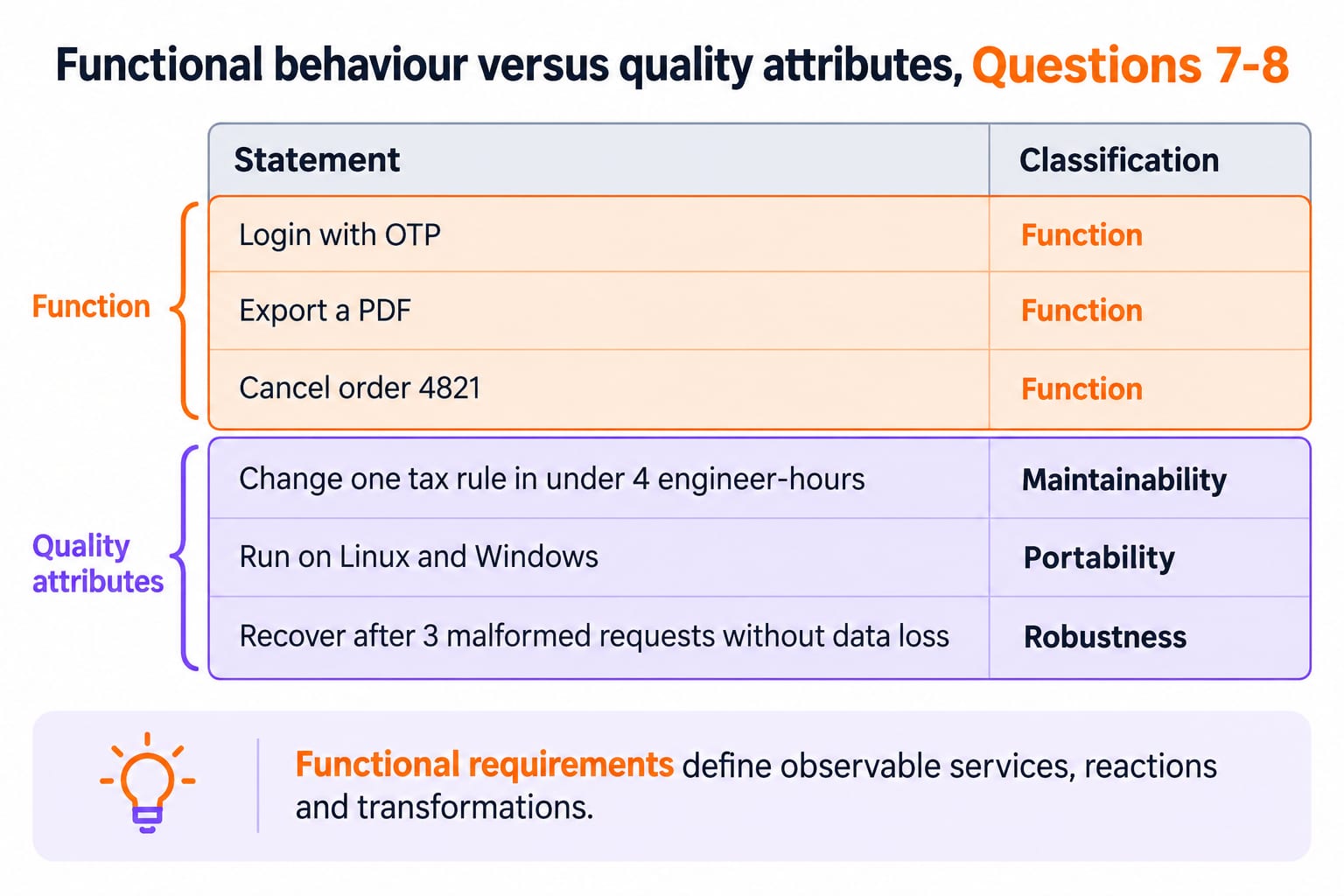
Answer: A. They specify what the system should do. Functional requirements define observable services, reactions and transformations. How the system is built concerns design or implementation constraints. Performance is non-functional.
FR-7: when order 4821 is submitted, calculate the total and return a confirmation number states behaviour. NFR-7: return that confirmation within 2 seconds at 1,000 concurrent sessions sets performance. DES-7: use a queue is a design decision.
Question 8
ISRO 2016.
Which one of the following is a functional requirement?

A. Maintainability
B. Portability
C. Robustness
D. None of the mentioned
Answer: D. None of the mentioned. All three choices are qualities, not functions. Question 2's caveat matters: elimination identifies the correct option, but a business goal still needs functional decomposition.
Statement | Classification |
|---|---|
Login with OTP | Function |
Export a PDF | Function |
Cancel order 4821 | Function |
Change one tax rule in under 4 engineer-hours | Maintainability |
Run on Linux and Windows | Portability |
Recover after 3 malformed requests without data loss | Robustness |
Read Software Quality in Software Engineering for the wider quality-attribute lesson.
Identify the outsider and match four definitions, Questions 9-10
Question 9
UGC NET 2022, Computer Science, Paper 2 (December).
Which of the following is not a non-functional requirement?

A. Portability
B. Security
C. Scalability
D. User interaction
Answer: D. User interaction. Portability, security and scalability are quality categories. Here, user interaction suggests behaviour or an interface flow, so it is the outsider. A concrete interaction can be functional, while its usability target is non-functional.
For example, FR-UI-1: after 3 invalid OTP entries, show a retry message states behaviour. NFR-UI-1: 18 of 20 first-time users complete the flow within 90 seconds is a measurable usability target. Here, 18 / 20 x 100 = 90% completion.
Question 10
UGC NET 2013, Computer Science, Paper 2 (June).
Match List I with List II:

List I:
a. Good quality
b. Correctness
c. Predictable
d. Reliable

List II:
i. Program does not fail for a specified time in a given environment
ii. Meets the functional requirements
iii. Meets both functional and non-functional requirements
iv. Process is under statistical control

A. a-iii, b-ii, c-iv, d-i
B. a-ii, b-iii, c-iv, d-i
C. a-i, b-ii, c-iv, d-iii
D. a-i, b-ii, c-iii, d-iv
Answer: A. a-iii, b-ii, c-iv, d-i. Good quality meets functional and non-functional requirements, so a-iii. Correctness meets functional requirements, so b-ii. A predictable process is under statistical control, so c-iv. Reliability means no failure for the specified time and environment, so d-i.
A release that implements all 12 functions and satisfies all 4 quality thresholds passes 12 + 4 = 16 checks. A reliability run completes 100 hours in environment E1 without failure. Weekly escaped-defect counts 3, 4, 2, 3 are within pre-established limits 1 to 5; their mean is (3 + 4 + 2 + 3) / 4 = 3. This illustrates predictability, but four observations cannot establish a real control chart.
Functional and non-functional requirements answer key and next step
Question | Answer | Deciding clue |
|---|---|---|
1 | C | Classification outsider |
2 | C | Only function-side option, with wording caveat |
3 | B | Quality bundle |
4 | A | Capacity |
5 | C | System detail refines user need |
6 | A | Constraint |
7 | A | System behaviour |
8 | D | All three are qualities |
9 | D | Interaction behaviour |
10 | A | Four definitions |
Missed Questions 4, 7 and 9? Revise function versus quality. Missed 5 and 6? Revise abstraction level versus constraint. For 10, rewrite each term as a testable statement.
Use NTA-UGC-NET Paper - 2 for sequenced review and timed practice. Start with the category that produced the most errors in your first attempt.
Go deeper with the full courseMP SET Computer Science (Paper 1 + Paper 2)
Keep learning
Cohesion and Coupling MCQs: 10 Solved Questions on Functional Independence
Practise 10 solved MCQs on cohesion, coupling, functional independence, module dependencies, and the distinctions that make closely matched options easier to separate.
Updated 24 Sep 20267 min readUGC NET Computer Science

Functional Completeness MCQs: 10 Solved Questions + 2 Bonus
Solve 10 unique Functional Completeness questions from live published records, then use two labelled bonus checks for repeated monotonicity and Boolean duality.
Updated 30 Oct 20268 min readDigital Electronics MCQs

Requirements Elicitation Techniques and Use Case Development: Worked Library Example
Follow a fictional library reservation from interviews and observation through testable requirements, a UML use-case model, UC-07, and acceptance checks.
Updated 30 Oct 20266 min readUGC NET Computer Science
Software Requirements in Software Engineering: SRS, Elicitation and Validation with a Worked Example
Turn vague stakeholder needs into precise, testable software requirements. Follow one mock-test portal from elicitation and SRS writing to acceptance tests and traceability.
Updated 14 Aug 20266 min readUGC NET Computer Science