

School of Thoughts for Competitive Exams: Nyaya Logic, Pramanas and Solved Examples
Learn to classify pramanas, label the five members of a Nyaya argument, and separate vyapti, paksha-dharmita and paramarsha through fixed examples.
KnowledgeGate Team
Exam prep & CS education
Updated 26 Nov 20265 min read
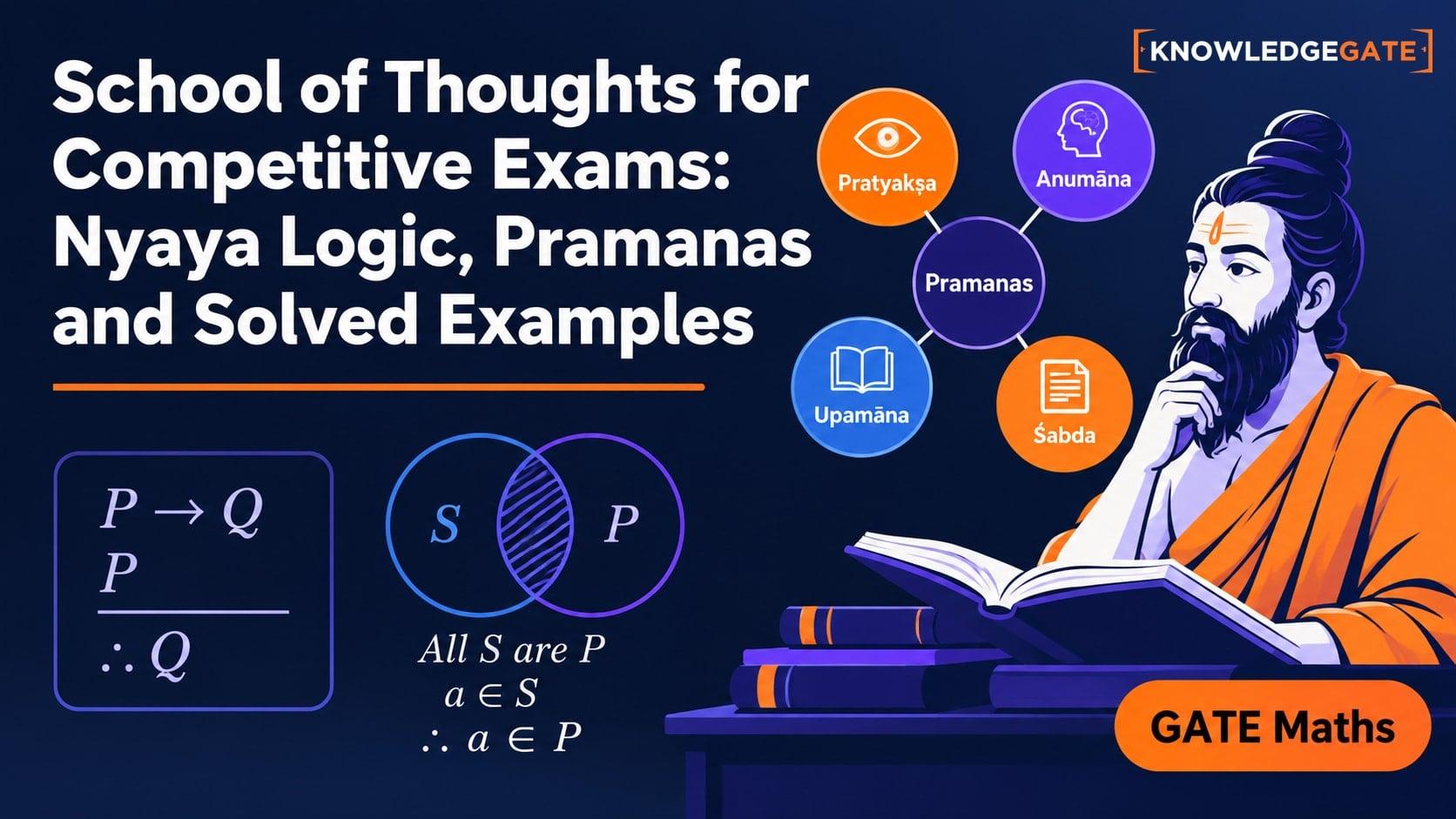
A question may use familiar words such as reason, example, application, inference and absence, yet ask for their exact Nyaya or Vedanta labels. That is where learners lose the thread. The labels are precise, so guessing from ordinary English often fails. Use three maps to keep the labels stable: four versus six pramanas, the five-member Nyaya argument, and a distinction table for closely related terms. In this context, School of Thoughts refers to classical Indian philosophy and logic represented in the Reasoning question bank, rather than a generic brainstorming technique.
School of Thoughts: first fix the scope
The exam-useful top-level map begins with six astika systems: Nyaya, Vaisheshika, Samkhya, Yoga, Mimamsa and Vedanta. Buddhism, Jainism and Charvaka are three traditions commonly grouped as nastika.
The classification test is acceptance or rejection of Vedic authority. Do not reduce astika and nastika to “believes in God” and “does not believe in God”. That shortcut uses the wrong test and can produce the wrong answer.
The high-value reasoning concepts are means of knowledge, Nyaya's five-member argument, vyapti, paksha-dharmita, paramarsha and types of inference. Use focused practice that mixes definitions, matching, ordering and scenario classification.
Check your exam's current notification before allocating study time; the concepts below are preparation material, and their inclusion varies by exam.
Pramanas: use the four-versus-six memory map
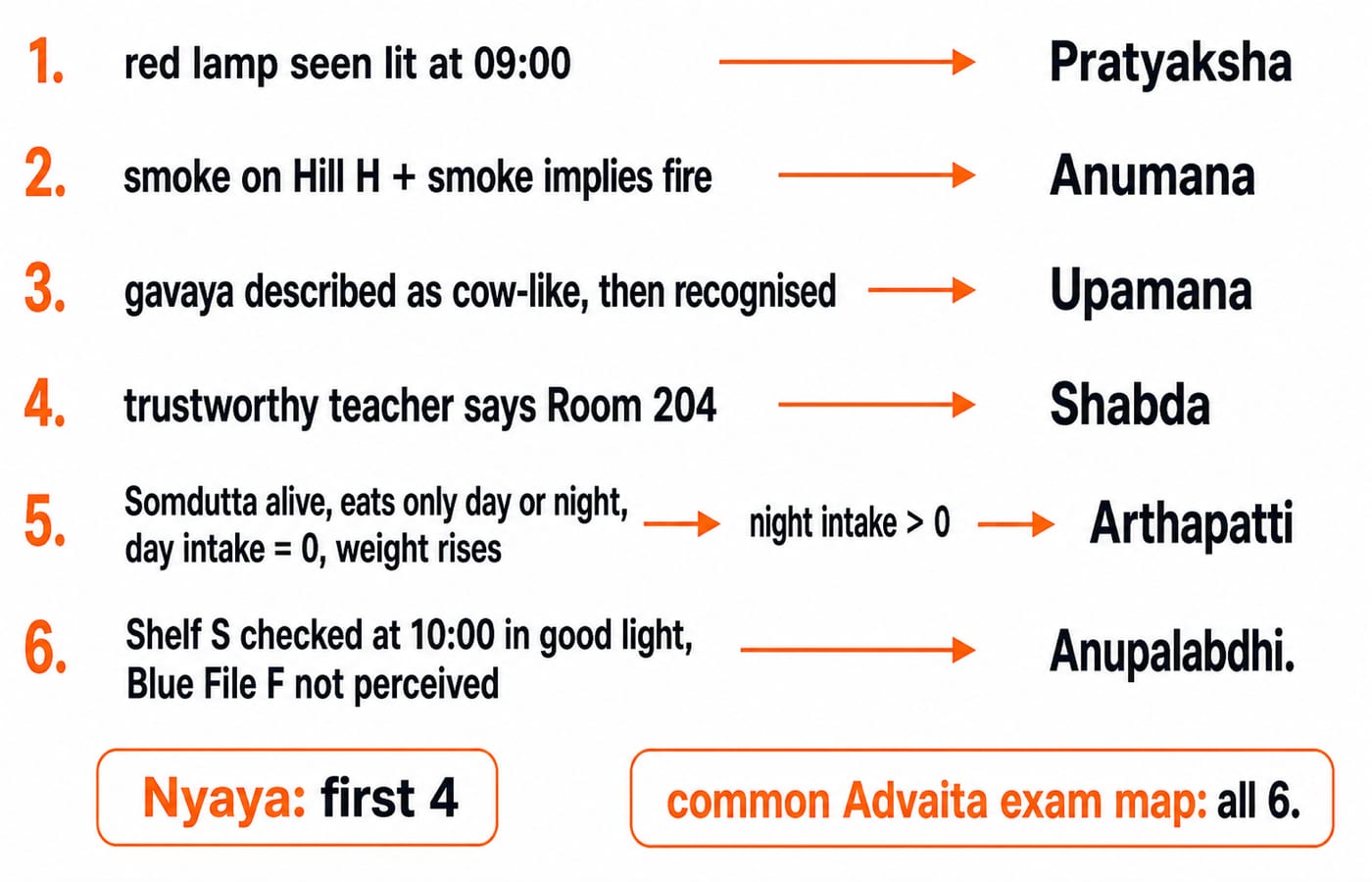
Nyaya accepts four pramanas: pratyaksha, perception; anumana, inference; upamana, comparison; and shabda, reliable verbal testimony. A common Advaita Vedanta exam classification adds arthapatti, a postulation required to reconcile facts, and anupalabdhi, knowledge of absence through non-perception under suitable conditions. This six-part map is useful for Advaita questions, but should not be imposed identically on every Vedanta school. Keep that boundary clear.
Classify by asking what actually produces the knowledge:
Input | Pramana |
|---|---|
A red lamp is seen lit at 09:00 | Pratyaksha |
Smoke is seen on Hill H, and smoke implies fire | Anumana |
A gavaya is identified after being described as cow-like | Upamana |
A trustworthy teacher says the room is 204 | Shabda |
Somdutta is alive, eats only by day or night, daytime eating = 0, yet body weight increases, so night eating > 0 | Arthapatti |
Shelf S is inspected at 10:00 in good light, and Blue File F is not perceived | Anupalabdhi |
The five-member Nyaya argument: one worked example
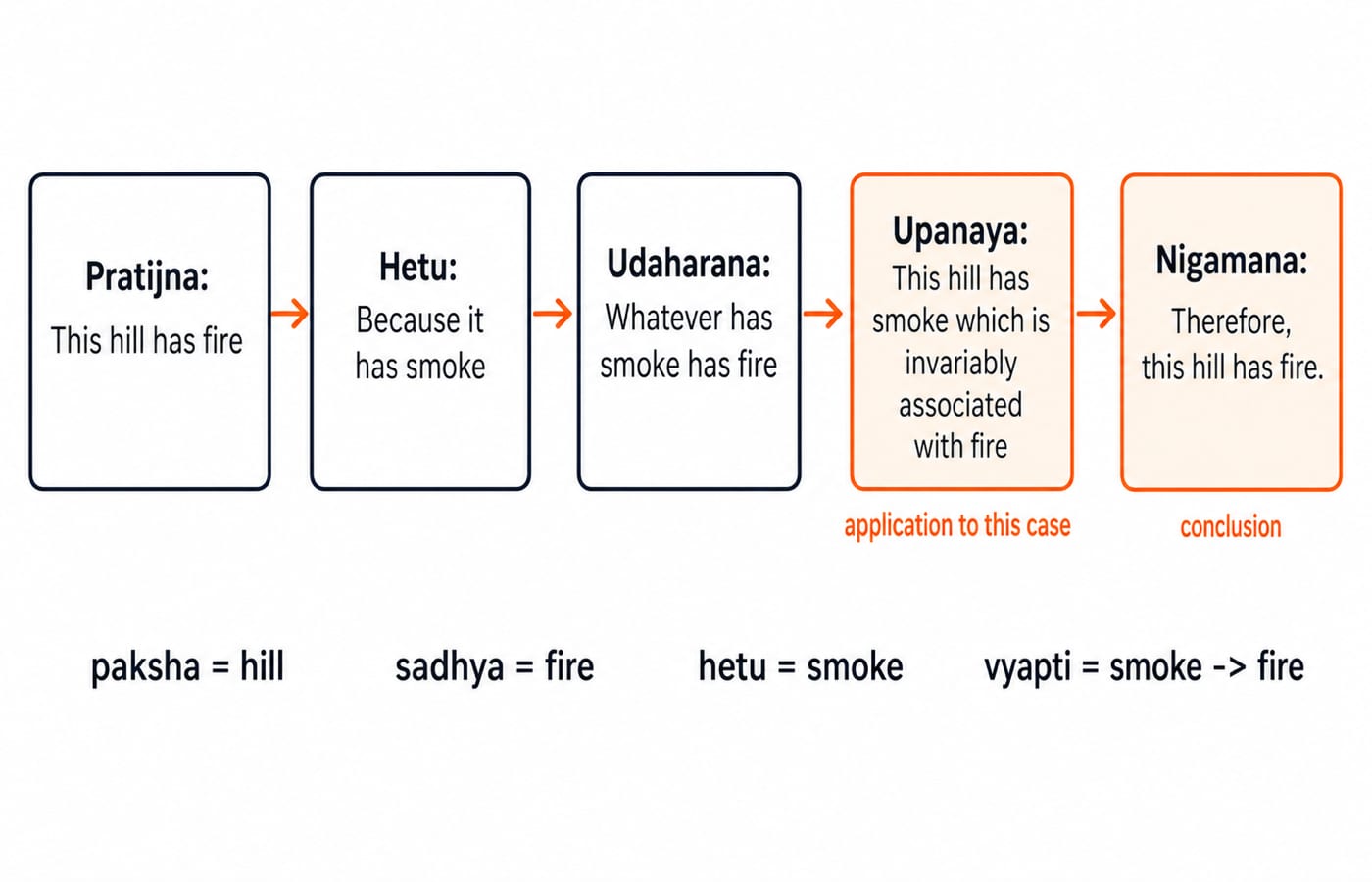
Keep the five statements separate. In the Hill H example, they are:
A. Pratijna: “This hill has fire.”
B. Hetu: “Because it has smoke.”
C. Udaharana: “Whatever has smoke has fire.”
D. Upanaya: “This hill has smoke which is invariably associated with fire.”
E. Nigamana: “Therefore, this hill has fire.”
The term values remain fixed throughout: paksha = hill, sadhya = fire, hetu = smoke, and vyapti = smoke is invariably accompanied by fire.
For speed, translate the sequence as Claim -> Reason -> Universal rule -> Apply rule to this case -> Conclude. The important check is between C and D. Udaharana states the universal rule. Upanaya applies that rule to Hill H. Nigamana is the final conclusion. If you collapse the universal statement and its application, you will mislabel D.
Read the construction in order: A sets the proposition, B supplies the reason, C states the universal relation, D connects that relation to the present case, and E records the proved result.
Use this 20-second routine:
Underline the case, or paksha.
Circle the sign, or hetu.
Write the universal relation once.
Ask whether the option states that general rule, which is Udaharana, or applies it to the named case, which is Upanaya.
Vyapti, paksha-dharmita and paramarsha
Hill H keeps the terms stable across the definitions. Paksha-dharmita is the presence of the hetu in the paksha: smoke is present on Hill H. Vyapti is the invariable relation between hetu and sadhya: wherever there is smoke, there is fire. Paramarsha is the cognition that Hill H has smoke qualified by that fire-pervasion. After these checks, the conclusion “Hill H has fire” follows.
The shortcut is three questions:
Question | Concept |
|---|---|
Is the sign present in this case? | Paksha-dharmita |
Is the sign invariably tied to what must be proved? | Vyapti |
Have I mentally joined this case-specific sign with that universal relation? | Paramarsha |
“Sound is eternal because it is produced” fails as support because being produced supports non-eternality, not eternality. The hetu-to-sadhya relation must point towards what you are trying to prove.
Classify inference and postulation questions quickly
Example A: The pond contains fresh muddy water; infer that rain occurred earlier. The observed effect points to a past cause, so this is sheshavat anumana.
Example B: Somdutta is alive, eats only by day or night, daytime eating = 0, yet body weight rises. Night eating > 0 is required to reconcile the facts, so this is arthapatti.
Keep the inference labels apart:
Type | Direction | Example |
|---|---|---|
Purvavat | Observed cause to unobserved effect | Dense rain clouds now -> likely rain later |
Sheshavat | Observed effect to prior cause | Muddy pond now -> past rain |
Samanyatodrishta | Generally observed relation, not a direct cause-effect chain | A conclusion rests on regular association |
If a stem gives a sign plus an invariable relation, test anumana. If an unstated fact alone can reconcile the supplied premises, test arthapatti.
Traps that cost marks
Trap | Why it happens | What goes wrong | What to do |
|---|---|---|---|
Astika versus theism | Labels seem similar. | Authority becomes theism. | Test Vedic authority. |
Udaharana versus Upanaya | Both use one relation. | Rule becomes application. | Find the paksha. |
Vyapti versus paksha-dharmita | Terms appear connected. | Relation becomes case presence. | Ask: universal or present? |
Anumana versus arthapatti | Both derive knowledge. | Derivation becomes inference. | Require a reconciling fact. |
Upanaya requires application to the paksha. Arthapatti needs a fact that reconciles premises.
Mini self-test: “Whatever has smoke has fire” = Udaharana; “Hill H has such smoke” = Upanaya; “middle term present in the minor term” = paksha-dharmita; “invariable concomitance” = vyapti.
How questions are framed and what to practise next
Practice questions can use direct definitions, match-the-lists, five-member ordering, identification of one member, scenario classification by pramana, and Statement I/Statement II evaluation. These are useful practice shapes; check the official notification for the pattern of your exam. For Paper 1 context, read UGC NET Paper 1 vs Paper 2. For broader reasoning-speed work, use MCA entrance logical reasoning.
Run a 30-minute loop: spend 8 minutes recreating the four-versus-six pramana map, 8 minutes labelling two five-member arguments, 10 minutes solving 10 mixed questions, and 4 minutes recording errors under “term confused”, “rule not applied”, or “school list mixed”. The check is 8 + 8 + 10 + 4 = 30 minutes.
The short version is: remember four versus six, translate the five stages as Claim -> Reason -> Rule -> Apply -> Conclude, and separate presence, universal relation and joined cognition. Continue with the NTA UGC NET Paper 1 course. For wider reasoning preparation, use the Aptitude for Placement course and the Aptitude category.
Keep learning
Adjectives for Competitive Exams: Rules, Shortcuts and Solved Examples
Learn to identify adjectives from the noun outward, handle comparison and adjective order, separate adjectives from adverbs, and correct common exam traps.
Updated 25 Nov 20266 min readAptitude & Reasoning
Puzzle Solving for Competitive Exams: Grid Method, Shortcuts and Solved Examples
Stop rereading clues and start converting them into constraints. This guide teaches a repeatable grid method through five fully worked puzzle families.
Updated 24 Nov 20266 min readAptitude & Reasoning

Data Sufficiency: A 5-Step Method, Shortcuts and Solved Examples
Learn to test each statement independently, prove insufficiency with two valid cases, and stop as soon as the target becomes unique. Three worked problems make the method concrete.
Updated 15 Nov 20266 min readAptitude & Reasoning

Data Arrangement Questions: Concepts, Shortcuts and Solved Examples
Turn names, cities, roles and scores into a clean grid. This guide shows safe shortcuts and solves one complete arrangement from clues to answer.
Updated 11 Nov 20266 min readAptitude & Reasoning