

Puzzle Solving for Competitive Exams: Grid Method, Shortcuts and Solved Examples
Stop rereading clues and start converting them into constraints. This guide teaches a repeatable grid method through five fully worked puzzle families.
KnowledgeGate Team
Exam prep & CS education
Updated 24 Nov 20266 min read
Many learners read a puzzle repeatedly, try to hold every clue in memory, then guess too early or redraw the same information. A better method is repeatable: identify the family, choose a representation, translate clues into constraints, place anchors and blocks, eliminate forced cases, branch only when needed, and verify. The method appears in a five-day presentation puzzle, a 3-by-3 number grid, and short alphabet, clock and card examples.
What puzzle solving covers, and which representation to choose
A puzzle is a finite constraint problem. A known set of people, positions, days, values, letters or objects must satisfy every stated rule. The target is not an attractive pattern, but an assignment that survives all the clues.
KnowledgeGate has over 350 published Reasoning questions under Puzzle Solving (Puzzles), covering logical and arrangement puzzles, numbers, missing letters, mixed number-letter patterns, clocks and playing cards. These are practice families, not an official syllabus. Use a row or circle for positions, a table for multiple attributes, a 3-by-3 matrix for number or letter relations, a clock face for angles or mirrors, and a short case list for cards. The broader Placement Preparation and Coding hub hub also covers quantitative aptitude, logical reasoning and verbal ability.
Translate every clue into a precise constraint
Turn prose into compact statements. “P is immediately left of Q” becomes the ordered block P-Q. “R is not at an end” crosses out positions 1 and 5 in a five-slot row. “S is two places after T” becomes position(S) = position(T) + 2. “U is either Monday or Friday” creates {Monday, Friday}. “If V is Tuesday, W is Thursday” is one-way: W being Thursday does not prove V is Tuesday.
Write the complete domain before solving. Mark fixed facts with a check, impossible cells with an x, and unresolved cells with a blank. Then the last candidate is an elimination, not an assumption. Also separate direct facts from blocks. “Aditi is on Monday” can be entered immediately; “DBMS is on Friday” remains a subject-day block even before its presenter is known.
The seven-step shortcut: inventory, anchor, block, link, eliminate, query, verify
Use this order:
Inventory every entity and note whether values are unique.
Enter direct anchors.
Preserve ordered or unordered blocks.
Link blocks that share a value.
Fill only forced cells.
Answer the requested query from the completed representation.
Verify every original clue.
Work most-constrained-first. Fixed days, ends and immediate-neighbour blocks usually remove more candidates than broad negative clues. Never split P-Q or eliminate a value from other rows unless the stem makes it unique. If two real possibilities remain, label Case 1 and Case 2, then continue until one contradicts a clue. Options can test the final query, but cannot replace the clue chain.
Fully worked logical puzzle: five presentations across five days
Aditi, Bharat, Charu, Danish and Esha each present once from Monday to Friday. Their distinct subjects are AI, DBMS, Networks, OS and Python. A day table provides the common frame, while presenter and subject remain separate attributes.
Aditi presents on Monday.
Aditi presents Python.
Charu presents on Wednesday.
Charu presents Networks.
DBMS is presented on Friday.
Bharat presents immediately before the DBMS presentation.
Esha presents OS.
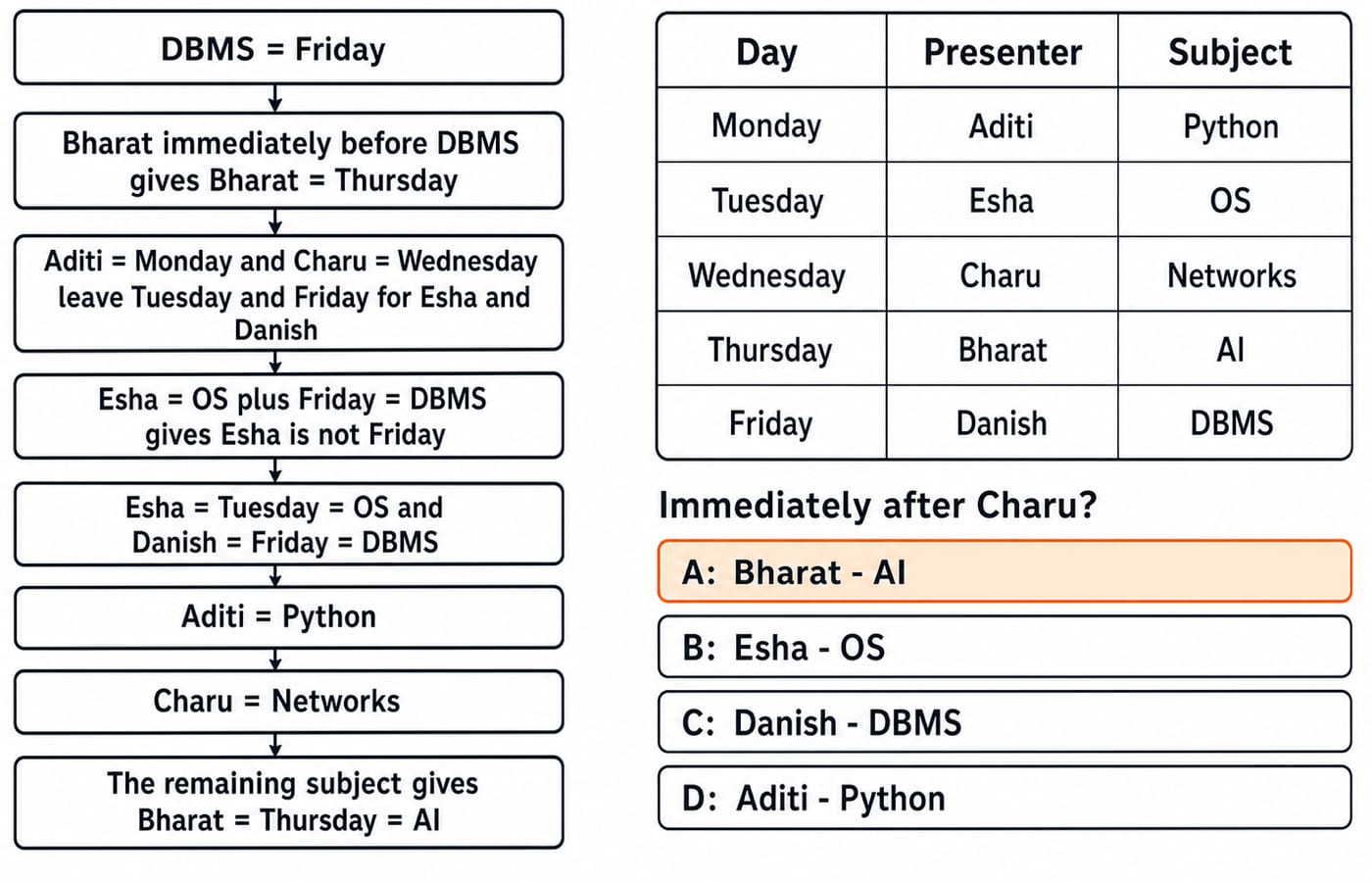
Start with the strongest chain. Clue 5 fixes DBMS on Friday, so clue 6 fixes Bharat on Thursday. Clues 1 and 3 place Aditi on Monday and Charu on Wednesday. Danish and Esha must therefore occupy Tuesday and Friday. Esha cannot be Friday because Esha has OS while Friday has the distinct subject DBMS. Thus Esha is Tuesday with OS, and Danish is Friday with DBMS. AI is the only unused subject, so Bharat presents AI on Thursday.
Day | Presenter | Subject |
|---|---|---|
Monday | Aditi | Python |
Tuesday | Esha | OS |
Wednesday | Charu | Networks |
Thursday | Bharat | AI |
Friday | Danish | DBMS |
Who presents immediately after Charu, and on which subject?
(a) Bharat - AI
(b) Esha - OS
(c) Danish - DBMS
(d) Aditi - Python
The answer is (a). The day after Wednesday is Thursday, occupied by Bharat with AI. Checking back confirms all seven clues and five distinct people, days and subjects.
Number and alphabet puzzles: keep one rule unchanged
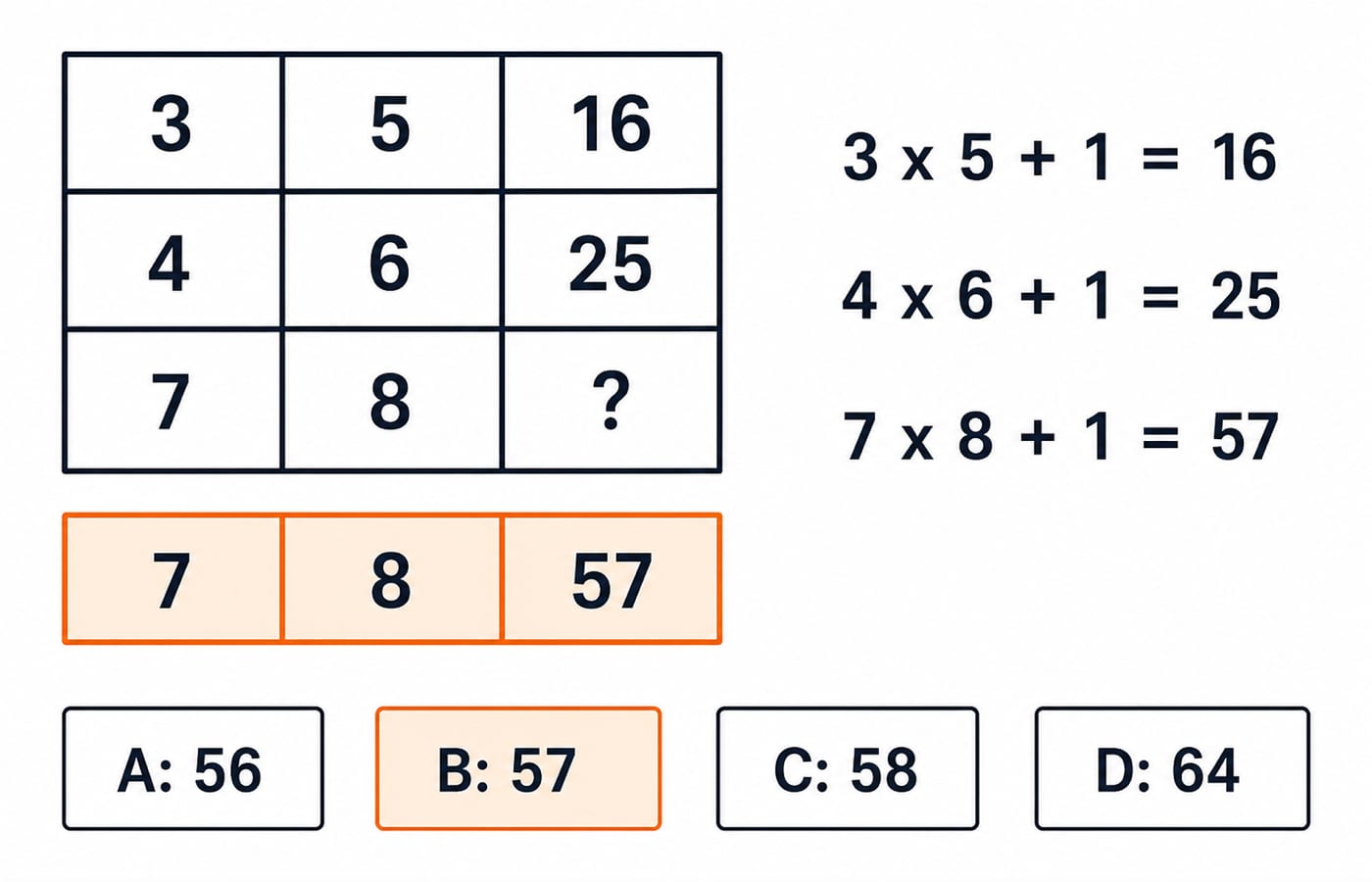
For the number grid, the rows are 3, 5, 16; 4, 6, 25; and 7, 8, ?. Test one rule twice: 3 x 5 + 1 = 16, and 4 x 6 + 1 = 25. Apply it unchanged: 7 x 8 + 1 = 57. The options are (a) 56, (b) 57, (c) 58 and (d) 64, so choose (b). Two examples do not prove a unique sequence outside the question; choose the simplest option-supported rule consistent with all supplied rows. This final substitution checks both the operation and constant, instead of accepting a visual resemblance.
For ACE, BDF, CEG, ?, the options are (a) DFH, (b) DEH, (c) DFG and (d) EGI. Read vertically: A-B-C-D, C-D-E-F and E-F-G-H. Every position shifts by +1, so the answer is DFH. Substitute answers back throughout, reject any rule that changes midway, and prefer a short complete rule over a decorative exception.
Clock and card puzzles: use the family-specific invariant
For a standard 12-hour analogue mirror puzzle showing 4:35, calculate 11:60 - 4:35 = 7:25. A visual check agrees: the minute hand at 35 minutes reflects to 25 minutes. This shortcut belongs to this mirror setup, not every clock question.
Now order A-spades, J-hearts, Q-clubs and K-diamonds. Q-clubs is immediately left of K-diamonds; J-hearts is at an end; A-spades is not adjacent to J-hearts; and A-spades is left of Q-clubs. For cards, the ordered Q-K block is the invariant that sharply limits the cases. If J-hearts is first, no A-spades position can be both left of the Q-K block and non-adjacent to J-hearts. Reject that case. With J-hearts fourth, the only valid order is A-spades, Q-clubs, K-diamonds, J-hearts. The transferable rule is simple: identify what stays fixed, then enumerate the smallest legal cases.
Common traps and how competitive exams may frame puzzles
Replace each bad habit with a precise repair:
Stop rereading prose; externalise each clue.
Do not align list order without evidence; use only stated relations.
Do not turn “if” into “if and only if”; preserve its direction.
Keep immediate blocks intact, and eliminate repeated values only when uniqueness is stated.
Do not stop at one possible arrangement; test uniqueness.
Validate a number rule across every supplied row.
Questions may ask for an arrangement, a must-or-cannot statement, a missing value, statement sufficiency, or the only valid case.
Formats, section structures and timings vary by examination and cycle. Confirm current exam-specific details in the relevant authority’s current notification and instructions.
For a bank-exam topic-priority overview and a broader reasoning mix, read Bank PO Reasoning: High-Yield Topics and Puzzle Method; this page stays with representation and worked puzzle families. For an eight-week SBI PO practice plan covering puzzle sets, seating and data sufficiency, use SBI PO Reasoning: 8-Week Puzzle and Sufficiency Plan; this page teaches the underlying constraint methods and worked examples.
Puzzle solving short version and the next practice step
Recall: classify -> represent -> anchor -> block -> eliminate -> query -> verify. The decisive results were Bharat with AI on Thursday, 57, DFH, 7:25, and A-spades, Q-clubs, K-diamonds, J-hearts. Try a 12-question learning drill: four logical, three number, two alphabet, two clock and one card puzzle. Label each miss as representation, translation, elimination, branch or verification. Repeat weak families. For a structured next step, continue with Aptitude for Placement.
Keep learning
Banking Exams Reasoning Puzzles: A Repeatable Grid Method
Learn a six-step puzzle method through one complete five-person day and city set. Build separate grids, control branches, finish the arrangement and verify every clue.
Updated 19 Aug 20266 min readBanking Exams
Logical Reasoning for Placement Tests: A Solving Method for Puzzles, Syllogisms and Series
Stop solving reasoning questions by instinct. Use one dependable procedure each for Venn syllogisms, number series and row-seating puzzles.
Updated 27 Jul 20265 min read53 viewsAptitude & Reasoning
Data Sufficiency: A 5-Step Method, Shortcuts and Solved Examples
Learn to test each statement independently, prove insufficiency with two valid cases, and stop as soon as the target becomes unique. Three worked problems make the method concrete.
Updated 15 Nov 20266 min readAptitude & Reasoning
Infosys Mock Analysis: Fix Puzzle, Pseudocode and Verbal Errors
Do more than record a mock total. Preserve each error, find its primary cause, repair puzzle, pseudocode and verbal losses differently, then retest.
Updated 30 Oct 20266 min readCompany-Specific Prep