

Adjectives for Competitive Exams: Rules, Shortcuts and Solved Examples
Learn to identify adjectives from the noun outward, handle comparison and adjective order, separate adjectives from adverbs, and correct common exam traps.
KnowledgeGate Team
Exam prep & CS education
Updated 25 Nov 20266 min read
An adjective looks easy alone, but an exam sentence can hide it beside a determiner, adverb or faulty comparison. Start with the noun or pronoun, identify the adjective's job, and only then apply a shortcut. Exam sentences test identification, position, types, comparison, order and timed verbal-ability error patterns in placement preparation courses. For rule-by-rule verbal-aptitude coverage, read Adjectives: Grammar Rules, Order and Comparison for Verbal Aptitude; use that rule treatment alongside worked comparisons, adjective-order phrases, fast checks and error traps.
Find the adjective by starting with the noun
An adjective describes or limits a noun or pronoun. Locate the noun, then ask: what kind, which one, how many, how much or whose? In The three diligent interns submitted a concise report, three answers how many interns, diligent what kind of interns, and concise what kind of report. Submitted is the verb.
An adjective is attributive before a noun and predicative after a linking verb. Compare The careful analyst checked the figures with The analyst was careful. In both, careful describes analyst. In The soup smells good, smells links soup to good, so good is an adjective, not the adverb well.
Scan in four steps:
Box the noun or pronoun.
Underline the word that describes or limits it.
Find the verb.
Check whether the marked word modifies the noun or the action.
An -ly ending is a clue, not a rule. Words such as friendly and lovely can be adjectives.
Use adjective types as working labels
School grammar uses common competitive-exam labels:
Type | Example |
|---|---|
Quality |
|
Quantity |
|
Number |
|
Demonstrative |
|
Possessive |
|
Interrogative |
|
Distributive |
|
Modern grammar may group possessives, demonstratives and quantifiers under determiners. Follow your target test's terminology, but apply the same noun-modifying test.
Now classify Each of those two careful reviewers checked her final answer. Each is distributive, those demonstrative, two numeral, careful quality, her possessive, and final quality or order. Several words can belong around one noun phrase without performing the same job.
In the edge case The rich are not always happy, rich is an adjective used substantively for a group, while happy is predicative after are.
Master degrees of comparison with a two-or-more check
The core forms are tall, taller, tallest; useful, more useful, most useful; good, better, best; and bad, worse, worst. Compare two with the comparative and usually than; compare three or more with the superlative and usually the. Use the taller of the two, but one of the tallest students, with a plural noun after one of the.
Aarav is 168 cm tall, Dev is 174 cm, and Kabir is 171 cm.
Dev is taller than Aarav because 174 cm is greater than 168 cm.
Dev is taller than Kabir because 174 cm is greater than 171 cm.
Dev is the tallest of the three because 174 cm is the greatest height.
No other student in the group is as tall as Dev.
The last sentence becomes Dev is taller than any other student in the group. Other is essential because Dev belongs to the group.
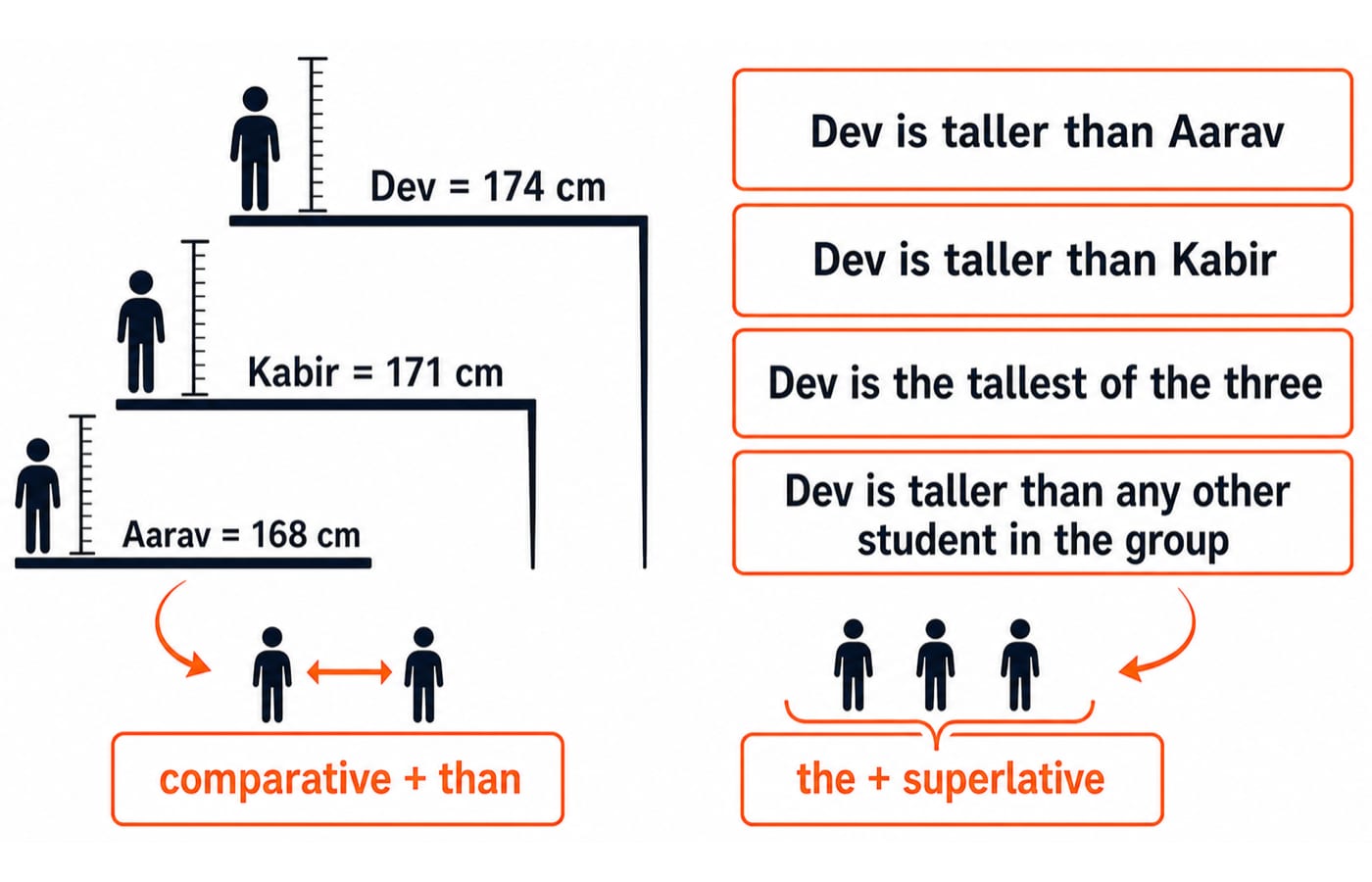
Keep the traps exact: Of the two plans, Plan B is better, not best; This method is better, not more better; and Riya is senior to Meera, not senior than Meera. Write Mumbai is larger than any other city in Maharashtra, since Mumbai is itself a city in Maharashtra.
Put multiple adjectives in a natural order
A practical order card is opinion -> size -> age -> shape -> colour -> origin -> material -> purpose -> noun. Few sentences fill every slot. Between a wooden small elegant writing desk and an elegant small wooden writing desk, the second is natural: opinion elegant, size small, material wooden, purpose writing, noun desk.
The deliberately dense phrase those three beautiful small old round brown Italian wooden coffee tables follows determiner, number, opinion, size, age, shape, colour, origin, material, purpose, noun. It is for learning, not everyday style.
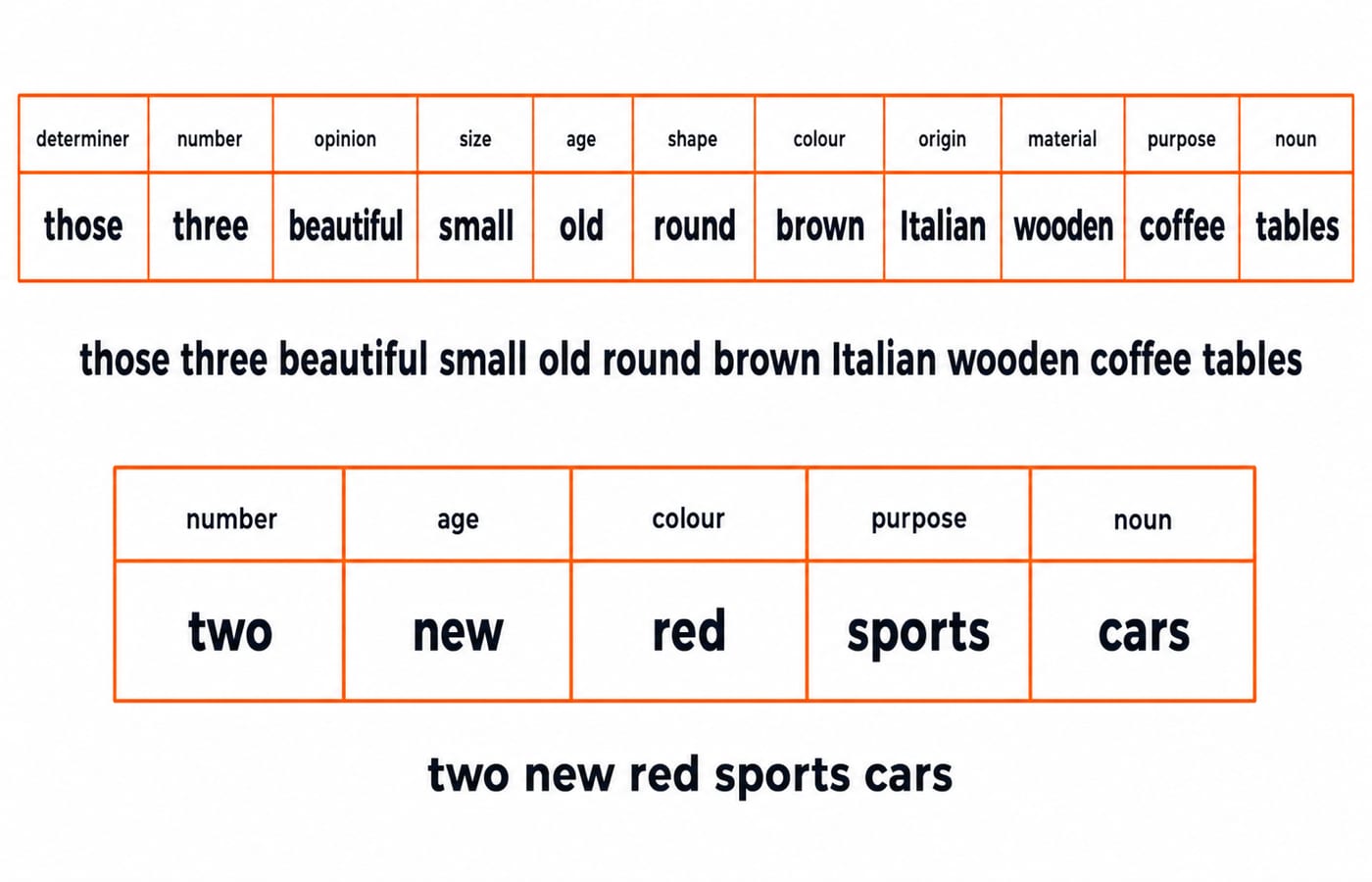
For speed, find the head noun on the right. Put material and purpose nearest it, then work left through origin, colour, shape, age, size and opinion. Keep determiner and number at the far left. Thus two / red / new / sports / cars becomes two new red sports cars.
Separate adjectives from adverbs and control quantifiers
Use the modification test. In She feels bad, bad describes she; in She performed badly, badly modifies performed. The workers laboured hard means with effort, while The workers hardly laboured means they almost did not work. He arrived late concerns time, while I have not seen him lately means recently.
Fix a set of four books. I read few of the four books presents the number as almost none or insufficient; I read a few of the four books presents it positively as some. I read the few books the library had means it had only four and all four were read. With uncountable nouns, little, a little and the little carry the same negative, positive and complete-amount contrast, without a universal numerical cutoff.
Countability decides the next pair. Write fewer than 30 candidates for 18 candidates because candidates are countable, but less than 2 hours for 90 minutes because time is an amount. The same check gives many questions and much time.
Solve the main adjective traps
She is the ___ of the two sisters (taller/tallest).Choosetallerbecause only two are compared.This is one of the ___ chapters (important/most important).Choosemost important;chaptersstays plural.The machine works ___ (smooth/smoothly).Choosesmoothlybecause it modifiesworks.The fabric feels ___ (soft/softly).Choosesoftbecausefeelslinksfabricto its quality.He has ___ patience for repeated errors (few/little).Chooselittlebecausepatienceis uncountable.A blue lovely silk scarfora lovely blue silk scarf? Choose the second: opinion, colour, material, noun.
In Rohan is more taller than Amit, remove more because taller is already comparative. In Chennai is hotter than any city in Tamil Nadu, insert other: Chennai is hotter than any other city in Tamil Nadu. Otherwise, Chennai is compared with itself.
Other corrections are unique, not the most unique, in conservative rule-based exam grammar; preferable to, not preferable than; good enough, not enough good; and a five-year-old course, not a five-years-old course. The compound adjective stays singular and hyphenated before the noun. Usage guides differ on grading some absolute adjectives, so use the conservative answer in traditional rule questions.
Adjectives for competitive exams: revise and take the next step
Questions ask you to identify or classify an adjective, fill a comparison form, arrange adjective order, distinguish adjective from adverb, or correct a modifier or quantifier. Exact formats vary, so check the notice or sample paper on the conducting body's official website.
Use this five-minute review:
Minute 0-1: locate the noun and verb.
Minute 1-2: decide adjective or adverb.
Minute 2-3: test comparison words and
other.Minute 3-4: check countability and quantifiers.
Minute 4-5: order multi-adjective phrases.
Use the Verbal Ability (English) > Adjectives practice set to test identification, comparison and modifier choices. For exam context, continue with the SSC CGL English section strategy or the Bank PO English section strategy.
The short version: find the noun, identify what describes or limits it, then apply comparison, order and countability checks. If you want verbal ability sequenced alongside aptitude and reasoning, the Aptitude for Placement course is the next step.
Go deeper with the full courseINFYTQ Superset
Keep learning

School of Thoughts for Competitive Exams: Nyaya Logic, Pramanas and Solved Examples
Learn to classify pramanas, label the five members of a Nyaya argument, and separate vyapti, paksha-dharmita and paramarsha through fixed examples.
Updated 26 Nov 20265 min readAptitude & Reasoning

Puzzle Solving for Competitive Exams: Grid Method, Shortcuts and Solved Examples
Stop rereading clues and start converting them into constraints. This guide teaches a repeatable grid method through five fully worked puzzle families.
Updated 24 Nov 20266 min readAptitude & Reasoning

Data Sufficiency: A 5-Step Method, Shortcuts and Solved Examples
Learn to test each statement independently, prove insufficiency with two valid cases, and stop as soon as the target becomes unique. Three worked problems make the method concrete.
Updated 15 Nov 20266 min readAptitude & Reasoning
Data Arrangement Questions: Concepts, Shortcuts and Solved Examples
Turn names, cities, roles and scores into a clean grid. This guide shows safe shortcuts and solves one complete arrangement from clues to answer.
Updated 11 Nov 20266 min readAptitude & Reasoning