

Selection Decision Table: Concepts, Shortcuts and Solved Examples
Learn a reusable five-rule method for eligibility notices, then trace referrals, rejections and exact-boundary cases without losing the AND/OR logic.
KnowledgeGate Team
Exam prep & CS education
Updated 27 Nov 20266 min read
Selection questions often look like long eligibility notices, but the real task is smaller: turn every sentence into a yes/no check and apply exceptions in the correct order. The method turns each sentence into a reusable check, then tests it on a campus-analyst case with five possible outcomes: Select, Refer to HR Manager, Refer to Academic Panel, Refer to Senior Panel, or Reject. For the wider study context, use the Aptitude for Placements Guide.
1. What a selection decision table actually does
A selection decision table maps a set of conditions to one final action. It separates three things that dense prose often mixes together:
Ordinary conditions, which define the standard route.
Stated exceptions, which replace only particular ordinary conditions.
Actions, such as selection, referral, or rejection.
Preserve the notice's exact AND/OR logic. Five conditions joined by AND must all pass, and an age exception cannot repair a failed interview.
Use four steps: normalise each condition, mark non-exempt failures, tag applicable exception bands, and read the resulting action. The exceptions belong only to the question that states them, not to recruitment generally.
2. Convert the notice into atomic checks
In this fictional campus-analyst notice, a standard candidate must be aged 21 to 28 inclusive, have at least 60% in the bachelor's degree, score at least 70 out of 100 in the written test and 55 out of 100 in the interview, and be willing to relocate.
Two exceptions apply. A candidate aged 29 to 32 inclusive with at least 2 years of experience goes to the HR Manager if every other ordinary condition is met. A candidate with 55% to 59% in the bachelor's degree and at least 65% in a postgraduate degree goes to the Academic Panel if ordinary age and every other condition are met. Both exception bands together lead to the Senior Panel. Anything outside the four valid routes is rejected.
Write the notice as boundary checks:
21 <= age <= 2829 <= age <= 32 AND experience >= 2UG >= 6055 <= UG < 60 AND PG >= 65written >= 70interview >= 55relocate = Yes
The phrase at least includes the boundary value. That detail decides the final row in the worked set.
3. Build the five-rule table once
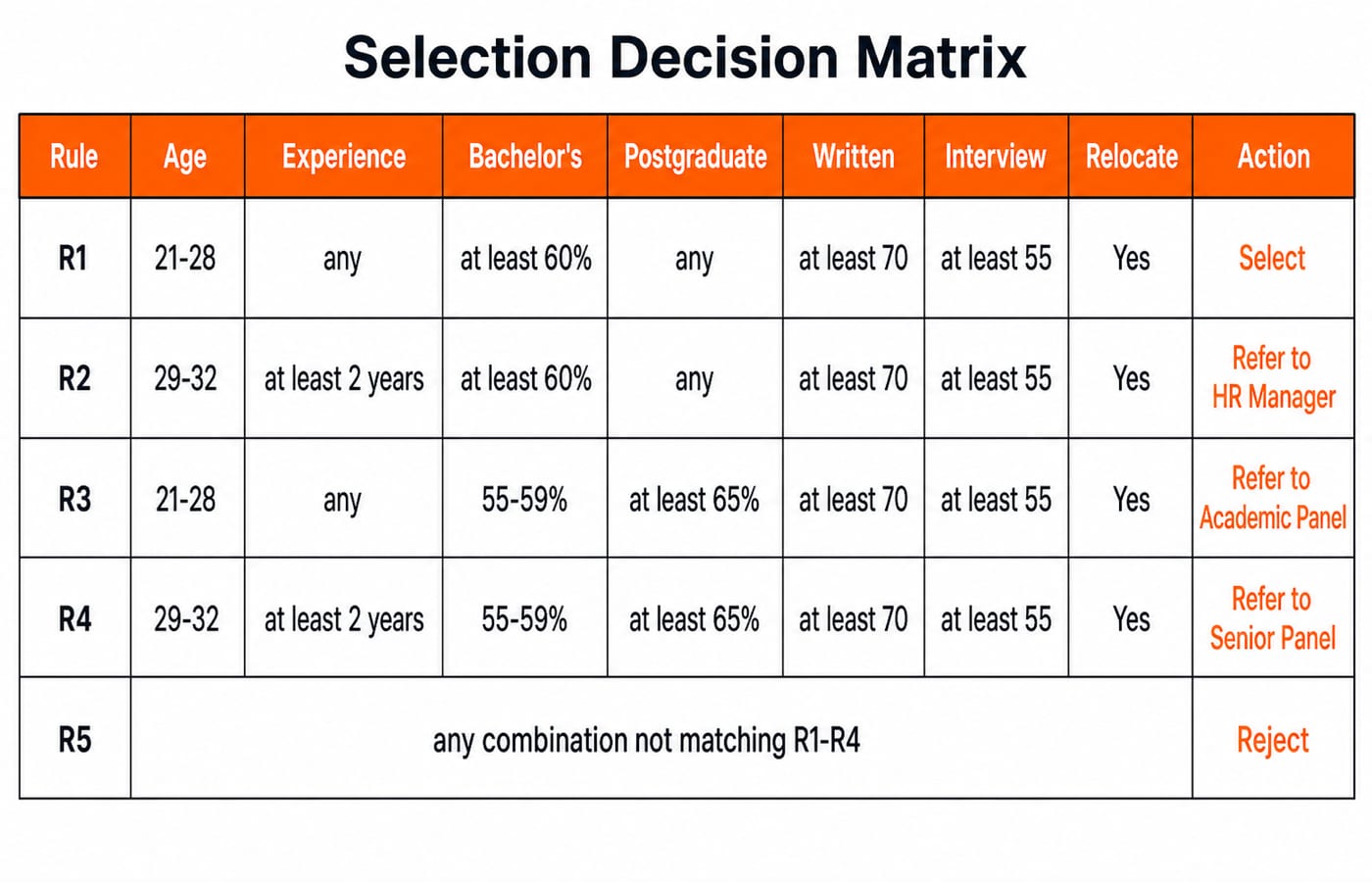
The normalised decision table is:
Rule | Age | Experience | Bachelor's | Postgraduate | Written | Interview | Relocate | Action |
|---|---|---|---|---|---|---|---|---|
R1 | 21-28 | any | at least 60% | any | at least 70 | at least 55 | Yes | Select |
R2 | 29-32 | at least 2 years | at least 60% | any | at least 70 | at least 55 | Yes | Refer to HR Manager |
R3 | 21-28 | any | 55-59% | at least 65% | at least 70 | at least 55 | Yes | Refer to Academic Panel |
R4 | 29-32 | at least 2 years | 55-59% | at least 65% | at least 70 | at least 55 | Yes | Refer to Senior Panel |
R5 | any combination not matching R1-R4 | any | any | any | any | any | any | Reject |
R5 must come last. First look for an exact valid route from R1 to R4, then reject everything left over. Experience does not affect R1, and postgraduate marks do not affect it either, because neither value can change that action unless its corresponding exception is needed.
4. Solve seven candidate rows without skipping a condition
Try each row first. A dash means postgraduate marks are not needed for that route.
Candidate | Age | Experience | Bachelor's | Postgraduate | Written | Interview | Relocate | Correct outcome |
|---|---|---|---|---|---|---|---|---|
Aditi Rao | 24 | 0 years | 68% | - | 78 | 61 | Yes | Select under R1 |
Bharat Singh | 30 | 3 years | 72% | - | 76 | 58 | Yes | Refer to HR Manager under R2 |
Charu Mehta | 25 | 0 years | 57% | 69% | 81 | 62 | Yes | Refer to Academic Panel under R3 |
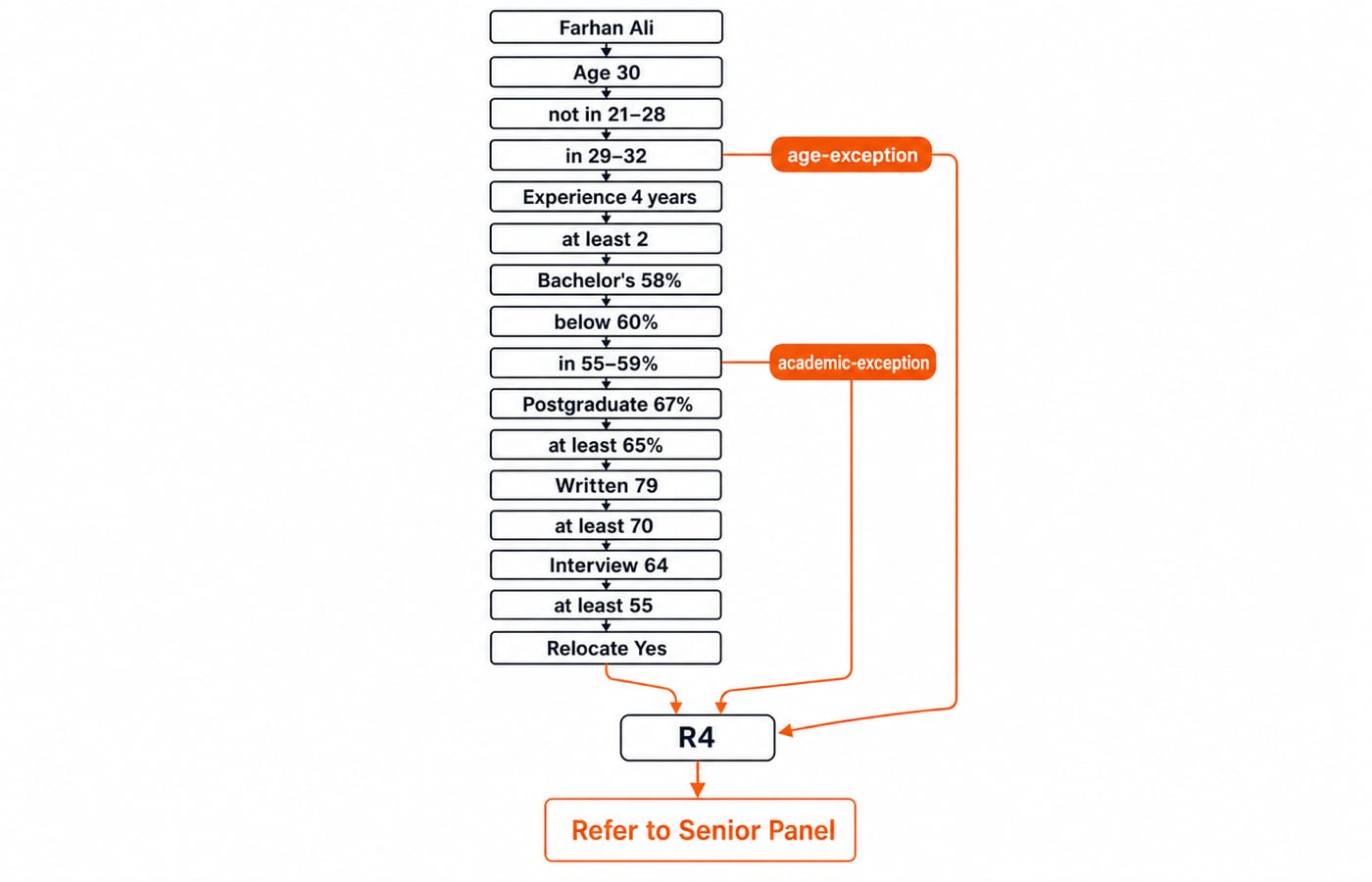
Farhan Ali | 30 | 4 years | 58% | 67% | 79 | 64 | Yes | Refer to Senior Panel under R4 |
Dev Nair | 27 | 1 year | 66% | - | 74 | 52 | Yes | Reject under R5 |
Esha Khan | 26 | 0 years | 64% | - | 73 | 60 | No | Reject under R5 |
Gita Bose | 28 | 0 years | 60% | - | 70 | 55 | Yes | Select under R1 |
Trace Farhan fully. Age 30 and 4 years satisfy the age exception. Bachelor's 58% is in the 55% to 59% band, while postgraduate 67% clears 65%. Written 79, interview 64, and relocation Yes pass the non-exempt checks. Both tags apply, so R4 sends him to the Senior Panel.
The other rows can be checked quickly:
Aditi passes every R1 check.
Bharat's age exception and remaining passes produce R2.
Charu's ordinary age and academic exception produce R3.
Dev's interview score 52 is below the non-exempt minimum of 55.
Esha's No fails the non-exempt relocation condition.
Gita proves inclusivity: age 28, bachelor's 60%, written 70, and interview 55 pass R1 exactly.
5. Use a reject-first shortcut safely
For this notice, test the conditions with no exceptions first: written >= 70, interview >= 55, and relocate = Yes. A failure ends the route. Then classify age and academics as ordinary, exception, or invalid.
Use A for the age exception and Q for the academic exception. No tag means Select, A means HR Manager, Q means Academic Panel, and A + Q means Senior Panel. Any non-exempt failure or invalid band means Reject. These labels apply only to this notice.
Draw a 20-second boundary box on rough paper: 21-28; 29-32 + 2 years; UG >= 60; UG 55-59 + PG >= 65; W 70; I 55; Relocate Yes. To develop the recognition habit behind this shortcut, read MCA Entrance Logical Reasoning: Build Speed from Patterns.
6. How competitive exams can test the same idea
Questions may ask you to classify one candidate or a batch, find the cause of rejection, or decide whether the data are sufficient.
Leena Das is 26, has 0 years of experience, 62% in her bachelor's degree, written 75, no interview score, and relocation Yes. Her result is unknown: below 55 means Reject, while at least 55 completes R1. Choose “Cannot be determined” only if that action is offered.
The question's rule block is authoritative. For a real exam's eligibility, stages, marks, dates, or selection instructions, confirm the conducting body's latest official notice.
Explore Placement Preparation and Coding: Exams, Eligibility & CoursesThose modules extend beyond this fictional rule set, so practise the underlying checks with varied aptitude questions.
7. Traps that turn a correct table into a wrong answer
Misreading “at least”. It means greater than or equal to, so Gita passes at 60, 70, and 55.
Stretching the academic exception. A postgraduate score cannot rescue a bachelor's score below 55%, because the stated band begins at 55%.
Repairing a non-exempt failure. Neither exception fixes Dev's 52 interview score or Esha's No for relocation.
Replacing AND with OR. Bharat needs age 29 to 32 and at least 2 years of experience for the exception.
Ignoring the dual-exception rule. Farhan matches both bands, so the stated Senior Panel action applies. Do not invent a priority.
Treating missing data as failure. Leena's interview value is unknown, not failed. Distinguish “Cannot be determined” from Reject when the options allow it.
8. The short version and next step
Atomise the prose, mark inclusive limits, test non-exempt conditions, add exception tags, and map the tag combination to one action. Remember Farhan as A + Q -> Senior Panel and Gita as the exact-boundary R1 pass.
Solve five new rows by hand, then repeat on a fresh set under a timer. The Aptitude Course for Placement offers a structured route for continued aptitude, reasoning, and verbal ability practice.
Keep learning

Clustering and Worker Threads in Node.js: Runnable Examples and a Decision Guide
Learn when Node.js needs Cluster, Worker Threads, or only asynchronous I/O. The examples include guarded CPU routes, a bounded pool, and measurement guidance.
Updated 21 Nov 20266 min readWeb Development

Decision Trees: Calculate Information Gain and Prune Weak Branches
Build one classification tree by hand from ten machine rows, audit every candidate threshold, and see why validation can justify removing a perfectly pure training branch.
Updated 15 Nov 20266 min readML & Data Science
Decision Properties in Theory of Computation: DFA Tests, CFG Boundaries and Turing Machine Undecidability
Learn an algorithm-first way to classify membership, emptiness, finiteness, inclusion, equivalence and universality for DFAs, CFGs and Turing machines.
Updated 29 Sep 20266 min readTheory of Computation
C++ STL Containers: Choose by Access Pattern, Mutation Cost and Ownership
Choose a C++ STL container from the workload, not from habit. Trace sequence operations, keyed counts, invalidation and object lifetime through exact examples.
Updated 27 Sep 20266 min readC++