SBI SO Eligibility and Selection Process: Role-wise Checks Before You Apply
SBI SO is not one fixed examination. Learn how to screen a role advertisement row by row, identify its selection route, and prove every eligibility claim.
KnowledgeGate Team
Exam prep & CS education
Updated 16 Sep 20265 min read
“SBI SO” sounds like one exam, but SBI issues separate Specialist Cadre Officer advertisements for different posts and engagement types. A degree, age rule, or stage from one cannot be carried into another. Identify the exact role, test every eligibility row, find its selection branch, and prepare only for stages in that notice.
SBI SO is a recruitment family, not one fixed exam
The SBI current-openings page lists Specialist Cadre Officer recruitments under separate advertisement numbers, role names, and engagement labels. Build this six-field table from the chosen PDF:
Post name | Regular or contract | Essential qualification | Experience as on cutoff | Age as on cutoff | Selection method |
|---|---|---|---|---|---|
Copy exact role | Copy exact status | Copy essential wording | Copy dates and domain | Copy cutoff rule | Copy stages and merit rule |
Do not fill a blank from another advertisement. The SBI PO Exam Preparation category maps KnowledgeGate's current SBI coverage, which presently covers SBI PO courses, not a universal SBI SO course.
Notice-dependence rule: this article teaches a checking method. The exact role advertisement and its corrigenda control every live eligibility and selection detail.
SBI SO eligibility: five checks that must all match
Read the eligibility section in this order:
Match the exact post title and grade.
Calculate age on the stated cutoff date, not the application date.
Match every essential degree, discipline, and certification condition.
Count only the experience permitted by the notice, including any post-qualification or domain condition.
Check category and documentary conditions in the prescribed format.
Keep essential, preferred, and desirable requirements separate. Preferred experience may strengthen a profile, but it cannot repair a missing essential qualification. Similarly, work completed before the qualifying degree does not count when the notice asks specifically for post-qualification experience.
The method in IBPS SO Eligibility by Degree: Match Your Qualification can help you compare degree wording carefully. Its degree rules do not establish eligibility for any SBI post.
Worked SBI SO eligibility screen: two illustrative candidates
This is illustrative, not an SBI threshold. Imagine a fictional role requiring age 21 to 32 on 30 June 2026, B.Tech in CS or IT, four years of post-qualification work, and two of those years in banking cybersecurity.
Candidate A was born on 15 July 1996 and completed B.Tech IT on 31 May 2021.
Age on the fictional cutoff: 29 years, 11 months, 15 days. Pass.
Qualifying employment from 1 August 2021 through 30 June 2026: 4 years 11 months. Pass.
Banking-cybersecurity work from 1 July 2024 through 30 June 2026: exactly 2 years. Pass.
Candidate A passes every fictional row if documents prove the dates and duties.
Candidate B has the same age, degree, and total experience, but banking-cybersecurity work runs from 1 August 2024 through 30 June 2026. That is 1 year 11 months. Total experience passes, but domain experience fails by 1 month. Replace every fictional value with the selected role advertisement before advising a real applicant.
SBI SO selection process: find the branch in the role notice
The role notice may describe either of these routes:
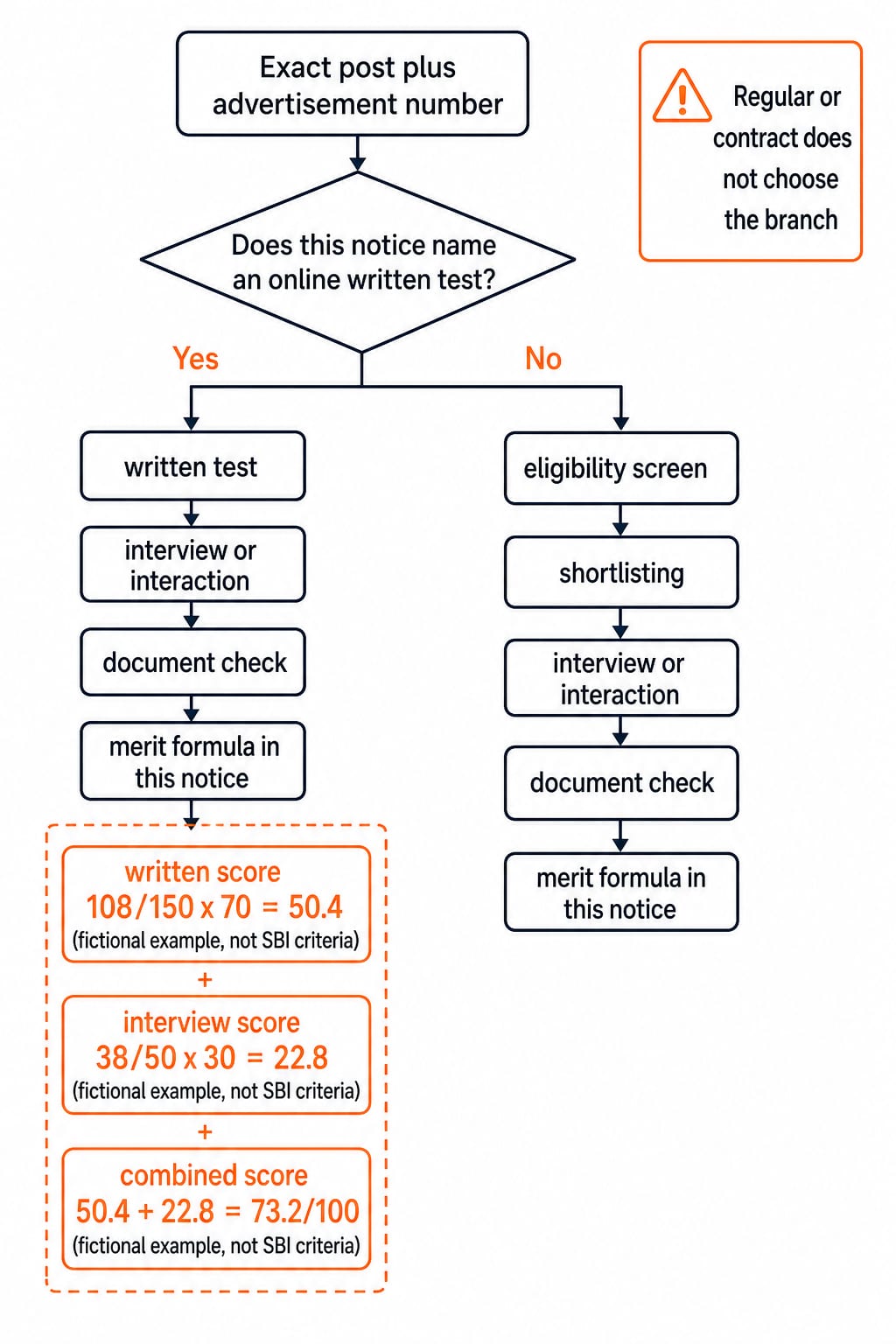
application -> eligibility or shortlisting -> interview or interaction -> document checks -> final selectionapplication -> online written test -> interview or interaction -> document checks -> final selection
These are possible branches, not fixed SBI-wide stages. Regular or contract status does not select the route by itself. Read “Selection Process”, “Shortlisting”, “Interview”, and “Merit List”, including any annexure or corrigendum. Do not infer prelims and mains from another banking examination. CTC negotiation or an additional assessment belongs in your plan only when the selected advertisement names it.
Worked merit example: normalise scores exactly as stated
This calculation is fictional. Suppose a notice assigns 70% weight to a 150-mark written test and 30% to a 50-mark interview.
Candidate A scores 108/150 and 38/50:
Written contribution:
108 / 150 x 70 = 50.4Interview contribution:
38 / 50 x 30 = 22.8Combined score:
50.4 + 22.8 = 73.2/100
Candidate B scores 112/150 and 33/50:
Written contribution:
112 / 150 x 70 = 52.27, rounded to two decimalsInterview contribution:
33 / 50 x 30 = 19.8Combined score:
52.27 + 19.8 = 72.07/100
Candidate A ranks higher despite a lower raw written score. Use the notice's weights, qualifying conditions, rounding rule, and tie-break. A qualifying written test may contribute nothing to merit, while an interview-only route has no written component.
SBI SO documents: prove each eligibility claim
Build a document-to-claim checklist before applying:
Claim | Evidence to inspect |
|---|---|
Age on cutoff | Date-of-birth proof |
Qualification | Degree certificate and marksheets |
Employment dates | Employer letters with start and end dates |
Domain experience | Duties or role description |
Category condition | Certificate in the required format and date window |
An accepted application is not an eligibility approval. Three preventable traps are a generic experience letter with no duties, overlapping jobs counted twice, and an application title that does not exactly match the post or grade. SBI PO Eligibility: Result Date, Attempts, Category reinforces the broader habit of checking cutoffs and category evidence, but its PO criteria are not SO criteria.
SBI SO preparation should follow the selected route
For a written-test route, divide preparation among the named common sections and professional or domain component. Do not build a syllabus from memory. For shortlisting plus interview, focus on domain revision, project examples, role knowledge, and evidence for each resume claim.
Use SBI PO Prelims, Mains and Final Stage: A 12-Hour Week Plan only as a model for stage-gated planning, not as the SBI SO pattern. For an IT-specialist reader who needs professional-knowledge revision, the IBPS SO IT Mains Preparation Course covers IBPS SO IT. It is not SBI-specific and does not prove SBI's syllabus.
SBI SO short version: verify the role before preparing
Take five actions:
Open SBI Current Openings.
Save the exact advertisement number and PDF.
Complete the six-column eligibility table.
Identify the selection branch and merit rule in that notice.
Prepare only for the stages it names.
Use the selected advertisement there for every live date, post, eligibility limit, selection stage, document rule, and result step.
The right answer to “Am I eligible for SBI SO?” begins with “Which exact post and advertisement?”, not with a generic age or degree list.
Keep learning
SBI SO Syllabus: Section-by-Section Study Map for IT Aspirants
Build an IT/System study map around your exact SBI post. Use a historical exam table, original worked exercises and an eight-hour sample week to turn topic lists into practice.
1 Oct 20265 min readSBI Exams
SBI SO Preparation Strategy: A 12-Week Role-Specific Plan
Build an SBI SO plan around the exact Specialist Cadre Officer post you are targeting. This guide gives an 11-hour weekly calendar, diagnostics, repair loops and separate written-test and interview branches.
Updated 24 Sep 20266 min readSBI Exams
SBI SO Exam Pattern and Marking Scheme: Post-Wise Routes Explained
There is no single SBI SO paper pattern. Use this guide to identify your post's route, understand qualifying and merit components, and build a timetable from the official notice.
Updated 22 Sep 20264 min readSBI Exams
SBI Clerk Preparation Mistakes: 7 Errors and Practical Fixes
High effort can still produce weak results when the study system rewards attempts, note collection and packed timetables. This guide replaces seven common errors with practical weekly actions.
Updated 21 Sep 20265 min readSBI Exams