SBI Clerk Preparation Strategy: A 14-Week Plan from Diagnostic to Mocks
Build from a custom 60-question baseline into a practical weekly plan. This route protects foundation work, mock analysis and a light Mains continuity lane.
KnowledgeGate Team
Exam prep & CS education
Updated 14 Sep 20265 min read
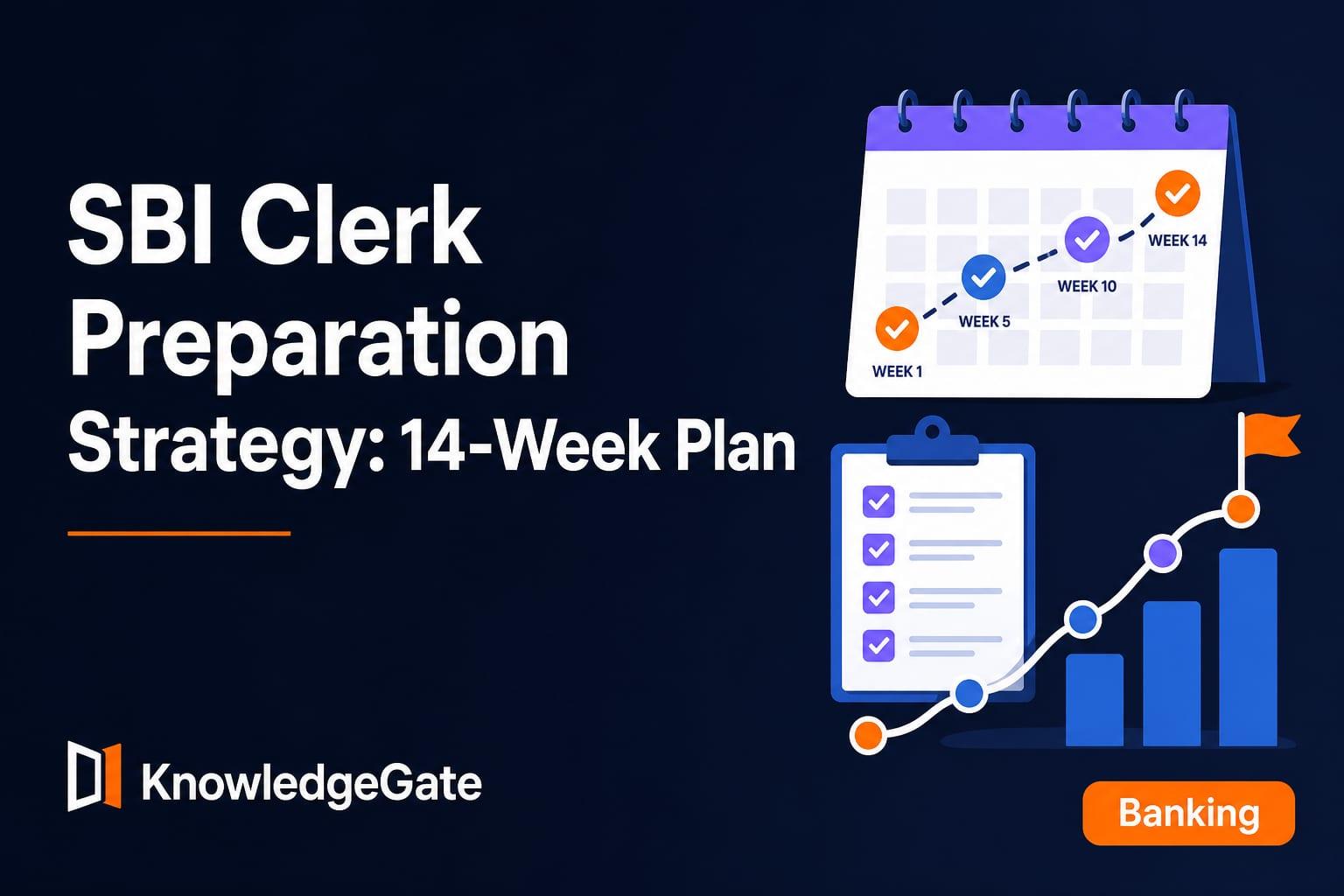
Many SBI Clerk aspirants collect topics and mocks but repeat one routine weekly, so basics, speed work and mock analysis compete for hours. This 14-week route uses 14 hours a week, a custom 60-question baseline, changing mock cadence, a repair queue and a 19-week working-candidate option. The plan controls preparation. SBI's current careers material controls stages, sections, prescribed timing and rules. That separation keeps your timetable useful when official instructions change.
1. SBI Clerk preparation starts with the live rules and a 60-question baseline
Verify the active advertisement, stages, sections, prescribed timing, marking, eligibility and instructions at SBI Careers current openings. Recheck updates. SBI Clerk Pattern: How Sections Shift Prelims to Mains maps stage changes; this plan maps weekly work.
Take a custom 60-question, 75-minute baseline, not an official paper: 20 Quant, 20 Reasoning and 20 English. Log attempted, correct, wrong, unattempted and time. Quant is 16, 11, 5, 4, and 11 / 16 x 100 = 68.8%. Reasoning is 18, 15, 3, 2, and 15 / 18 x 100 = 83.3%. English is 17, 14, 3, 3, and 14 / 17 x 100 = 82.4%. Overall, 51 attempted = 40 correct + 11 wrong, 9 are unattempted, and 40 / 51 x 100 = 78.4%. Do not calculate an official score.
2. Choose a 14-hour week that protects practice and review
Work lane | Standard hours | Working-candidate hours |
|---|---|---|
Quant | 3.5 | 2.5 |
Reasoning | 3 | 2 |
English | 2 | 1.5 |
Current Mains continuity | 1.5 | 1 |
Timed drills | 1.5 | 1 |
Mock or error-log review | 2.5 | 2 |
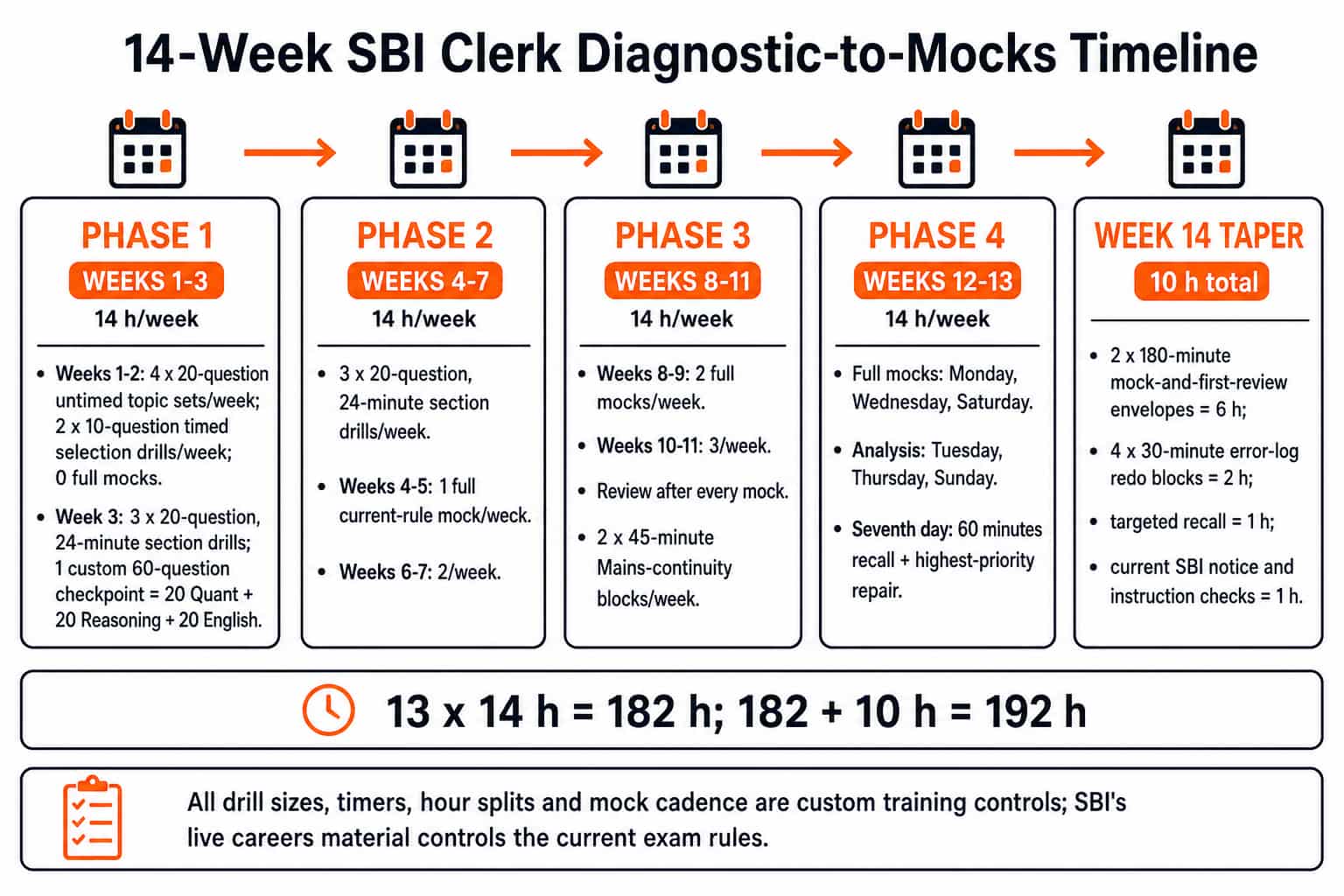
Standard total: 3.5 + 3 + 2 + 1.5 + 1.5 + 2.5 = 14 hours. Weeks 1 to 13 give 13 x 14 = 182 hours; 182 + 10 taper hours = 192 hours. Let current SBI material define continuity. Count solved questions, active recall, timed results, corrected notes or error-log changes, not passive watching twice.
Working total: 2.5 + 2 + 1.5 + 1 + 1 + 2 = 10 hours. Stretch to 4 + 5 + 5 + 4 + 1 = 19 weeks; 18 x 10 = 180 hours, then 180 + 8 = 188 hours. Finishing later protects review and sleep.
3. Weeks 1-3: repair the weakest foundation before chasing mock volume
Quant comes first at the lowest accuracy, 68.8%. Assign Quant 5 hours, Reasoning 2.5, English 2, continuity 1.5, timed work 1 and review 2: 5 + 2.5 + 2 + 1.5 + 1 + 2 = 14 hours.
In Weeks 1 and 2, complete four 20-question untimed topic sets and two 10-question timed selection drills each week, with zero full mocks. In Week 3, do three 20-question, 24-minute section drills and a fresh 20 + 20 + 20 checkpoint.
Advance after every wrong answer has a label and repeated concept errors have scheduled repair. SBI Clerk Prelims provides a structured foundation route. Filter its practice to the current stage.
4. Weeks 4-7: convert coverage into timed selection and clean accuracy
Restore 14 hours and do three 20-question, 24-minute section drills weekly. Add one current-rule mock in Weeks 4 and 5, then two in Weeks 6 and 7. Review each before the next for at least the attempt time. Drills are custom; full mocks follow current SBI rules.
For a 20-question drill with 16 attempted, 13 correct, 3 wrong and 4 unattempted, accuracy is 13 / 16 x 100 = 81.25%, reported as 81.3%; attempt rate is 16 / 20 x 100 = 80%. Label the wrong answers one concept, one calculation or reading and one poor selection. Label blanks two deliberate skips, one slow method and one unknown method.
If Quant remains slow, use the SBI Clerk Quant: 6-Week Calculation Speed Routine. The illustrative 81.3% is not a cutoff, target or selection prediction.
5. Weeks 8-11: integrate full mocks without abandoning Mains continuity
In Weeks 8 and 9, schedule two current-rule mocks plus reviews weekly. In Weeks 10 and 11, schedule three only after analysing the previous mock. Keep two 45-minute Mains-continuity blocks, following changes in SBI's structure.
For illustrative attempted accuracies of 78%, 82%, 86% and 89%, the middle values are 82 and 86, so the rolling median is (82 + 86) / 2 = 84%. It is a stable practice signal, not an official threshold.
If one error family appears four times across two consecutive mocks, turn one 60-minute mixed block into repair next week. SBI Clerk Mains offers continuity, but the immediate stage stays dominant.
6. Weeks 12-14: simulate consistently, then taper without cramming
In Weeks 12 and 13, take full mocks on Monday, Wednesday and Saturday. Analyse them on Tuesday, Thursday and Sunday. Use the seventh day for 60 minutes of recall and the highest-priority unresolved error family. Stop adding low-priority resources. Judge readiness from the latest five reviewed mocks, repeat-error counts and selection decisions, not one unusually high result.
Week 14 is a 10-hour taper. Two 180-minute mock-and-first-review calendar envelopes total 6 hours. Four 30-minute error-log redo blocks total 2 hours. Targeted formula, grammar and current-stage recall takes 1 hour, while current SBI notice, admit-card and instruction checks take 1 hour. Therefore, 6 + 2 + 1 + 1 = 10 hours. Each 180-minute envelope is a study block, not an official paper duration. Attempt for SBI's current prescribed duration, then begin review in the remaining time.
7. Turn the baseline into a repair queue and recover missed days honestly
Wrong split: 5 concept + 3 calculation or reading + 3 poor selection = 11. Unattempted split: 4 deliberate skips + 3 slow methods + 2 unknown methods = 9.
Repair | Calculation | Time |
|---|---|---|
Concept | 5 x 20 | 100 min |
Calculation or reading | 3 x 12 | 36 min |
Selection | 3 x 8 | 24 min |
Slow method | 3 x 15 | 45 min |
Unknown method | 2 x 20 | 40 min |
Deliberate skips get no repair unless wrongly chosen. Total: 100 + 36 + 24 + 45 + 40 = 245 minutes = 4 hours 5 minutes. Split it into 2 hours 5 minutes, then 2 hours.
Miss 2 hours: recover 60 minutes at the weekend, replace a low-priority 60-minute block next week, and avoid a 4-hour penalty. Miss 5 hours: carry the best 3 repair hours and remove 2 low-priority hours. Below 10 of 14 hours twice, use 19 weeks.
8. SBI Clerk preparation strategy: run the phase, review the evidence, then advance
Confirm live rules, log the 20 + 20 + 20 baseline, choose the 14-hour or 10-hour model, change cadence after each phase gate, and analyse every mock before the next. Move through foundation, timed selection, integrated mocks, simulation and taper.
Browse Banking & Insurance Exam Preparation for current options. Today, reserve 75 minutes for the custom baseline and create an attempted, correct, wrong, unattempted and time log.
Keep learning
SBI SO Syllabus: Section-by-Section Study Map for IT Aspirants
Build an IT/System study map around your exact SBI post. Use a historical exam table, original worked exercises and an eight-hour sample week to turn topic lists into practice.
1 Oct 20265 min readSBI Exams
SBI SO Preparation Strategy: A 12-Week Role-Specific Plan
Build an SBI SO plan around the exact Specialist Cadre Officer post you are targeting. This guide gives an 11-hour weekly calendar, diagnostics, repair loops and separate written-test and interview branches.
Updated 24 Sep 20266 min readSBI Exams
SBI SO Exam Pattern and Marking Scheme: Post-Wise Routes Explained
There is no single SBI SO paper pattern. Use this guide to identify your post's route, understand qualifying and merit components, and build a timetable from the official notice.
Updated 22 Sep 20264 min readSBI Exams
SBI Clerk Preparation Mistakes: 7 Errors and Practical Fixes
High effort can still produce weak results when the study system rewards attempts, note collection and packed timetables. This guide replaces seven common errors with practical weekly actions.
Updated 21 Sep 20265 min readSBI Exams