SBI PO Previous Year Analysis: Read Past Papers for Section Difficulty
Recent SBI PO papers reward selection over speed. Read your past papers and mocks as a section-difficulty log, then reshape the final eight weeks around it.
KnowledgeGate Team
Exam prep & CS education
Updated 29 Jul 20265 min read
SBI PO and IBPS PO draw from familiar banking-exam subjects, but familiar labels can hide a different attempt experience. Candidates who prepare only by completing generic topic lists often struggle when puzzles take longer, data interpretation demands judgement and English rewards patient reading.
No official body publishes a topic-wise blueprint for SBI PO, so an old paper cannot forecast the next one. What it can do is show where your time went, which sets you walked away from too late, and which section actually decided your score.
SBI PO question style: puzzles, dense data and patient reading
Recent SBI PO cycles are widely described by aspirants as puzzle-heavy in Reasoning, interpretation-heavy in Quantitative Aptitude and dependent on sustained reading in English. The common thread is selection: the paper rewards deciding what to attempt at least as much as it rewards knowing how to solve it.
That is a description of experience, not a rule. Shift variation, your own strengths and the exact set on the day all move it. The usable lesson is that SBI practice should include ambiguous-looking sets, dense data and longer passages, not only fast drills of isolated question types.
A stage-by-stage comparison with IBPS PO, including the extra rounds SBI has run at the final stage, sits in the SBI PO versus IBPS PO differences guide.
SBI PO Prelims: where the time actually goes
SBI PO prelims feels sectional even when your final concern is the overall result, because each subject asks for a different kind of time decision.
In Reasoning, a long puzzle can consume the time meant for several independent questions. The skill is not merely solving puzzles. It is scanning the variables, estimating setup cost and leaving a set when the entry path is unclear.
In Quantitative Aptitude, arithmetic fluency supports everything, but a dense data set can still punish a candidate who starts calculating before understanding what the table or chart is asking. Read the units and relationships first.
In English, reading comprehension can carry substantial cognitive load. Candidates who depend only on grammar rules may find that vocabulary-in-context, inference and paragraph logic decide how quickly they move.
The practical pattern is speed through selection, not speed through frantic clicking. A strong attempt leaves expensive questions early enough to collect accessible ones elsewhere.
SBI PO Mains: where the difficulty concentrates
Mains increases the cost of shallow preparation. In Data Analysis and Interpretation, the difficulty can come from deciding which numbers matter, combining conditions and maintaining accuracy across several steps. Faster calculation helps, but it cannot replace correct setup.
Reasoning can demand sustained work on fewer, denser arrangements. The best preparation is to compare complete set types, record why an initial diagram failed and build a triage rule for unfamiliar structures.
English continues to reward reading quality. Longer or more nuanced passages test whether you can separate the author's claim, evidence, tone and implication. Regular reading should therefore feed timed question practice, not remain a passive current-affairs habit.
The descriptive component adds a different demand: producing structured English instead of recognising a correct option. It needs its own timed writing practice, and the 30-minute essay and letter method for the descriptive paper is where to start.
SBI PO previous year analysis: build a section-difficulty log
The analysis worth doing needs one paper or full-length mock you have the complete question set for and can name by source and date. Attempt it under exam timing, then go back over it with a log rather than only a score.
Minutes spent in each section, against the minutes you intended to spend.
Questions attempted and accuracy, section by section.
Every set you entered and then abandoned, with the point at which you abandoned it.
The single question or set that cost the most time, and what made it expensive.
Anything you never reached, and the reason: time, fatigue or avoidance.
Read that log for decisions rather than for topics. Three questions answer themselves quickly. Which section took more time than it returned? Which set should you have left, and how many minutes earlier? Which section did you enter with no plan for its first two minutes?
Repeat this across four or five papers before you change anything, and keep the papers separate. One paper describes one paper; a pattern that survives four is worth acting on. Averaging them into a single figure destroys the spread between shifts, and that spread is exactly what SBI variation looks like.
SBI PO in the last eight weeks: turn the log into a plan
An eight-week runway should shift from skill repair to paper decisions.
Window | Main job | Evidence to collect |
|---|---|---|
Weeks 8 and 7 | Diagnose section weaknesses with mixed sets | Slow topics, abandoned sets, accuracy errors |
Weeks 6 and 5 | Repair the two largest bottlenecks | Time saved and repeated error types |
Weeks 4 and 3 | Increase sectional and full-paper practice | Attempt order, set selection and fatigue points |
Weeks 2 and 1 | Stabilise strategy and revise error logs | Consistent decisions across several mocks |
For Reasoning, allocate more practice to full puzzles if selection and setup are weak. For Quantitative Aptitude, move from isolated calculations to DI sets if interpretation is the bottleneck. For English, combine passage reading with timed questions and short written summaries.
Do not respond to a difficult mock by changing the entire attempt order immediately. Look across several papers. A stable pattern deserves an adjustment; one unusual set deserves a review.
The SBI PO complete preparation bundle covers that wider runway, and the SBI PO exam preparation category gathers the SBI course routes in one place.
SBI PO current cycle: take the details from the notification
Previous-year analysis cannot define the next paper. Take the exact stages, structure, marks, duration and other cycle-specific rules from the current official SBI Careers notification. Aspirant impressions and coaching analysis describe how a paper felt; only the notification is binding.
When the notification changes a structural detail, update the plan. When it does not, still expect the mix and difficulty of individual questions to vary.
The short version
Prepare for SBI PO as a selection-heavy paper. Train puzzle triage, DI interpretation and close reading, then use mocks to test attempt order and exit decisions. No memory-based report can hand you a reliable topic count, and last year's hardest section carries no obligation to repeat.
Start the final eight weeks by diagnosing, spend the middle on bottlenecks, and finish by stabilising decisions. The SBI PO Mains Preparation Course carries the mains sections this plan leans on hardest. The goal is not to predict the paper, but to be prepared when it refuses to be predictable.
Keep learning
NABARD Grade A Finance Preparation: Resources and an 8-Week Plan
Build a Finance specialist study plan around accounting, calculations and management applications. Use a 12-hour weekly schedule, a worked project appraisal and an error-based review routine.
5 Oct 20265 min readBanking Exams
LIC AAO Preparation for Repeat Attempts: A Six-Week Reset Plan
Familiar chapters need a sharper review method. Use your previous attempt and recent errors to plan six weeks of focused repair, protected mains work and manageable retests.
30 Sep 20265 min readBanking Exams
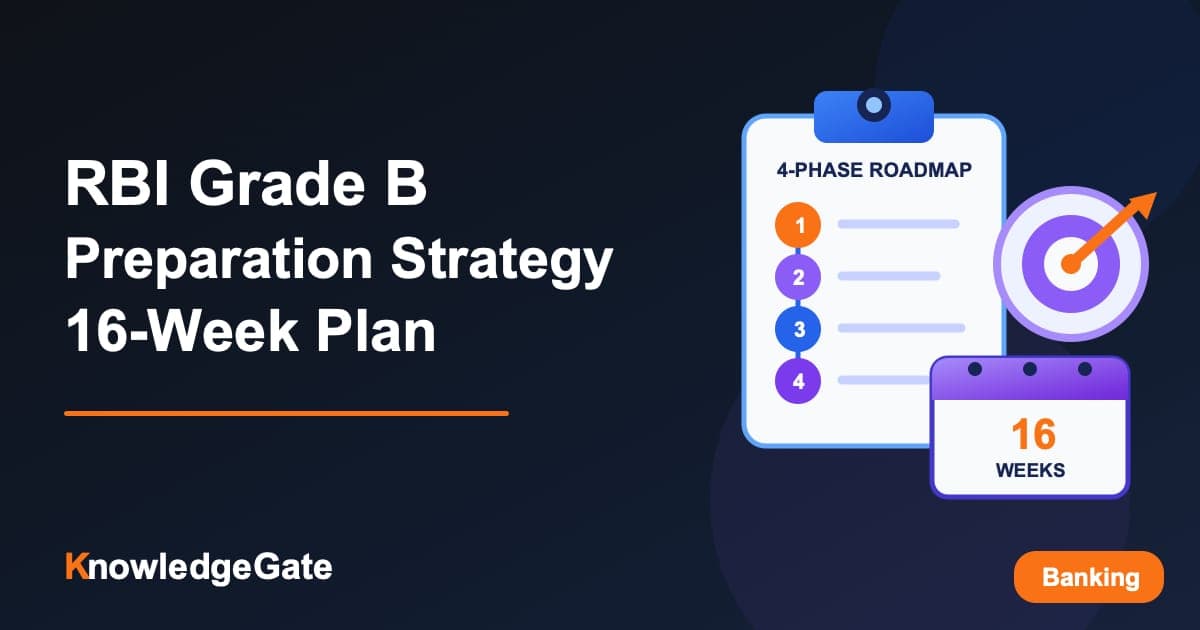
RBI Grade B Preparation Strategy: A 16-Week Phase-by-Phase Plan
A working aspirant must build early-stage speed without leaving economics, finance, management and writing cold. This plan turns 15 hours a week into foundations, timed practice, mock repair and a post-Phase-I bridge.
Updated 27 Aug 20265 min readBanking Exams
RBI Grade B Syllabus 2026: Phase 1 and Phase 2 Decoded
Separate RBI's official General Cadre syllabus from practical study buckets, then use diagnostics and worked examples to build a balanced weekly plan.
Updated 26 Aug 20265 min read56 viewsBanking Exams