SBI PO Group Exercise: Build Evidence-Based Contributions with the C-E-A-B Framework
Learn to turn a group-exercise prompt into a concise claim, support it with accurate evidence, and move the discussion towards a decision.
KnowledgeGate Team
Exam prep & CS education
Updated 29 Aug 20265 min read
Many candidates can make one neat point but lose the thread when the group disagrees. C-E-A-B is most useful when each contribution changes the shared decision: make a claim, attach prompt evidence, analyse its meaning, then bridge to another speaker, a trade-off, or the next test.
Related reading: SBI PO exam pattern and SBI PO preparation.
SBI PO Group Exercise: keep official instructions and practice targets separate
Check the current cycle's advertisement on the SBI current-openings page for Phase III composition, marks, timing, qualifying rules, and call-letter instructions. A 20 to 30 second contribution or a 12-minute mock is a rehearsal constraint, not a prediction of the exercise you will receive.
Use SBI PO Group Exercise: A 4-Step Evidence-Based Contribution Framework to practise the solo move and its 30-minute drill. Once that move is stable, add a decision ledger: what the group accepts, what it disputes, what evidence is missing, and which rule can settle the choice.
SBI PO Group Exercise contributions: use C-E-A-B as a group protocol
Part | Job inside the discussion | Useful sentence cue |
|---|---|---|
Claim | Put one decision on the table. |
|
Evidence | Name the prompt fact that supports it. |
|
Analysis | State what the fact changes. |
|
Bridge | Invite a test, addition, or synthesis. |
|
Consider a fictional bank case. It invites 1,000 rural customers to begin digital onboarding. Of them, 620 start, 465 complete, and 155 abandon. Among those 155 exits, 93 concern OTP or network difficulty and 62 concern documentation confusion. The budget permits one first intervention.
Completion among starters:
465 / 620 = 75%.Abandonment among starters:
155 / 620 = 25%.OTP or network share of recorded exits:
93 / 155 = 60%.Documentation share of recorded exits:
62 / 155 = 40%.
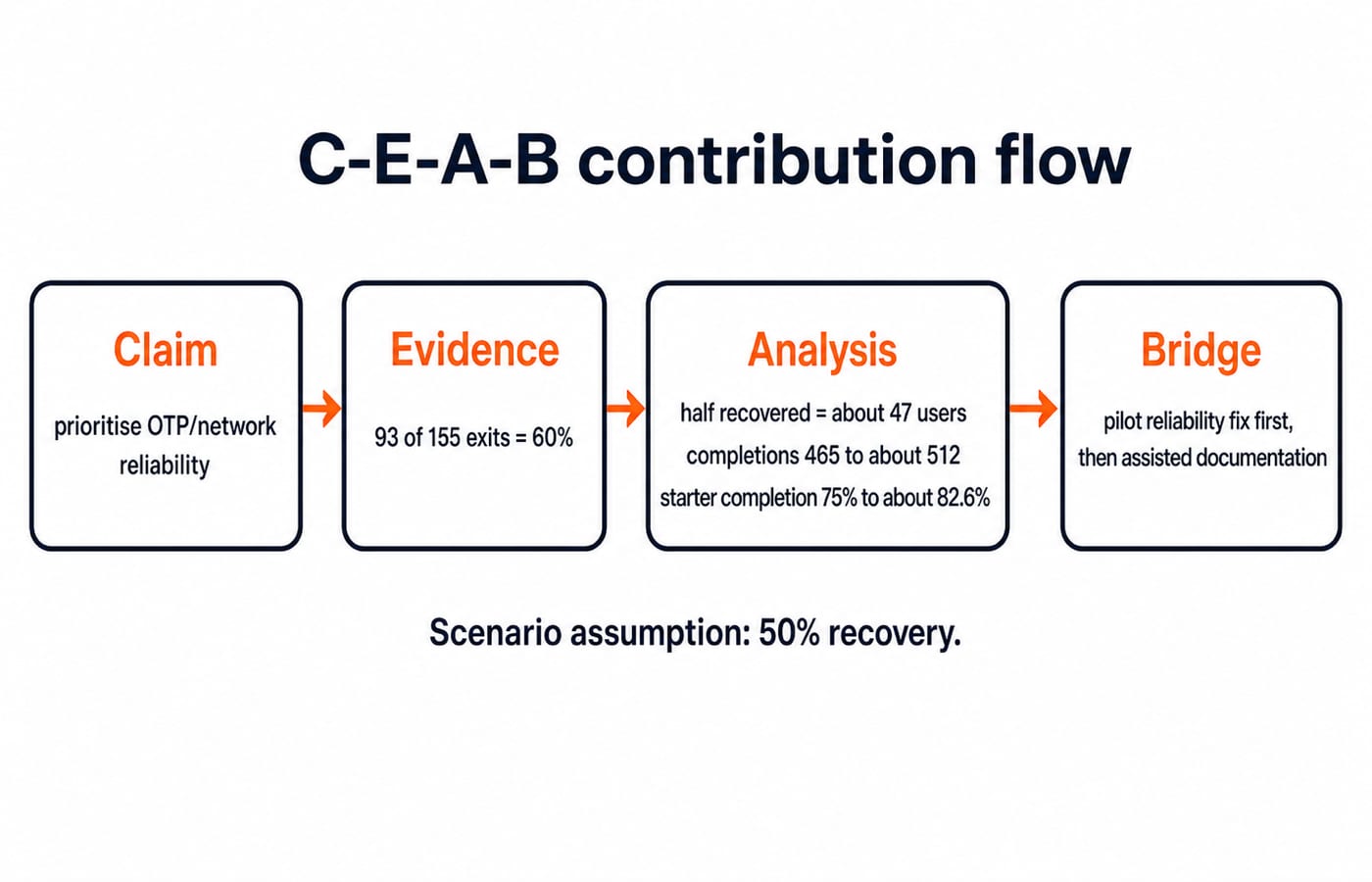
A first contribution could be: "I would test OTP and network reliability first. It accounts for 93 of 155 recorded exits, or 60%, compared with 40% for documentation confusion. Can we check whether both interventions have comparable cost and feasibility before deciding?"
The counts establish incidence, not recoverability, cost, or impact. The bridge tests the missing comparison instead of treating the largest count as an automatic verdict.
SBI PO Group Exercise evidence map: separate agreement from dispute
After two or three people speak, stop collecting isolated points. Record the discussion in four cells.
Cell | Onboarding case entry | What it prevents |
|---|---|---|
Agreed evidence | 93 exits concern OTP or network; 62 concern documentation. | Repeating settled facts |
Disputed inference | Whether the larger group should receive the first intervention | Treating a preference as a fact |
Missing evidence | Relative cost, feasibility, and likely recovery for each option | Inventing certainty |
Decision rule | Prefer the larger recorded gap only if cost and feasibility are comparable | Choosing by volume alone |
Candidate A may argue for reliability because 93 exceeds 62. Candidate B may prefer documentation support because it could be cheaper or faster. The disagreement is not over the two counts; it is over the missing comparison. Say that distinction aloud: "We agree on the 60:40 split. The unresolved question is whether the two fixes are equally feasible. If they are, reliability leads; if not, we need the cost and recovery comparison."
SBI PO Group Exercise bridge moves: build, test, then combine
Use three different bridges rather than repeating "I agree."
Build: retain a useful point and add one consequence. "Documentation affects 40% of recorded exits. Adding assisted document checks after the access pilot could protect that group."
Test: name the assumption behind a proposal. "Reliability first assumes the two interventions have comparable cost. Does the case support that?"
Combine: turn rival proposals into an order. "Test reliability first because it covers the larger recorded gap, then use assisted documentation for customers who still leave."
Each move needs a traceable anchor. Empty agreement adds no value; attack without a test makes the group defend positions instead of comparing them.
SBI PO Group Exercise analysis: label scenarios before calculating them
Suppose the group wants to illustrate a 50% recovery scenario for the 93 OTP or network exits. Half of 93 is 46.5, so a whole-person estimate is about 47 additional completions. Adding 47 to 465 gives 512, and 512 / 620 x 100 = 82.58%, about 82.6%.
Those numbers describe a hypothetical, not an observed result. State the assumption in the same breath: "If a pilot recovered half of those 93 exits, about 47 additional customers would complete, taking starter completion from 75% to about 82.6%. We still need evidence that 50% recovery is realistic."
If another candidate challenges the figure, repair the exact layer that failed. A denominator challenge needs the denominator: 93 out of 155 recorded exits, not 93 out of 1,000 invitees. An assumption challenge needs the scenario label. A source challenge means withdraw an external number that cannot be traced to the prompt or a named source.
SBI PO Group Exercise synthesis: finish with a decision and an open risk
A useful synthesis contains four elements: common ground, current choice, remaining assumption, and next test.
"We agree that access problems form the larger recorded share, 93 of 155 exits, while documentation accounts for 62. Our current recommendation is a reliability pilot followed by assisted documentation. That order assumes comparable cost and feasibility, so the first implementation check should compare cost per recovered completion for both options."
The synthesis preserves the evidence, names the decision, and exposes the condition that could reverse it. If the group remains split, state both branches and the missing fact.
SBI PO Group Exercise preparation: a four-week decision-lab plan
Use six hours each week: two 45-minute evidence-mapping sessions, two 60-minute three-person role drills, one 90-minute recorded mock and review, and one 60-minute correction session. The total is 90 + 120 + 90 + 60 = 360 minutes.
Week 1: build decision ledgers for five prompts. Mark agreed evidence, disputed inference, missing evidence, and decision rule.
Week 2: practise build, test, and combine bridges. Complete ten of each and remove every empty agreement.
Week 3: rotate proposer, tester, and synthesiser roles in four live discussions. No speaker keeps the same role twice in succession.
Week 4: run four timed mocks. Score evidence accuracy, response to peers, assumption control, and synthesis from 0 to 2, then repeat the lowest-scoring move.
If a day disappears, move one 45-minute mapping session to the correction hour. Preserve the live role drill and recorded mock because silent reading cannot test listening or synthesis. The SBI PO Mains Preparation Course supports the preceding written stage, while SBI PO Exam Preparation keeps the broader route visible.
SBI PO Group Exercise: the short version and next step
Use C-E-A-B to make a testable contribution, then update the group's decision ledger. Separate facts from inferences, expose the missing comparison, change bridge moves as the discussion develops, and finish with a recommendation plus the condition that could change it.
Run one 12-minute discussion with the onboarding case. Make one proposal, test another speaker's assumption, combine two positions, and deliver a 30-second synthesis. Recompute 93 / 155 = 60%, label the 50% recovery scenario, and score the four moves before repeating the weakest one.
Keep learning
SBI SO Cutoffs: Check Corrections and Build a Practice Target
A cutoff becomes useful only when its post, category and score basis match your comparison. Work through a real SBI correction and a hypothetical target-setting exercise to plan your next mocks.
5 Oct 20264 min readSBI Exams
SBI SO Syllabus: Section-by-Section Study Map for IT Aspirants
Build an IT/System study map around your exact SBI post. Use a historical exam table, original worked exercises and an eight-hour sample week to turn topic lists into practice.
1 Oct 20265 min readSBI Exams
SBI SO Preparation Strategy: A 12-Week Role-Specific Plan
Build an SBI SO plan around the exact Specialist Cadre Officer post you are targeting. This guide gives an 11-hour weekly calendar, diagnostics, repair loops and separate written-test and interview branches.
Updated 24 Sep 20266 min readSBI Exams
SBI SO Exam Pattern and Marking Scheme: Post-Wise Routes Explained
There is no single SBI SO paper pattern. Use this guide to identify your post's route, understand qualifying and merit components, and build a timetable from the official notice.
Updated 22 Sep 20264 min readSBI Exams