SBI Clerk Role: Daily Branch Work, Core Skills and Promotion Routes
See what a Junior Associate may handle in a branch, why controlled follow-through matters, and how to think accurately about officer-cadre progression.
KnowledgeGate Team
Exam prep & CS education
Updated 27 Aug 20265 min read
After clearing the exam, what does an SBI Clerk actually do between opening checks and end-of-day balancing? Can that role later lead to officer responsibilities? An SBI Clerk's work spans branch operations, customer service, balancing and conditional progression to the officer cadre. Duties vary with the branch, counter assignment, authorisation and local workload; official SBI schedules and procedures may differ.
Start with the official role, not the coaching shorthand
SBI Clerk is the common search label. SBI's Roles @ SBI careers page identifies Junior Associate as a clerical-cadre entry. Its 2025-26 recruitment notice used the fuller name Junior Associate (Customer Support & Sales); the notice for each new cycle remains the authority for current wording.
In plain language, this is a customer-facing operations-support role: handling or routing requests, supporting authorised transactions, keeping accurate records, following controls and explaining processes. The counter, cash, sales, digital-support and back-office mix changes by posting and branch need. If you are comparing officer-entry routes rather than duties, SBI PO vs IBPS PO: Pattern, Difficulty & Career Differences separates those two officer exams; Junior Associate remains a different clerical-cadre entry.
Map one illustrative branch day from opening checks to close
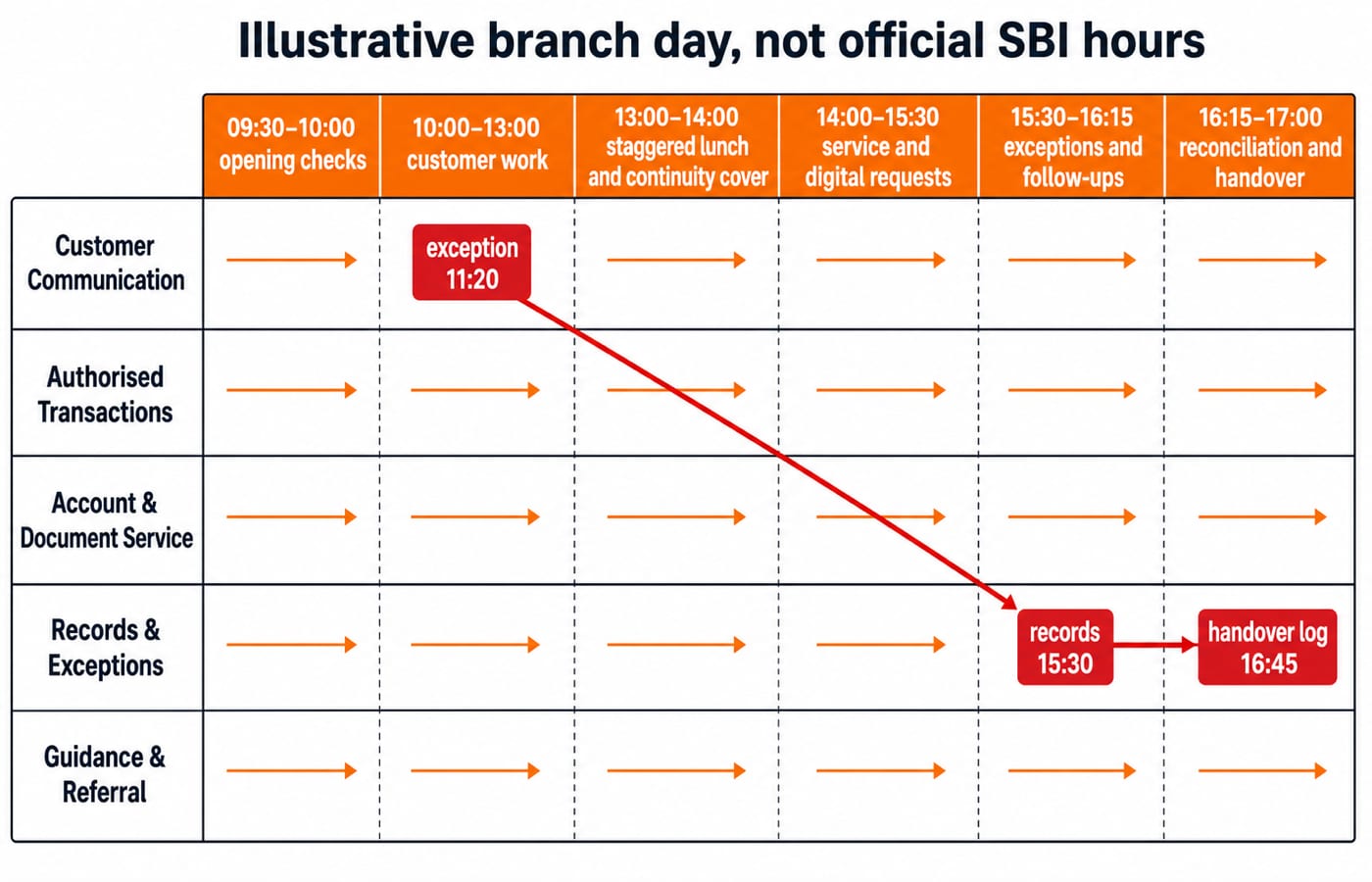
A branch can move through the following illustrative sequence. The times are a planning aid, not official SBI working hours:
Time | Illustrative focus |
|---|---|
09:30-10:00 | Opening checks and pending-item review |
10:00-13:00 | Customer transactions and service requests |
13:00-14:00 | Staggered lunch and continuity cover |
14:00-15:30 | Account-service and digital-channel requests |
15:30-16:15 | Vouchers, exceptions and follow-ups |
16:15-17:00 | Reconciliation and handover |
A real day can shift these blocks substantially. Five work lanes may appear: customer communication; authorised receipts, payments or transfers; account and document service; record, voucher and exception control; and guidance followed by an authorised referral. One employee may not perform all five daily.
Work a balancing example that shows why accuracy beats speed
The clerk's task is to reconcile recorded movement before handover. In this fictional case, the ledger entries are:
Opening till record:
150,000Recorded deposits:
83,500Recorded withdrawals:
62,300Authorised reversal reducing the expected balance:
1,200
The expected closing balance is:
150,000 + 83,500 - 62,300 - 1,200
= 233,500 - 62,300 - 1,200
= 171,200 - 1,200 = 170,000 ledger units
The physical count is 169,500, so the mismatch is 170,000 - 169,500 = 500 units.
Pause handover, recount, compare denomination totals, trace the voucher and system entry, preserve the audit trail, and escalate through the authorised process. Never hide, personally replace or carry forward a difference. This builds accuracy, maker-checker discipline where applicable, documentation, calm exception handling and early escalation. Follow SBI's internal instructions.
Show customer support as controlled follow-through
A second fictional queue illustrates controlled customer support. Its 16 pending requests comprise 2 suspected unauthorised-transaction complaints, 5 profile or KYC updates, 4 cheque-book requests, 3 mobile-channel access issues and 2 nomination updates. The check is 2 + 5 + 4 + 3 + 2 = 16. After identity and urgency checks under the authorised process, the two higher-risk complaints are flagged or routed. That leaves 16 - 2 = 14 requests, grouped by service type and required documents. Branch policy and authorised escalation rules determine the real priority order.
In one complaint, a customer reports a debit of 2,400 ledger units at 11:20 after the merchant screen showed failure. Acknowledge the issue, authenticate through approved steps, check the available status, create or route a traceable request SR-118, communicate only a verified next step, and record it for follow-up. Do not invent a refund time or expose customer data.
Useful sales support follows the same discipline: understand the need, explain a suitable product or channel accurately, and make an authorised referral. It is not a reason to pressure every customer or invent a universal target.
Connect exam preparation to transferable branch skills
The recruitment exam does not simulate branch work, but its skill families transfer. Quantitative practice supports quick checks and reconciliation. Reasoning supports sequence and exception handling. English supports instructions, forms and calm explanations. Banking awareness supplies vocabulary and context. Confirm current sections, marks and timing in the latest official SBI notice.
Try this 45-minute weekly bridge drill:
15 minutes: balance three fictional ledgers.10 minutes: explain one banking term plainly.10 minutes: triage a five-item service queue.10 minutes: write an exception note with action, owner and follow-up time.
The total is 15 + 10 + 10 + 10 = 45 minutes. Use the Banking Exams Blog for broader exam navigation.
Explain promotion routes without promising promotion
SBI's official careers page states Junior Associates are eligible for promotion in the officer cadre after completing 3 years of service. Eligible after 3 years does not mean automatically promoted at the three-year mark.
The conditional route is:
Junior Associate -> satisfies the then-current eligibility conditions -> enters the applicable internal selection or promotion process -> qualifies and is selected -> officer cadre
Current SBI service rules or staff circulars govern the selection channel, tests, attempts, seniority, performance, vacancies, service requirements, transfers and postings.
A development plan can build readiness without making a guarantee. Split 3 hours per week into 90 minutes of banking operations, 60 minutes of communication and banking awareness, and 30 minutes reviewing errors and feedback. That is 90 + 60 + 30 = 180 minutes, or 3 hours. Across 52 weeks, 3 x 52 = 156 hours. That steady practice supports stronger performance while SBI's selection process remains unchanged.
Decide whether the role fits, then choose the honest next step
The role may suit you if you are comfortable with repeated customer interaction, careful transaction or document work, local-language communication, queue pressure and rule-bound escalation. It may frustrate you if you want only quiet desk work, immediate officer authority, guaranteed transfers or automatic promotion. Verify any cycle-specific language, transfer or service condition in the applicable SBI notice.
The short version
SBI recruits clerical-cadre entrants as Junior Associates (Customer Support & Sales). The work combines people, records, authorised operations and controls. Accuracy and communication matter together, while officer-cadre progression is possible but conditional.
Complete the 45-minute bridge drill, then verify the current recruitment or promotion rules on SBI's official site. SBI PO Exam Preparation organises preparation for the direct-officer route. If you are separately targeting direct SBI PO recruitment, consider the SBI PO Prelims Preparation Course or SBI PO Mains Preparation Course. Neither is an SBI Clerk course, and neither replaces or accelerates SBI's internal promotion process.
Keep learning
SBI SO Cutoffs: Check Corrections and Build a Practice Target
A cutoff becomes useful only when its post, category and score basis match your comparison. Work through a real SBI correction and a hypothetical target-setting exercise to plan your next mocks.
5 Oct 20264 min readSBI Exams
SBI SO Syllabus: Section-by-Section Study Map for IT Aspirants
Build an IT/System study map around your exact SBI post. Use a historical exam table, original worked exercises and an eight-hour sample week to turn topic lists into practice.
1 Oct 20265 min readSBI Exams
SBI SO Preparation Strategy: A 12-Week Role-Specific Plan
Build an SBI SO plan around the exact Specialist Cadre Officer post you are targeting. This guide gives an 11-hour weekly calendar, diagnostics, repair loops and separate written-test and interview branches.
Updated 24 Sep 20266 min readSBI Exams
SBI SO Exam Pattern and Marking Scheme: Post-Wise Routes Explained
There is no single SBI SO paper pattern. Use this guide to identify your post's route, understand qualifying and merit components, and build a timetable from the official notice.
Updated 22 Sep 20264 min readSBI Exams