RRB NTPC Normalisation and Cutoffs: Read Raw Marks, Percentile and RRB Score
Learn what raw marks, percentile, RRB Score and Normalized Marks mean, then use worked examples to compare your score with the correct cutoff row.
KnowledgeGate Team
Exam prep & CS education
Updated 14 Aug 20264 min read64 views
After results appear, raw marks, percentile, RRB Score, Normalized Marks, a qualifying standard and a cutoff often get discussed as if they mean the same thing. They do not. The safe method is document-first: identify each number, learn where it is used, and match every coordinate before comparing it with a cutoff.
Put every RRB NTPC score label in the correct box
Label | Unit or scale | Calculated from | Used for | Official document to check |
|---|---|---|---|---|
Raw marks | Marks | Final accepted responses and CEN marking rule | Starting score evidence | CEN and final response evidence |
Percentile Score | 0 to 100 relative scale | Candidates in the same shift at or below your raw score | Shift-wise relative position | Normalisation methodology |
RRB Score | Merged shift percentiles | Percentile Scores across shifts | Merit processing | Result and methodology notice |
Normalized Marks | Marks | Base-shift interpolation | Minimum-qualifying check | Methodology notice and CEN |
Minimum qualifying marks are the eligibility floor specified by the applicable CEN. A shortlisting cutoff is the category, RRB, stage, post or pay-level boundary published with a result. Clearing the first does not guarantee crossing the second.
Reconstruct raw marks from the final response evidence
Consider an illustrative 100-question CBT attempt: 68 correct, 18 wrong and 14 unattempted. Check the count first:
68 + 18 + 14 = 100
Using +1 for a correct answer and -1/3 for a wrong answer:
Raw marks = 68 - (18 x 1/3) = 68 - 6 = 62
The completed RRB NTPC Graduate CEN 05/2024 specified a deduction of one-third of the marks allotted to a question for each wrong CBT answer. Replace that rule with the rule in your current CEN. Objections may change the final accepted key or the treatment of a question, so an estimate based on a provisional key is not the official raw score.
Worked percentile example across two shifts
The 2024 all-CEN methodology gives this formula:
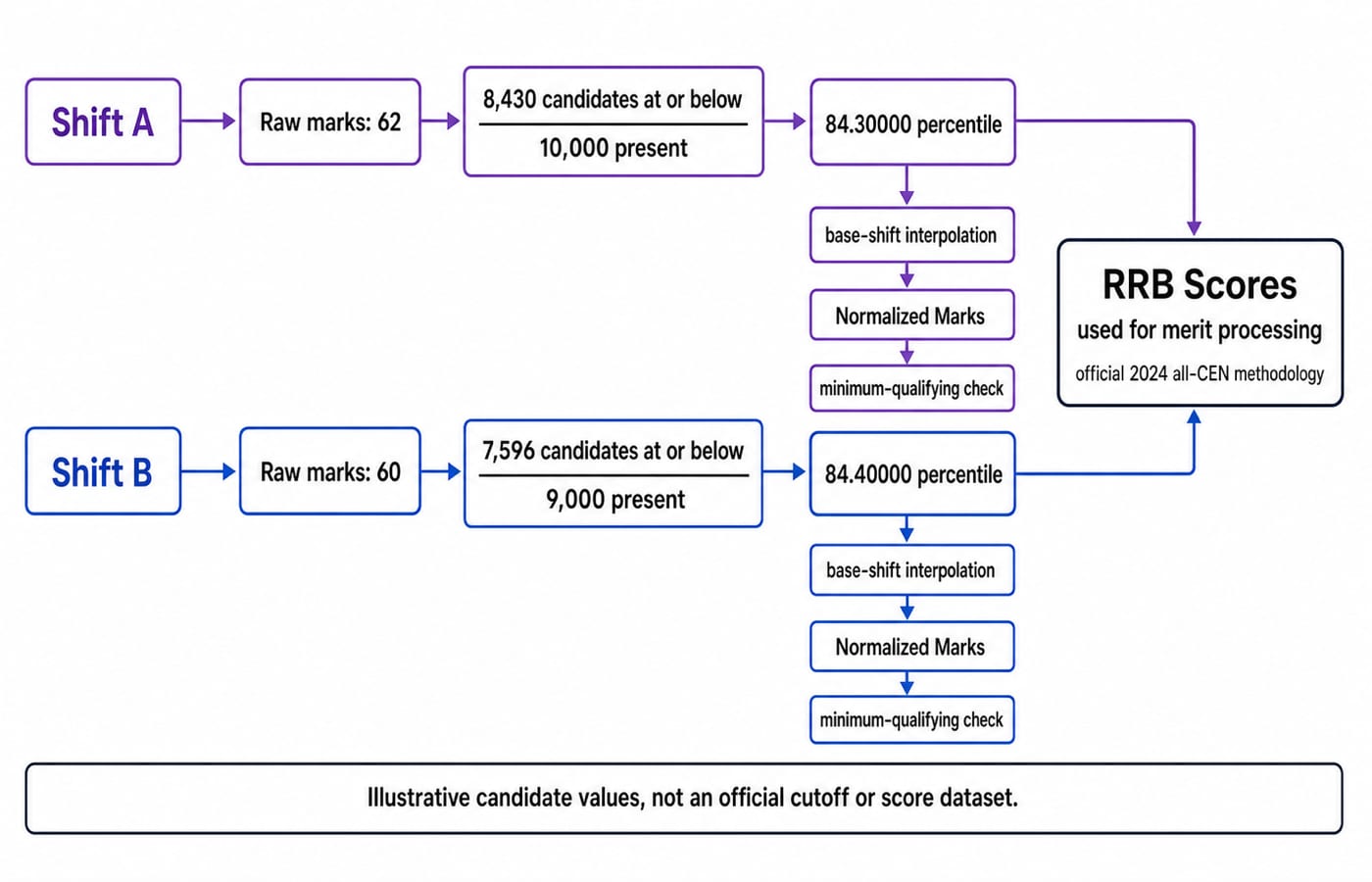
Percentile Score = candidates in the shift with a raw score equal to or below yours / total candidates present in that shift x 100
It distinguishes percentile from percentage of marks, calculates the value to five decimal places, and calls the merged shift percentiles RRB Scores for merit processing.
In Shift A, 8,430 of 10,000 candidates scored at or below Candidate A's 62:
8,430 / 10,000 x 100 = 84.30000
In Shift B, 7,596 of 9,000 scored at or below Candidate B's 60:
7,596 / 9,000 x 100 = 84.40000
Candidate B has lower raw marks but a higher percentile because each value describes position within a shift. This alone does not prove that either shift was easier. Once every shift is merged, that Percentile Score is what the notice calls the RRB Score, so 84.30000 is the figure Candidate A carries into merit processing and into any cutoff comparison.
Worked Normalized Marks example
Apply the official methodology's interpolation form:
N = ((Y2 - Y1) / (X2 - X1)) x (X - X1) + Y1
For Candidate A, let X = 84.30000. In an illustrative base-shift neighbourhood, the immediate lower point is X1 = 84.25000 with Y1 = 63.00 marks. The immediate higher point is X2 = 84.50000 with Y2 = 64.00 marks.
N = ((64 - 63) / (84.50 - 84.25)) x (84.30 - 84.25) + 63
= (1 / 0.25) x 0.05 + 63
= 4 x 0.05 + 63
= 63.20 normalized marks
The real neighbouring pairs come from the base-shift table published with your own result notice, not from the 63.00 and 64.00 used above. The notice uses Normalized Marks for the CEN minimum-percentage test, while the percentile or RRB Score drives merit processing.
Match all six coordinates before reading a cutoff
Match CEN or cycle, RRB, stage, post or pay level, category, and score label or unit.
Take this hypothetical row:
CEN Example/2024 | RRB X | CBT 1 to CBT 2 | Pay Level L | UR | cutoff 82.45000 RRB Score
Candidate A's 84.30000 is 1.85000 points above it. Candidate C's 82.44999 is 0.00001 below it. An exact line matters, and a display rounded to 82.45 can hide the difference. Another RRB, stage, category or pay level cannot establish shortlisting. The post or pay level coordinate is the one most often mismatched, so confirm which posts your qualification actually reaches in RRB NTPC Eligibility: Graduate vs Undergraduate Post Fit before reading any cutoff row against your own score.
Avoid five score-reading shortcuts
Percentile is not percentage of marks.
Raw marks are not directly comparable across shifts when the applicable notice normalises them.
Minimum qualifying marks are not the shortlisting cutoff. The same distinction appears in CTET Qualifying Marks and Certificate Validity, but its exam-specific rules remain separate.
An old cutoff or another RRB's cutoff is not a prediction.
A difference between raw and normalized values is not evidence of an unfair bonus or penalty.
Beware a historical-formula trap. RRB's 2020 revised formula was attached to CEN 01/2019 NTPC. The official 2024 all-CEN notice states a percentile-equivalence method. Follow the methodology named in your current CEN and result notice, not the first formula in a search result.
The short version and your next preparation step
Rebuild raw marks from final response evidence. Read the labelled percentile or RRB Score. Keep Normalized Marks separate. Open the official cutoff PDF and match all six coordinates. Use the relevant NTPC cycle page on the official RRB domain for the real score card and cutoff, never an expected-cutoff table.
For structured study, use the RRB NTPC 2026 Complete Course (CBT 1 & 2) and Railway Exam Preparation Courses. SSC CGL Mock Test Strategy: Turn Mocks Into Marks can help turn score evidence into revision actions, but transfer no SSC pattern values.
Keep learning

RRB NTPC Posts Explained: Match Duties and Skill Tests to Your Preference Order
Compare the six graduate roles in CEN 06/2025 by typical duties, work setting, medical standard and skill stage. Then build a personal preference order using elimination and a weighted example.
Updated 16 Aug 20266 min read94 viewsRRB NTPC
RRB NTPC PYQ Analysis: Separate CBT 1 Screening From CBT 2 Merit
Do not mix CBT 1 and CBT 2 questions in one notebook. Use separate ledgers to measure screening coverage, later-stage accuracy, error types and repair actions.
Updated 12 Aug 20265 min readRRB NTPC

RRB NTPC CBAT Preparation: Build Accuracy Across All Five Tests
Find the weak process hidden by one total practice score. Build a separate CBAT baseline, run precise repair drills, and retest every battery on fresh material.
Updated 10 Aug 20265 min readRRB NTPC

RRB NTPC Typing Skill Test: A 35-Day Speed and Accuracy Plan
Follow a five-week typing routine that begins with a three-passage baseline, adds speed only after accuracy holds, and ends with realistic unseen tests.
Updated 7 Aug 20265 min readRRB NTPC