RRB NTPC CBT 1 vs CBT 2: Purpose and Preparation Shift
See what to retain after CBT 1, what to change for CBT 2, and how to turn diagnostics, subject drills and mock errors into a focused transition plan.
KnowledgeGate Team
Exam prep & CS education
Updated 26 Jul 20265 min read
CBT 1 preparation sets a trap: CBT 2 draws on the same three subjects, so it looks like more of the same paper. It is not. CBT 1 rewards a fast, clean first pass across broad coverage, while CBT 2 asks you to hold that accuracy through denser, multi-step sets and is the stage that carries your merit. The base you built stays. The way you work it has to change.
CBT 1 and CBT 2 are two preparation jobs, not duplicate labels
Both stages draw on the same three areas: Mathematics, General Intelligence and Reasoning, and General Awareness. What changes between them is how far you must push inside those areas, not the subject list.
Treat CBT 1 practice as breadth, clean triage and reliable basics. For CBT 2, make that base survive denser, unfamiliar, multi-step sets.
That difference is structural, not cosmetic. CBT 1 acts as a screening gate, CBT 2 is the stage your merit position is built on, and for several posts a typing or aptitude test sits behind it. The RRB NTPC eligibility and exam-pattern guide sets out that stage chain post by post, so read your own chain there before you plan the shift below. For this cycle's question counts, durations, negative marking and normalisation, the Centralised Employment Notice on the official RRB application portal is the authority.
What stays the same, and what must change after CBT 1
Preparation dimension | CBT 1 working emphasis | CBT 2 working emphasis | Evidence to track |
|---|---|---|---|
Subject base | Broad coverage | Retrieve inside mixed sets | Attempted accuracy |
Question selection | Clean first pass | Abandon poor choices earlier | Questions abandoned after first pass |
Depth | Isolated chapter drills | Denser, multi-step work | Multi-step errors |
Time control | Basic pacing | Protect harder-set accuracy | Correct attempts by pass |
Review | Read solutions | Retest an error ledger | Errors repeated within seven days |
What stays the same is worth naming, because this is the point at which aspirants throw it away: the three subject families, the formulas and rules you already drilled, and the habit of a clean first pass. What changes is the operating method. Shift coverage to retrieval, isolated drills to mixed sets, shortcuts to deliberate method selection, raw scores to an error ledger, and higher attempts to protected accuracy. The same prelims-to-mains change of job runs through Bank PO preparation, on a different subject list.
Worked diagnostic: prove whether the old routine still transfers
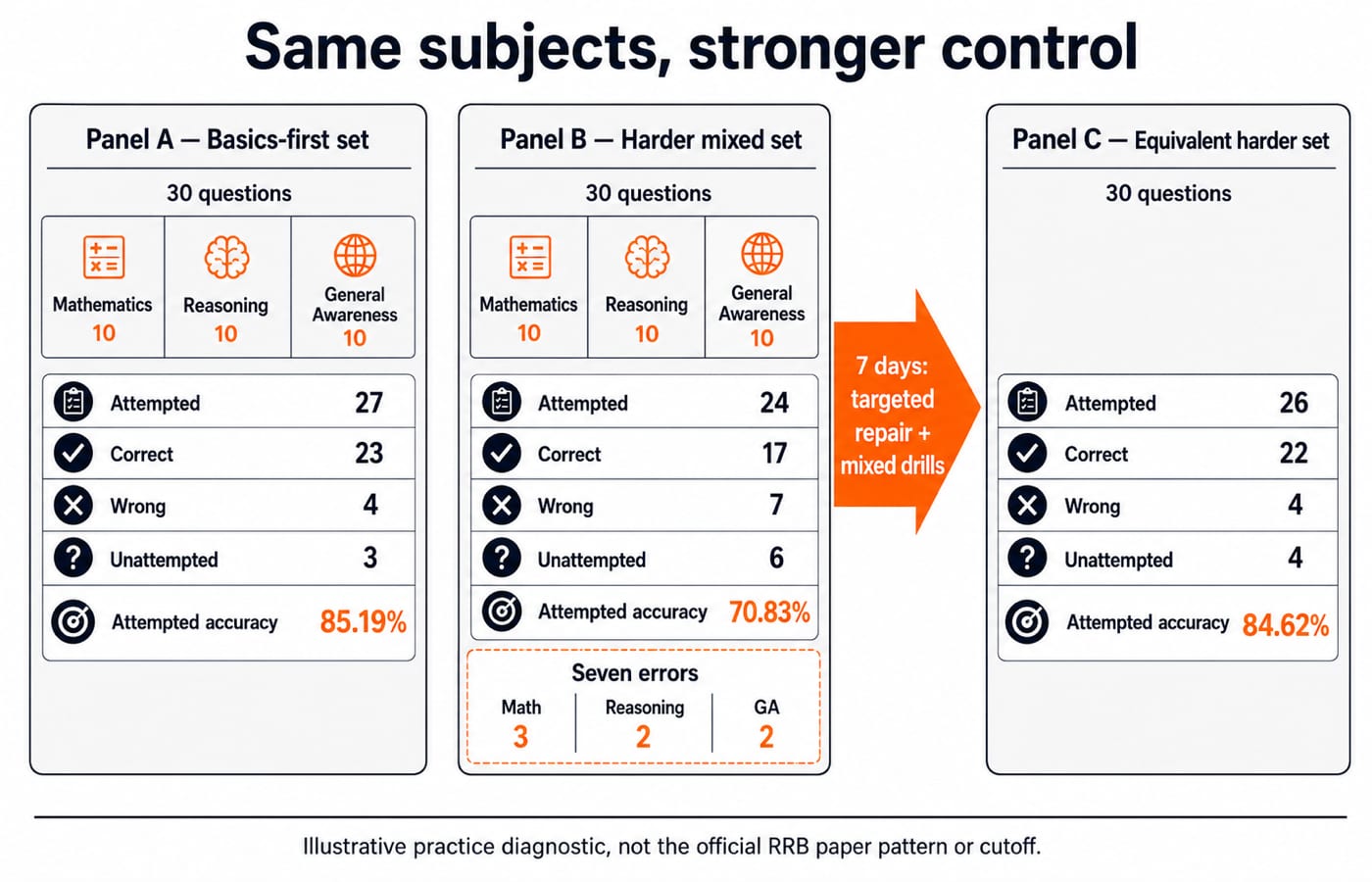
Build three 30-question practice sets of your own, each with 10 Mathematics, 10 Reasoning and 10 General Awareness questions.
Set A, basics-first: 27 attempted, 23 correct, 4 wrong, 3 unattempted. Attempted accuracy =
23 / 27 x 100 = 85.19%.Set B, intentionally harder and mixed: 24 attempted, 17 correct, 7 wrong, 6 unattempted. Attempted accuracy =
17 / 24 x 100 = 70.83%.
Split Set B's seven wrong answers into 3 multi-step Mathematics errors + 2 incomplete Reasoning constraint maps + 2 General Awareness near-match recalls. Split six unattempted into 4 slow Mathematics items + 2 unresolved General Awareness items. The ledger chooses the drills.
After seven targeted days, take equivalent parallel Set C: 26 attempted, 22 correct, 4 wrong, 4 unattempted. Attempted accuracy = 22 / 26 x 100 = 84.62%. That shows restored harder-set accuracy as controlled attempts rose from 24 to 26.
Shift each subject from completion to control
Mathematics: A takes 12 days and B 18 days to finish a job. Their daily rate is 1/12 + 1/18 = 5/36. In three days they finish 3 x 5/36 = 5/12, leaving 1 - 5/12 = 7/12. If A leaves, B needs (7/12) / (1/18) = 10.5 more days. Total time is 3 + 10.5 = 13.5 days. Reasonableness check: slower B completes the larger remainder alone.
Reasoning: C at the left end and E immediately right give C E. A is two seats right of E, and D is immediately left of A, giving C E D A. B immediately left of F completes C E D A B F. An ordered constraint map prevents incomplete placements.
General Awareness: Build a 20-fact deck from sources you can re-open. Recall of 11/20 on Day 0, 15/20 on Day 2 and 17/20 on Day 7 means misses fall from 9 to 5 to 3. Recycle the misses on every round and keep a source against each fact, so a near-match answer in a mock traces back to something you can re-read rather than to a vague memory.
Replace the CBT 1 routine with a 14-hour transition week
Old week: 8 hours chapter completion + 3 hours isolated practice + 2 hours mocks + 1 hour review = 14. Transition week: 3 hours gap repair + 5 hours harder mixed sets + 3 hours timed sectional practice + 3 hours mock review and retrieval = 14. Reallocate the hours.
Schedule Monday 2 hours gap repair; Tuesday 2 hours harder mixed Mathematics; Wednesday 2 hours harder mixed Reasoning; Thursday 1 hour gap repair + 1 hour harder mixed General Awareness; Saturday 3 hours timed sectionals; Sunday 3 hours mock review and retrieval. Total: 3 hours repair + 5 hours mixed sets + 3 hours sectionals + 3 hours review = 14. Recover a missed weekday session as two one-hour blocks before Sunday.
The RRB NTPC Complete Preparation Course already runs lessons, practice sets and mocks in this order across both stages, if you would rather not assemble the week yourself.
Make every mock produce the next week's work
Try a 45-question, 45-minute practice mock: 38 attempted, 31 correct, 7 wrong, 7 unattempted. Attempted accuracy = 31 / 38 x 100 = 81.58%. Code seven errors as K4, four knowledge gaps; M2, two method errors; and T1, one time-choice error.
Turn four K errors into cards retested on Days 1, 3 and 7. Solve each M error once untimed and twice in 90-second learner drills. Put T in a 10-question first-pass drill. On a 15-question parallel set: 13 attempted, 12 correct, 1 wrong, 2 unattempted. Attempted accuracy = 12 / 13 x 100 = 92.31%.
A score tells you what happened; it does not tell you what to do next. A diagnosis does, because it gives every wrong and skipped item an owner, a repair drill and a retest date. The same review loop, worked in more detail on a different exam, is set out in the SSC CGL mock-test strategy.
The short version: carry the base forward, change the operating method
Keep the three broad subject families.
Diagnose yourself on harder mixed material.
Record attempted accuracy and error types.
Move hours from passive completion to mixed practice and review.
Confirm this cycle's stage rules in the current CEN before you plan around them.
Create one 30-question 10/10/10 diagnostic today. Calculate attempted accuracy, classify every wrong and skipped question, then schedule a parallel retest seven days later.
Do not restart after CBT 1. Keep the base you built and put the new hours into control: harder mixed sets, an error ledger, and a retest date on every mistake you make. More railway-recruitment guidance sits in the Railways exam category.
Keep learning

RRB NTPC Posts Explained: Match Duties and Skill Tests to Your Preference Order
Compare the six graduate roles in CEN 06/2025 by typical duties, work setting, medical standard and skill stage. Then build a personal preference order using elimination and a weighted example.
Updated 16 Aug 20266 min read95 viewsRRB NTPC

RRB NTPC Normalisation and Cutoffs: Read Raw Marks, Percentile and RRB Score
Learn what raw marks, percentile, RRB Score and Normalized Marks mean, then use worked examples to compare your score with the correct cutoff row.
Updated 14 Aug 20264 min read64 viewsRRB NTPC
RRB NTPC PYQ Analysis: Separate CBT 1 Screening From CBT 2 Merit
Do not mix CBT 1 and CBT 2 questions in one notebook. Use separate ledgers to measure screening coverage, later-stage accuracy, error types and repair actions.
Updated 12 Aug 20265 min readRRB NTPC

RRB NTPC CBAT Preparation: Build Accuracy Across All Five Tests
Find the weak process hidden by one total practice score. Build a separate CBAT baseline, run precise repair drills, and retest every battery on fresh material.
Updated 10 Aug 20265 min readRRB NTPC