RRB NTPC Previous Year Analysis: Why General Awareness Dominates the Topic Split
Use the recurring section and topic pattern from past RRB NTPC papers to protect high-yield General Awareness, arithmetic and Reasoning preparation.
KnowledgeGate Team
Exam prep & CS education
Updated 29 Jul 20266 min read
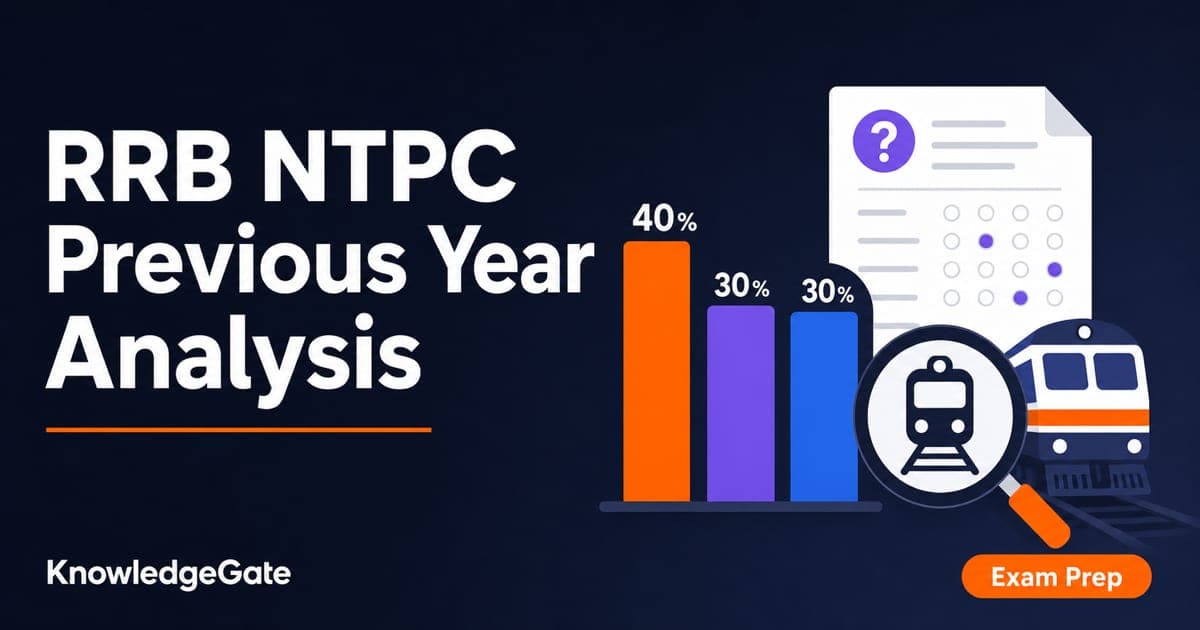
With three subjects and limited time, the useful question is not what RRB NTPC contains. It is where the questions come from and which areas return marks fastest. Past papers put General Awareness first by share, which does not mean Maths and Reasoning can wait.
The headline from past papers: General Awareness leads
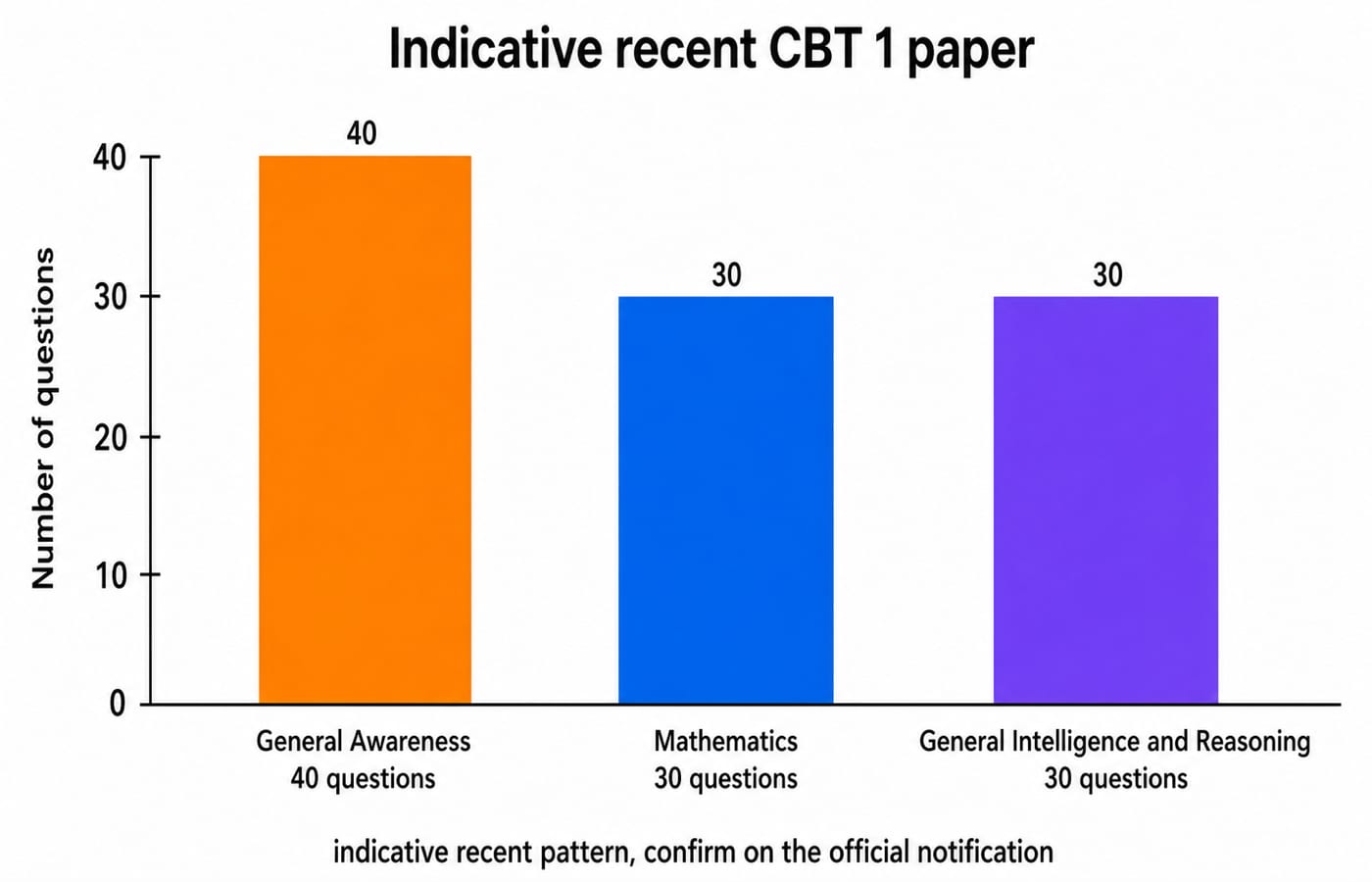
Across recent CBT 1 and CBT 2 patterns, General Awareness has had the largest question share, while Mathematics and General Intelligence and Reasoning have had equal smaller shares. Recent CBT 1 notices, for example, have used an indicative split of 40 General Awareness questions, 30 Mathematics questions and 30 Reasoning questions. Check the current counts in the CEN on the official RRB application portal, because the live notification, not an old paper, controls your exam.
That lead is larger than the raw count suggests, because General Awareness is both the biggest block and the quickest one. A fact you know is answered in seconds, while an arithmetic sum or a seating puzzle costs a minute or more, so one section holds the largest share of the questions and the smallest share of the clock. A weak General Awareness attempt therefore costs you twice: its own marks, and the minutes it steals from the other two sections.
That corrects a common preparation mistake. Mathematics feels harder, so a student spends the week on it and leaves the larger General Awareness block to vague last-minute reading. Difficulty and weight are different things, and a demanding topic does not automatically deserve the largest share of your hours.
Read that as a shape, not a forecast. Shifts differ, and the split above is what recent papers and notices have looked like, not a promise about the paper you sit. What holds across shifts is the ranking: General Awareness first, Mathematics and Reasoning level behind it. Plan against the ranking.
Inside General Awareness: what actually recurs
General Awareness has a finite core and a volatile edge, and the two need different treatment.
Static core, learned once and revised often: Indian history and the freedom struggle, geography, polity and the Constitution, basic economics, and general science across school-level physics, chemistry and biology.
Static GK, quick to bank: sports, awards, books and authors, important days.
Volatile edge, never closes: appointments, schemes, reports, prizes and major events.
No one-time list closes that volatile edge, so the working answer is a small, steady current-affairs habit running alongside repeated revision of the static core. The Railways exam category works through all three RRB NTPC subjects in lessons and practice sets.
Recall is the whole skill here, and it only becomes reliable after spaced revision and mixed questions. So do not confuse breadth with random reading: build compact topic notes, revise them on a schedule, and let wrong answers show which fact families are still weak.
Inside Mathematics: arithmetic dominates
The centre of RRB NTPC Mathematics is arithmetic, and the paper keeps returning to the same three layers.
Recurring core: percentage, ratio and proportion, profit and loss, averages, time and work, time-speed-distance, simple and compound interest, and data interpretation.
Supporting layer: the number system, which feeds almost every item in that core.
Advanced tail: mensuration, elementary algebra and geometry.
The core recurs because it tests a small set of methods in many disguises. The tail still appears, so the rule is not to skip it, it is to stop polishing it while the arithmetic underneath is unreliable.
So work method before variety. Learn the standard relationship, solve a clean example, then practise timed variations. If percentage change and ratio conversion are slow, data interpretation will be slow too. Which chapter feeds which is mapped topic by topic in the RRB NTPC syllabus study map.
Inside Reasoning: pattern types, not surprises
Reasoning rotates through a recognisable set of templates, and each one has a first move that does most of the work.
Analogies and number or alphabet series: name the operation, then test it against every option, not the first that looks close.
Coding-decoding: recover the rule from the given pair before touching the question word.
Syllogisms and Venn diagrams: draw the set relations, never argue from the wording.
Seating and puzzle arrangements: fix the one definite clue, place the rest against it, then read the finished line-up back through every clue.
Direction sense: a small path diagram beats mental rotation.
Statement-conclusion: accept the statement as given, then test each conclusion alone.
Classifying before solving is the whole advantage of a repeating section: inventing a fresh method each time throws away the repetition that makes Reasoning winnable. Drill each template until the setup is automatic, then mix templates so recognition itself is tested, which is closer to the real paper than a long block of one type.
Turning the split into an honest allocation
Allocate by question share, speed potential and personal weakness together. The static General Awareness core gets protected revision, because it is large and quick to answer when known. Reasoning templates get frequent timed practice, because their forms are finite. Arithmetic comes next, as the method-heavy foundation under Mathematics.
Current affairs gets a steady daily dose and a hard boundary; advanced Maths waits until the recurring arithmetic methods are stable.
Treat that as a priority order, not a timetable. A student already strong in static GK may need more arithmetic; another who calculates accurately but slowly needs timed sets. Use sectional results to move effort toward the weakest high-yield block.
The trap in over-indexing on General Awareness
Once students hear that General Awareness is largest, some swing too far and spend hours on current-affairs feeds. That fails twice over. Current affairs has no natural endpoint, so extra reading soon returns very little, and a strong General Awareness attempt still cannot make careless arithmetic or unpractised Reasoning harmless.
Hold a floor instead: close the static core, keep current affairs moving in small portions, and protect fixed practice for arithmetic and Reasoning. The largest section should lead your plan, not swallow it.
How to drill this and what to do next
KnowledgeGate's question bank holds about 3,000 General Awareness questions. Revise the static core through those questions rather than by re-reading notes, and rotate short timed sets in arithmetic and Reasoning alongside them.
Then run this same analysis on your own attempts, because your error pattern is the only past-paper evidence that is specifically about you.
Tag every wrong answer by section and by topic, using the topic names above.
Tag it again by cause: not known, known but too slow, or careless read. Those three need different repairs, and confusing them is why revision can feel busy and change nothing.
After three papers, rank topics by wrong answers weighted by that section's share of the paper. That ranking, not a feeling, sets next week's hours.
Re-test the top two topics a week later, closed book, before you add anything new.
The SSC CGL Tier 1 topic-wise question distribution runs this same share-first reading on a different paper, and the SSC CGL General Awareness approach goes further on splitting a static base from an open-ended current layer.
Then work through the RRB NTPC Complete Preparation Course at the depth each section needs, and confirm the section counts in the current CEN before you finalise your hours.
Keep learning
Browsers and Search Engines MCQs: 9 Solved Questions with Explanations
Solve nine published browser and search engine questions, check each answer, and rebuild the browser, cache, crawler and indexing distinctions that exam distractors blur.
Updated 6 Oct 20267 min readTeaching Recruitment (Computer Science)
IT Act, 2000 Explained: Key Sections, Digital Signatures and Worked Exam Examples
Build an exam-ready map of the IT Act, then apply it to an exact digital-signature walkthrough and a section 43, 66, 66C and 66D caselet.
Updated 2 Oct 20266 min readTeaching Recruitment (Computer Science)
Emerging Trends Introduction MCQs: 12 Solved Questions with Explanations
Solve 12 Emerging Trends Introduction questions with clear answer logic, exam-year labels and a compact trap check for focused revision.
Updated 27 Sep 20268 min readTeaching Recruitment (Computer Science)
MS Word Basics MCQs with Answers: 12 Solved Questions Explained
Work through 12 MS Word questions covering everyday commands, page layout, formatting, links, file features and mail merge. Each answer explains the decisive clue and the closest distractor.
Updated 25 Sep 20267 min readTeaching Recruitment (Computer Science)