RRB NTPC CBAT Preparation: Build Accuracy Across All Five Tests
Find the weak process hidden by one total practice score. Build a separate CBAT baseline, run precise repair drills, and retest every battery on fresh material.
KnowledgeGate Team
Exam prep & CS education
Updated 10 Aug 20265 min read

One total CBAT practice score can hide the cause of your misses. You cannot tell whether attention, route scanning, ordering or figure reasoning needs repair. Record a separate baseline for every battery, tag the process behind each error, run a short drill and retest on a comparable set. Done across fourteen days, that turns one blurred percentage into five numbers you can act on separately, and it tells you which of them actually moved.
Know what must be tracked before practising faster
RDSO's published Station Master guidance names Intelligence Test, Selective Attention Test, Spatial Scanning Test, Information Ordering Test and Personality Test. It also warns that these names are indicative and may change. RDSO's aptitude-test FAQ says the Station Master/Traffic Assistant battery has five tests but generates six scores because the Personality Test evaluates two dimensions.
This battery is set for the Station Master and Traffic Assistant posts, so confirm which RRB NTPC post band you are applying to before you build a tracker around it. Names alone do not make these skills interchangeable. Track correctness separately for the first four practice types. For personality practice, track completion and honest response behaviour. This prevents one weak process from hiding inside a blended average.
Build a five-row CBAT baseline, not one headline score
Say a first honest pass, one sitting per practice type, lands here:
Practice type | Attempted | Result | Home metric |
|---|---|---|---|
Intelligence | 50 items | 38 correct, 12 wrong | 76.0% |
Selective attention | 40 items | 31 correct, 9 wrong | 77.5% |
Spatial scanning | 30 items | 21 correct, 9 wrong | 70.0% |
Information ordering | 30 items | 24 correct, 6 wrong | 80.0% |
Personality practice | 24 prompts | 24 answered, 0 skipped | 100% completion |
38/50 x 100 = 76.0%; 21/30 x 100 = 70.0%. Never average rows. Correctness and completion differ. Accuracy cannot become an official T-score without cohort mean and standard deviation.
Add these columns: rule misunderstood, scan miss, calculation slip, constraint broken, rushed choice and time used. It is the same habit that turns SSC CGL mocks into marks: read every attempt by pace and error type, never by the headline percentage.
Repair Intelligence and Selective Attention with repeatable drills
For Intelligence, compare five symbol pairs: A, two touching circles; B, two touching squares; C, two touching triangles; D, two separated diamonds; E, two touching pentagons. D is the answer because separation is the only changed relation. Choosing D because “diamonds look different” still reveals a rule-identification error.
For Selective Attention, use 4 1 6 3 2 5 8 7 4 9 and ignore even digits. After five digits, 1 + 3 = 4. Continue from that checkpoint: 4 + 5 + 7 + 9 = 25. Thus, 1 + 3 + 5 + 7 + 9 = 25. An answer of 33 is an inclusion error because the 8 was added.
Run three rounds: ten items of each type untimed, a mixed set of 20 under a personal 12-minute drill cap, then only the misses after 24 hours.
Make Spatial Scanning and Information Ordering visible
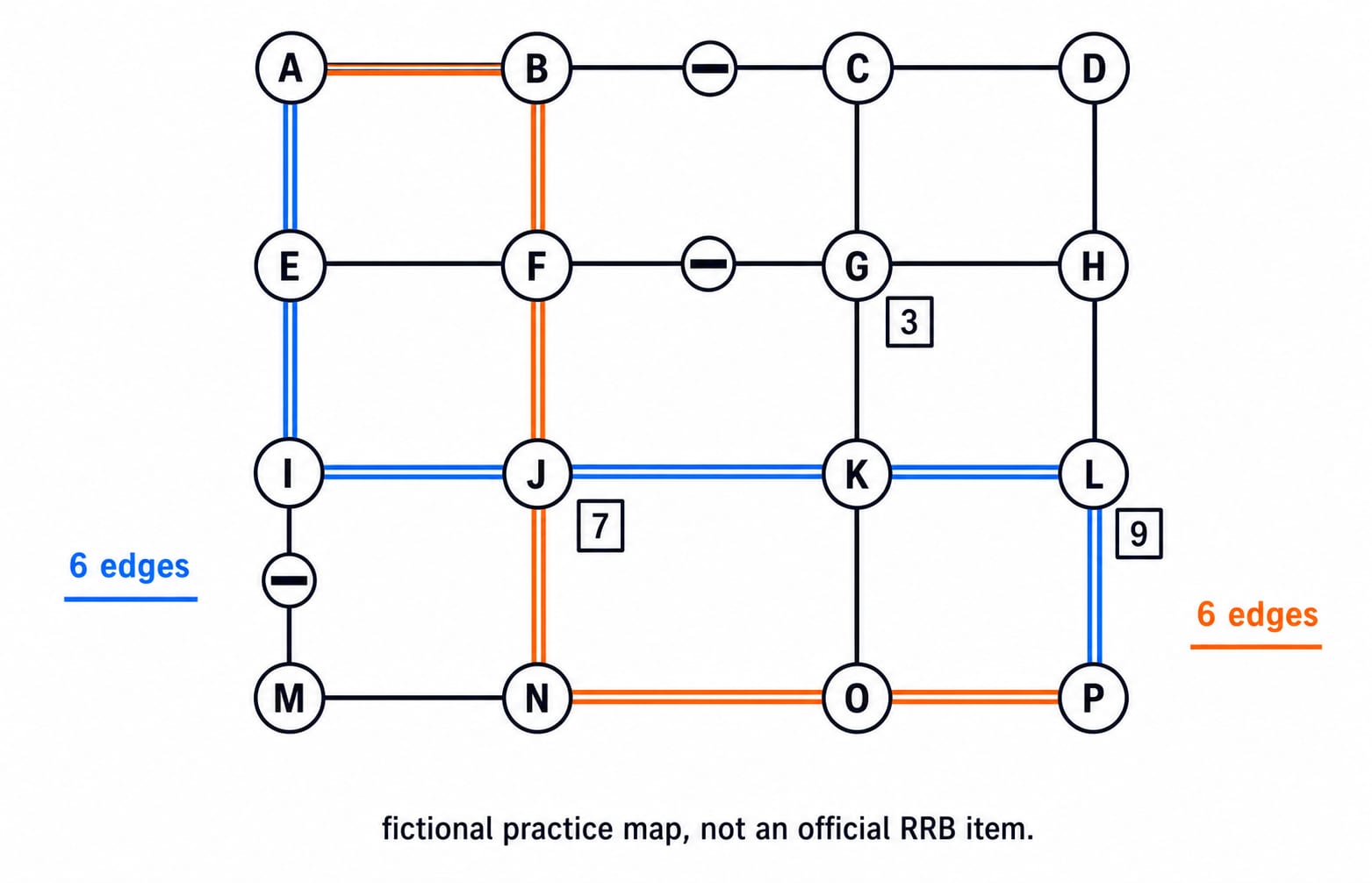
Draw a 4 by 4 map as A B C D / E F G H / I J K L / M N O P. Keep adjacent horizontal and vertical streets open except B-C, F-G and I-M. Put building 7 at J, 3 at G and 9 at L.
From A to P, A-E-I-J-K-L-P uses six edges and passes building 7. The route A-B-F-J-N-O-P also uses six edges and passes 7, so the answer is not route-choice luck. Tag a miss as a barrier miss, endpoint miss or route-length miss.
For an ordering drill, use cards A to E with four rules: C before A; D immediately after B; E after A; E before B. Reading the chain left to right gives the unique order C-A-E-B-D, and each rule holds. Tag a miss by the first violated rule.
Treat Personality as honest completion, not an accuracy hack
Personality prompts do not have a worked “correct option” to reverse-engineer. For a 24-prompt practice set, record 24 answered, 0 accidental skips and 0 answers copied from an external key. Do not calculate correctness or convert completion into a score.
RDSO's guidance advises honest answers without skipped items, while its FAQ explains that the Personality Test produces two dimension scores. Do not rehearse an ideal persona, force every extreme option or repeatedly edit answers to look consistent. Practise calm reading and truthful completion, not performance.
Run a 14-day repair cycle with one buffer day
Day 1: 60 minutes for five-row baseline. Days 2 to 5: 35 minutes each for Intelligence, Selective Attention, Spatial Scanning and Information Ordering. Day 6: 45 minutes mixed. Day 7: 35 minutes buffer or error re-solve. Days 8 to 11: four fresh 35-minute focused sessions. Day 12: 45 minutes mixed. Day 13: 20 minutes reviewing instructions and completing personality prompts calmly. Day 14: 60-minute comparable retest.
The total is 60 + 140 + 45 + 35 + 140 + 45 + 20 + 60 = 545 minutes = 9 hours 5 minutes. Move one missed 35-minute block to Day 7. If you miss two days, retain the weakest battery's block and drop one mixed block instead of doubling a tired session. If a fortnight is not enough runway, the same tag-and-retest habit stretches across a 30-day aptitude practice routine built for placement tests.
Retest each row and separate home scores from T-scores
Day 14 on the same tracker:
Practice type | Day 14 result | Movement |
|---|---|---|
Intelligence | 44/50 = 88.0% | +6 correct |
Selective attention | 36/40 = 90.0% | +5 correct |
Spatial scanning | 26/30 = 86.7% | +5 correct |
Information ordering | 27/30 = 90.0% | +3 correct |
Personality practice | 24/24 answered, 0 skipped | Completion unchanged |
Set your own retirement bar and hold to it: retain a row until it reaches 85% on two fresh comparable sets and no tag exceeds two. If set difficulty changes, compare tags.
Home accuracy is not a T-score. RDSO's FAQ example uses raw 20, mean 14 and SD 3: T = 50 + 10((20-14)/3) = 70. It does not estimate yours.
The short version and your next RRB NTPC step
Name each test, baseline it separately, tag the process behind every miss, repair one process at a time, and retest on a fresh comparable set. Create the five-row tracker before doing another mixed session. For wider structured study, use the RRB NTPC Complete Preparation Course, or compare it against the other Railway exam preparation courses. For live test names, interface, scoring and session rules, always follow the current official RDSO and RRB instructions.
Keep learning
RRB NTPC Posts Explained: Match Duties and Skill Tests to Your Preference Order
Compare the six graduate roles in CEN 06/2025 by typical duties, work setting, medical standard and skill stage. Then build a personal preference order using elimination and a weighted example.
Updated 16 Aug 20266 min read95 viewsRRB NTPC

RRB NTPC Normalisation and Cutoffs: Read Raw Marks, Percentile and RRB Score
Learn what raw marks, percentile, RRB Score and Normalized Marks mean, then use worked examples to compare your score with the correct cutoff row.
Updated 14 Aug 20264 min read64 viewsRRB NTPC
RRB NTPC PYQ Analysis: Separate CBT 1 Screening From CBT 2 Merit
Do not mix CBT 1 and CBT 2 questions in one notebook. Use separate ledgers to measure screening coverage, later-stage accuracy, error types and repair actions.
Updated 12 Aug 20265 min readRRB NTPC
RRB NTPC Typing Skill Test: A 35-Day Speed and Accuracy Plan
Follow a five-week typing routine that begins with a three-passage baseline, adds speed only after accuracy holds, and ends with realistic unseen tests.
Updated 7 Aug 20265 min readRRB NTPC