RRB NTPC Syllabus: Maths, Reasoning and General Awareness Study Map
Turn the RRB NTPC topic list into an ordered study map, a coverage sheet and a self-set diagnostic that decides what to revise next.
KnowledgeGate Team
Exam prep & CS education
Updated 25 Jul 20266 min read
The RRB NTPC syllabus tells you what can appear in the paper, not what to learn first, what to revise in one sitting, or what to repair before your next full mock. Mathematics, General Intelligence and Reasoning, and General Awareness each need a different order, and that order decides how much of the list you still hold on exam day.
Start with the official list, then add a study structure
CEN No. 05/2024 for graduate NTPC listed objective multiple-choice content under Mathematics, General Intelligence and Reasoning, and General Awareness for both CBT stages. A notice names topics; it does not say which of them feed each other. The clusters below answer that, and they are a study grouping, not RRB's own subject headings.
Official subject family | Study clusters | Learn first | Revise together |
|---|---|---|---|
Mathematics | Number, commerce, rates, shape, data | Fractions, decimals, geometry | Percentage, commerce, rates |
General Intelligence and Reasoning | Patterns, relations, deduction, arrangement | Symbols, one relation | Arrangements, checks |
General Awareness | Static, science/digital, current/policy | Concepts, source discipline | Retrieval, source checks |
The Railways category on KnowledgeGate works through these same three subject families for RRB NTPC, in lessons, practice questions and mock tests.
Mathematics map: build arithmetic before speed chapters
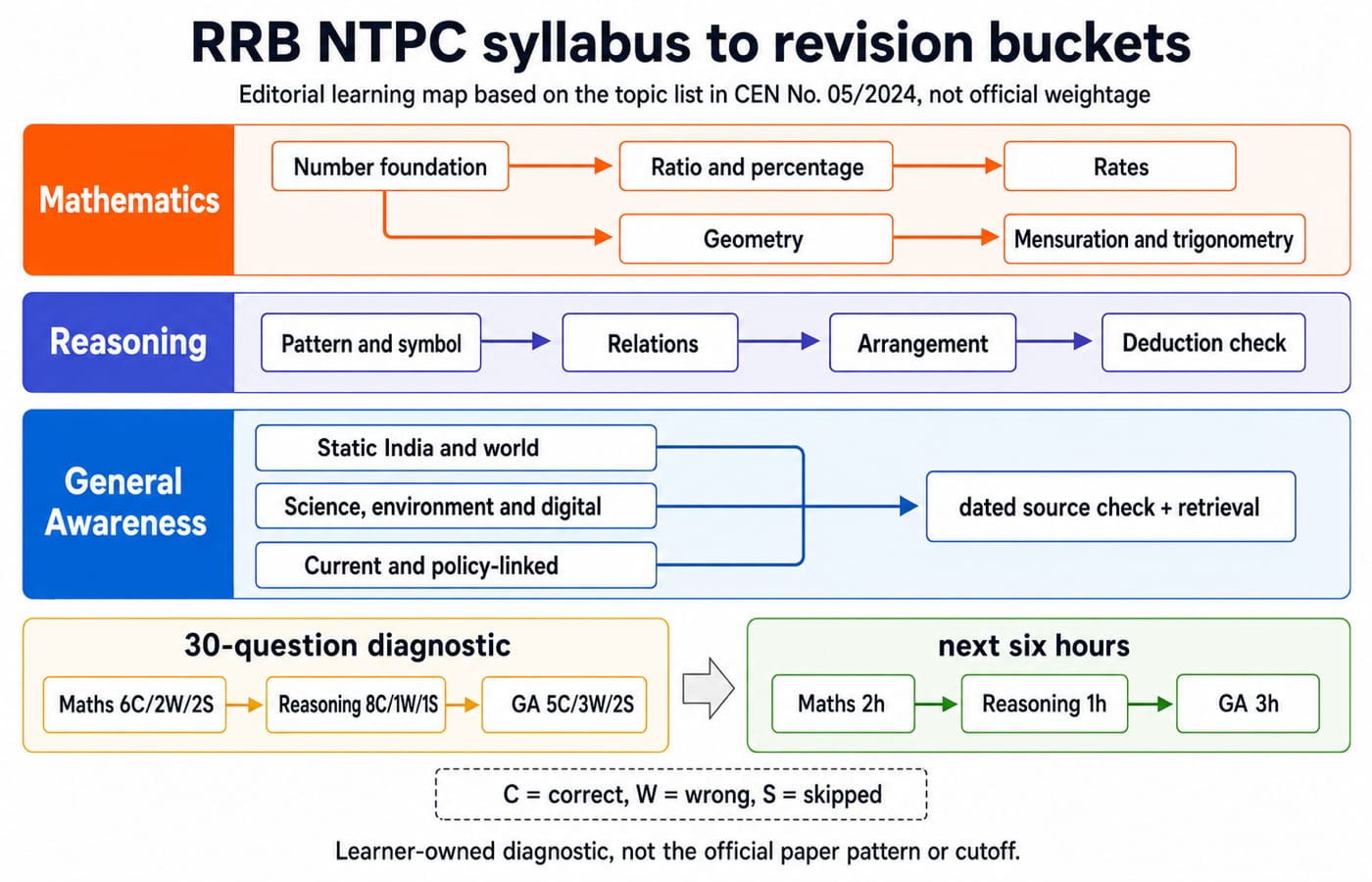
Mathematics splits into five clusters. Number foundation: number system, decimals, fractions, LCM, HCF. Ratio and commercial arithmetic: ratio and proportion, percentage, simple and compound interest, profit and loss. Rates: time and work, time and distance. Shape and symbols: mensuration, elementary algebra, geometry, trigonometry. Data summary: elementary statistics.
Work them in dependency order: fractions and decimals -> ratio and proportion -> percentage -> interest and profit/loss; fractions and LCM -> time and work; ratio and unit conversion -> time and distance; geometry -> mensuration and trigonometry. Each arrow means the skill on the left is used inside the chapter on the right, so a shaky fraction habit returns as a wrong time-and-work answer.
For two equal 120 km legs, 120 / 40 = 3 hours and 120 / 60 = 2 hours. Total distance is 240 km, total time 5 hours, so average speed is 240 / 5 = 48 km/h. The simple mean (40 + 60) / 2 = 50 km/h is wrong because the legs take different times. Log it under ratio and unit conversion: the repair is weighting by time, not a new formula.
Reasoning map: move from symbols to multi-constraint decisions
Reasoning splits into four clusters. Pattern and symbol: analogies, number and alphabetical series, coding-decoding, mathematical operations, similarities and differences. Relations and representation: relationships, maps, Venn diagrams, graph interpretation. Deduction and judgement: analytical reasoning, syllogism, data sufficiency, statement-conclusion, courses of action, decision making. Arrangement: jumbling, puzzles.
Build the skill in that order: read symbols accurately -> place one relation -> combine two relations -> solve a full arrangement -> test a conclusion with all constraints. Every step adds one more constraint to hold.
For six seats facing north: R is far left, seat 1; T is immediately right, seat 2; P is second right of T, seat 4; S is immediately left of P, seat 3; Q is immediately left of U, seats 5 and 6. The order is R T S P Q U.
Check the finished order back against every clue. Miss P's spacing and you can build a line-up that satisfies four clues and fails the fifth, which is how most arrangements go wrong. The same symbols-then-constraints ladder runs through Bank PO reasoning practice, on a different question style.
General Awareness map: separate stable knowledge from moving facts
General Awareness splits into three clusters. Static India and world: history/freedom struggle, geography, polity, economy, art/culture, literature, monuments, sports, transport, organisations, personalities, abbreviations, flora/fauna. Science, environment and digital: general/life science at the named level, technology, space/nuclear programmes, environment, computers. Current and policy-linked: national/international events, flagship programmes, the UN, world, government and public-sector organisations.
Stable concepts, how a bill becomes law or where the Western Ghats run, go into notes you write once and reuse. Office-holders, flagship programmes, sporting results and organisation memberships move, so each of those cards carries a date and a source. The same split drives the SSC CGL General Awareness approach.
Test the moving half the way you test a formula, with a 24-fact deck: 8 science/digital + 8 static India/world + 8 current/policy-linked. A realistic curve is 13/24 on Day 0, 18/24 on Day 3, 21/24 on Day 7, with misses falling 11 -> 6 -> 3. Recycle the misses and replace any current-affairs card that has gone stale. Watch the miss count, not the score.
Turn the three maps into revision buckets
Keep the week small enough to survive a bad day. One that holds up: 7 hours Mathematics + 5 hours Reasoning + 4 hours General Awareness + 2 hours mixed review = 18 hours.
Monday: Maths foundation, 3 hours.
Tuesday: Reasoning patterns/relations, 2 hours.
Wednesday: Maths rates/shape, 2 hours.
Thursday: GA static/science, 2 hours.
Friday: kept free, so a missed session has somewhere to go.
Saturday: Maths 2 hours, reasoning arrangement 3 hours.
Sunday: GA current/source check 2 hours, mixed review 2 hours.
Give every session one job. Learn for unseen work, Drill for same-type practice, Retrieve for closed-book recall, Mix for switching between subjects. A topic moves to Mix after one clean explanation and two short drills.
Track each topic on one row: Learned once | Two drills done | Recalled after 7 days | Seen in mixed set | Error code. A filled row reads Time and distance | Yes | Yes | Yes | No | A1: averaged speeds directly. It names the next action: redo the 240 km example, then one parallel problem.
Use a diagnostic before full mocks
Before your first full mock, sit a 30-question diagnostic you build yourself: 10 Mathematics + 10 Reasoning + 10 General Awareness. First attempt: Maths 6 correct, 2 wrong, 2 skipped; Reasoning 8 correct, 1 wrong, 1 skipped; General Awareness 5 correct, 3 wrong, 2 skipped. Totals: 19 correct, 6 wrong, 5 skipped; 25 attempted; 19 / 25 x 100 = 76% accuracy.
The next six hours come off that sheet, not off the subject you enjoy: Maths ratio and rate repair, 2 hours; Reasoning constraint checks, 1 hour; General Awareness retrieval and source verification, 3 hours. General Awareness takes the largest share because it produced the most wrong answers.
Re-test on a parallel set: Maths 8 correct, 1 wrong, 1 skipped; Reasoning 9 correct, 1 wrong, 0 skipped; General Awareness 7 correct, 1 wrong, 2 skipped. Totals: 24 correct, 3 wrong, 3 skipped; 27 attempted; 24 / 27 x 100 = 88.89%. Skips down and accuracy up means coverage is no longer the problem. What changes after that is depth: CBT 2 works the same three subjects in denser, multi-step sets, so the map stays and the practice gets harder.
The short version: cover, connect, retrieve, then mix
Copy every topic from the CEN for your cycle.
Put every topic in a study cluster.
Respect the prerequisite arrows.
Record drill and retrieval evidence.
Start mixed mocks only when no official topic remains unseen.
Marks, question counts, timing, negative marking, exam dates and the selection stages for your cycle live in that CEN and its corrigenda.
Today: build the three-column topic map, sit the 10/10/10 diagnostic and assign your next six hours from the errors and skips it produces. If you would rather work from a plan already built for both stages, the RRB NTPC Complete Preparation Course covers CBT 1 and CBT 2 with lessons, practice questions and mock tests.
Keep learning
RRB NTPC Posts Explained: Match Duties and Skill Tests to Your Preference Order
Compare the six graduate roles in CEN 06/2025 by typical duties, work setting, medical standard and skill stage. Then build a personal preference order using elimination and a weighted example.
Updated 16 Aug 20266 min read94 viewsRRB NTPC
RRB NTPC Normalisation and Cutoffs: Read Raw Marks, Percentile and RRB Score
Learn what raw marks, percentile, RRB Score and Normalized Marks mean, then use worked examples to compare your score with the correct cutoff row.
Updated 14 Aug 20264 min read64 viewsRRB NTPC
RRB NTPC PYQ Analysis: Separate CBT 1 Screening From CBT 2 Merit
Do not mix CBT 1 and CBT 2 questions in one notebook. Use separate ledgers to measure screening coverage, later-stage accuracy, error types and repair actions.
Updated 12 Aug 20265 min readRRB NTPC

RRB NTPC CBAT Preparation: Build Accuracy Across All Five Tests
Find the weak process hidden by one total practice score. Build a separate CBAT baseline, run precise repair drills, and retest every battery on fresh material.
Updated 10 Aug 20265 min readRRB NTPC