An internship entry can name the company, dates and tools yet still read like a job description. The usual problem is that every bullet begins with “worked on”, “helped with” or “responsible for”. A stronger bullet identifies your action, defines its scope and constraint, and attaches an outcome you can trace. If your evidence is weaker, reduce the claim instead of decorating it.
Build each bullet from action, scope, constraint and outcome
Use four parts as a drafting model:
Action: what you personally did.
Scope: the endpoint, workflow, dataset or audience affected.
Constraint: the method, environment or limit.
Outcome: the observed result.
An optional fifth part, evidence, answers where the number came from. You can omit one part for readability, but never blur ownership or invent an outcome.
Compare Responsible for improving API performance and documentation with this:
Implemented Redis caching for a product catalogue endpoint under mentor review, reducing p95 response time from 1.8 s to 1.1 s in a 500-request staging test; documented 3 invalidation cases.
The second line names the contribution, boundary, measurement and output. It is not universally “ATS-proof”; it is simply more specific and defensible. Use the fresher resume guide to place this focused experience section alongside education, projects and skills.
Make an evidence ledger before polishing the prose
Create a five-column ledger before trying to sound impressive:
Raw duty | Personal contribution | Scope or constraint | Measured result | Proof location |
|---|---|---|---|---|
Improve catalogue API | Implemented a mentor-approved Redis cache | One product catalogue endpoint | p95 1.8 s before, 1.1 s after, same 500-request staging test | Load-test report and pull request notes |
Document cache behaviour | Documented 3 cache invalidation cases | Handover documentation | 3 cases completed | Handover document |
Traceable evidence can be a pull request, issue ticket, test report, dashboard export, release note, supervisor feedback or dated handover document. Memory can help you locate a source, but it should not support a precise percentage by itself.
Apply a strict rule. If proof supports only the action, write action plus scope. If comparable before-and-after values exist, add the result. If the result belongs to a team, state your bounded contribution.
Work one internship duty through the complete rewrite
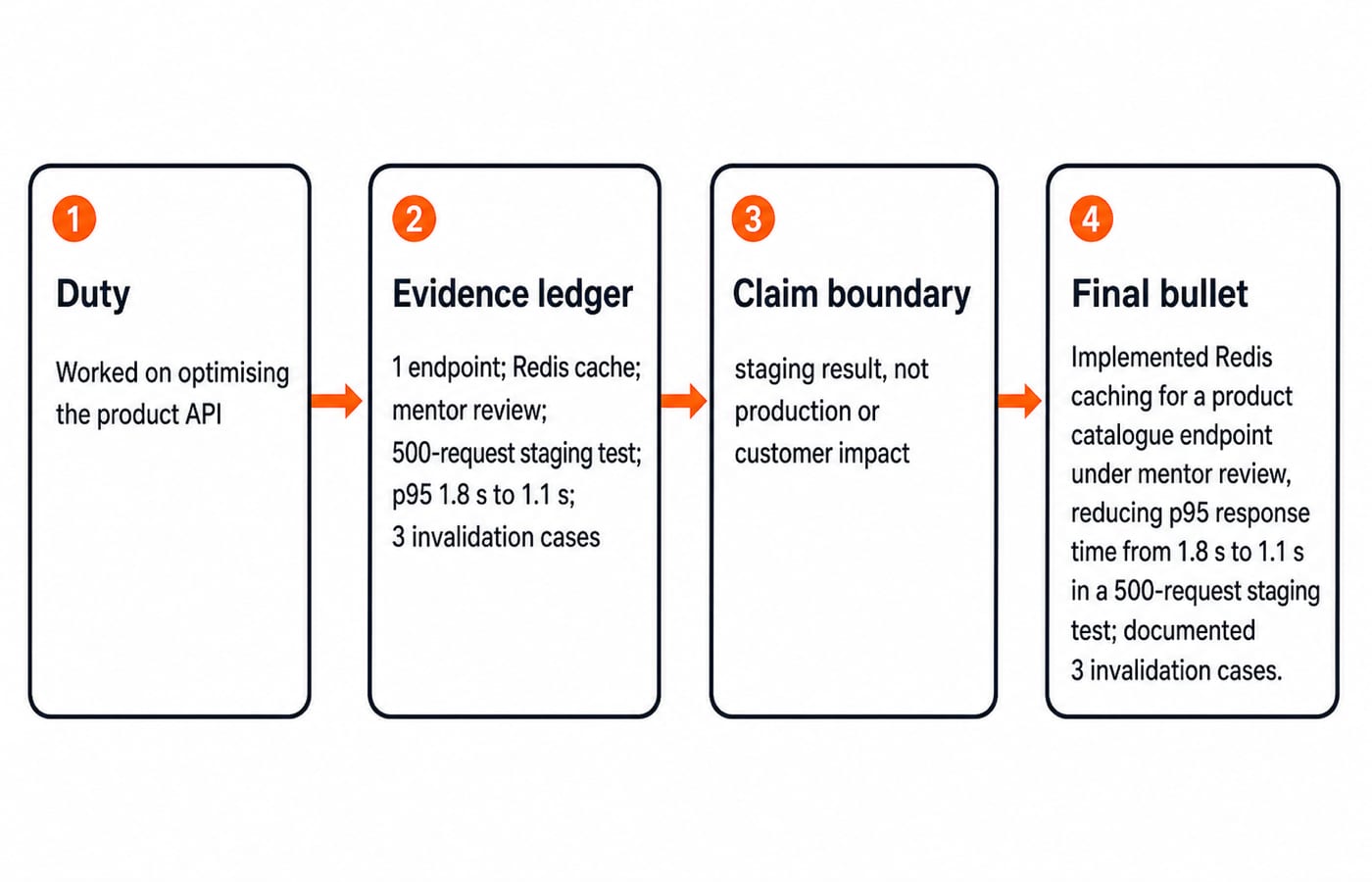
Consider a hypothetical 8-week backend internship and the starting line Worked on optimising the product API. The evidence ledger yields one endpoint, a Redis cache implemented under mentor review, p95 response times of 1.8 s and 1.1 s under the same 500-request staging workload, and 3 documented invalidation cases.
The relative reduction is:
(1.8 - 1.1) / 1.8 x 100 = 38.888...%, rounded to 39%.
You do not have to put that percentage in the bullet. From 1.8 s to 1.1 s preserves the baseline, endpoint statistic and test context, so it is often easier to audit. This remains a staging result, not a production or customer result.
The final bullet is:
Implemented Redis caching for a product catalogue endpoint under mentor review, reducing p95 response time from 1.8 s to 1.1 s in a 500-request staging test; documented 3 invalidation cases.
If the load-test log is missing, use the evidence-limited fallback:
Implemented Redis caching for a product catalogue endpoint under mentor review and documented 3 invalidation cases.
Use output and quality measures when revenue is unavailable
Internship evidence follows a useful ladder: genuine business outcome, product or process outcome, quality or reliability signal, completed output, then non-numeric scope. Do not add currency, users, conversions or percentages merely to sound impressive.
At the lower rungs, your evidence can still be concrete. Verify every number against your own records before using it:
Added 14 regression tests across login and password-reset flows, covering 3 recurring edge cases and catching 2 failures before the weekly release.This shows a quality contribution.Reviewed 240 support tickets over 6 weeks, grouped them into 5 onboarding issues and built a tracker used in 4 weekly reviews.This shows structured analysis and adoption.Migrated 36 internal help articles to the new template and resolved 11 broken links before handover.This shows completed scope.
The phrase used in 4 weekly reviews needs meeting minutes, calendar records or supervisor confirmation. Without that proof, end the bullet after built a tracker.
Match the verb to your real level of ownership
Choose verbs for accuracy, not seniority:
Observed means you shadowed.
Assisted means you performed a supporting task.
Contributed means you completed part of a shared deliverable.
Implemented means you built an assigned component.
Owned means you held end-to-end responsibility.
Led means you directed people or decisions.
Suppose a four-person team produced 18 API tests and the intern authored 6. Reject Led API test automation for 18 cases. Prefer Authored 6 of 18 API regression tests in a four-person team, covering authentication and password-reset error paths. If you also coordinated the test plan and can prove it, state that separately.
Similarly, replace Scaled the platform through Redis optimisation with the bounded cache bullet: one endpoint, mentor review and a staging test. Proportionate scope makes interview follow-ups easier because you can explain the exact decision and trade-off.
Assemble an experience block, not a stack of technologies
For the same hypothetical candidate, the section could read:
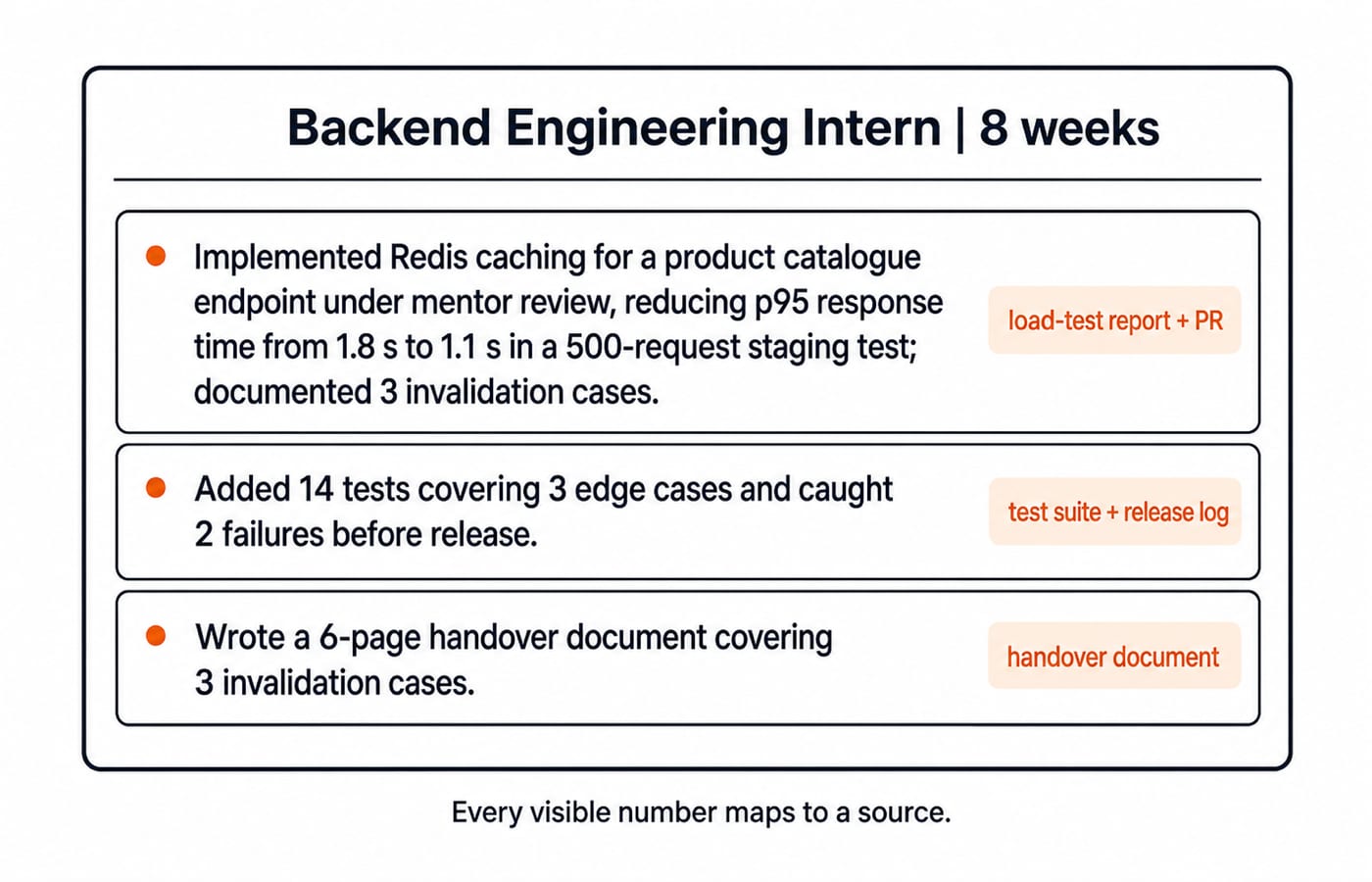
Backend Engineering Intern | 8 weeks
Implemented Redis caching for a product catalogue endpoint under mentor review, reducing p95 response time from 1.8 s to 1.1 s in a 500-request staging test; documented 3 invalidation cases.
Added 14 regression tests across login and password-reset flows, covering 3 recurring edge cases and catching 2 failures before the weekly release.
Wrote a 6-page handover runbook covering deployment, rollback and the 3 cache invalidation cases.
Lead with the contribution closest to the target role, follow with a quality result, and close with a durable handover artifact. Do not add an isolated Redis, APIs, Git and testing bullet when those terms already have context.
For a backend role, retain endpoint, p95, caching and regression-test language only when true. For a QA role, move the 14-test bullet first. Prepare to explain every technical noun and number with the technical interview preparation guide.
Run the recruiter follow-up test and remove common traps
Read each bullet aloud and answer five questions:
What was the baseline?
p95 1.8 s.What exactly changed?
A Redis cache on one catalogue endpoint.How was it measured?
The same 500-request staging test.What did you personally own?
Implementation under mentor review.What limitation should you name?
This was not a production or customer-impact claim.
Then remove five traps. Turn a copied duty into an action. Delete an unsupported 80% improvement. Separate personal contribution from a team result. Give a tool list a deliverable. Replace confidential or incomparable figures with safe, verifiable scope. Never compare average response time before with p95 after, since those are different measures.
Honest scope also prepares you for behavioural questions about teamwork, feedback and responsibility. Use the HR interview questions guide to practise explaining those boundaries.
The short version: rewrite, verify, then get feedback
Run one exact 15-minute pass: spend 4 minutes listing duties and proof, 5 minutes drafting action-scope-constraint-outcome bullets, 4 minutes verifying every noun and number, and 2 minutes reordering the strongest bullets for the target role. Delete or soften any figure that fails verification.
Keep the action personal, scope bounded, metric traceable and claim explainable aloud. The best bullet is not the biggest claim. It is the strongest claim you can defend.
Continue with the Resume & Interview Preparation category for the broader track, or use the Interview & Resume Preparation Course for structured resume building, one-to-one resume review and interview preparation.