

What to Do When You Have No Internship Experience
No internship yet? Turn coursework, projects, volunteering, and other real experience into credible evidence for entry-level roles.
KnowledgeGate Team
Exam prep & CS education
31 Oct 20266 min read

Not having an internship does not mean you have nothing relevant to show an employer. Coursework, personal projects, volunteering, campus responsibilities, part-time work, and independent learning can all help demonstrate skills—if you explain what you actually did and connect it to the role.
The goal is not to make a student project sound like professional employment. It is to build credible evidence of how you learn, solve problems, work with others, and follow through.
Start with the role, not a generic resume
Choose one entry-level job description that genuinely interests you. If you are applying through campus placements, check the official notice for branch, graduation-year, CGPA, backlog, and other eligibility conditions before investing time in a role. Highlight the skills and tasks it asks for, then look for honest examples from your own experience. A software role might ask for programming, debugging, teamwork, or written communication. A support role might value clear explanations, patience, and issue tracking. Different roles need different evidence, so a single generic resume may not show your strongest fit.
Make a two-column list: “What the role asks for” and “Evidence I can show.” Evidence can come from a class assignment, a personal build, a club, a volunteer role, a family business, or paid work outside your field. If you cannot identify evidence for a requirement, treat it as a skill to practise—not a claim to add to your resume.
Turn projects into proof
A project is useful when a reader can understand the problem, your contribution, and the result. You do not need an elaborate app or a large user base. A small, complete project with clear decisions and a working demonstration can be more persuasive than a list of unfinished ideas.
For each project, write down:
The problem: What did you set out to make, analyse, or improve?
Your contribution: Which parts did you personally handle? If it was a team project, distinguish your work from the group’s work.
Your choices: Which tools or concepts did you use, and why?
The result: What works now? What did you test, learn, or change?
The evidence: Can someone inspect a demo, code repository, report, screenshots, or presentation?
For example, “Created a Python expense tracker” is a start. A more informative description might explain that you designed the input flow, stored transactions in a local file, handled invalid entries, and tested the summary with sample data. Include only details you can explain and demonstrate.
LinkedIn’s student career guide encourages students to show relevant skills and the impact of what they created or supported. Its profile guidance on projects also treats projects as a way to describe work you have built. You can use that same principle in a resume, portfolio, or interview: give a specific example, name your contribution, and be ready to discuss the details.
Build one focused project if your evidence is thin
If you have little work to show, choose a small project tied to the jobs you want. Keep the scope realistic enough to finish. For a data role, you might clean and analyse a public dataset, document your method, and explain what the data cannot tell you. For a software role, you might build a simple tool, add input validation, and write a short readme. For a support role, you could create a troubleshooting guide for a common technical issue and ask someone to test whether the steps are clear.
Avoid building a project only because it sounds impressive. Pick something you can finish, test, and explain. Include a short “what I would improve next” section; recognising a limitation shows that you evaluated your work rather than presenting it as perfect.
Count experience broadly, but label it accurately
An internship is one way to gain experience, not the only one. Relevant evidence might include:
A part-time job where you handled customers, schedules, records, or competing tasks.
Volunteer work where you organised an activity, supported a community, or communicated with participants.
A college club or event where you managed a real responsibility.
Research, lab work, coursework, or a capstone project with a clear individual contribution.
Freelance or family-business work, described with the actual client, task, and scope where appropriate.
A competition, hackathon, or open-source contribution, including what you built and what you learned.
Use an accurate label such as “Academic Project,” “Volunteer Experience,” or “Part-time Work.” Do not call a course project an internship, imply that a real company sponsored it when it did not, or claim a team outcome as your individual result. LinkedIn’s Experience section rules explain that professional associations should be labelled accurately. That is a useful standard for resumes and profiles too.
Make a portfolio simple to review
A clean document or public repository is enough if it makes your best work easy to find. For each item, include your role, tools, outcome, and a link to a demo or report. Test links while signed out, remove secrets and personal data, and choose two or three relevant examples rather than listing every assignment. If work cannot be shared, describe it without exposing confidential details.
Write resume bullets that are concrete and truthful
Use a simple structure: action + task + method or tool + outcome/evidence. The outcome does not have to be a percentage. It can be a working feature, a documented analysis, a test suite, a completed event, or a clear deliverable.
Weak: “Hardworking student with excellent technical skills.”
Stronger: “Built a course timetable planner in Java, added checks for overlapping classes, and tested it with sample schedules.”
The second version gives an interviewer something specific to ask about. Do not invent metrics, inflate your role, or add keywords for tools you have only heard of. Indeed’s guide to resumes with no experience offers another useful checklist for presenting education, skills, and relevant activities when you are at the beginning of your career.
Answer the internship question with confidence
If an interviewer asks why you have no internship, answer directly without apologising or inventing an excuse. Briefly explain what you focused on, name one relevant piece of work, and connect it to what you want to learn in the role. For example, adapt this template with your real details:
I did not complete an internship during college. I used that time to work on [project, coursework, or responsibility], where I learned [specific skill]. I can walk you through my contribution and what I would improve next. I’m now looking for an opportunity to apply that foundation on a team.
Only use details you can support. If circumstances shaped your availability, share only what you are comfortable discussing; you do not owe an interviewer private personal information.
Find opportunities to practise with real feedback
Ask a professor, senior student, mentor, or peer to review one project and one resume bullet. Give them the job description and ask concrete questions: Is my contribution clear? What would you ask me in an interview? Which part needs more evidence? A focused review is more useful than asking whether the resume “looks good.”
You can also look for campus projects, research assistant roles, volunteering, open-source contributions, or short-term work that fits your schedule and interests. Before accepting a role, clarify its responsibilities, time commitment, supervision, and any conditions. Choose opportunities where you will learn or produce work you can discuss—not just a title to add to your profile.
Make your next step small and specific
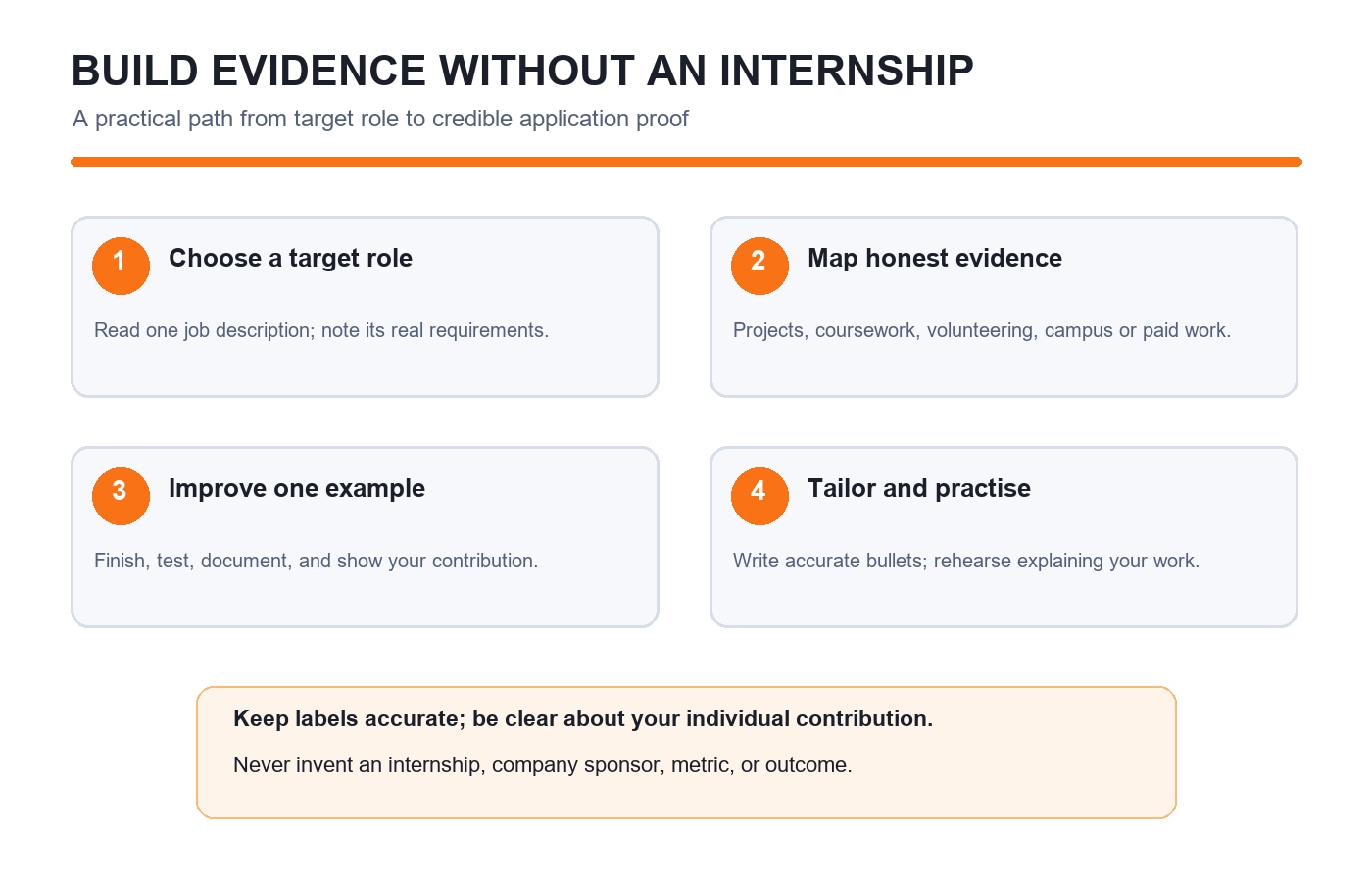
Choose one target role, map its requirements to evidence you already have, and improve one example. Update your resume and practise explaining your contribution aloud.
KnowledgeGate’s Interview & Resume Preparation course can help you prepare your application, and the Computer Science Fundamentals for Placements course can support your technical revision. For more on demonstrating relevant strengths, read AI Is Changing Campus Hiring: How Students Can Show Their Skills.
You do not need to disguise the fact that you are new to the workforce. Show what you have done, explain what you learned, and make your next step visible. That gives an employer a fair basis to judge your potential—and gives you a stronger starting point for the conversation.
Keep learning

How to Use AI in Your Job Search Without Losing Your Own Voice
Use AI to explore job roles, refine applications, and practise interviews while keeping your claims truthful, your voice natural, and your choices your own.
Updated 31 Oct 20266 min readPlacement Preparation

How to Compare Job Offers Beyond Salary
Compare job offers using dependable pay, benefits, learning, work expectations, flexibility, and your own career priorities—not just the headline salary.
Updated 31 Oct 20266 min readPlacement Preparation

Which Skill Sets Are in Demand for Tech Jobs?
Explore the technical and human skill combinations showing up across software, AI, data, cloud, and security roles, and how students can prove them with focused projects.
Updated 31 Oct 20265 min readPlacement Preparation
AI Is Changing Campus Hiring: How Students Can Show Their Skills
Make your technical skills visible in AI-assisted campus hiring with clear resume evidence, one explainable project, and a practical interview routine.
Updated 30 Oct 20265 min read53 viewsPlacement Preparation