ctype.h Functions in C: Classify Characters and Convert Case Safely
Learn which character test to choose, trace a complete C classifier, and avoid signed-char and EOF mistakes. Worked examples separate classification from case conversion.
KnowledgeGate Team
Exam prep & CS education
Updated 5 Oct 20266 min read
Checking whether input contains letters, digits or spaces can quickly turn into a pile of fragile character comparisons. The <ctype.h> library gives you named tests, but you must understand their inputs and results. We will build a compact function map, classify every character in "Az9 !\t\n", and handle string bytes and stream input safely. Classification asks what a character is; case conversion returns a character value.
What ctype.h tests, and what its return values mean
Include the header before using its functions. Two representative declarations are:
#include <ctype.h>
int isalpha(int c);
int toupper(int c);
A classification function, or predicate, returns zero for false and nonzero for true. True need not be exactly 1. A conversion function returns a character value as an int.
Compare these normalised results:
Expression | Result | Reason |
|---|---|---|
| 1 | A is a letter |
| 0 | A is not a digit |
| 1 | 9 is a digit character |
The character constant '9' differs from the integer 9. All examples use the default "C" locale. Arguments must be representable as unsigned char, or equal EOF; we apply that rule below. Character handling connects naturally with the array and input fundamentals in C Programming & Data Structures.
A practical map of classification functions
Choose the property you actually need. These functions test individual character values:
Purpose | Functions | Meaning in the C locale |
|---|---|---|
Letters and digits |
| Letter; decimal digit; either |
Letter case |
| Lowercase; uppercase |
Spacing |
| Whitespace; space or horizontal tab |
Punctuation |
| Printing character other than space, letter or digit |
Hexadecimal |
| One of 0–9, A–F or a–f |
Control |
| Control character, such as tab or newline |
Visibility |
| Printable including space; printable excluding space |
isblank is available from C99. In the C locale, isspace recognises space, horizontal tab, newline, carriage return, form feed and vertical tab.
The tests overlap. 'A' is alphabetic, uppercase, alphanumeric and hexadecimal. '9' is both a decimal digit and hexadecimal. '!' is punctuation, printable and graphical.
A space is whitespace, blank and printable, but not graphical. Tab is whitespace, blank and control. Newline is whitespace and control, but neither blank nor printable.
Therefore, several predicates can accept the same character. The classifier below creates mutually exclusive categories through its if/else if chain, not because every library test describes a separate group.
Convert case with toupper and tolower
Conversion returns the mapped value, or the original value if no conversion applies:
printf("%c %c %c\n", toupper('a'), tolower('Z'), toupper('9'));
/* Output: A z 9 */
Use %c to print characters instead of relying on ASCII numbers. Consider:
char c = 'a';
int upper = toupper((unsigned char)c);
Here, c remains 'a'; upper represents 'A'. A function call does not assign its result back to the argument. To update this variable, write c = (char)upper;.
Subtracting 32 is not a portable general conversion rule: it assumes an encoding relationship and ignores whether the input needs conversion. These functions operate on individual byte character values. They neither convert an entire string automatically nor provide general UTF-8 or Unicode case conversion. Locale-sensitive behaviour does not change that limitation.
Worked example: classify every character in a string
This complete program counts letters, digits, whitespace and everything else:
#include <ctype.h>
#include <stdio.h>

int main(void)
{
    const char text[] = "Az9 !\t\n";
    int letters = 0, digits = 0, spaces = 0, other = 0;

    for (size_t i = 0; text[i] != '\0'; ++i) {
        unsigned char c = (unsigned char)text[i];
        if (isalpha(c)) {
            ++letters;
        } else if (isdigit(c)) {
            ++digits;
        } else if (isspace(c)) {
            ++spaces;
        } else {
            ++other;
        }
    }

    printf("letters=%d digits=%d whitespace=%d other=%d\n",
           letters, digits, spaces, other);
    return 0;
}
Despite its name, spaces counts all whitespace, including tab and newline. Each iteration increments exactly one counter. Starting from (0,0,0,0), track the tuple (letters,digits,spaces,other):
Index | Character | Selected category | Counters after processing |
|---|---|---|---|
0 |
| Letter |
|
1 |
| Letter |
|
2 |
| Digit |
|
3 |
| Whitespace |
|
4 |
| Other |
|
5 |
| Whitespace |
|
6 |
| Whitespace |
|
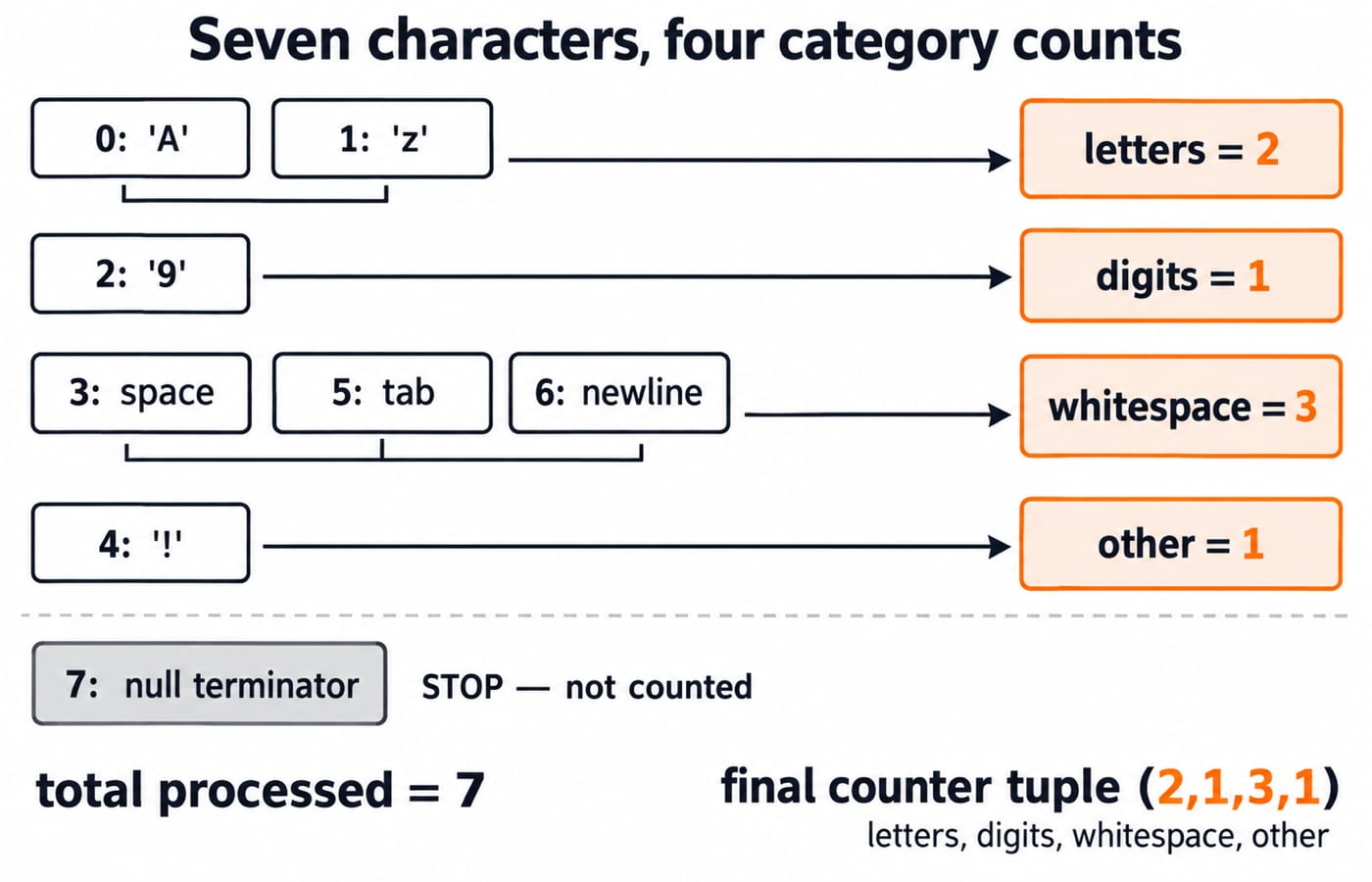
Index 7 contains the terminating '\0'. The loop stops before classifying it. For more on traversing character arrays and finding that boundary, read Character Pointers in C: Memory Traces and Exam Traps.
The output is:
letters=2 digits=1 whitespace=3 other=1Check the total: 2 + 1 = 3, 3 + 3 = 6, and 6 + 1 = 7 processed characters. The escape sequences \t and \n each represent one character, despite using two symbols in the source. The terminating null occupies an additional array element but contributes to none of the counts.
Avoid signed-char and EOF mistakes
For arbitrary stored bytes, isalpha(text[i]) can be unsafe when plain char is signed. A negative argument other than EOF violates the function's argument domain and causes undefined behaviour. Use isalpha((unsigned char)text[i]).
Assume an implementation with 8-bit signed plain char and EOF == -1. If a stored byte has value -23, converting it to unsigned char gives -23 + 256 = 233, a permitted argument. This fixes the range; it does not promise that 233 is a letter or decode a UTF-8 code point.
Stream input starts differently. Preserve the int returned by getchar:
int ch;
while ((ch = getchar()) != EOF) {
    if (isdigit(ch)) {
        /* digit */
    }
}
Check for EOF before classification. Do not first narrow the result to char or unsigned char, because that can lose the end-of-file distinction. EOF is not guaranteed to equal -1 on every implementation.
Another common bug is isalpha(c) == 1. For a valid argument, use if (isalpha(c)); any nonzero result means true. If you later replace the fixed string with fgets input, remember that a retained newline also increments the whitespace counter.
How exam-style questions test these rules
These are original practice checks. Predict:
printf("%d %d %c", isdigit('7') != 0, isalpha('7') != 0, toupper('b'));The output is 1 0 B. The digit test supplies 1, the alphabetic test supplies 0, and the conversion supplies B.
Two quick checks: isblank('\n') is false in the C locale, whereas isspace('\n') is true. Also, toupper('!') leaves the punctuation unchanged.
Now debug this:
char c = 'a';
toupper(c);
printf("%c", c);
It prints a because the conversion result was discarded. Replace the middle statement with c = (char)toupper((unsigned char)c); and this input prints A. Trace the assignment separately from the conversion call.
The legal argument domain and zero/nonzero convention are specified in section 7.4 of WG14's N1570 committee draft, dated 12 April 2011. That language reference settles these practice answers; it is not an exam syllabus.
The short version and your next exercise
Make three decisions correctly: choose a predicate or conversion, supply a valid byte value while preserving stream EOF, and test classification results for nonzero.
Rerun the classifier on "B4? ". B adds one letter, 4 one digit, ? one other character, and the trailing space one whitespace character. Expect letters=1 digits=1 whitespace=1 other=1, with 1 + 1 + 1 + 1 = 4 characters processed.
For structured study beyond this exercise, the C Language Course is an optional next step for building your broader C fundamentals.
Keep learning
Key Features of the C Programming Language: Code Examples
What do C's features actually do in a program? Follow an even-number sum and a pointer update, then test your understanding with small code changes.
Updated 30 Sep 20266 min readC
Preprocessor and Macros in C: Expansion Rules and Worked Examples
Learn what happens before C compilation, expand object-like and function-like macros by hand, and avoid precedence and repeated-evaluation bugs.
Updated 18 Sep 20266 min readC
Variables and Data Types in C: Declarations, Conversions and Runnable Examples
Learn how C types control stored values, expressions and I/O. Compile a complete marks program, trace its conversions and repair common type mistakes.
Updated 17 Sep 20266 min readC
Unions in C: Syntax, Shared Memory and Worked Examples
A C union reuses one storage region for alternative member types, while a separate enum tag keeps each payload read consistent. Safe member switching prevents stale reads, layout mistakes, and character-array errors.
Updated 15 Sep 20265 min readC