

RBI Assistant Eligibility: Age, Degree and Selection Stages
Graduation is only one eligibility check. Use worked age and percentage examples to audit your evidence, then understand prelims, mains and the language requirement.
KnowledgeGate Team
Exam prep & CS education
Updated 6 Nov 20265 min read

Graduation is only one part of RBI Assistant eligibility. Check the notification's age reference date, degree evidence and office language before you plan for the prelims, mains and Language Proficiency Test. RBI's Panel Year 2025 notice was published in February 2026, so the panel label and publication year are different.
Read the right RBI Assistant notice before checking eligibility
Reference notice:RBI's Assistant recruitment notice for Panel Year 2025, dated 16 February 2026. Read it with its linked corrigenda and use the applicable notice for your recruitment cycle.
RBI Grade B uses a different cadre, stream-specific qualification route and Phase I, Phase II and interview sequence; this page focuses on RBI Assistant's age, degree, office-language and prelims-mains-LPT checks. Compare the separate RBI Grade B eligibility and selection process when you are assessing that role.
Create a worksheet with three columns: “condition”, “my evidence” and “needs clarification”. Check notice identity, nationality, age, degree, office language and selection conditions in that order.
Section 2.1 covers nationality and certificate-of-eligibility requirements. Read your exact clause: different nationality categories need not have identical paperwork. You can explore Banking, Insurance & Regulatory Exams hub, but eligibility comes from RBI's notice.
Check age using the notification's birth-date window
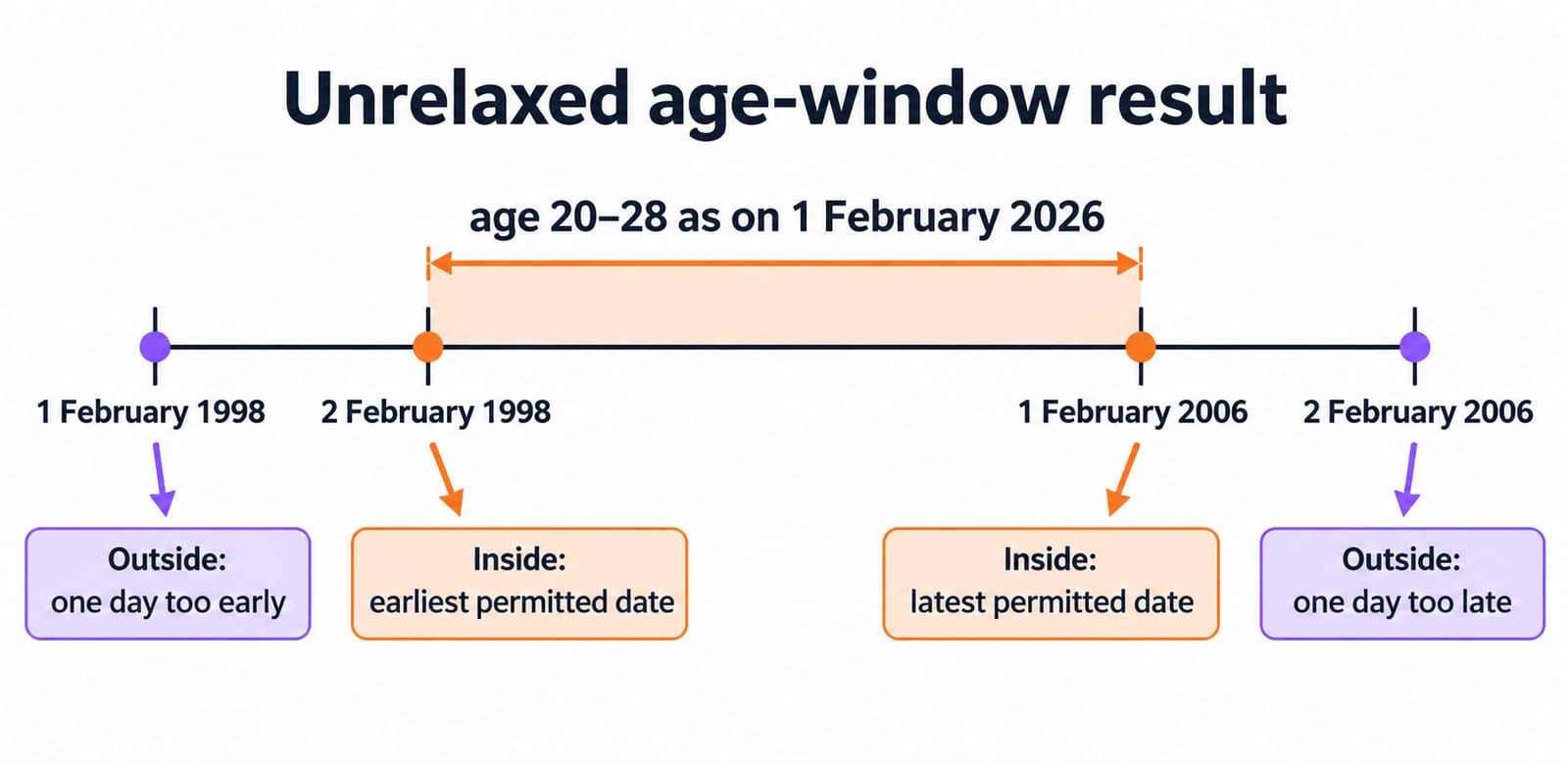
Section 2.2 of the February 2026 notice specified age 20–28 as on 1 February 2026. Its unrelaxed birth-date window was 2 February 1998 to 1 February 2006, inclusive.
Compare the complete date of birth with both endpoints:
Candidate | Date of birth | Unrelaxed age-window result |
|---|---|---|
A | 2 February 1998 | Inside: earliest permitted date |
B | 1 February 1998 | Outside: one day too early |
C | 1 February 2006 | Inside: latest permitted date |
D | 2 February 2006 | Outside: one day too late |
These results concern age alone. Today's age answers the wrong question, while subtracting birth years ignores whether a birthday has occurred at the reference date.
The same section permits upper-age relaxations, including five years for SC/ST and three for OBC, and disallows cumulative relaxation. The OBC illustration is 28 + 3 = 31 years, conditional on eligibility and documentation. Consult the full table for other cases; do not add several concessions together.
Verify graduation, aggregate marks and computer skills
Section 2.3 of the February 2026 notice required a bachelor's degree in any discipline with at least 50% aggregate marks, or pass class for SC/ST/PwBD candidates, plus knowledge of word processing on a PC. The qualification reference date was 1 February 2026. Read the original clause for special ex-servicemen provisions.
Suppose a university calculates aggregate percentage using total obtained marks divided by total maximum marks:
1,530 out of 3,000: 1,530 ÷ 3,000 = 0.51; 0.51 × 100 = 51%. This meets the general marks threshold only.
1,497 out of 3,000: 1,497 ÷ 3,000 = 0.499; 0.499 × 100 = 49.9%. This falls below that threshold. Do not round it up to manufacture eligibility.
Use your recognised institution's aggregation or CGPA-conversion method and the notification. Result timing and supporting records remain separate checks.
Comparing applications? Read SBI Clerk graduation and language checks, but do not transfer another employer's thresholds or language exemptions to RBI.
Choose the office with its language requirement in mind
Use the February 2026 notice's office/language provisions to copy your chosen office and its listed language into the worksheet. Do not infer the requirement from geography or assume your mother tongue settles it.
Try this diagnostic: read a 120-word passage in that language, write a 60-word summary and explain it aloud for 60 seconds.
If speaking feels easy but writing stalls after 15 words, record writing as the gap. Practise forming complete sentences and summarising accurately, then repeat the exercise with a fresh passage. Familiarity and usable proficiency are different things.
Understand what each selection stage decides
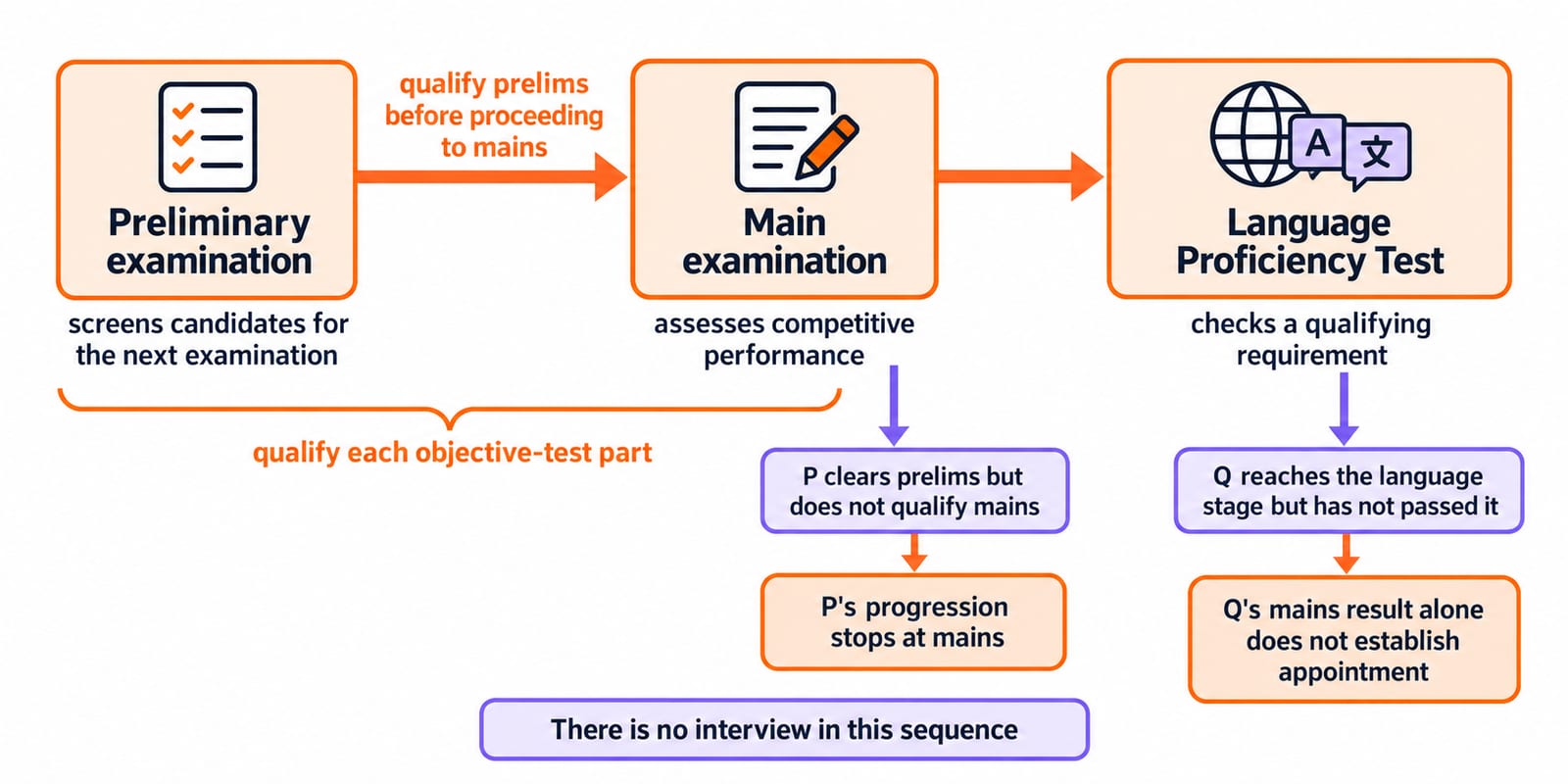
Section 3 of the February 2026 notice sets out the sequence: Preliminary examination → Main examination → Language Proficiency Test.
Prelims screens candidates for the next examination. Mains assesses competitive performance. The language stage checks a qualifying requirement. The same section requires candidates to qualify each objective-test part and qualify prelims before proceeding to mains. There is no interview in this sequence.
Consider two examples:
Candidate P clears prelims but does not qualify mains. P's progression stops at mains; clearing the earlier stage cannot compensate.
Candidate Q reaches the language stage but has not passed it. Q's mains result alone does not establish appointment.
Keep progression and final appointment separate in your planning. After each result, identify the next condition still outstanding. Predicting a cutoff is less useful at this point than understanding which requirement must be met before you can proceed.
Treat language proficiency and document checks as selection requirements
Under section 3 of the February 2026 notice, LPT is mandatory without exemption. Final selection also depends on medical fitness and satisfactory certificate verification. A school-language certificate does not create an exemption under these rules.
Organise an evidence folder containing:
Date-of-birth proof.
Qualification and result records.
Applicable category and age-relaxation evidence.
Identity records, checked for consistent names and details.
Resolve discrepancies while you have time to obtain the correct records.
For transferable reading, writing and speaking exercises, use these local-language practice ideas. Keep that article's IBPS-specific rules separate from RBI's requirements; borrow the practice approach, not its exemption policy.
Finish the eligibility audit, then prepare the gaps
Mark every worksheet row “evidence ready”, “needs document” or “rule needs checking”. Resolve the last two states before treating yourself as eligible. Only RBI determines eligibility.
After the audit, try a simple study block: 25 minutes each for numerical ability, reasoning and English. 3 × 25 = 75 minutes of practice; add 15 minutes to review errors, giving 75 + 15 = 90 minutes overall.
The IBPS Clerk CSA prelims course for overlapping fundamentals is an optional IBPS resource covering these foundations. Compare its displayed curriculum with your RBI preparation needs before choosing it.
Complete the evidence worksheet, then choose your weakest foundation for the next session.
Keep learning

RBI Grade B Eligibility and Selection Process: Age, Qualifications and Stages
Check your RBI Grade B General Cadre eligibility in the right order: stream, age, qualification and previous appearances. Worked examples explain the boundaries before you plan for each selection stage.
Updated 29 Oct 20265 min readBanking Exams
IBPS RRB PO Eligibility and Selection Process: Age, Degree, Language and Stages
Use this dated checklist to test age, graduation and local-language eligibility for RRB Officer Scale-I, then understand how prelims, mains, interview and allotment connect.
Updated 30 Oct 20265 min readIBPS Exams

HPSC PGT Computer Science Eligibility 2026: Degree, HTET and Age Rules, Explained
Check your degree route, teaching qualification, HTET status and age against the HPSC advertisement before you invest time in the application or subject preparation.
Updated 29 Oct 20265 min read401 viewsTeaching Recruitment (Computer Science)
IBPS PO Eligibility: Graduation, Age Limit and Document Checklist
Check IBPS PO eligibility as a chain of dated tests: graduation result, age window, category proof and documents that match every application entry.
Updated 30 Oct 20265 min readIBPS Exams