

RBI Assistant Syllabus: What to Study in Each Section
Turn RBI Assistant section names into a practical study checklist. Work through arithmetic, reasoning, English and computer examples, then plan awareness revision and local-language practice.
KnowledgeGate Team
Exam prep & CS education
Updated 4 Nov 20264 min read

A list of section names leaves tomorrow's practice unclear. Use the RBI Assistant syllabus as a topic map, then test each gap with a short example or retrieval check.
Read the RBI Assistant syllabus as a stage-and-skill map
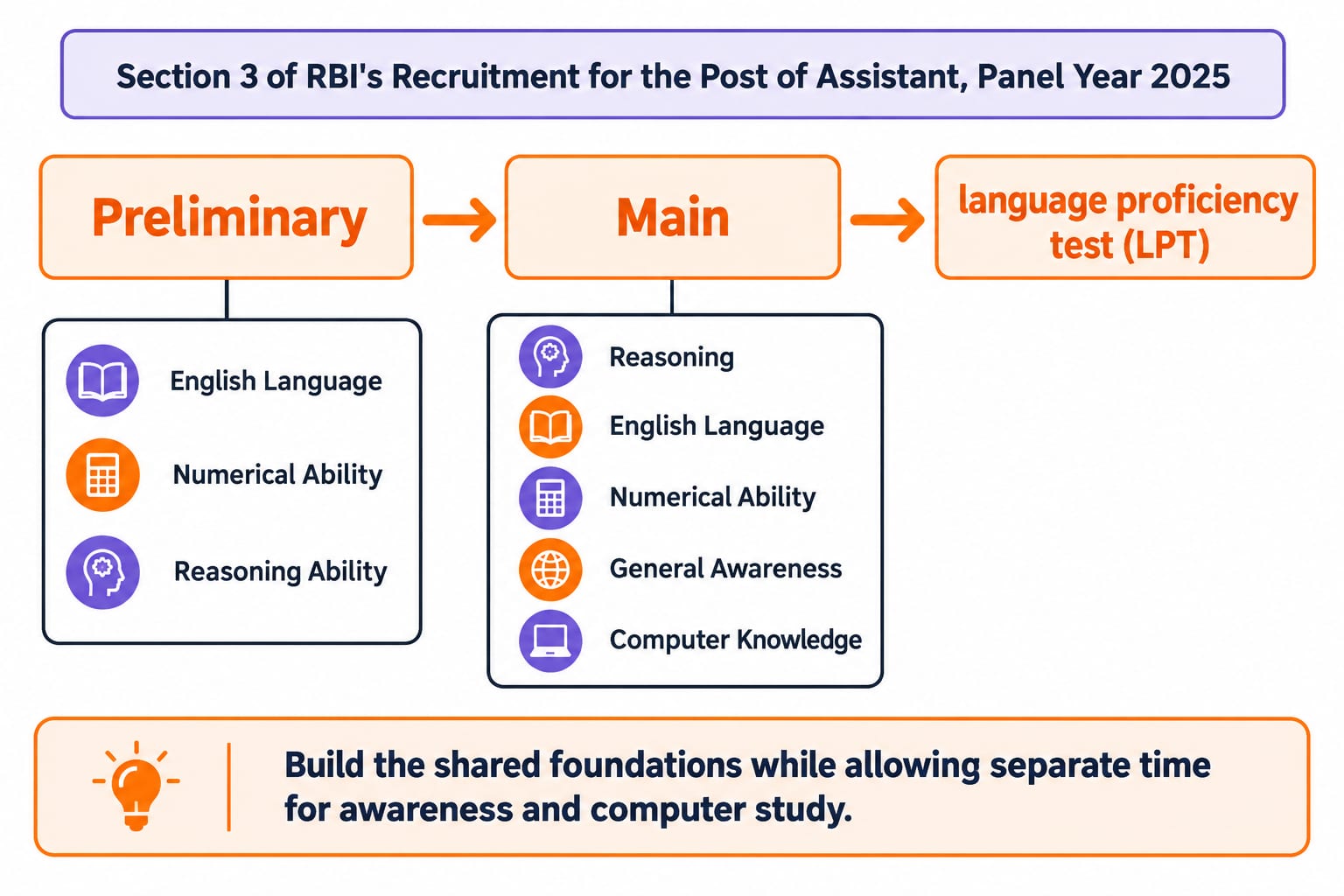
Section 3 of RBI's Recruitment for the Post of Assistant, Panel Year 2025 specifies preliminary and main examinations followed by a language proficiency test (LPT). Its examination sections provide this framework:
Stage | Sections |
|---|---|
Preliminary | English Language, Numerical Ability, Reasoning Ability |
Main | Reasoning, English Language, Numerical Ability, General Awareness, Computer Knowledge |
Build the shared foundations while allowing separate time for awareness and computer study. The broader banking and insurance preparation category helps you locate related study options. For the RBI Grade B phase-and-subject map, see the RBI Grade B syllabus guide; this post stays with RBI Assistant Preliminary/Main sections and the language proficiency test.
Numerical Ability: arithmetic before timed data interpretation
Start with calculation accuracy and simplification, then arithmetic, then data interpretation. Practise fractions, percentages, ratios, averages, profit and loss, interest, time and work, and speed and distance. Before applying a shortcut, identify the quantity that forms the base.
Consider this table of applications processed:
Office | January | February |
|---|---|---|
North | 144 | 180 |
South | 96 | 120 |
For the North office, the increase is 180 - 144 = 36. Percentage increase uses January's value: 36/144 x 100 = 25%.
January's total is 144 + 96 = 240. February's total is 180 + 120 = 300. The total increase is 300 - 240 = 60, so total growth is 60/240 x 100 = 25%.
Dividing the North increase by 180 gives 36/180 x 100 = 20%, which uses the wrong base. Write 'original value' beside the denominator until this becomes automatic.
Use arithmetic foundations before speed to strengthen this habit. Redo an incorrect calculation untimed before repeating it under a timer you choose.
Reasoning: translate clues before trying to solve a puzzle
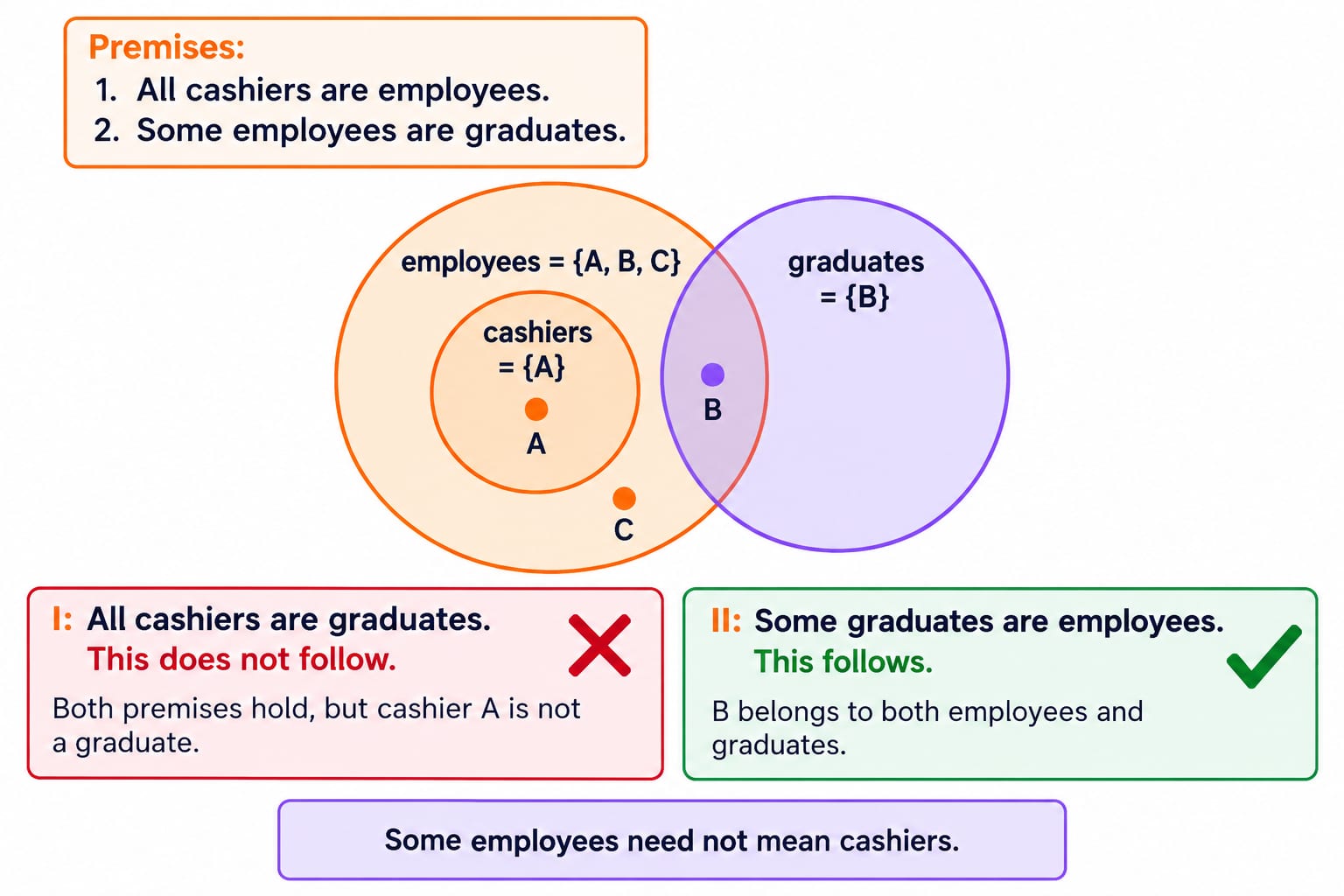
Organise practice into puzzles, seating arrangements, syllogisms and coding-decoding. Write each constraint before combining clues. For conclusions, ask whether the premises force the answer or merely allow it.
Take this syllogism: "All cashiers are employees. Some employees are graduates." Test two conclusions:
I: All cashiers are graduates. This does not follow.
II: Some graduates are employees. This follows.
To check I, construct employees = {A, B, C}, cashiers = {A}, and graduates = {B}. Both premises hold, but cashier A is not a graduate. One valid counterexample disproves the claim that I must follow.
For II, B belongs to both employees and graduates, demonstrating the overlap stated in the premise. "Some employees" need not mean cashiers.
In your error log, distinguish mistranslating a clue, reversing a statement and adding an assumption.
English Language: connect grammar with reading
Bring reading comprehension, grammar, cloze tests and error spotting into one loop: read for meaning, identify sentence structure, then select the form or word that fits. Learn vocabulary through sentences so that you remember usage alongside meaning.
Consider the sentence: "The list of documents are on the desk." The subject head is list, which is singular. "Of documents" modifies it. The correct sentence is: "The list of documents is on the desk."
Compare "The documents are on the desk." Here, "documents" is the subject. Agreement follows the subject, not simply the nearest noun.
For reading practice, take "The branch extended opening hours after customer requests." The requests preceded the change. Identify this sequence of events before drawing a conclusion about cause and effect.
General Awareness: organise facts so that you can retrieve them
For the main-exam awareness section, use a dated retrieval ledger with three columns: the fact, its primary source, and the implication you can explain.
For each development, record its date, institution, decision, one-sentence meaning, primary source and revision date. Keeping the date beside the fact helps you distinguish an earlier decision from a later update. During revision, hide the implication and try to reproduce it before checking the source.
Check your understanding: "Is a recurring deposit a borrowing facility or a deposit product?" It is a deposit product involving regular deposits. Recognising the abbreviation "RD" is insufficient if you cannot explain the underlying product.
Computer Knowledge: practise distinctions and small tasks
Cover hardware versus software, operating systems, memory and storage, office tools, basic networks and safe account use. Turn each label into something you can distinguish or demonstrate.
In a spreadsheet, B2 = 120, B3 = 80 and B4 = 50. The formula =SUM(B2:B4) adds the inclusive range: 120 + 80 = 200, then 200 + 50 = 250. Practise interpreting formulas by identifying the cells included and calculating the result.
Similarly, RAM holds active working data, while an SSD stores files persistently. Explain the difference in your own words, then use the computer-awareness revision guide for fuller practice.
Turn the map into a weekly checklist, including language practice
Build a seven-day rotation: two Numerical Ability sessions, two Reasoning sessions, two English sessions, one awareness review, one Computer Knowledge block, one local-language passage, and one error-log review. Give every session a written output, such as a corrected calculation or a five-sentence summary.
If you miss a session, move only its output to the next available slot and keep the error-log review. Doubling tomorrow's load usually reduces accuracy and hides the original gap.
For the LPT, verify the language applicable to the recruiting office in the notice. Read a short passage aloud, summarise it and write five sentences.
Choose your weakest shared foundation before the next practice set. The IBPS Clerk CSA Prelims course supports overlapping English, numerical and reasoning skills.
Keep learning

RBI Assistant Exam Pattern: Section Timings and Negative Marking
Understand the RBI Assistant section budgets and see how wrong answers change a practice score. Use the worked examples to plan timed practice, review mistakes and prepare separately for language proficiency.
Updated 7 Nov 20264 min readBanking Exams

RBI Assistant Eligibility: Age, Degree and Selection Stages
Graduation is only one eligibility check. Use worked age and percentage examples to audit your evidence, then understand prelims, mains and the language requirement.
Updated 6 Nov 20265 min readBanking Exams

RBI Grade B Previous Year Analysis: Recurring Topics and Study Priorities
Use recurring topic families to choose what to revise, then let your errors decide the time allocation. Work through DI, reasoning and reading examples before building a practical weekly plan.
Updated 30 Oct 20265 min readBanking Exams

IISc Administrative Assistant Preparation: A Section-wise Study Plan for the Written Test
Build on familiar SSC and banking material instead of searching for secret IISc notes. Follow a practical eight-week cycle that survives missed days.
Updated 30 Oct 20266 min readAptitude & Reasoning