

RBI Assistant Exam Pattern: Section Timings and Negative Marking
Understand the RBI Assistant section budgets and see how wrong answers change a practice score. Use the worked examples to plan timed practice, review mistakes and prepare separately for language proficiency.
KnowledgeGate Team
Exam prep & CS education
Updated 7 Nov 20264 min read

RBI Assistant preparation has two separate timing problems: each prelims section has its own clock, and a wrong answer can reduce the net score. The section budgets, quarter-mark penalty, two illustrative scores and a mock-review routine turn those rules into the next practice drill.
The applicable RBI notice, corrigenda and information handout control the rules for your examination; check them before setting your practice timers.
Where prelims, mains and the language test fit
The cited RBI notice sets out the sequence: prelims, mains, then a Language Proficiency Test (LPT). Prelims preparation builds speed and accuracy in the initial subjects. Mains requires broader preparation, while the LPT checks proficiency in the relevant local language.
Qualification in each objective test matters. A strong total does not make a neglected section harmless, so review your performance section by section.
For broader resources, explore banking and insurance preparation.
RBI Assistant prelims: three separately timed sections
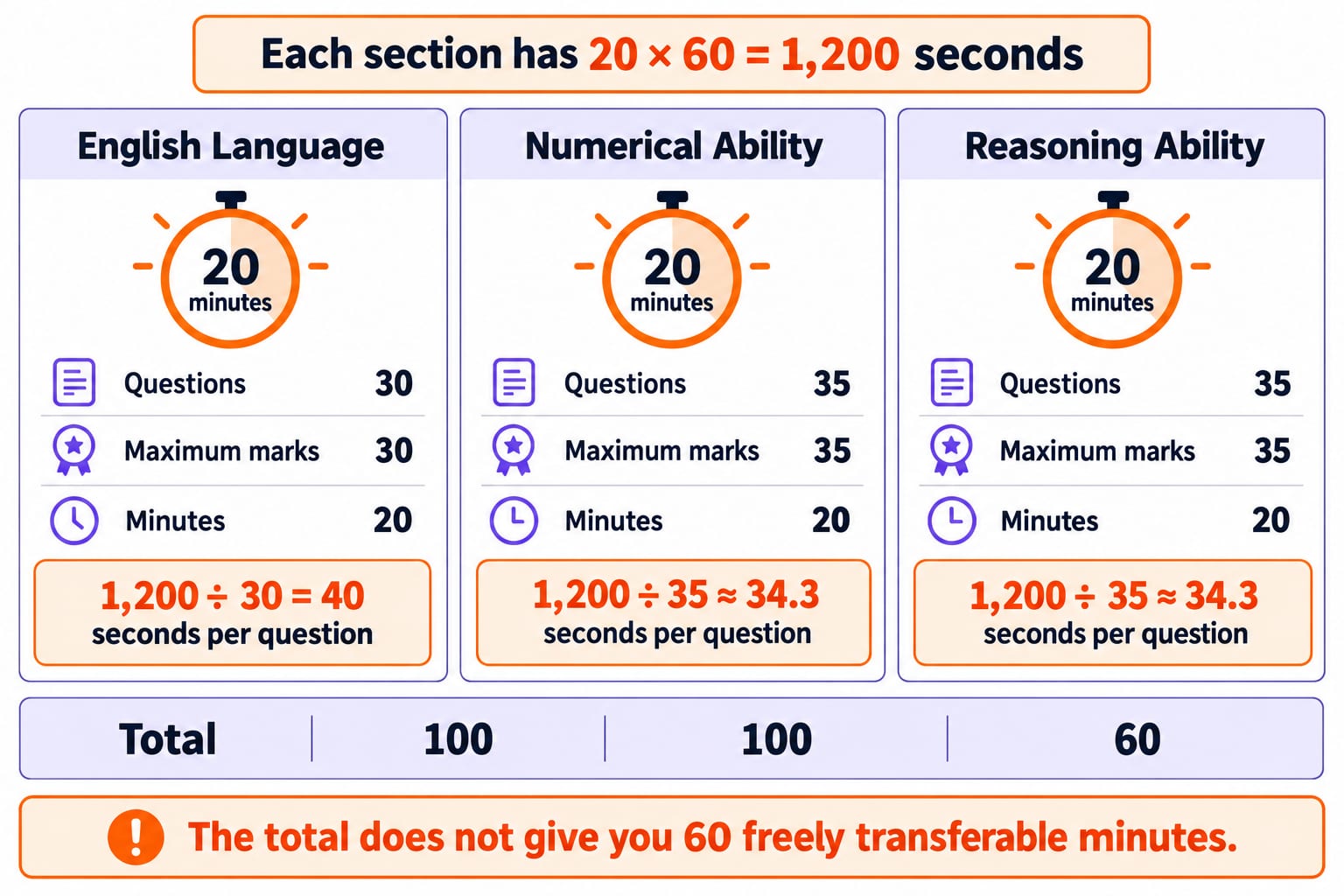
Section 3 of the RBI Assistant Panel Year 2025 recruitment notice, dated 16 February 2026, supplies both pattern tables below and the marking and language-test rules discussed here. These are its standard timings; applicable accommodations follow RBI instructions.
Section | Questions | Maximum marks | Minutes |
|---|---|---|---|
English Language | 30 | 30 | 20 |
Numerical Ability | 35 | 35 | 20 |
Reasoning Ability | 35 | 35 | 20 |
Total | 100 | 100 | 60 |
Each section has 20 x 60 = 1,200 seconds. English therefore averages 1,200 / 30 = 40 seconds per question. Numerical Ability and Reasoning each average 1,200 / 35 about 34.3 seconds per question.
Practise with separate budgets: the total does not give you 60 freely transferable minutes.
Mains: more sections and different time budgets
The same notice specifies this mains structure:
Section | Questions | Maximum marks | Minutes |
|---|---|---|---|
Reasoning | 40 | 40 | 30 |
English Language | 40 | 40 | 30 |
Numerical Ability | 40 | 40 | 30 |
General Awareness | 40 | 40 | 25 |
Computer Knowledge | 40 | 40 | 20 |
Total | 200 | 200 | 135 |
Equal marks do not mean equal time. As a planning comparison, Computer Knowledge provides 20 x 60 = 1,200 seconds, or 1,200 / 40 = 30 seconds per question. Reasoning provides 30 x 60 = 1,800 seconds, or 1,800 / 40 = 45 seconds per question.
Include knowledge-recall practice alongside calculation and reasoning. When reviewing a recall question, identify what you did not know instead of treating every delay as a speed problem.
The RBI Grade B exam pattern and marking scheme article covers Phase I, Phase II and final-merit treatment. This page focuses on RBI Assistant's three separately timed prelims sections, five mains sections and the Language Proficiency Test.
Negative marking: calculate net score, not just attempts
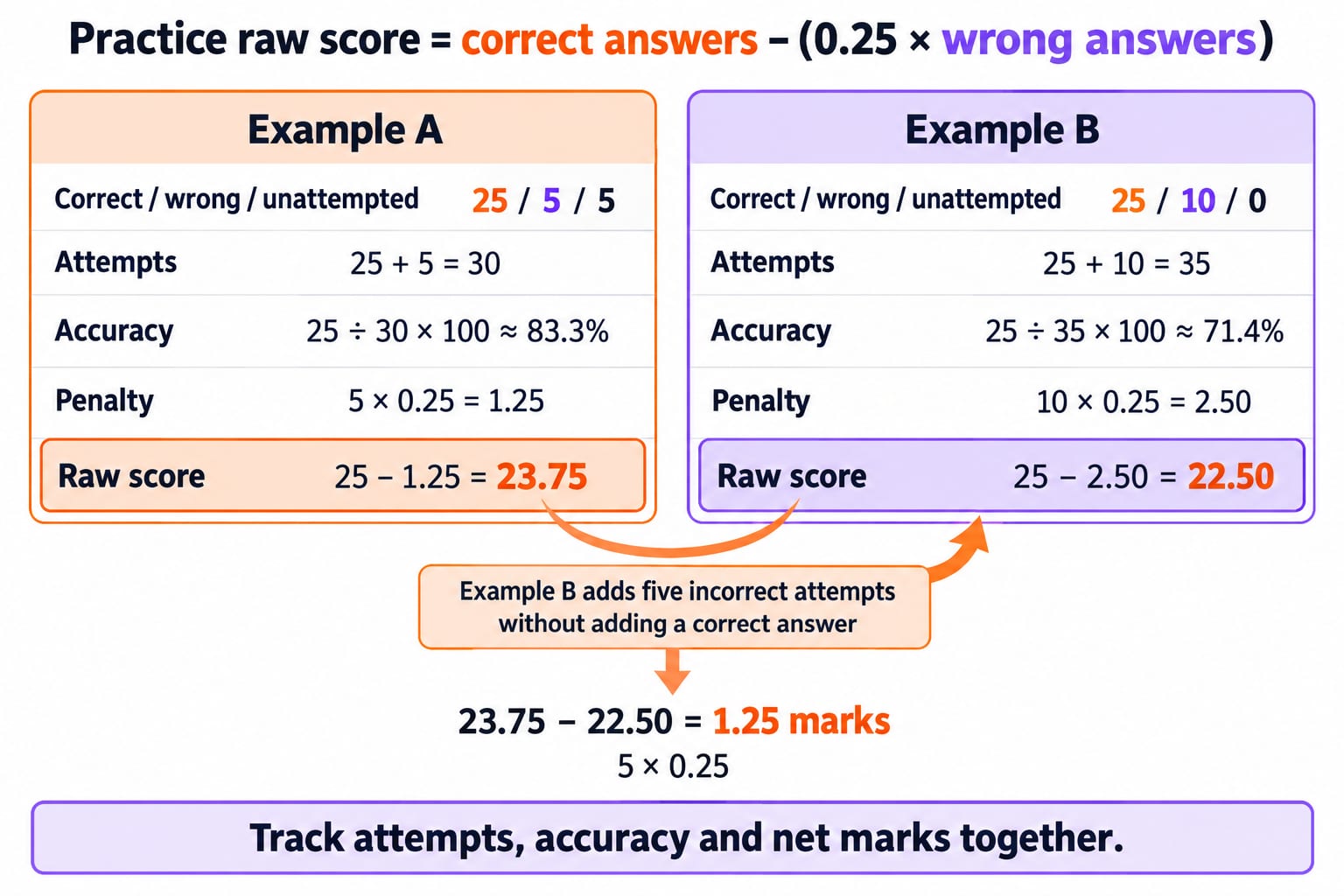
The cited notice applies a quarter-mark deduction for each wrong objective answer in prelims and mains. For these one-mark items, use:
Practice raw score = correct answers - (0.25 x wrong answers).
Take two constructed examples from a 35-question practice section.
Calculation | Example A | Example B |
|---|---|---|
Correct / wrong / unattempted | 25 / 5 / 5 | 25 / 10 / 0 |
Attempts | 25 + 5 = 30 | 25 + 10 = 35 |
Accuracy | 25 / 30 x 100 about 83.3% | 25 / 35 x 100 about 71.4% |
Penalty | 5 x 0.25 = 1.25 | 10 x 0.25 = 2.50 |
Raw score | 25 - 1.25 = 23.75 | 25 - 2.50 = 22.50 |
Example B adds five incorrect attempts without adding a correct answer. The score falls by 23.75 - 22.50 = 1.25 marks, or 5 x 0.25.
Track attempts, accuracy and net marks together to understand what changed.
Treat language proficiency as a separate preparation task
Under the cited notice, candidates shortlisted after mains face an LPT in the relevant state's official or local language(s). Lack of proficiency can disqualify a candidate. Check the office-specific language list rather than assuming one language applies everywhere.
For self-study, try 10 minutes reading a local-language passage aloud, 5 minutes explaining its meaning and 5 minutes writing a short summary. That is 10 + 5 + 5 = 20 minutes of practice.
Convert one mock into a useful repair plan
Set aside an illustrative 60-minute review session: 15 minutes to classify errors, 25 minutes to resolve weak concepts and 20 minutes to reattempt similar items. The allocation adds up: 15 + 25 + 20 = 60 minutes.
Suppose Example A's five wrong answers comprise two concept gaps, two misread instructions and one time overrun. Assign a different repair to each:
Concept gaps: rework the two questions untimed and explain the method before checking the solution.
Misread instructions: mark the missed qualifiers and read the requirement again before solving.
Time overrun: practise leaving a stalled question before it consumes the remaining section budget.
The related SBI Clerk preparation mistakes article uses an error-led review model. After your next mock, record accuracy and raw score for every section. Check whether the same errors recur.
Your next step: verify the pattern, then practise one section
Check the applicable RBI notice and handout, reproduce the section timers, and attempt one section. Calculate its net score and identify where the lost marks came from.
The IBPS Clerk CSA prelims course offers English, Numerical Ability and Reasoning practice, which overlap with RBI Assistant prelims. Use it for those three subjects as supplementary practice.
Before starting another full mock, review the section's wrong answers and decide what you will change in the next attempt.
Keep learning

RBI Assistant Eligibility: Age, Degree and Selection Stages
Graduation is only one eligibility check. Use worked age and percentage examples to audit your evidence, then understand prelims, mains and the language requirement.
Updated 6 Nov 20265 min readBanking Exams

RBI Assistant Syllabus: What to Study in Each Section
Turn RBI Assistant section names into a practical study checklist. Work through arithmetic, reasoning, English and computer examples, then plan awareness revision and local-language practice.
Updated 4 Nov 20264 min readBanking Exams

IBPS RRB Clerk Exam Pattern: Sections, Timings and Marking Scheme
Decode the Office Assistant route, calculate penalties for questions with different values, and turn the two exam stages into a measured practice week.
Updated 3 Nov 20265 min readIBPS Exams

UGC NET CS Attempt Strategy Without Negative Marking: A Three-Pass Plan
Use a rehearsed 180-minute clock to answer quick recalls first, protect time for technical work, and leave disciplined elimination and guesses until the final pass.
Updated 30 Oct 20265 min readNET Strategy & Updates