Infosys Mock Analysis: Fix Puzzle, Pseudocode and Verbal Errors
Do more than record a mock total. Preserve each error, find its primary cause, repair puzzle, pseudocode and verbal losses differently, then retest.
KnowledgeGate Team
Exam prep & CS education
Updated 23 Aug 20266 min read
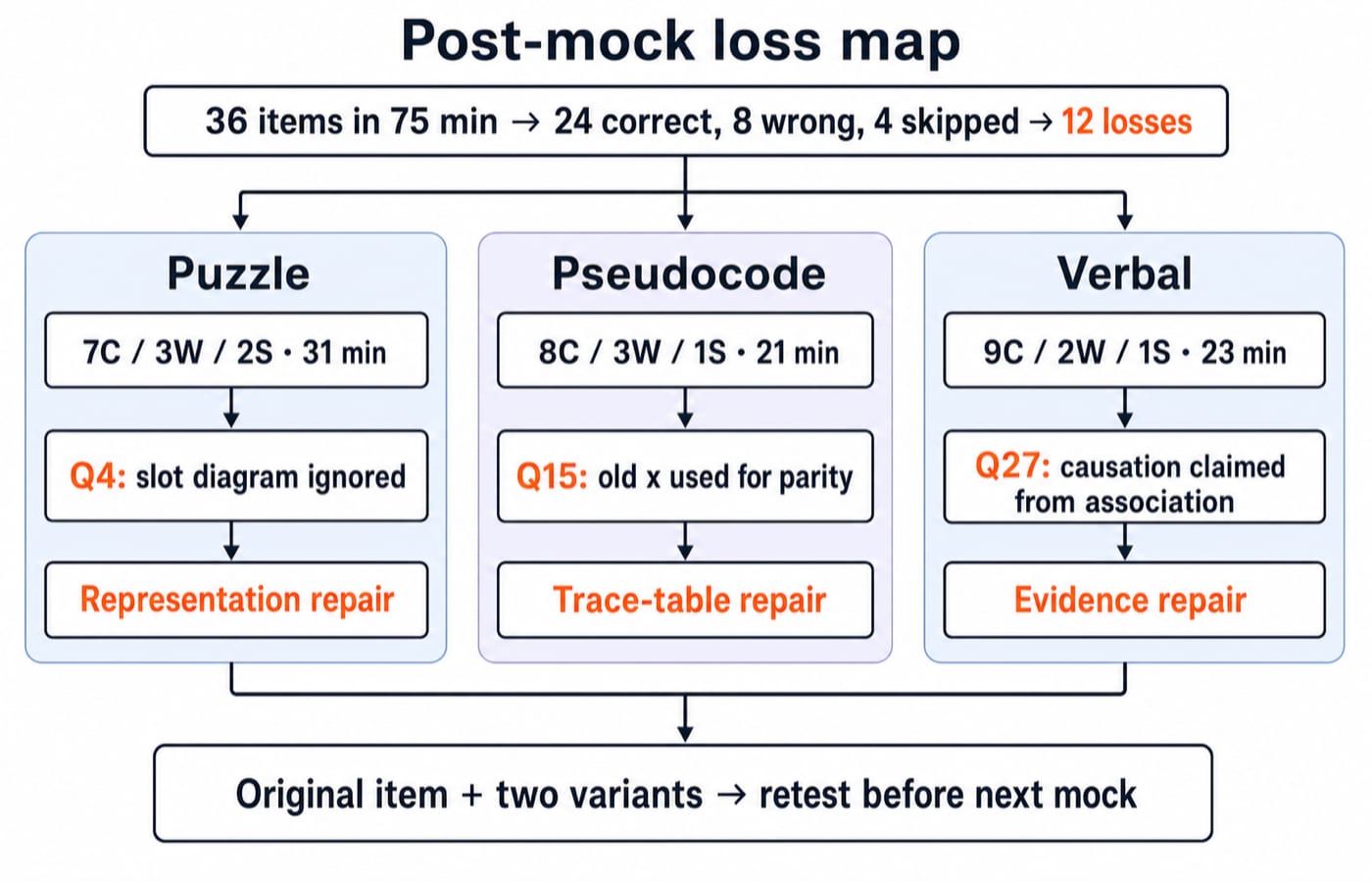
You finish an Infosys-style mock, record the total, and start more questions. But you still do not know why a puzzle stalled, a pseudocode trace drifted, or a verbal answer overreached the passage. So preserve the evidence, give every loss one primary cause, repair the three lanes by different methods, and retest before the next full mock. These 36-item, 75-minute totals come from one practice mock, not an Infosys-published pattern, so substitute your own.
1. Freeze the evidence and build a three-lane baseline
Before solutions, record item ID | lane | attempted/skipped | confidence 1-3 | minutes | chosen answer | correct answer | first point of failure. Preserve the puzzle grid, last pseudocode state, and verbal evidence. Seeing the key early hides knowledge versus process failures. Infosys Placement Preparation: Sections, Roles, Study Plan sets the term-long plan these mocks sit inside.
Lane | Correct / wrong / skipped | Accuracy | Coverage | Time |
|---|---|---|---|---|
Puzzle | 7, 3, 2 |
|
| 31 min |
Pseudocode | 8, 3, 1 |
|
| 21 min |
Verbal | 9, 2, 1 |
|
| 23 min |
Overall: 24 correct + 8 wrong + 4 skipped = 36; accuracy 24/32 x 100 = 75%; coverage 32/36 x 100 = 88.9%; time 31 + 21 + 23 = 75 minutes. Puzzles combine the lowest accuracy and coverage with the highest time.
2. Give every lost item one cause that determines the repair
Label by counterfactual. Concept or rule gap: rule unavailable. Representation or trace error: known rule, inconsistent working. Reading or evidence error: answer exceeds clue, code line, grammar cue or passage. Pacing or selection error: route did not justify its time. One primary cause controls repair; notes can remain secondary.
Classify all 12: representation or trace at puzzle Q4, Q7 and pseudocode Q15, Q19 (4); concept or rule at puzzle Q10, pseudocode Q22 and verbal Q30 (3); reading or evidence at verbal Q27 (1); pacing or selection at puzzle Q11, Q12, pseudocode Q24 and verbal Q36 (4). Thus 4 + 3 + 1 + 4 = 12.
Ledger row: Q15 | pseudocode | chose 3 | correct 10 | trace error | tested parity before updating x | repair: state table, then two changed-value traces on Day 3. “Careless” prescribes nothing. Name the wrong line, the wrong clue, or the inference the answer actually turned on.
3. Rebuild a puzzle from fixed clues before seeking speed
In Q4, interns A, B, C, D, E, F occupy seats 1-6, facing north. C=3; A is immediately left of B; F=6; D is not adjacent to C; E is left of A. Find D.
The A-B block cannot be 1-2 because no open seat would remain left of A. With seats 3 and 6 occupied, A,B=4,5. D and E take 1 and 2. Seat 2 is adjacent to C, so D=1, E=2. The unique row is D, E, C, A, B, F; D occupies seat 1.
Answering seat 2 means A-B was drawn but C's neighbours were not crossed out. Repair for 75 minutes: 15 reconstructing Q4, 40 on two six-slot puzzles, 20 checking every clue. Mark each used once / contradicted / still unused; add speed only after reconciliation. If the same gap survives two reviews, rebuild grid discipline from the basics instead of adding volume: one clue placed, one deduction written, one cell crossed out.
4. Trace pseudocode line by line, including update order
Find the final y in this snippet:
x = 2
y = 5
for i = 1 to 3
    x = x + i
    if x % 2 == 0
        y = y + x
    else
        y = y - i
print y
i | x after | condition | y after branch |
|---|---|---|---|
1 | 3 | odd | 4 |
2 | 5 | odd | 2 |
3 | 8 | even | 10 |
Starting x=2, y=5, the output is 10. Judging parity from the value of x before it was updated, while still adding the updated x, flips the branch at i=1 and again at i=3, and produced 3. That is a trace-order error, not a modulo gap. Write a value only after its line executes; check loop start, end and endpoint inclusion. Infosys Pseudocode Questions: 17 Solved Traces and Traps carries seventeen more worked traces to drill that habit on.
5. Make every verbal answer point to a sentence or rule
Q27 passage: A checkout pilot reduced the flow from five screens to three. Completion rose from 62% to 74% during the pilot. Average order value remained unchanged.
Options: A, fewer screens caused every user to finish; B, the pilot was associated with higher completion while average order value did not change; C, the pilot increased average order value; D, three-screen checkouts always outperform five-screen checkouts. B preserves both numbers without turning association into universal causation. A is evidence overreach. Write the supporting sentence beside each inference.
Q30 is Each of the reports contain two appendices. The subject head Each is singular, so write Each of the reports contains two appendices. The nearby reports does not control the verb. Treat choosing by sound as a rule gap. Repair with 10 subject-verb items and two variants: Each of the files contains one chart and The reports contain two appendices.
6. Run an honest 8-hour-30-minute review week
Four phases: evidence on Day 1, lane repair on Days 2 to 4, selection practice on Day 5, mixed retest on Days 6 and 7.
Day 1 is 75-minute mock + 60-minute audit = 135 minutes; Days 2-7 are puzzle 75, pseudocode 75, verbal 60, pacing 45, mixed set 60, closed-book retest 60. So 135 + 75 + 75 + 60 + 45 + 60 + 60 = 510 minutes = 8 hours 30 minutes.
Finite blocks: puzzle 15 reconstruct + 40 solve + 20 clue-check; pseudocode 20 trace review + 35 on five snippets + 20 boundary checks; verbal 20 grammar + 25 evidence questions + 15 error-log reattempts. Day 5 has four self-set stops. At each one, either carry on with a written next step or abandon the item and start the next.
Miss one session: preserve audit and Day 7, move the most frequent unresolved cause to Day 6, drop new volume. Miss two: roll repairs forward and postpone the mock. For material, KnowledgeGate's Infosys practice sets hold about 1,700 questions across their sections, enough to keep Days 2 to 6 supplied without reusing an item you have already logged.
7. Close rows with parallel retests, then earn the next mock
Run three parallel checks. Books G, H, J, K, L, M occupy 1-6: J=3, G immediately left of H, M=6, K not adjacent to J, and L left of G. The same chain gives K, L, J, G, H, M, so K=1.
The same snippet, started at x=1, y=4: at i=1, x=2, y=6; at i=2, x=4, y=10; at i=3, x=7, y=7. Output 7. Verbal: After reminder emails, on-time submissions rose from 68 to 82 out of 100, while the average mark stayed 71. This supports association with timeliness, not causation or higher marks.
Close a row after correct separate attempts on the original and two variants, with the governing clue, line or sentence named. If the two largest loss buckets pass, move to the next cycle; the Infosys Superset Preparation Course supplies its mocks and drills. If either fails, repeat that repair before booking another mock. Where the three lanes are aptitude, coding and a written essay instead, Wipro Mock Analysis: Turn Aptitude, Coding and Communication Errors into a Study Plan runs the same freeze, classify and retest loop on those sections, and Company-Specific Placement Courses collects the drills for the other recruiters.
Preserve the evidence, label each loss, reconstruct the weak areas, retest, and then take another mock.
Keep learning
HCLTech Recruitment Process and Test Pattern: Build Your Drive Map
Build a source-controlled HCLTech drive map from the current role page and invitation, then use worked diagnostics to prepare for each assigned stage.
Updated 23 Oct 20265 min readCompany-Specific Prep
Capgemini Coding Questions: 4 Patterns with Step-by-Step Solutions
Learn four transferable coding patterns through constructed Capgemini preparation examples. Each solution includes an invariant, complete trace, complexity and edge-case checks.
Updated 19 Oct 20266 min readCompany-Specific Prep
Capgemini Placement Preparation: An 8-Week Test-Matched Study Plan
Build an eight-week Capgemini preparation timetable from the route you are actually invited to take. Use two baselines and an error log to decide where every study hour goes.
Updated 15 Oct 20265 min readCompany-Specific Prep
Cognizant Recruitment Process and Test Pattern: What Each Stage Screens
Learn how to read a Cognizant drive invitation, map each possible stage to the skill it screens, and turn the stated test blocks into a focused study plan.
Updated 11 Oct 20265 min readCompany-Specific Prep