

Polynomials and Algebraic Expressions Questions with Solutions: 12-MCQ Practice Set
Attempt these 12 questions before reading the worked solutions. Each one tests a specific algebra rule, helping you find which methods need revision.
KnowledgeGate Team
Exam prep & CS education
Updated 16 Nov 20268 min read
Polynomial questions look unrelated until you sort them by operation. Attempt each before checking its solution, record the rule, and diagnose six skills: degree and HCF, expansion and collection, factorisation and identities, remainder and factor theorems, roots and symmetry, and coefficient patterns. The set moves from degree and HCF through coefficient patterns, with each method represented by a concrete algebraic question. For general equations, identities and substitution, use Algebra for Aptitude Tests: Fast Methods and Checks. The present questions focus on exam-attributed polynomial calculations from degree through coefficient patterns.
1. Warm-up: degree and HCF of algebraic terms
Degree uses the largest exponent with a non-zero coefficient; a monomial HCF uses each variable's minimum exponent.
Q1. Degree of a polynomial
UPTET 2011
The degree of the polynomial 4x^2 - 3x^5 + 8x^6 is
(a) 6
(b) 5
(c) 3
(d) 2
Answer: (a) 6.
Exponents 2, 5, and 6 have non-zero coefficients 4, -3, and 8. Reorder as 8x^6 - 3x^5 + 4x^2. The leading exponent and degree are 6. Option (b) is one term's exponent, not the maximum.
Q2. HCF of two monomials
Infosys 2025
If A = x^3y^2 and B = xy^3, then find the HCF of A and B.
(a) x^2y^2
(b) xy^3
(c) xy^2
(d) none
Answer: (c) xy^2.
Write B = x^1y^3. Take min(3, 1) = 1 for x and min(2, 3) = 2 for y. Thus HCF = xy^2. Check: x^3y^2 / xy^2 = x^2 and xy^3 / xy^2 = y. Option (a) fails because x^2 does not divide B. Continue with CAT Quant Preparation: Arithmetic and Algebra First.
2. Expand first, then collect exactly matching terms
Combine only identical variable parts. Distribute a minus sign before collecting.
Q3. Expansion and coefficient matching
CTET 2023
If A = x^2(1 - 3y^2), B = x(xy^2 - 2x) and C = 3y(y - 4x^2y), then A + B - C = px^2 + qx^2y^2 + ry^2. What is the value of (5p + q - r)?
(a) 12
(b) 10
(c) 18
(d) 8
Answer: (d) 8.
Expand: A = x^2 - 3x^2y^2, B = x^2y^2 - 2x^2, and C = 3y^2 - 12x^2y^2. Therefore,
A + B - C = x^2 - 3x^2y^2 + x^2y^2 - 2x^2 - 3y^2 + 12x^2y^2
= -x^2 + 10x^2y^2 - 3y^2.
Thus p = -1, q = 10, r = -3, so 5p + q - r = 5(-1) + 10 - (-3) = 8. At x = y = 1, both forms give 6.
Q4. Addition and subtraction of three polynomials
CTET 2021
Let P = 12xy - 10y^2 - 18x^2, Q = 14x^2 + 12y^2 + 9xy, and R = 5y^2 - x^2 + xy. Then (P + Q) - R =
(a) 22xy - 3x^2 + 3y^2
(b) 22xy + 3x^2 - 3y^2
(c) 20xy - 7x^2 - 3y^2
(d) 20xy - 3x^2 - 3y^2
Answer: (d) 20xy - 3x^2 - 3y^2.
Combine P + Q: xy: 12 + 9 = 21, y^2: -10 + 12 = 2, x^2: -18 + 14 = -4. Thus P + Q = 21xy + 2y^2 - 4x^2. With -R = -5y^2 + x^2 - xy, the result has xy: 20, y^2: -3, x^2: -3. At x = y = 1, P = -16, Q = 35, and R = 5, so both forms give 14.
3. Factor by grouping and use identities before multiplying
Q5 creates a repeated binomial after grouping. In Q6, the three signed bases add to zero.
Q5. Factorisation by grouping
CTET 2024
One of the factors of p^3x + p^2(x - y) - p(y + z) - z is:
(a) p^2x - py + z
(b) p^2x + py + z
(c) p^2x - py - z
(d) p^2x + py - z
Answer: (c) p^2x - py - z.
Expand and regroup:
p^3x + p^2x - p^2y - py - pz - z
= (p^3x + p^2x) - (p^2y + py) - (pz + z)
= p^2x(p + 1) - py(p + 1) - z(p + 1)
= (p + 1)(p^2x - py - z).
Expanding returns the original six terms, confirming option (c).
Q6. Zero-sum identity for three cubes
TCS 2025
N = 82^3 - 62^3 - 20^3 is divisible by
(a) 31 and 41
(b) 13 and 67
(c) 17 and 7
(d) none
Answer: (a) 31 and 41.
Set a = 82, b = -62, c = -20. Since a + b + c = 0, a^3 + b^3 + c^3 = 3abc. Hence N = 3 * 82 * 62 * 20. As 82 = 2 * 41 and 62 = 2 * 31, N contains both factors. Check: N = 305,040, N / 31 = 9,840, N / 41 = 7,440.
4. Remainder theorem and factor theorem
For x + 5, substitute -5. A known factor supplies roots.
Q7. Remainder after division by a linear factor
Tech Mahindra 2023
Find the remainder when (x^3 + 4x^2 + 6x - 2) is divided by (x + 5).
(a) -57
(b) 57
(c) -37
(d) 37
Answer: (a) -57.
For p(x) = x^3 + 4x^2 + 6x - 2, the remainder theorem gives p(-5):
p(-5) = (-5)^3 + 4(-5)^2 + 6(-5) - 2
= -125 + 100 - 30 - 2 = -57.
Do not substitute +5. Division confirms quotient x^2 - x + 11 and remainder -57.
Q8. A quadratic factor of a quartic
BPSC 2024
If (x^2 - 3x + 2) is a factor of (x^4 - Px^2 + Q), then what are the values of P and Q respectively?
(a) 5, 4
(b) -5, 4
(c) 5, -4
(d) More than one of the above
(e) None of the above
Answer: (a) 5, 4.
Factor x^2 - 3x + 2 = (x - 1)(x - 2). Roots 1 and 2 give P - Q = 1 and 4P - Q = 16. Subtract: 3P = 15, so P = 5; then Q = 4.
5. Use roots and even-odd structure
Use Vieta's relations, then separate even powers from the linear term.
Q9. Sum and product of zeroes
REET 2022
If the sum of the zeroes of the polynomial (kx^2 - 3x - 6k) is equal to their product, then the value of k is:
(a) -1/2
(b) 1/2
(c) 2
(d) -2
Answer: (a) -1/2.
Here a = k, b = -3, c = -6k, with k != 0. Sum = -b/a = 3/k; product = c/a = -6. Equate: 3/k = -6, so 3 = -6k and k = -1/2.
Q10. Recover F(3) from F(-3)
Infosys 2023
An expression is F(x) = ax^4 - bx^2 + x + 5 and F(-3) = 2. Find F(3).
(a) 6
(b) 7
(c) 8
(d) 4
Answer: (c) 8.
F(-3) = 81a - 9b - 3 + 5 = 2, so 81a - 9b = 0. At x = 3, only the linear term changes. Thus F(3) = 81a - 9b + 3 + 5 = 8.
6. Detect degree and coefficient patterns
Use finite differences for degree, and f(1) with f(-1) for even-index coefficients.
Q11. Minimum degree from equally spaced values
GATE 1997
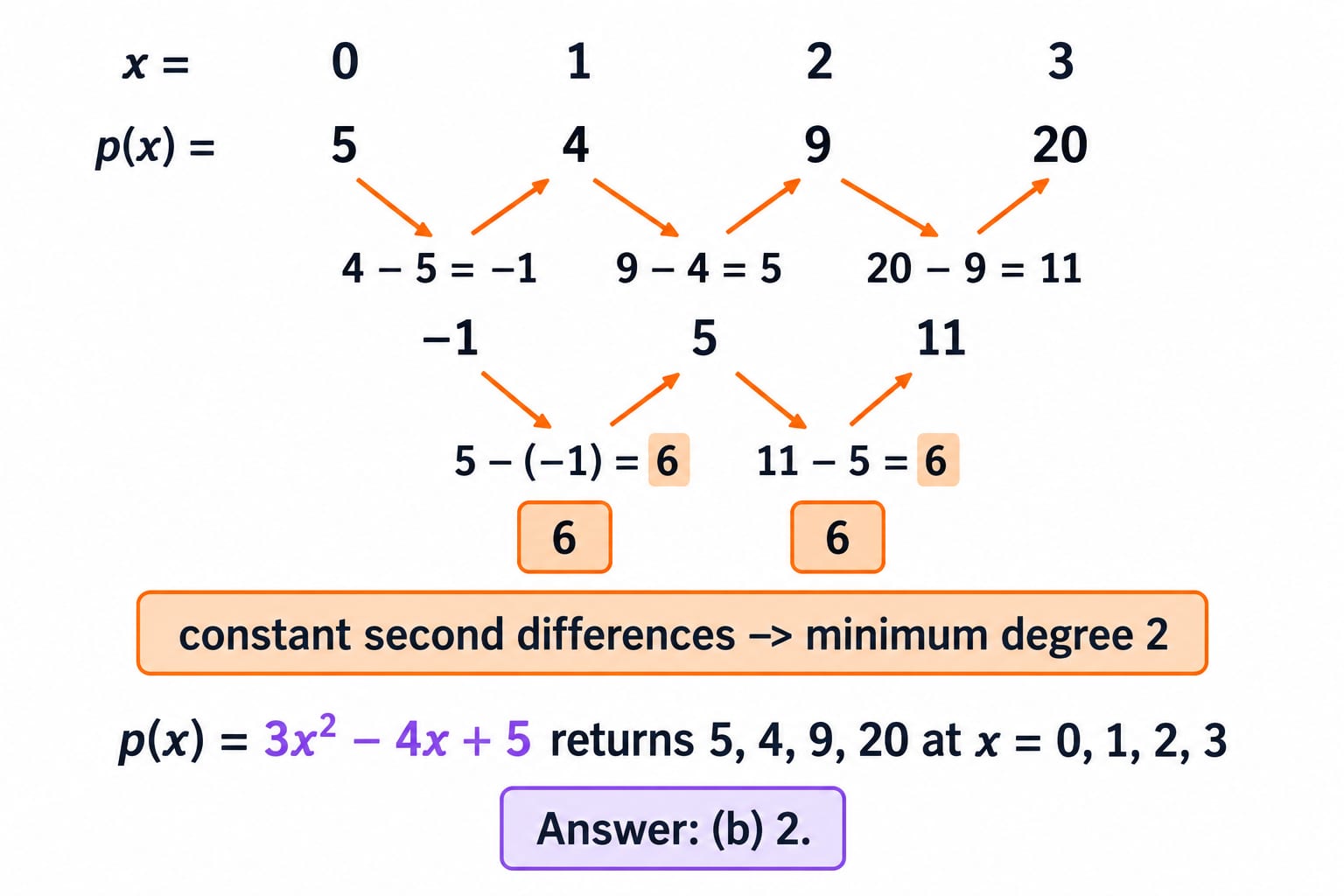
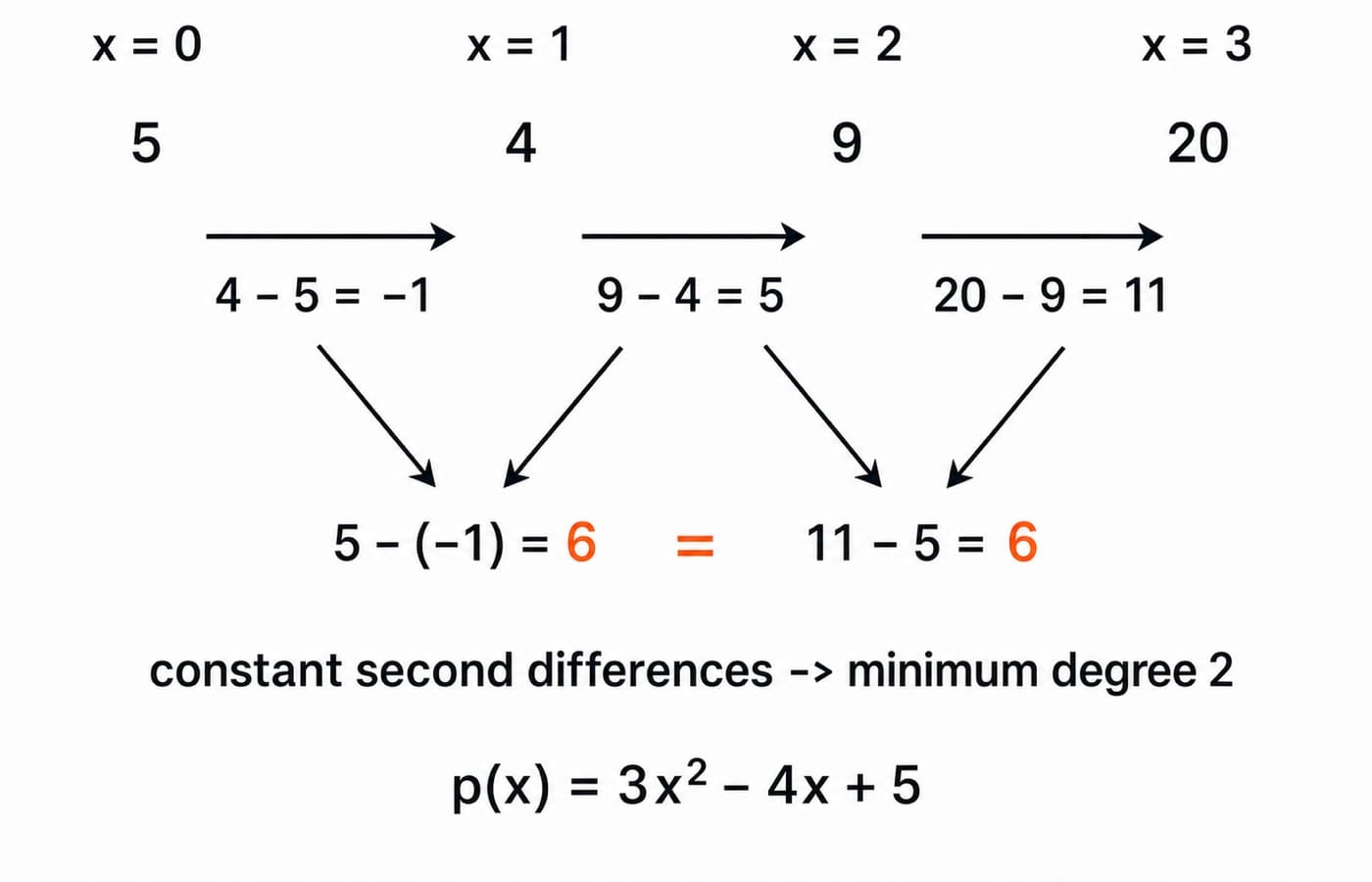
A polynomial p(x) is such that p(0) = 5, p(1) = 4, p(2) = 9, and p(3) = 20. The minimum degree it can have is
(a) 1
(b) 2
(c) 3
(d) 4
Answer: (b) 2.
From 5, 4, 9, 20, first differences are -1, 5, 11, so degree 1 fails. Second differences are 5 - (-1) = 6 and 11 - 5 = 6, so a quadratic works. Indeed, p(x) = 3x^2 - 4x + 5 returns 5, 4, 9, 20 at x = 0, 1, 2, 3.
Q12. Sum of even-index coefficients
NIMCET 2019
If (1 + x - 2x^2)^6 = 1 + a_1x + a_2x^2 + ... + a_1_2x^1^2, then a_2 + a_4 + ... + a_1_2 is?
(a) 29
(b) 30
(c) 31
(d) 32
Answer: (c) 31.
Let f(x) = (1 + x - 2x^2)^6. Then f(1) = (1 + 1 - 2)^6 = 0 and f(-1) = (1 - 1 - 2)^6 = (-2)^6 = 64. Adding their expansions cancels odd-index terms, so 2(a_0 + a_2 + ... + a_1_2) = 64. The even-index sum including a_0 is 32. Since a_0 = f(0) = 1, the answer is 31. Next, see MCA Entrance Mathematics: Algebra to Calculus Order.
7. Score the set, diagnose the error, and choose the next drill
Treat these as study actions, not predicted exam performance bands.
Score | Study action |
|---|---|
10-12 correct | Repeat only the methods that felt slow. |
7-9 correct | Redo Q3 to Q10 after writing one rule for every miss. |
0-6 correct | Rebuild expansion, signs, identities, and the remainder theorem before timing another set. |
Use this error log for up to six misses:
Question number | Chosen option | Correct option | Rule missed | Arithmetic or sign slip | Retry date |
|---|---|---|---|---|---|
___ | ___ | ___ | ___ | ___ | ___ |
___ | ___ | ___ | ___ | ___ | ___ |
___ | ___ | ___ | ___ | ___ | ___ |
___ | ___ | ___ | ___ | ___ | ___ |
___ | ___ | ___ | ___ | ___ | ___ |
___ | ___ | ___ | ___ | ___ | ___ |
Watch for recurring traps: not comparing all exponents, taking maximum HCF exponents, failing to distribute -R, substituting +5 for x + 5, ignoring k != 0, or expanding (1 + x - 2x^2)^6 instead of using f(1) and f(-1).
For the next drill, use Aptitude Course for Placement or browse Placement Preparation & Coding. Retry only the missed questions after a gap, then explain each method aloud without looking at the options.
Keep learning
Closure, Associativity, Semigroup and Monoid MCQs: 12 Solved Questions
Test each unfamiliar operation in the right order. These 12 MCQs explain closure, associativity, identity, semigroups, monoids and stronger classifications step by step.
Updated 29 Oct 20267 min readDiscrete Mathematics MCQs
Evaluation of Expressions MCQs: 12 Solved Questions with Stack Traces
Solve 12 expression MCQs step by step. Trace postfix and prefix evaluation, nesting depth, precedence and notation conversion without reversing operands.
Updated 27 Sep 20267 min read76 viewsData Structures MCQs
C Operators and Expressions MCQs: 12 Solved Questions with Explanations
Solve 12 C operators and expressions MCQs from UGC NET, ISRO, Coal India, BPSC and UPPSC papers. Each answer traces the rule, value change, or representation that decides it.
Updated 30 Oct 20268 min read76 viewsData Structures MCQs
Basic Arithmetic Questions with Solutions: 12 Solved MCQs
Practise 12 arithmetic MCQs, inspect every worked step, and diagnose whether each miss came from order, scale, fraction base or translation.
Updated 20 Nov 20267 min readAptitude & Reasoning